A world record is not inherited from past medals. Jiang earned another one in the water in Japan.
Thirty-four seconds that travelled around the world
At the Aichi–Nagoya Asian Para Games on October 20, China’s Jiang Yuyan turned a 50-metre swim into a world-record statement. She completed the women’s 50 m butterfly S6 in 34.52 seconds, taking gold and resetting the world and Asian Para Games marks, according to the Asian Paralympic Committee. The achievement happened in Japan but belongs to an international story: one of the outstanding athletes of Paris 2024 is still finding another level.
A second gold, a different challenge
Jiang returned to win the women’s 100 m freestyle S6 in 1:12.18, ahead of China’s Song Lingling (1:17.92) and Zhu Ji (1:18.92). The same committee’s account gives 37.39 seconds for Liu Daomin in the butterfly race and 41.58 for Lu Dong, who competed in the S5 classification. Reporting the latter correctly matters: when different sport classes appear in an event’s combined results or medal presentation, finishing order and class-specific records must not be casually described as if every competitor raced in S6.
How fast is a world record?
The distance is short, but a 50 m butterfly is technically exacting. A start, underwater phases, acceleration, stroke timing and the touch all matter. In para swimming, each athlete develops a technique around her own physical function; the fastest method cannot simply be copied from another swimmer. Jiang’s recorded 34.52 seconds is the official accomplishment. Without split times or competition video independently examined for this article, claims about how she won the race on a particular stroke or turn would be inventions.
Seven Paris gold medals, then another peak
At the Paris 2024 Paralympic Games, Jiang won seven gold medals, the largest gold haul by any athlete at those Games. Her victories included individual freestyle, butterfly and backstroke events as well as mixed relay races. That was not an isolated burst of good fortune: she had won two golds at the Tokyo 2020 Paralympics, held in 2021, and had already become a major figure in international para swimming. The 2026 world record adds a new chapter rather than introducing a newcomer.
What the S6 designation actually means
World Para Swimming uses the prefix S for freestyle, butterfly and backstroke, SB for breaststroke and SM for individual medley. Classes S1–S10 group swimmers with physical impairments according to the impact on the swimming tasks being assessed; they do not correspond to a single diagnosis. Lower numbers generally indicate greater activity limitation within this scale. Classification is not a handicap added to the clock, nor does S6 mean every competitor has the same physical characteristics. A clear explanation makes the athletic achievement more understandable—not less impressive.
The athlete, not an inspirational prop
Jiang has described losing her right arm and right leg in a childhood accident. In a 2025 account published by the International Paralympic Committee, she explained how swimming became a way to move freely. Those are parts of her life, but they are not substitutes for evaluating her speed, preparation, competitive judgement and career. She is a world-class athlete first. Reporting should not treat a disability as the only reason that her performance matters.
From Tokyo to Paris to Nagoya
Jiang’s first Paralympics took place in Tokyo in 2021, at an Olympics and Paralympics held without ordinary spectator crowds because of the pandemic. At Paris 2024 she competed in the electric atmosphere of La Défense Arena and won seven titles. The 2026 Asian Para Games brought her back to Japan, this time before regional rivals and a home audience watching China’s dominance of the pool. The sequence illustrates how Asia has become an important stage for the sport, not merely a stop between Paralympics.
A prize that placed her on the wider sporting map
In April 2025, Jiang received the Laureus World Sportsperson of the Year with a Disability Award. Such recognition matters because the profile of para sport too often surges during a Paralympics and subsides afterward. A world record at a continental championship deserves the same care with times, classifications and rivals that would be standard in coverage of an Olympic swimming final.
The Chinese depth behind the result
The October 20 races also demonstrated China’s depth: Jiang’s fellow Chinese swimmers filled both other podium places in the freestyle S6 event, while the butterfly report listed further Chinese podium performances with differing classifications. This is not evidence by itself that the country will sweep future major championships, but it raises a reporting question: how do athlete-development pathways, coaching and investment sustain successive generations? Answering that would require interviews and comparable program data, not assumptions from one day’s medals.
Why Japan is part of this story
Japan’s role is not incidental. The host venues give international athletes a major platform while bringing para sport to Japanese spectators and young swimmers. A champion from China breaking a world record in Japan offers an unusually powerful story across borders: fans can argue about national sporting rivalry while sharing an objective result. Good coverage should respect the achievement instead of making an athlete’s nationality the entire meaning of the event.
A visual record must also be honest
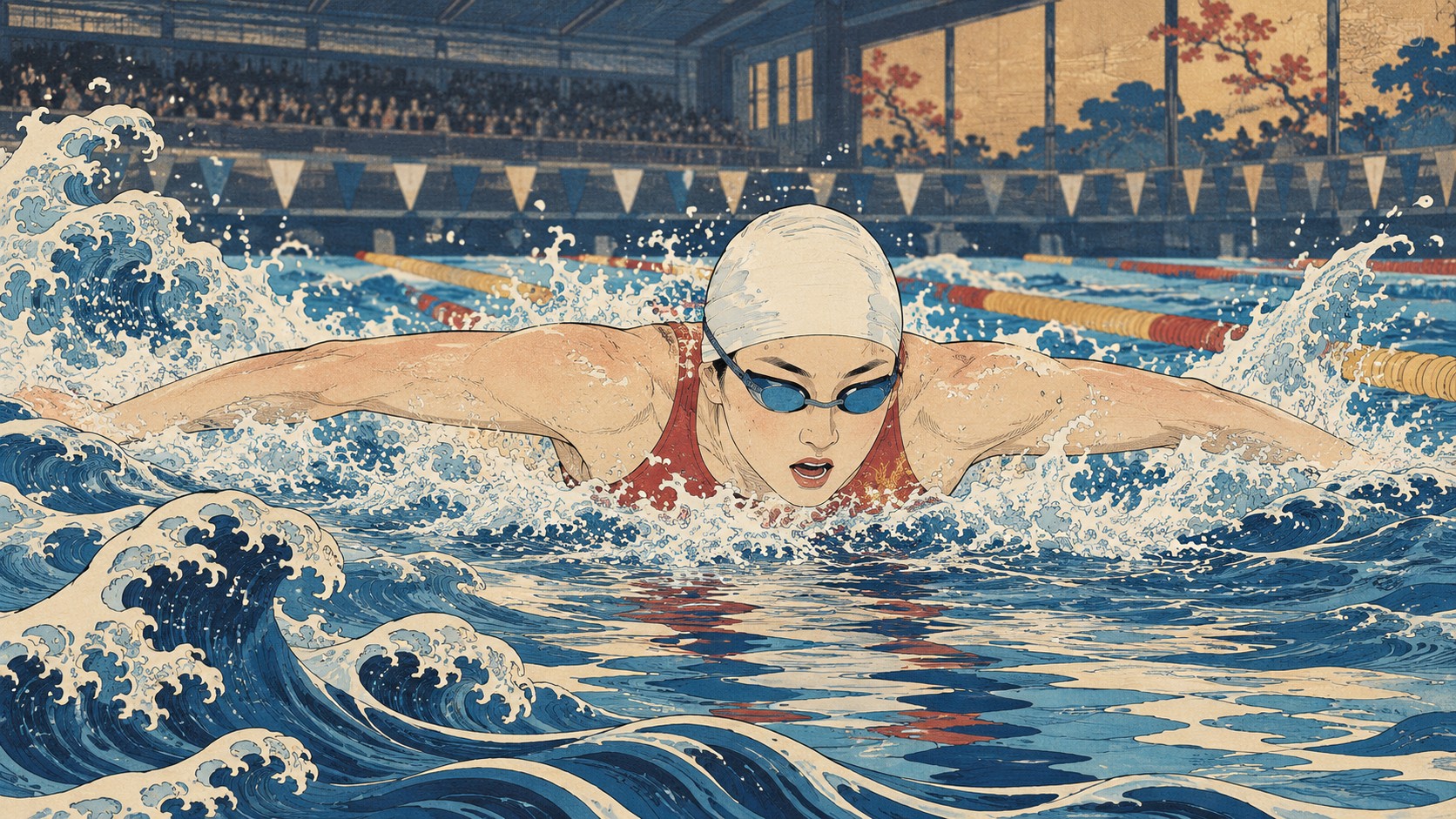
The accompanying image for this report is an AI-generated woodblock-inspired editorial illustration, not a photograph of Jiang’s October 20 swim. Her physical characteristics and swimming class should not be erased or altered in pursuit of a generic heroic figure. Nor should graphics invent lane numbers, scoreboard text or medal ceremonies that have not been documented. Historical art styles can illuminate a contemporary competition, but they must remain distinguishable from evidence.
What remains to verify as the Games continue
The Asian Paralympic Committee’s October 20 report is the basis for the two races described here. This article does not claim a final medal tally for the entire Aichi–Nagoya Games, a later race result, or an interview conducted by Japan.co.jp. The organizing committee’s certified result sheets and any subsequent record ratification would provide additional technical confirmation. For now, the core fact stands clearly: 34.52 seconds, a world record, and another gold later that day.
A record worth watching beyond one day
Jiang’s medal history can tempt sportswriters to frame every swim as inevitable. World records are the opposite of inevitable: they must be earned in a measured race, against a clock and competitors. The significance of Nagoya is that even after seven gold medals in Paris and global recognition in 2025, Jiang delivered a new verified mark in 2026. The next chapter should be written from her next actual results, not a prediction presented as fact.
Sources and further reading
The race results refer to the Asian Paralympic Committee’s October 20 announcement. This article does not claim a final Games medal tally or an original interview.
- Asian Paralympic Committee: Jiang Yuyan world record and double gold, October 20
- International Paralympic Committee: Jiang’s seven Paris 2024 titles
- World Para Swimming: Paris 2024 final-day results
- IPC: Jiang’s 2025 Laureus Award
- World Para Swimming: Classification explained
- IPC official athlete profile and historical results
- Laureus: Jiang Yuyan award profile