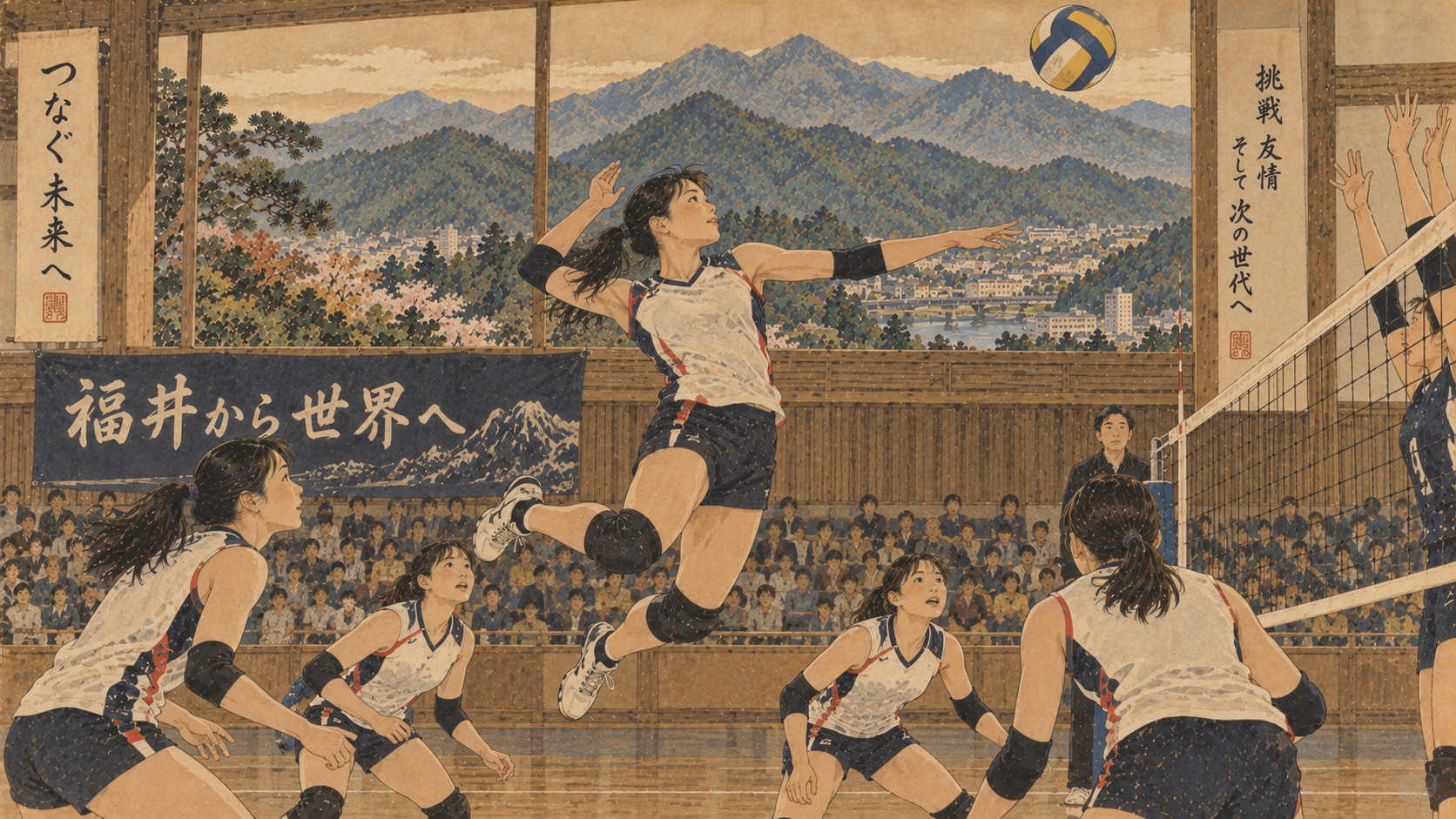
The bronze medal was not the end of Yuko Mitsuya’s sporting journey.
A medal, then a much longer journey
On August 7, 1984, Japan's women's volleyball team defeated Peru three sets to one in the Los Angeles Olympic bronze-medal match. Among the twelve players was Yuko Mitsuya, a middle-position player for Hitachi who had been born in Katsuyama, Fukui Prefecture. Her Olympic medal remains the most visible milestone in a career that subsequently traveled far beyond volleyball.
Mitsuya became a teacher, coach, researcher, entrepreneur and, eventually, president of Japan's basketball federation. Her path offers a more revealing definition of sporting legacy than the familiar image of an athlete frozen at the medal ceremony: what happens when sporting skill is converted into education and public leadership?
Growing up in Katsuyama
Mitsuya was born on July 29, 1958. Katsuyama, inland among Fukui's mountains, would later become widely associated with dinosaurs; for Mitsuya's story it is the beginning of an altogether different journey. In an extensive interview with the Sasakawa Sports Foundation, she recalled childhood frailty and discomfort with being tall. She described badminton as a familiar sport for local schoolchildren.
Such details challenge the idea that an Olympian's destiny was obvious from the beginning. Physical stature became an asset in volleyball, but her account suggests that confidence had to develop alongside skill. This is her recollection, not a claim that every athlete from Fukui shared the same experience.
Schools and the making of an international player
She attended Hachioji Jissen High School in Tokyo and entered the University of Tsukuba's physical education program in 1977. She competed at the Universiade and was called up to Japan's senior national team in 1979. In 1981 she joined Hitachi, a powerhouse of the company-team system that long underpinned elite Japanese volleyball.
Japan's women's game already carried the weight of Olympic history: gold at Tokyo in 1964, another title in Montreal in 1976, and the disruption of Japan's absence from the 1980 Moscow Games. This backdrop helps explain the expectations that greeted the 1984 team, without mistaking historic team achievements for Mitsuya's own.
The Los Angeles tournament, match by match
According to the Japan Volleyball Association's official match record, Japan beat South Korea 3–1, Peru 3–0 and Canada 3–0 in its preliminary group. China won the semifinal in straight sets. On August 7, Japan rallied its campaign into a bronze-medal finish by beating Peru 3–1.
The association lists Mitsuya as a Hitachi center, the terminology used in its historic roster. The accomplishment belonged to a roster that also included Kumi Nakada, Yumi Egami and their teammates, supported by coaches and staff. It was a team bronze, not the story of one player's lone triumph.
A deliberate turn toward education
Mitsuya retired from competitive volleyball soon after the Games. Instead of extending an elite playing career, she moved into teaching, including work at Kokugakuin High School, and later university instruction. Her University of Tsukuba biography documents graduate study completed in 1994 and the founding of her company, Saifa, that year.
Athlete retirement is often described as a decline from a peak. Her experience invites the opposite interpretation: the medal was a qualification for an expanding range of responsibilities. The transitions were not all within sport. They included business management, research and formal education.
Passing expertise on
Mitsuya continued working with volleyball through coaching and youth development. Fuji Television credits her with originating the FNS Spring High School Volleyball Coaching Caravan in 2001, a program intended to connect established expertise with younger athletes.
Its historical existence is documented; any precise causal claim that it raised participation or competitive results in Fukui would require a separate evaluation. That caution matters in an article celebrating a hometown figure: admiration should not become an excuse for unmeasured promises.
The volleyball Olympian who led basketball
In one of the more unusual leadership transitions in Japanese sport, Mitsuya became vice president of the Japan Basketball Association in 2015 and president in June 2016. She held the presidency for five terms, until September 2025. The federation elected Shinji Shimada as her successor.
In her departure statement, Mitsuya recalled milestones during her term, including the Japanese women's basketball team's first Olympic silver medal at Tokyo, participation by Japan's national five-a-side and 3x3 teams, and the men's return to Olympic competition following the 2023 Basketball World Cup. These were collective accomplishments of athletes, coaches, clubs, organizers and the federation, not achievements that should be assigned solely to its president.
On October 9, 2025, the association appointed her to a newly created senior adviser role relating to its international basketball relationships. Describing her as the sitting president in October 2026 would therefore be inaccurate.
Katsuyama remembers—and corrects the record
This autumn brings the story back to Fukui. In September 2026, Katsuyama City announced materials for a display titled 'The Trajectory of Yuko Mitsuya's Challenges,' devoted to her career. The municipality also published a correction: an exhibit initially described as a Los Angeles Olympic women's volleyball bronze medal was in fact a participation commemorative medal.
There is no contradiction between that correction and Mitsuya's established status as an Olympic bronze medalist. The physical item on display and the medal she earned in competition are different questions. Katsuyama's clarification illustrates why accurate labels matter in public memory.
A legacy bigger than one sport
Mitsuya's path offers a practical framework for thinking about sport in a prefecture facing demographic change. Children need places to play and people prepared to teach. Talented teenagers sometimes need access to schools farther from home. Retired athletes need opportunities beyond the court. Towns need institutions through which experience can return to the next generation.
No single Olympian can answer those challenges. Yet a Katsuyama-born player who moved from volleyball to classrooms, businesses and the governance of a different sport shows why the question is worth asking. Her 1984 medal marks a victory; the decades afterward show how much further an athlete's influence can travel.
The Conversation Continues
Japan.co.jp welcomes historical materials, corrections and follow-up perspectives from Ms. Mitsuya, Katsuyama City, former teammates, educators and sports organizations. Please contact our editorial desk.
Contact the editorial deskSources and further reading
- Japan Volleyball Association, 1984 Olympic roster
- Japan Volleyball Association, match results
- University of Tsukuba, biographical profile
- Sasakawa Sports Foundation, interview with Mitsuya
- Japan Chamber of Commerce and Industry, interview
- Japan Basketball Association, leadership transition 2025
- Japan Basketball Association, senior adviser appointment
- Katsuyama City, September 2026 exhibition correction
- Olympedia, Yuko Mitsuya