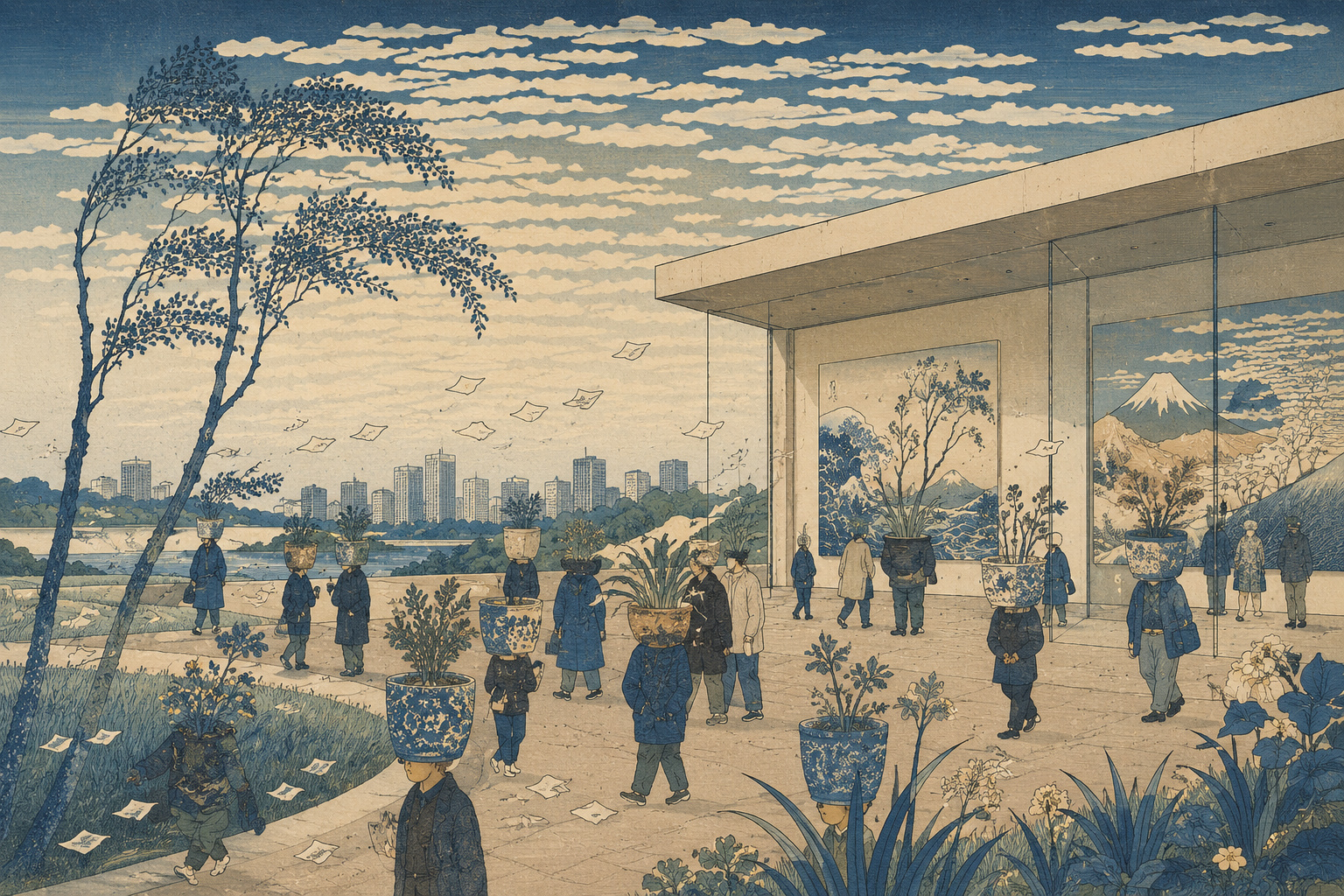
A figure with a human body and a head of branches is easy to mistake for a mascot. It may look friendly, theatrical, even collectible. Stay with it, however, and the categories begin to slip. Is this a person borrowing the visual language of a tree, a tree forced into human posture, or a witness that belongs fully to neither world?
That unstable encounter sits at the center of HUMAN AND NATURE, a major exhibition by contemporary artist Yuichi Hirako opening September 5 at Tokyo Midtown Hibiya. The show is the first inaugural program in the newly opened Tokyo Midtown Hibiya Hall, a sixth-floor venue with more than 1,200 square meters of event space. Organizers say it will contain approximately 300 paintings, sculptures and other works, including new series and a group of mobiles reaching about 3.5 meters in height.
The headline number matters, but the geography matters more. The exhibition does not stop at the ticketed hall. Sacred Tree 01 stands in Hibiya Step Square, while the mirror-finished Mirror Plant 01 enters Hibiya Park. Together, the three sites turn a polished commercial complex, a hard-surfaced public plaza and a historic designed park into different stages of the same question: when city dwellers say “nature,” what exactly do they mean?
Not a retrospective, but a constructed world
An exhibition of nearly 300 pieces can sound like a career survey. The organizers describe something different: a large spatial composition centered on recent and newly made work. Announced highlights include Lost in Thought 258, Green Master 121, the painted wooden sculpture Wooden Wood 233, and entries in the new Human or Nature series.
Curator and critic Yuji Akimoto, who planned and supervises the project with Yuichi Hirako Studio, describes the plant-headed figures neither as emblems praising nature nor as simple agents of social criticism. In his reading, they are observers stationed between human and natural worlds, city and forest, reality and imagination. The installation joins painting and sculpture into a single landscape through which visitors move and spend time.
That distinction keeps the work from collapsing into a fable with an approved moral. Hirako's figures do not announce that nature is good and cities are bad. They make such a clean opposition difficult to maintain. Their bodies wear clothes, inhabit rooms and share space with furniture, food and domestic animals. Their heads belong to botanical and mythic vocabularies. Each figure is an argument against purity.
The unease behind the plant-headed figure
Hirako was born in Okayama Prefecture in 1982. He went to Britain in 1999 and graduated from the painting program at Wimbledon College of Art in 2006. Based in Tokyo today, he works across painting, drawing, sculpture, installation and sound performance.
The official account of his practice begins with an ordinary urban habit: people call potted plants, street trees and planted parks “nature,” even though humans select their species, decide their locations, trim their growth and remove what is unwanted. Hirako's discomfort with that usage became a sustained inquiry into the boundary modern society places between humans and the natural world.
This is why the recurring hybrid is more than a recognizable signature. It denies viewers a stable position outside the scene. A human face would invite psychological identification; an ordinary tree might be admired from a safe distance. The fusion does both and neither. It converts the boundary into a character, then lets that character stare back.
In comments released for the Hibiya exhibition, Hirako sharpens the stakes. He asks whether the rhetoric of environmental protection and the Sustainable Development Goals can become a set of symbols while “living nature” is neglected—and whether the restorative greenery prized by urban residents is, in fact, a highly controlled artifact organized for human convenience. This is the artist's stated provocation, not evidence that every planted landscape is deceptive. The exhibition invites the visitor to test it.
Why Hibiya is more than a venue
Hibiya Park makes that test unusually precise. Before the modern era, the site contained feudal estates. It later became a military drill ground. Designed by forestry scholar Seiroku Honda and opened on June 1, 1903, it is described by the Tokyo Metropolitan Park Association as Japan's first Western-style park. Its formal flowerbeds, imported flowers and public music facilities helped embody the civic culture of a modern capital.
The park is undeniably green, alive and ecologically meaningful. It is also designed, planted and maintained. Camphor seedlings planted around the time of opening have grown into century-old trees under human care. The celebrated giant ginkgo, threatened by road construction, survived because Honda insisted it be moved. The park therefore refuses a lazy conclusion that designed nature is somehow unreal. It shows instead that the natural and the artificial accumulate history together.
Mirror Plant 01, installed near Tsutsuji-yama and Hibiya Matsumotoro from September 4, is built for that ambiguity. A reflective surface absorbs the surrounding trees, flowers, weather and passing bodies into its appearance. The sculpture does not merely stand against a natural backdrop. Its visible identity changes with a landscape that is itself the result of more than a century of planning and care.
The placement also reverses a familiar museum relationship. Usually, the institution controls light, distance and sightlines while the outside world remains beyond the frame. In the park, the frame cannot hold still. Wind moves leaves, pedestrians interrupt reflections, and seasonal maintenance changes what the work can show.
Three encounters across the district
| Site | Work or display | Dates | What changes |
|---|---|---|---|
| Tokyo Midtown Hibiya Hall, 6F | HUMAN AND NATURE, about 300 works | Sept. 5–Oct. 18 | Paintings, sculptures, timber structures and mobiles create an interior landscape |
| Hibiya Step Square | Sacred Tree 01 | Aug. 29–Sept. 26 | A monumental tree-like presence makes the pedestrian look upward |
| Hibiya Park, Tsutsuji-yama | Mirror Plant 01 | Sept. 4–Oct. 18 | A mirror finish incorporates actual vegetation and viewers into the object |
Sacred Tree 01 began its outdoor run before the indoor exhibition. In the artist's official comment, the longevity and vitality of great trees suggest that some special force might inhabit them. In Step Square, that idea enters a highly managed pedestrian environment. The sculpture asks the public to perform a basic gesture that towers and trees share: look up.
There is no prescribed route connecting the works. Beginning in the square, moving through the hall and ending in the park produces a progression from sculpted tree to imaginary forest to living vegetation. Reversing the journey makes the ticketed installation feel like a concentrated dream extracted from urban greenery. The walk between sites is not neutral downtime; it supplies traffic, storefronts, stone, shade and actual trees as comparative evidence.
A career built by changing scale
Hirako's rise can be traced through both the persistence of his motifs and a steady expansion in scale. He received a Tokyo Wonder Wall prize in 2010. In 2013, his 200-by-340-centimeter acrylic painting Lost in Thought won a VOCA Encouragement Prize at the Ueno Royal Museum. The official jury commentary noted the emotional intensity of his densely worked image of nature.
In 2020, he received the grand prize in the 13th I Prize program, an Okayama Prefecture initiative supporting emerging artists connected to the region. A 2022–23 project at the Nerima Art Museum asked him to select ten works from the museum collection, interpret their treatment of plants and nature, and fold those readings into a new four-panel painting measuring 3.3 by 10 meters. It demonstrated that his imagined ecosystem could absorb art history as readily as furniture or foliage.
Institutional solo exhibitions followed at Space K in Seoul in 2023 and the Nagi Museum of Contemporary Art in Okayama in 2024. In 2025, the Keelung Museum of Art in Taiwan presented Beyond the Ideal Landscape. That autumn, the Okayama Prefectural Museum of Art staged ORIGIN, Hirako's first large-scale solo exhibition in his home prefecture, extending beyond galleries into an indoor plaza and courtyard.
Hibiya carries that expansion into a different civic condition. A museum frames the encounter as art from the outset. Tokyo Midtown Hibiya is simultaneously an office complex, retail destination and cultural venue beside a public park. Here the work must coexist with shopping, commuting, leisure and corporate place-making. The friction is part of its relevance.
1999: Moves to Britain.
2006: Graduates from the painting program at Wimbledon College of Art.
2010: Receives a Tokyo Wonder Wall prize.
2013: Wins a VOCA Encouragement Prize for Lost in Thought.
2020: Wins the grand prize in Okayama Prefecture's 13th I Prize.
2022–23: Creates a 10-meter work in dialogue with the Nerima Art Museum collection.
2025: Stages the large-scale ORIGIN exhibition in Okayama.
2026: Opens the first inaugural program at the new Tokyo Midtown Hibiya Hall.
An environmental theme is not an environmental audit
There is an important limit to what can responsibly be claimed before opening. The organizers have published the conceptual relationship between the exhibition and Hibiya's greenery, but not a lifecycle accounting of shipping, fabrication, energy use or waste. A show about nature should not automatically be described as environmentally beneficial.
Nor should commercial collaborations—a limited doughnut, apparel and exhibition merchandise—be confused with the work's critical argument. They extend Hirako's imagery into everyday products and help build a broad public event. They also place his questions about desire and managed experience inside the commercial system that hosts the exhibition. Whether that sharpens or softens the art is something visitors can judge rather than something publicity can settle.
Japan.co.jp viewing guide: three useful questions
- Gaze: Do the plant-headed figures welcome the viewer, ignore the viewer or study the viewer?
- Scale: How does the body respond differently to a small wooden sculpture and a mobile rising roughly 3.5 meters?
- Boundary: At what point does the artwork end and the architecture, plaza or planted park begin?
Visiting the exhibition
HUMAN AND NATURE runs September 5 through October 18, 2026, without scheduled closing days. Tokyo Midtown Hibiya Hall is open from 11:00 a.m. to 8:00 p.m.; last admission is at 7:30 p.m. Online tickets cost ¥2,000 for adults, ¥1,500 for university and vocational-school students, and ¥1,000 for junior-high and high-school students. Same-day tickets are ¥2,200, ¥1,600 and ¥1,100 respectively. Children of elementary-school age and younger enter free.
The official listing assigns no admission charge to the outdoor displays, which are presented separately from the ticketed hall. Sacred Tree 01 is scheduled for Hibiya Step Square through September 26; Mirror Plant 01 is scheduled for Hibiya Park from September 4 through October 18.
Related programs include September 5 gallery tours with Hirako and Akimoto, September 12 workshops for children and adults, and September 28 talks on why the tree became human and on the relationships among art, architecture and the city. Reservation rules, capacities and additional fees vary, so visitors should confirm the current details on the official site.
The exhibition's strongest idea may be the simplest: Hibiya is not a city on one side and nature on the other. It is a layered habitat in which design, capital, care, plants, memory and public life are already interdependent. Hirako's hybrid figures do not solve that condition. They give it a body—and allow it to look back at us.
Sources
- Tokyo Midtown Hibiya: HUMAN AND NATURE official site (artworks, artist and curator statements, outdoor installations and programs)
- Mitsui Fudosan: Announcement of Yuichi Hirako's HUMAN AND NATURE (July 22, 2026; venue, scale, admission and credits; Japanese)
- Tokyo Metropolitan Park Association: Hibiya Park at 120 (park history and managed plantings; Japanese)
- Tokyo Metropolitan Park Association: Hibiya Park guide (history, Seiroku Honda, trees and facilities; Japanese)
- Okayama Prefectural Museum of Art: Yuichi Hirako, ORIGIN (biography and recent exhibition history; Japanese)
- Nerima Art Museum: inheritance, metamorphosis, rebirth (2022–23 collection project; Japanese)
- The Ueno Royal Museum: VOCA 2013, Lost in Thought (award, medium and dimensions; Japanese)
- Okayama Prefecture: 13th I Prize presentation (March 18, 2020; Japanese)
Japan.co.jp checked information published through 10:45 p.m. JST on September 2, 2026. Japanese names, readings, artwork titles and statements were verified against Japanese-language material from the organizer, government bodies and museums. This is a researched preview, not an on-site review; descriptions of the planned installation are attributed to organizers, while interpretation is identified as analysis.
Image rights: © 2026 Japan.co.jp. This AI-assisted editorial illustration does not reproduce an artwork by Yuichi Hirako. Unauthorized reuse is prohibited. For licensing, visit the contact page.