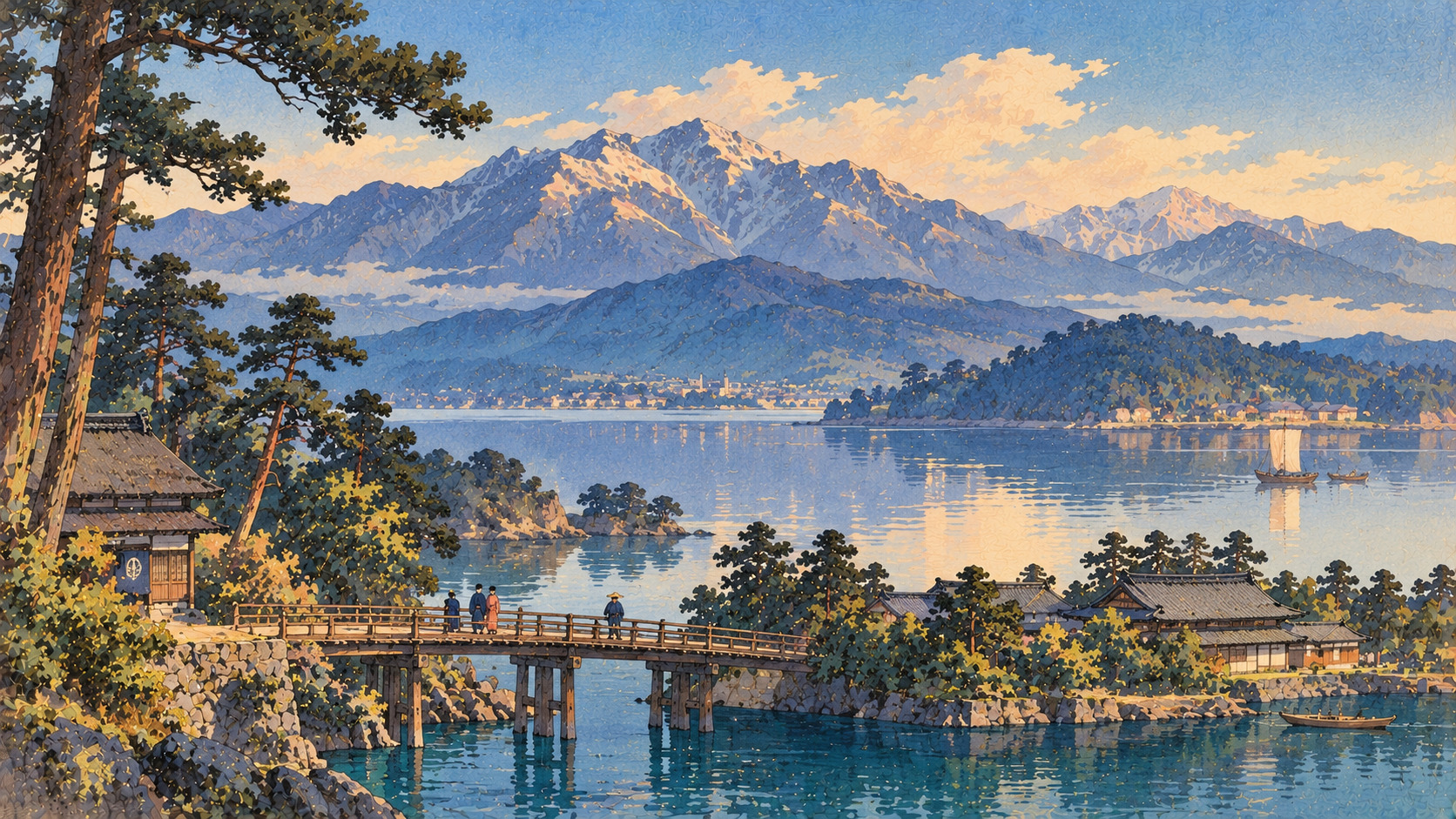
The same landscape is never the same light: Yoshida made the changing hour his subject.
A sailor, six skies
The boat remains recognizable; almost everything around it changes. In Hiroshi Yoshida’s Seto Inland Sea sailing-boat prints, morning, mist, afternoon, evening and night transform one maritime subject into a meditation on how light changes a place. The Tokyo Fuji Art Museum documents these variations in its collection. The achievement is more radical than a beautiful landscape: Yoshida made the color woodblock print a disciplined experiment in time.
A painter before a printmaker
Born in Kurume, Fukuoka Prefecture, in 1876, Yoshida followed a trajectory unlike that of an Edo-period ukiyo-e designer. He trained in Western-style painting, first with Sōryū Tamura in Kyoto and then at Shōtarō Koyama’s Fudōsha academy in Tokyo. He belonged to a generation questioning how Japanese artists could absorb European realism without surrendering their own visual language. That tension would become central to his prints decades later.
America made the young watercolorist international
In 1899, Yoshida traveled to the United States carrying watercolors. Museum histories recount successful exhibitions and sales, including in Detroit, which helped finance further travel in Europe. It is tempting to call this the international triumph of shin-hanga; that would be premature. Yoshida was still known primarily as a painter. His international career was underway long before the woodblocks that now define his reputation.
An established artist takes a risk at forty-four
Yoshida helped establish the Pacific Painting Association in 1902 and gained standing through Japanese official exhibitions. Then, in 1920, he published his first woodblock print with publisher Shōzaburō Watanabe. In the years after the 1923 Great Kantō Earthquake, he reassessed the possibilities of the medium. By 1925 he was pursuing a more directly supervised printmaking practice, seeking to combine the painter’s study of atmospheric light with traditional cutting and printing skills.
What shin-hanga meant—and what Yoshida changed
The shin-hanga or “new prints” movement revisited a collaborative system: an artist designed the picture, a specialist carved blocks, a printer applied color, and a publisher coordinated production. It was a reinvention rather than an unbroken reproduction of Edo art. Yoshida brought intensive personal supervision to his own workshop and was closely associated with the jizuri or “self-printed” mark. That mark should not be taken to mean he personally carved and printed every impression unaided; different workers and printings require case-by-case attribution.
The watercolor hiding in plain sight
One revealing object is Evening at Nakagami, a quiet landscape the Tokyo Fuji Art Museum dates to around 1909. It is watercolor on paper, measuring 33.0 by 49.2 centimeters—not a shin-hanga woodblock print. It reminds us that Yoshida’s fascination with the hour between daylight and darkness existed before his turn to carving and printing. Any article that captions it as a woodblock print erases an important part of his artistic development.
How one block becomes six different moments
In the Sailing Boats series of 1926, Yoshida reused blocks while changing color combinations to evoke distinct times of day and weather. Paper, pigment, gradual shading, water reflections and atmospheric distance do the narrative work. The lines may hold the landscape steady; the palette tells the viewer when and how it is being seen. This was a highly controlled variation, not simply a convenient way to sell the same picture in different colors.
Printing light, layer after layer
Museum documentation describes Yoshida’s habit of applying many successive impressions—often thirty or more. The MOA Museum reports more than seventy for some prints and ninety-six for Yōmeimon. Such figures describe particular works and should not be generalized to the entire oeuvre. Keeping colors aligned on damp paper, especially in oversized compositions, required technical discipline. The softly glowing result can conceal extraordinary labor.
Into the Japan Alps
Yoshida was a committed mountaineer. His 1926 Twelve Scenes in the Japan Alps brought peaks, snow valleys and weather into unusually intimate focus. Mount Hodaka, Mount Bessan and the Harinoki snow valley belong to a vocabulary of observed rather than imagined altitude. The Fukuoka Prefectural Museum of Art records his role in founding the Japan Alpine Artist Association in 1936. In these works, the traveler’s physical encounter with a mountain matters as much as its silhouette.
A Japanese technique for the Grand Canyon
A 1925 Grand Canyon print held by the Yokohama Museum of Art shows that Yoshida did not limit woodblock printmaking to Japan. European alpine views, including the Wetterhorn, appear alongside Japanese mountains. These were not exercises in disguising Western scenery as Japanese. Their achievement lies in using a Japanese medium to record the scale, rock formations and light conditions of unfamiliar places.
India and Southeast Asia broadened the horizon
After travel to India around 1930–31, Yoshida developed images of the Taj Mahal, Kangchenjunga and sites across South and Southeast Asia. Tokyo Fuji Art Museum holds prints of the Taj Mahal Gardens, Singapore and the Golden Pagoda in Rangoon. The series reveals how adaptable his method had become: mist around mountains, brilliant light on monumental architecture, and heat in urban landscapes each demanded different palettes.
Rain in Tokyo, not only mountains
Kagurazaka Street at Night after Rain, dated 1929 in the Tokyo Fuji Art Museum collection, captures a very different kind of atmosphere: reflections of urban light on wet pavement. It expands Yoshida’s identity beyond the mountain specialist. The underlying question is the same—how can the artist make a viewer feel the quality of a fleeting moment?—but the setting is a human-built city.
The museum network that carried his work abroad
Yoshida helped present contemporary Japanese prints to overseas audiences, including through collaborations associated with the Toledo Museum of Art’s 1930 exhibition of modern Japanese prints. His prints circulated within an international cultural and collecting network. The international response was not solely the achievement of a lone genius; it depended on printers, galleries, curators, collectors and exhibitions connecting Japan with the wider world.
The later years and an artistic family
Yoshida continued to work through the turbulent early Shōwa decades and died in 1950. His sons Tōshi and Hodaka also became printmakers, though their individual artistic paths should not be flattened into mere continuations of their father’s. His legacy also lives in the debate over artistic authorship: when a print is the work of an artist and skilled collaborators, who is responsible for its final light and color? Yoshida answered by taking unusually close responsibility for the result.
A vital distinction about public-domain images
Yoshida’s original works are generally beyond the ordinary Japanese life-plus-seventy-years copyright period. That does not make every digital reproduction on the internet interchangeable. Tokyo Fuji Art Museum specifically offers its digital image of Evening at Nakagami under CC0, while other institutions publish their own image policies. Japan.co.jp’s feature illustration is newly generated editorial art inspired by his approach, not a photograph or reproduction of one of his historical prints.
Why his light still travels
Yoshida did not have a camera’s instant exposure or a screen’s infinite colors. His answer to a fleeting sunset was to observe, draw, plan a palette and orchestrate repeated hand printing. More than a century after his earliest journeys abroad, that slowness feels unexpectedly modern. The beauty of his landscapes is inseparable from their insistence that looking carefully—and looking again—reveals more than a quick glance ever can.
Sources and research notes
Institutional collections and museum histories underpin the dates, techniques and work descriptions in this feature.
- Tokyo Fuji Art Museum: Yoshida collection
- Tokyo Fuji Art Museum: Evening at Nakagami, watercolor c.1909
- MOA Museum of Art: biography and technique
- MOA Museum of Art: Yoshida then and now
- Fukuoka Prefectural Museum of Art: artist record
- Yokohama Museum of Art: Grand Canyon, 1925
- Tokyo Fuji Art Museum: collection checklist
- British Museum: Yoshida Hiroshi biography
- Toledo Museum of Art: artist biography
- Museum of Contemporary Art Tokyo: The Jungfrau
- MOA Museum: Yoshida woodblock exhibition