- A white plum blossom opens a much larger story
- Who was Yosa Buson?
- The painter who returned to Bashō’s journey
- Go Shun, the artist between two schools
- A surprise connection: Nagasawa Rosetsu
- The art of tea as creative interpretation
- An Italian glass vessel in a Japanese tea room
- Ichizō Kobayashi: modernizer and collector
- From a private collection to a museum for a city
- Look beyond the headline painters
- Visiting on November 8
- Why this exhibition matters after it closes
A white plum blossom opens a much larger story
The white branches seem to emerge from darkness. In Go Shun’s White Plum Blossoms, a pair of six-panel folding screens, a striking indigo ground makes the flowers feel suspended between night and morning. The painting is an Important Cultural Property, but its significance extends beyond its visual elegance: Go Shun had studied with Yosa Buson, the poet-painter whose farewell haiku also evokes white plum blossoms and the coming dawn.
The encounter takes place at Tokyo’s Suntory Museum of Art, where Masterpieces from the Itsuo Art Museum Collection: Buson, Go Shun, and the Art of Tea closes on Sunday, November 8, 2026. The exhibition draws on a collection assembled by Ichizō Kobayashi, one of modern Japan’s most consequential entrepreneurs. It offers Tokyo its first major showing of this collection in roughly three decades.
Its ambition is bigger than a survey of two Edo painters. The exhibition asks how poetry can become painting, how a vessel from Europe can become a Japanese tea utensil, and how the private aesthetic judgments of a businessman eventually become a public museum.
Who was Yosa Buson?
Yosa Buson (1716–1783) belongs to the celebrated lineage of Japanese haiku poets alongside Matsuo Bashō and Kobayashi Issa. Yet calling him a poet first and a painter second imposes a separation that his work resists. Buson understood visual space, poetic compression and the rhythms of classical Chinese painting as interconnected ways of making meaning.
His haiga—paintings accompanied by haiku or related verse—can seem disarmingly light. A few strokes establish a scene; a short phrase shifts its emotional temperature. Words and images need not illustrate each other literally. Each can create space for the viewer to complete what remains unstated.
The exhibition includes Buson’s Cherry Blossom Viewing Painting and Inscription, listed for the October 14–November 8 display period, and his Stone Painting and Inscription. They reveal an artist working across forms at a moment when Kyoto’s literary and visual cultures mingled in unusually creative ways.
The painter who returned to Bashō’s journey
One of the most important objects is Buson’s 1779 Narrow Road to the Deep North Picture Scroll, a two-scroll work designated an Important Cultural Property. Its foundation is Bashō’s seventeenth-century travel writing, Oku no Hosomichi. Buson’s contribution was not simply to illustrate a famous literary itinerary; it was to revisit another artist’s imaginative geography through calligraphy and painting.
The original journey through northeastern and northern Japan was already history by Buson’s day. Reading the scroll thus involves several kinds of distance at once: between places, between generations and between the written voice and the drawn image.
The museum has changed the portions on view during the exhibition. That matters for readers planning a visit: the two scrolls should not be imagined as entirely visible at a single moment. The unfolding, partial nature of a handscroll is part of the encounter.
Go Shun, the artist between two schools
Go Shun (1752–1811) was born in Kyoto as Matsumura Gekkei. He learned poetry and painting from Buson, lived for a period in Ikeda, and later studied the observational techniques associated with Maruyama Ōkyo. The Itsuo Art Museum identifies this combination—Buson’s lyrical imagination and Ōkyo’s commitment to nature—as central to his achievement.
Go Shun helped establish the artistic lineage later called the Shijō school. This was not a mechanical compromise between poetry and naturalism. His paintings show how accurate observation can deepen, rather than extinguish, an atmosphere of suggestion.
The white-plum screens make the case memorably. Their blue ground and pale branches are not a direct picture of Buson’s death poem, and no evidence here proves such a commission. Yet the association gives viewers a powerful way to consider what a pupil may inherit from a teacher: not a fixed iconography, but a feeling for time, season and silence.
A surprise connection: Nagasawa Rosetsu
The show also brings other Edo painters into view, including Nagasawa Rosetsu (1754–1799), whose playful, startling compositions are a reminder that the eighteenth century was not stylistically uniform. His Puppies in Snow is listed for display from October 14 until November 8.
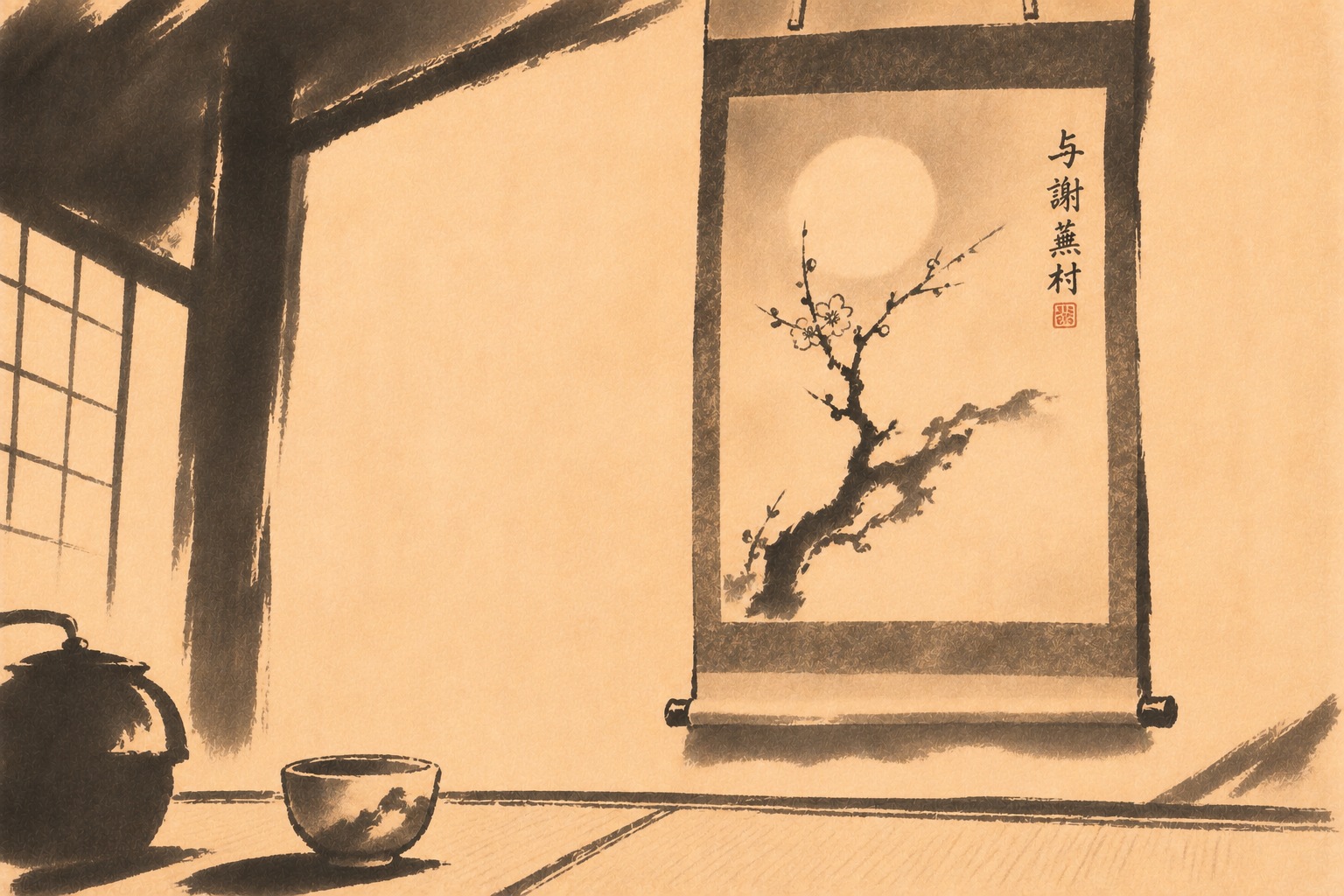
Rosetsu is especially relevant to this edition of JAPAN.co.jp: its commissioned editorial illustrations draw inspiration from his dramatic scale and expressive animal painting. The illustration accompanying this article is interpretive and AI-generated, not a photograph of a work displayed by the museum.
The connection points toward an important truth. Buson, Go Shun and Rosetsu did not all see nature in the same way, but they inhabited an artistic environment that permitted wit, lyricism and observation to flourish in very different voices.
The art of tea as creative interpretation
Tea ceremony is sometimes presented abroad as a practice governed entirely by fixed rules. Kobayashi’s collection tells a more adventurous story. A tea bowl is not only an old object; in the setting of a gathering, its history, seasonal appropriateness, name and relationship to other utensils become part of the event.
An example is an old repaired bowl that Kobayashi named Iemitsu-kō. The act of naming and assembling a tea arrangement involved aesthetic authorship by the owner as well as craftsmanship by the maker.
Kobayashi experimented with chair-seated tea rooms, used European ceramics and glassware as tea equipment, and incorporated Western dishes and rice bowls into the food served at some gatherings, according to the museum’s curatorial account. These choices did not reject Japanese tradition; they tested its capacity to remain inventive.
An Italian glass vessel in a Japanese tea room
Among the objects listed for the full exhibition period is an eighteenth-century Italian green glass jar decorated with flowers, reinterpreted as a tea container. It occupies an intriguing position between trade history and the imaginative practice of mitate: recognizing new aesthetic possibilities in something originally made for another purpose.
The museum also discusses a vessel from the Sèvres porcelain works repurposed as a water container. Both examples complicate any simple division between “Japanese” and “foreign” art. Objects travel; settings change; meaning follows a new arrangement.
In this context, cultural continuity is not the absence of alteration. It can consist of the care with which later generations decide what an old object might be allowed to become.
Ichizō Kobayashi: modernizer and collector
Ichizō Kobayashi (1873–1957) helped shape the businesses that became associated with Hankyu Railways, department stores, the Takarazuka Revue and Toho cinema. His vision of leisure and suburban life placed him among the architects of modern Japanese consumer culture.
He also collected paintings, calligraphy fragments, ceramics and tea utensils, and participated in the culture of modern sukisha—collectors and practitioners who approached tea as both a disciplined art and an opportunity for personal invention. His art name, Itsuo, eventually became the name of the museum established in Ikeda in 1957.
The approximately 5,500 objects in the Itsuo Art Museum collection now carry an unusual historical double identity. They are documents of older Japanese artistic traditions and records of how a modern industrial entrepreneur chose to see, combine and preserve those traditions.
From a private collection to a museum for a city
Kobayashi imagined a Japan where smaller cities, not only Tokyo and other national centers, would have museums of their own. The Suntory Museum’s exhibition account calls attention to his aspiration for “one museum in every city.” He died before seeing his own museum open.
The relationship between the Itsuo Art Museum and Suntory Museum of Art has an unexpected family dimension. Kobayashi’s daughter Haruko married Kichitarō Torii, son of Suntory founder Shinjirō Torii. Suntory Museum itself opened in Tokyo in 1961. Their present collaboration reflects connections in both cultural purpose and family history.
The exhibition can therefore be read as a history of philanthropy and regional cultural infrastructure, not merely a loan of valuable artworks from Osaka to Tokyo.
Look beyond the headline painters
The six-part exhibition also includes fragments of classical calligraphy, Buddhist manuscripts, narrative scrolls, Asian lacquerware and works by modern artists. One especially evocative exhibit is the Important Cultural Property fragment portraying poet Fujiwara no Takamitsu from the Satake Thirty-Six Immortal Poets scrolls, listed for October 14–November 8.
The original scroll was separated into individual poet portraits in 1919, becoming an important episode in the history of collecting and conservation. Visitors who look at a single fragment are also confronting the complicated afterlife of a once-unified artwork.
In the twentieth-century section, a 1933 lacquer tea caddy inspired by the score of a Takarazuka performance shows how Kobayashi’s worlds of entertainment and tea could meet in one small object. Meanwhile, the museum’s published display guide also includes works shown only in the earlier part of the run. Not every object pictured online is guaranteed to be present on closing day.
Visiting on November 8
The Suntory Museum of Art is on the third floor of Tokyo Midtown’s Galleria in Roppongi. According to the museum’s published schedule, the show closes on Sunday, November 8; standard Sunday hours are 10 a.m.–6 p.m., with admission ending 30 minutes before closing. Same-day general admission is ¥1,700, with other categories and discounts available.
For a focused visit, begin with Go Shun’s White Plum Blossoms, then seek out the currently displayed portion of Buson’s Bashō scroll and his haiga. Continue to Kobayashi’s tea utensils and Rosetsu’s Puppies in Snow. Actual room order and object availability can change, so consult the on-site display guide.
The most rewarding question to bring is not simply “Which object is the masterpiece?” but “How did this work’s meaning change when it passed from one reader, painter or collector to another?”
Why this exhibition matters after it closes
An exhibition that reunites objects from a collection can appear to be a brief interruption of their ordinary museum life. This one reveals something lasting. A poet-painter reimagined a predecessor’s journey. His pupil absorbed both lyricism and close observation. A business leader later brought such works into a new kind of urban and regional cultural world.
The final day in Tokyo should not be mistaken for the end of that story. The Itsuo Art Museum continues to safeguard the collection in Ikeda, where the idea that culture should be shared has an institutional home.
In the white-plum screens, the relationship between art and time is visible without being explained. One branch reaches into darkness; another catches the light. The same collection holds works that invite a different generation to look again.
Sources and reporting method
This is a documentary report based on official museum announcements, curatorial notes, and published display schedules. It does not claim an original exhibition visit or interviews. Objects may rotate or be withdrawn; visitors should confirm what is on display.