Tokyo summer is not just hot. It is heavy, bright, humid and relentless. People pause on station platforms, look for shade on slopes, and count the minutes until water appears. For 2026, Yomiuriland’s Pool WAI has a quietly clever answer. It is not only adding another place to cool down. It is adding a warm bubbling pool called Bubble Oasis — a place to recover, sit, breathe and turn a day of splashing into a full summer rhythm.
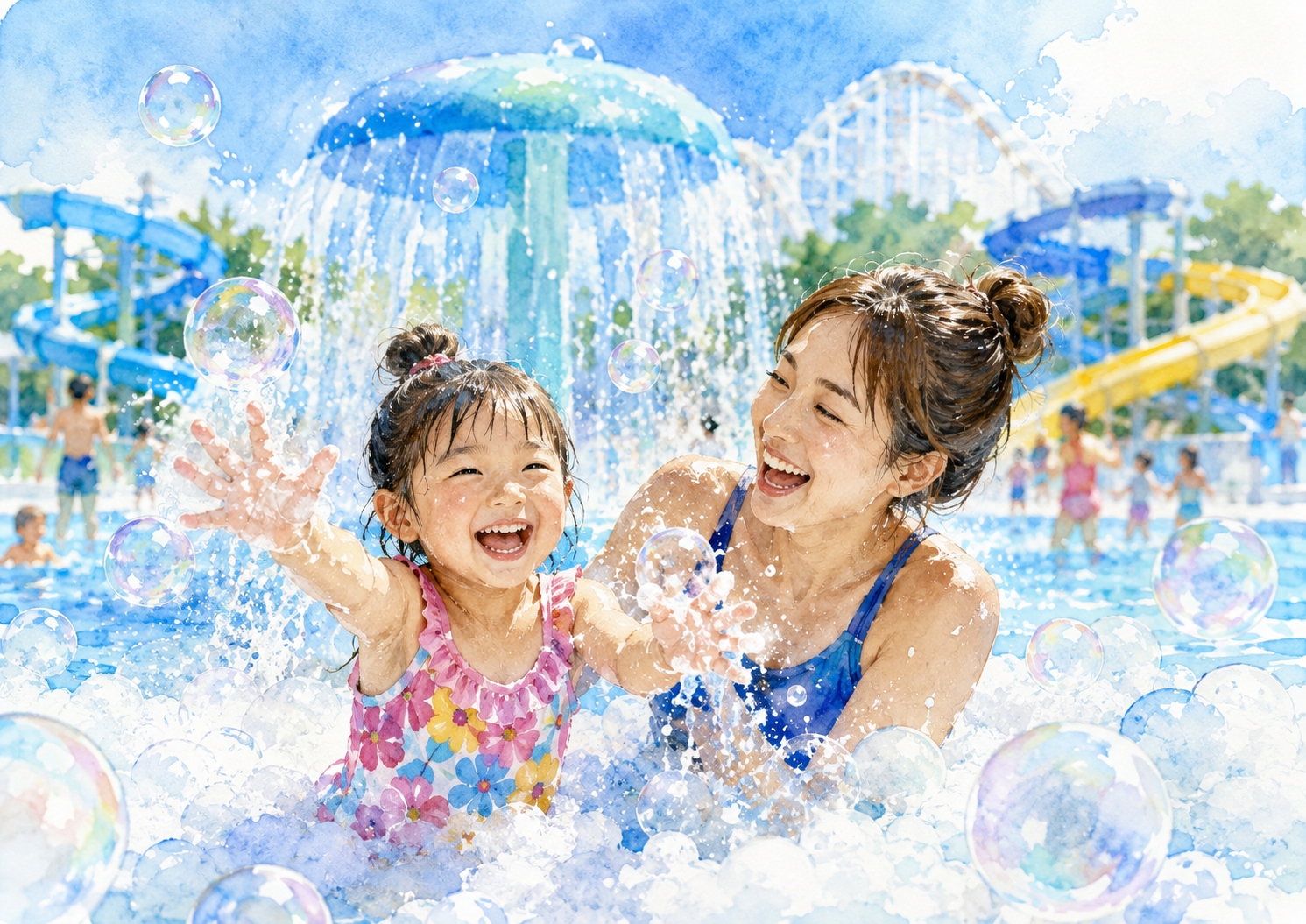
Pool WAI opens for the 2026 season from June 27 through September 23 inside Yomiuriland, the hilltop amusement park on Tokyo’s western edge. The new Bubble Oasis is the season’s headline: a 100-square-meter warm pool, 0.8 meters deep, where fine bubbles rise from the walls and floor until the surface turns white. Built-in seating lets guests rest between active pool events during the day and warm up during the illuminated night pool. It is a small attraction, but it says something larger about the future of summer leisure in Japan.
A South Pacific mood on a Tokyo hill
Pool WAI is interesting because of where it is. Yomiuriland is not a seaside resort. It sits in the Tama Hills, straddling the Tokyo and Kanagawa border, close enough to central Tokyo to be reached from Shinjuku in about 35 minutes but high enough to feel like a real escape. Pool WAI’s name stands for Water Amusement Island, and Yomiuriland explains that “wai” means water in Fijian. With palm trees, beach-like edges and resort styling, the park tries to create a South Pacific mood without asking Tokyo families to go all the way to the coast.
That matters. Summer leisure in Tokyo is often a logistics problem. A beach day means early trains, traffic, towels, bags, lunch, sunscreen, sleepy children and a long trip home. A pool inside a major amusement park solves a different problem: how to feel as if you went away without actually going far. Yomiuriland has always understood that suburban leisure is part geography, part fantasy. It gives Tokyo families a place where the city loosens its grip for a day.
A park born in 1964
Yomiuriland opened in 1964, the same year Tokyo hosted the Olympics and Japan introduced itself to the world as a modern, fast-growing nation. The park grew out of a postwar world in which newspapers, television, railways, baseball and amusement parks helped create the modern Japanese weekend. Central Tokyo was for business, politics and shopping. The suburban hill became a place where families could spend a full day together.
Over the decades, Japanese amusement parks changed. They chased thrill-ride records, responded to the arrival of global theme parks, built character zones, invented winter illumination seasons and added educational experiences. Yomiuriland adapted by becoming seasonal: cherry blossoms in spring, Pool WAI in summer, Jewellumination in winter, Goodjoba!! for family manufacturing-themed fun, HANA・BIYORI for flowers and digital art, and the nearby Hanabiyori hot spring for recovery. Pool WAI is the most physical of these seasons. It is the one that asks visitors to enter the weather rather than simply look at it.
Why Bubble Oasis feels timely
Most water-park attractions are built around speed, height and impact. Bubble Oasis goes the other way. It is warm. It is seated. It is soft. It is designed for the pause between bigger moments. That does not make it less important. In a hotter Japan, outdoor leisure has to think not only about excitement but also about recovery. Visitors need shade, water, timing and rest. A warm bubbling pool may seem counterintuitive in summer, but after hours of cold water, fountains and evening air, it becomes a reset button.
The Japanese summer has changed. Heat, humidity, reflected pavement, sudden storms and heatstroke awareness have altered how families plan a day outdoors. Parks cannot simply offer more activity. They need to manage the body. Pool WAI’s 2026 lineup turns that reality into programming: active pools, slides, family areas, night swimming and now a warm-bubble rest zone. The attraction is not only about novelty. It is about pacing a summer day.
Waves, lazy rivers and big slides
Pool WAI’s heart remains the water itself. The facility offers five pools and eight types of slides. The wave pool brings a beach memory to a Tokyo hillside. The 250-meter lazy river turns water into a slow moving path. The Giant Sky River offers the larger thrill-ride energy that an amusement park visitor expects, converting height and speed into a wet landing and shared laughter. Unlike a roller coaster, a water slide does not end with a brake run. It ends with a splash.
The family appeal is just as important. The Anpanman children’s pool gives younger guests a friendly entry point into water play, with familiar character-themed areas and smaller attractions. For a small child, a large pool can be intimidating: deep water, noise, crowds and the feeling of being wet. A recognizable, child-scaled zone changes the first impression. Family water parks live or die not only by the largest slide but by whether the youngest visitor feels safe enough to begin.
The night pool as modern Tokyo evening cool
Yomiuriland’s night pool is another major part of the 2026 story. According to official event information, the night pool runs on 50 days from July 11 through September 13, with swimming from 5:15 p.m. to 8:30 p.m. The lit palm trees and pools are meant to create a resort atmosphere while helping visitors avoid the harshest sunlight and daytime heat. Paid seating, float rentals, food options and illumination make the night pool feel less like extended operating hours and more like a different product.
In Japanese cultural terms, the night pool is a modern version of yusuzumi — evening cooling. Older summer evenings meant verandas, riverbanks, fans, fireworks and yukata. Contemporary Tokyo adds phones, music, lighting, after-work visits and short-form social photography. Pool WAI translates that older summer instinct into a modern leisure format. It is still about water, air and relief. It just happens under LEDs and palm trees.
More than a photo backdrop
Night pools are easy to dismiss as photo spots. The reflections, neon, drinks, floats and palm trees are part of the appeal, but they are not the whole appeal. The true value of a night pool is temperature. Daytime Tokyo can be too strong. At night, the light softens, the water reflects, and the body relaxes. Bubble Oasis fits that moment especially well. A warm bubbling pool gives the night pool a place to linger, not just a background for pictures.
That connects to Yomiuriland’s broader nighttime identity. Jewellumination made the park a winter night destination. Pool WAI’s night pool does something similar for summer. In winter, people go to the hill to look at light. In summer, they go to enter light and water together. It is seasonal programming, but it is also a clever use of time. A park that can make night feel valuable can stretch the meaning of a day ticket, a summer visit and a neighborhood destination.
The one-day circuit: amusement park, pool and hot spring
Yomiuriland’s strength is not just one facility. It is the way experiences stack. A visitor can ride attractions, swim, stay into the evening, eat, take photos and then finish with a hot spring nearby. The official night pool page even promotes the idea of refreshing after the pool at Hanabiyori no Yu, while noting usage rules for young children. This matters because modern family leisure needs flexibility. Weather changes. Children tire. Adults need a break. A single-purpose destination is fragile. A layered destination can rescue the day.
That flexibility makes Yomiuriland especially useful for families. If the children still want water, stay at the pool. If the heat gets difficult, rest. If the group arrives late, use the night pool. If the weather changes, shift to food, rides or another indoor-adjacent activity. Suburban leisure parks survive because they can absorb imperfect days. Pool WAI is not just a pool; it is a summer operating system.
What foreign visitors should know
For international visitors, Yomiuriland is less famous than Tokyo Disney Resort or Universal Studios Japan. That may be part of its charm. The official English page positions Pool WAI as a major Tokyo water park and emphasizes the short journey from Shinjuku. For families spending a summer week in Tokyo, a water day can balance museums, temples, shopping and restaurants. It gives children a day that does not feel like sightseeing.
Visitors should still check the rules before going. Yomiuriland’s English Pool WAI page states that tattoos are not permitted and that guests with tattoos may be refused entry. This kind of rule can surprise overseas travelers, but it remains common at some Japanese pools and bathing facilities. A good travel article should not hide it. Practical honesty is part of good hospitality. The attraction is fun, but preparation matters.
| Feature | How to read it |
|---|---|
| Bubble Oasis | The 2026 newcomer: a warm bubble pool built for rest, not speed. |
| Wave pool | The symbolic beach moment on a Tokyo hillside. |
| Lazy river | A 250-meter floating walk through the park’s summer mood. |
| Giant Sky River | A large-scale slide that brings amusement-park thrill logic into water. |
| Night pool | Tokyo evening cooling remade as a resort-style summer event. |
The memory power of pools
Pools create strong memories. The first time a child puts their face underwater. The moment a parent lets go of a float. The wave that knocks everyone sideways. The lazy river that feels longer than it is. The friend group that stays until the lights come on. Yomiuriland has lasted because it is not only a collection of rides. It is a seasonal memory machine for generations of Tokyo families.
Bubble Oasis adds a new layer to that memory. Children race toward the splashes. Adults sit in the bubbles. Young visitors take photos under the night lights. Families board the train home tired and happy. Tokyo’s summers may be harder than they used to be, but people still want to go outside. They still want a water sound, a place to laugh, and a day that feels like summer rather than simply surviving summer.
Japan.co.jp view
Pool WAI’s 2026 season is not a giant theme-park opening. It is something more local, more practical and in some ways more revealing. It shows how Japanese amusement parks are adapting to hotter weather, evening demand, family pacing, photo culture and the growing desire for recovery inside leisure itself. Bubble Oasis is a warm pool, yes. But editorially, it is a signal.
Yomiuriland is both a Tokyo tourist attraction and a place for Tokyo residents. It is where families go when they cannot travel far, when the beach feels too much, or when they still want summer to feel festive. On the hill, water becomes an island. There are waves, slides, lazy current, night lighting, food, characters for children and now a bubbling place to rest.
Summer news is not only politics, markets and corporate announcements. It is also the opening of a pool, the return of night swimming, and the small design decisions that help people enjoy a hotter city. A child running toward the water is news too. So is an adult sitting in warm bubbles at dusk, remembering that summer can still be fun.
Sources and references
This article is based on public information from Yomiuriland, PR TIMES, Let’s Enjoy Tokyo and GOOD LUCK TRIP. Operating dates, prices, rules and event details may change, so readers should confirm the latest information with the official site before visiting.
- PR TIMES / Yomiuriland Co., Ltd.: Pool WAI June 27 opening announcement, Bubble Oasis and night pool details.
- Yomiuriland: Official Pool WAI page.
- Yomiuriland: Official night pool page.
- Yomiuriland: English Pool WAI guide and visitor guidance.
- Let’s Enjoy Tokyo: 2026 night pool event details.
- GOOD LUCK TRIP: Pool WAI travel overview.