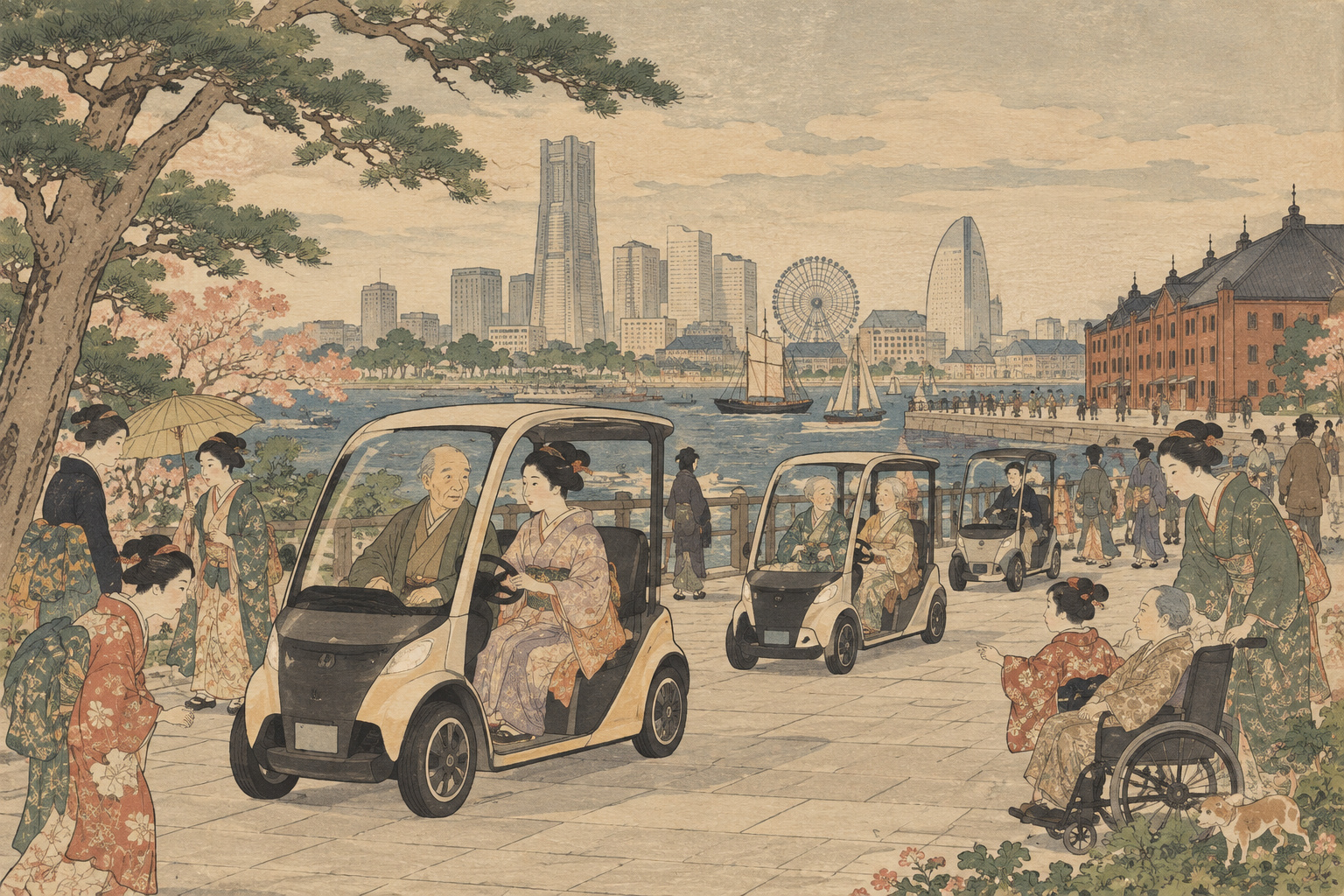
Most shared-mobility systems promise to get you somewhere faster. Yokohama is about to test one whose defining feature is the opposite. On October 5, the city and OpenStreet will begin offering “SloMobi,” a compact electric mobility device capped at 6 kilometers per hour, from stations at Sakuragicho, Kannai and the Nihon-odori underground parking facility. The experiment runs through March 31, 2027, and rides of up to 12 hours are free through the HELLO CYCLING app. [1][2][3]
The city says the main intended users include older people and people who have temporary difficulty walking. The question is not whether a 6 km/h device can beat a bicycle. It is whether it can make a few hundred meters—or a few kilometers—manageable for someone who can technically walk but finds the distance tiring, painful or impractical. Yokohama says it will collect data on actual use and user needs, then evaluate benefits and obstacles to further deployment. [2]
The legal design is as important as the engineering. SloMobi belongs to Japan’s category of idō-yō kogata-sha, or mobility-use small vehicles. A qualifying device is treated as a pedestrian under the Road Traffic Act, not as a bicycle or e-scooter. It can use sidewalks and roadside strips, requires no driver’s license, and has no helmet mandate. [4][5]
The legal category itself is not restricted to people 16 and older. OpenStreet’s Yokohama sharing service imposes its own safety conditions: users must be at least 16 and weigh less than 100 kilograms. “License-free” does not mean “unrestricted.” [3][4]
Making slowness useful
Transport innovation is usually narrated as a speed story: faster rail, faster roads, faster dispatch, faster automation. A sidewalk has a different logic. It is shared by people walking at different speeds, children, wheelchair users, people with luggage and visitors looking at maps. In that environment, matching walking speed can be a feature rather than a limitation.
National Police Agency guidance defines the category tightly. Mobility-use small vehicles must fit within maximum dimensions of 120 centimeters long, 70 centimeters wide and 120 centimeters high, use an electric motor, be incapable of exceeding 6 km/h, and avoid sharp protrusions. A prescribed marker is required when they are used on the road. [4] The legal category was established through Road Traffic Act changes that took effect in April 2023. [5]
That separates SloMobi from Japan’s license-free electric kick scooters. Those “specified small motorized bicycles” remain vehicles, generally operating on the roadway and subject to a different regulatory system. Mobility-use small vehicles are designed to coexist inside pedestrian space.
Shared, but not one-way
The most revealing restriction may be the return rule. A SloMobi must go back to the same station from which it was borrowed. A rider cannot pick one up at Sakuragicho and leave it at Kannai or Nihon-odori. [3]
That makes this a different proposition from a typical bike-share trip. It favors loops: exploring a neighborhood, going from a station to an appointment and back, shopping in several places, or making a round trip from a parking garage. It is less useful for a one-way “last mile” in which the destination itself should become the return point.
Yokohama describes the larger concept as a network of “shared-mobility ports” combining bicycles and pedestrian-domain mobility around stations and public parking. The goal is not necessarily one giant hub. The city wants clusters of mobility points arranged around actual travel paths, widening the set of choices between a transport node and a final destination. [2]
The city and operator have not published the number of vehicles to be deployed, vehicles per station, expected turnover, future one-way capability, a post-trial price, or the exact conditions for continuing beyond March 2027. Because rides are free, usage counts alone will not reveal willingness to pay or commercial viability.
Yokohama already built the bike-sharing layer
This experiment sits on top of years of bicycle-sharing expansion. Yokohama’s earlier citywide social experiment framed bike sharing as a way to complement public transport, secure local travel options and widen everyday mobility choices. [11] The city’s 2026 guidance now treats electric-assist bike sharing as an established part of urban travel, with multiple operators and ports across the city. [12]
OpenStreet is using that existing layer rather than creating a completely separate user system. SloMobi appears inside the HELLO CYCLING app, which handles membership, station discovery and service access. That matters because a new mobility device often fails not only on engineering but on friction: another account, another payment method, another map, another set of instructions.
Placing a new vehicle type inside an existing mobility app also creates a useful test. Researchers and operators can begin to see when a user chooses a 6 km/h seated device instead of an electric-assist bicycle. The interesting data are not simply how many trips occur, but what kinds of trips migrate toward the slower option.
The vehicle program has been developing since 2023
OpenStreet and Toyoda Iron Works announced a partnership in September 2023 to co-develop vehicles that fit the new mobility-use small-vehicle category and bring them into shared-mobility services. [6] For the Yokohama launch, OpenStreet says it has now built a fully keyless system in which app commands can turn the vehicle on and off, start or end a rental and place the vehicle in a temporary parked state without the manual smart lock familiar from bicycles. [3]
Toyoda Iron Works separately markets a pedestrian-domain three-wheeler called Comove. Its published characteristics include automatic slowing while turning or descending, a 0.92-meter turning radius and an indicated range of about 12 kilometers under the company’s test conditions. [7][8] In August, OpenStreet held a Comove test-ride event at Umi Expo Yokohama 2026, attracting about 120 participants. [9]
There is an important reporting limit: the September 15 sharing announcement does not publish the exact model designation of the fleet that will be placed at the three stations. The development relationship and recent Comove trial are documented, but Japan.co.jp does not identify every SloMobi in the October service as a particular Comove model without an explicit vehicle list.
Yokohama has been testing several kinds of “slow” mobility
SloMobi is not Yokohama’s first 2026 experiment with compact low-speed transport. From May to July, Yamashita Park and Yamashita Pier hosted “TOYOTA Petit RIDE,” an unmanned sharing trial using Toyota C+walk T and seated C+walk S devices. Its purpose included visitor circulation and testing a smartphone-based rental system. [10]
The Kannai area has also seen experiments with larger “green slow mobility” vehicles carrying several passengers. These projects share a word—slow—but not a business model or legal identity. One serves individual sidewalk travel; another supports tourism; another behaves more like a tiny neighborhood shuttle.
The October experiment is notable because it places pedestrian-domain vehicles at everyday transport nodes and connects them to an established bike-sharing interface. It also lasts long enough to capture weekday behavior, weather, tourism peaks and seasonal changes that a weekend demonstration cannot.
It would be a mistake to label the idea “for seniors only”
Older residents are clearly part of the policy case. Yokohama explicitly cites population aging and names older people among the main intended users. [1][2] Yet “older-person mobility” can become too narrow a label for a device designed around walking burden.
A pregnant person, someone recovering from injury, a visitor exhausted after hours of walking, a person carrying heavy purchases or someone whose condition varies from day to day may all value a seated device that moves no faster than a brisk pedestrian. Independent coverage of the launch also notes use cases involving pregnancy, disability and heavy luggage. [16]
At the same time, a small mobility vehicle is not universal accessibility. The sharing service has age and weight limits, requires users to transfer onto the device, and may not suit every disability. Yokohama’s broader barrier-free policy addresses stations, roads, buildings, parks, parking facilities and signals as an integrated system. [15] A shared three-wheeler can fill a gap; it does not replace curb cuts, elevators or accessible transit.
At 6 km/h, sidewalk behavior still matters
Being legally treated as a pedestrian does not mean a rider can simply claim space on a sidewalk. A 6 km/h device still has mass, turning radius and stopping distance. In a crowded station district, the operator has to anticipate children changing direction, people stepping sideways, blind corners and cyclists or delivery activity crossing pedestrian paths.
Comove’s published design includes automatic deceleration in turns and on descents, a low-speed reverse mode and the ability to negotiate modest surface irregularities. [7] Those engineering features are useful, but the city itself is the larger test track. Pavement quality, slopes, curb geometry, congestion, crosswalk timing and where riders can pause without blocking others will shape whether the experience feels natural.
That is why Yokohama’s press material emphasizes collecting usage patterns and needs, not merely counting rentals. [2] A strong evaluation should include where users hesitate, where they dismount, what pedestrians report, and how often staff must intervene, recover or reposition devices.
Free rides make adoption easier—and economics harder to read
Free use for up to 12 hours lowers the psychological barrier to trying an unfamiliar machine. That is sensible for an experiment designed to discover who might use the service. People who do not see themselves as users of formal welfare equipment can test it in an ordinary mobility app.
Free pricing also weakens the business signal. A high trip count does not tell an operator whether people would pay ¥100, ¥500 or a monthly fee. It does not show whether a municipality, shopping district, parking operator or healthcare institution would need to subsidize service. Nor does it reveal the labor cost of charging, inspection, repairs and recovery.
Yokohama’s wider transport planning recognizes a difficult background: driver shortages, changing population patterns and areas where conventional public transport cannot solve every access problem. [13] SloMobi is not a substitute for a bus or taxi. It is an attempt to strengthen the thinnest layer of the network—the distance normally left to walking.
Success should mean more than “many rides”
The easiest trial metric will be rentals. The more useful ones are harder. Did people who normally limit outings travel farther or more often? Did the devices improve transfers from trains or cars? Did riders reach shops, appointments or public facilities they would otherwise skip? Did pedestrians feel the devices fit naturally into the sidewalk? How often did batteries, maintenance or station capacity become constraints?
The same-station return rule is another test variable. If users repeatedly abandon the idea because they cannot leave the device at their destination, future versions may need one-way returns or a denser port network. If round trips dominate, a same-port system may be operationally simpler and still useful.
The point of SloMobi is not to outrun a bicycle. It is to increase the distance a person can comfortably participate in the city on a day when walking is the limiting factor.
Adding one more speed to the city
Yokohama’s transport strategy has been adapting to an aging population, digital services, tourism and the need for sustainable mobility. [14] Against that scale, three stations and a six-month experiment look small. They are small.
But urban accessibility is often decided in small distances. Can someone cover the 700 meters after leaving a station? Can a shopper carry purchases to the next stop? Can two companions stay together when one can no longer walk for hours? Those questions are not solved by the fastest train in the network.
On October 5, Yokohama will test whether “walking speed” can become a shared transport service in its own right. The machine is new. The problem it is trying to solve is as old as cities: the last stretch is sometimes the hardest one.
| Item | Published condition |
|---|---|
| Period | October 5, 2026 to March 31, 2027 |
| Locations | Sakuragicho Station, Kannai Station, Nihon-odori underground parking |
| Maximum speed | 6 km/h |
| Legal status | Mobility-use small vehicle; treated as a pedestrian under the Road Traffic Act |
| License / helmet | No driver’s license required; no helmet mandate |
| Service eligibility | Age 16+, under 100 kg |
| Price | Free up to 12 hours; ¥5,000 recovery charge for each 12-hour overrun period |
| Return rule | Must be returned to the station where it was borrowed; no one-way return |
| App | HELLO CYCLING |
| Not yet published | Fleet size, exact deployed model, post-trial continuation terms and future price |
Sources and references
- City of Yokohama: Launch of the pedestrian-domain mobility social experiment (Sept. 15, 2026)
- City of Yokohama / OpenStreet: social-experiment press material with dates, target users, fees and evaluation goals
- OpenStreet: launch of SloMobi sharing service in Yokohama (Sept. 15, 2026)
- National Police Agency: traffic rules for mobility-use small vehicles and pedestrian treatment
- Kanagawa Prefectural Police: April 2023 Road Traffic Act changes creating the mobility-use small-vehicle category
- Toyoda Iron Works: partnership with OpenStreet to co-develop mobility-use small vehicles (Sept. 4, 2023)
- Toyoda Iron Works: official Comove product site, functions and operating characteristics
- Toyoda Iron Works: Comove specifications including dimensions, weight, speed, range and turning radius
- OpenStreet: Comove test rides at Umi Expo Yokohama 2026, about 120 participants
- At Yokohama: TOYOTA Petit RIDE sharing trial at Yamashita Park and Yamashita Pier (May 2026)
- City of Yokohama: citywide bicycle-sharing experiment and its public-transport complement role
- City of Yokohama: bicycle-sharing services in Yokohama (2026)
- City of Yokohama: draft 2026-2029 medium-term plan on transport access, driver shortages and new local mobility
- City of Yokohama: urban transport plan and response to an aging society
- City of Yokohama: barrier-free planning for older people and people with disabilities
- Impress Watch: 6 km/h license-free SloMobi sharing to start in Yokohama (Sept. 15, 2026)
Evidence reviewed September 16, 2026, Japan time. Yokohama and OpenStreet’s September 15 releases control the operating conditions, goals, user rules and return policy. National Police Agency and Kanagawa Police materials support the legal classification; Toyoda Iron Works materials support development history and general Comove specifications; other Yokohama trials are described from organizer records. The exact model and fleet size for the October sharing service, future paid pricing and continuation after March 2027 were not established in the published materials and are not stated as facts here. Analysis is Japan.co.jp’s unless otherwise attributed.