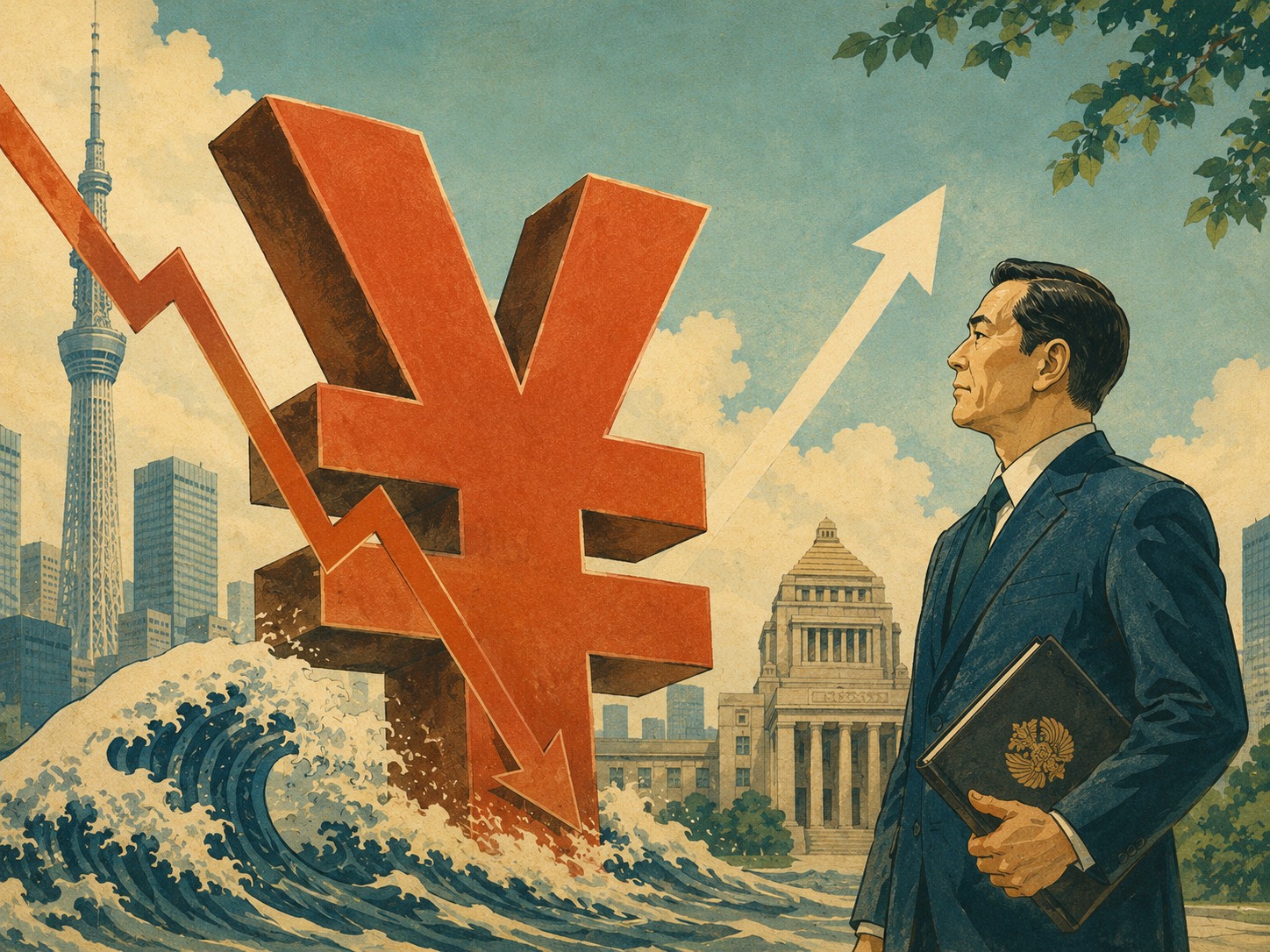
The yen is back at the center of Japan’s economic story. Dollar-yen has moved into the 162 area, pushing the currency into its weakest zone in roughly four decades and reviving the question Tokyo never wants to answer directly: where is the line that would trigger another round of intervention?
Reuters reported on June 30 that Japanese authorities kept their intervention rhetoric largely unchanged even as the yen pushed through a level long watched by traders. Officials repeated familiar language about responding to excessive moves, while also saying Japan must build an economy more resilient to exchange-rate swings. Markets heard the restraint as much as the warning. If 160 was the old alarm bell, and 162 did not force a dramatic escalation, is 165 now the next line in the sand?
Exchange rates look like numbers, but they do not stay on screens. A weak yen moves through gasoline prices, electricity bills, food imports, travel costs, corporate earnings, government-bond markets, tourism receipts and Japan’s growth strategy. It helps exporters and inbound tourism, but it hurts households, smaller businesses and anyone who buys dollar-priced energy or food. The yen is not just a currency. It is a machine that quietly redistributes pain and profit through the Japanese economy.
The psychology of 162
The 162 level matters because it is not just another tick on a chart. It sits close to memories of earlier intervention zones: the 2024 yen-buying operations, the spring 2026 intervention, and the repeated market tests of 160. Traders remember where the Ministry of Finance acted before. They also know that if Tokyo defends the same level too predictably, the market will test it.
That is why Japanese officials rarely name a line. They say they are watching speed, disorderly moves and excessive volatility rather than any specific number. But markets still try to decode the official script: the strength of the wording, the number of press briefings, whether the Ministry of Finance, Financial Services Agency and Bank of Japan meet together, whether U.S. holidays create thin liquidity, and whether dollar-yen suddenly lurches in a way that looks official.
Why the yen is weak
The main reason remains the U.S.-Japan interest-rate gap. The Bank of Japan raised its policy rate to 1% in June, a level unseen since the mid-1990s. But if U.S. interest rates stay high and the American economy remains resilient, investors still have an incentive to borrow cheaply in yen and buy higher-yielding dollar assets. That is the carry trade, and it has been one of the most powerful forces in global finance for years.
This is why the yen is more than a national currency. It is a global funding currency. Japan’s long era of ultra-low interest rates made the yen useful as borrowed money. When the yen weakens, those trades can become even more attractive. Yen weakness feeds yen selling. The BOJ’s normalization helps, but unless the rate gap narrows enough, the gravitational pull remains.
Energy and geopolitics add pressure. Japan imports much of its fuel, food and raw materials. When oil or LNG prices rise and the yen is weak, import bills become more painful. A distant war, an oil-market shock or a shipping disruption can show up in a Japanese household’s electricity bill and a factory’s monthly input costs.
Who actually decides intervention?
Many people associate intervention with the Bank of Japan, but in Japan the decision belongs to the Ministry of Finance. The BOJ acts as the ministry’s agent in the market. The BOJ’s own public explanation notes that intervention uses funds such as yen or U.S. dollars and that Japan’s Foreign Exchange Fund Special Account, controlled by the MOF, is the funding mechanism.
That distinction matters. BOJ rate hikes are monetary policy. MOF intervention is international financial policy. A rate hike changes the economic price of money. An intervention sells dollars and buys yen in the market. The two can reinforce each other, but they are not the same tool.
Rate hikes can reduce the underlying rate gap, but they also affect mortgages, corporate borrowing, the government’s debt-service burden and stocks. Intervention can jolt the market quickly, but if the underlying rate differential and macro story do not change, traders may eventually sell yen again.
History is a strict teacher
Japan’s currency history has several turning points. The 1985 Plaza Accord changed the yen’s path. Major economies coordinated to push down an overvalued dollar, and the yen surged. Japan then faced yen-strength recession, aggressive easing and the asset bubble that defined the late 1980s.
The 1990s brought the bubble collapse, banking stress, deflation and major currency swings. In 1998, amid the Asian financial crisis and yen weakness, Japan bought yen. Later, the more familiar Japanese intervention story became the opposite: selling yen to restrain excessive strength and protect exporters.
That world has flipped. In 2022, widening U.S.-Japan rate differentials forced Japan back into yen-buying intervention for the first time in 24 years. In 2024, the yen tested 160 and Tokyo intervened again. In spring 2026, Japan reportedly spent a record amount buying yen. The country once known for battling excessive yen strength now struggles with the political and economic consequences of a weak yen.
Is yen weakness bad for Japan?
The answer is not simple. A weak yen raises the yen value of overseas profits for exporters. Automakers, machinery makers, electronics companies, game firms and tourism operators can benefit. For foreign tourists, Japan becomes cheaper. Hotels, railways, department stores and restaurants feel the lift. In equity markets, yen weakness can support large exporters.
But Japan is not only an exporter. Households buy imported food and fuel. Logistics companies pay for diesel. Smaller manufacturers import materials. Students and families pay more to travel abroad. A weak yen can become a tax on ordinary life if wages do not rise fast enough. That makes the exchange rate not only a market issue but a political issue.
Currency weakness also raises questions of national credibility. A weak currency is not automatically bad. But prolonged weakness, fiscal expansion, energy dependence and doubts about policy coordination can cause investors to question the long-term policy mix. The foreign-exchange market is one place where a country’s economic credibility is constantly repriced.
The ammunition question
When Japan buys yen, it generally sells dollar assets. Japan’s foreign reserves include U.S. Treasuries and other dollar instruments, so large-scale intervention can matter beyond the currency market. Some analysts have warned that if Japan has to sell significant reserves, the U.S. bond market could feel it too.
But intervention is not a simple fire sale. The Ministry of Finance considers liquidity, asset mix, timing, diplomatic coordination and market conditions. Reuters reported in June that Japan was looking at better ways to manage its intervention war chest, a sign that officials view the yen problem as a continuing campaign rather than a one-day event.
How much can the BOJ help?
The BOJ’s June rate increase to 1% strengthened the case that Japan is finally normalizing monetary policy. The latest Tankan survey showed business sentiment improving, giving policymakers more room to argue that the economy can handle higher rates.
Still, the BOJ cannot move for the yen alone. Higher rates affect government debt costs, corporate credit, housing, small businesses and the stock market. The central bank must weigh inflation, wages, growth and financial stability. That makes the yen a pressure point, not a single-command policy target.
The contradiction: strong Japan, weak yen
The current moment contains a strange contradiction. Japan’s stock market is strong. Corporate sentiment is resilient. The government is promoting long-term investment in AI, semiconductors, space, defense and startups. Kyoto’s IVS conference is telling the world that “Japan is Back.” Yet the currency is at a 40-year low zone.
That does not mean Japan is simply collapsing. It means the Japanese story has split. Investors may like Japanese equities while hedging the currency. Exporters may celebrate profits while households face higher import prices. The same yen that supports tourism can make Japanese residents feel poorer abroad. A country can look strong in stocks and weak in currency at the same time.
What to watch next
Markets will watch U.S. payrolls, Treasury yields, Fed expectations, BOJ guidance, Ministry of Finance language and sudden moves during thin-liquidity windows. Intervention often comes when one-way trading becomes too easy. The memories of 2024 and spring 2026 are still fresh.
But the bigger question is not only whether Tokyo intervenes. It is whether Japan can build an economy that is less vulnerable to yen weakness: more energy resilience, stronger wage growth, deeper startup and technology productivity, credible fiscal policy and a more normal monetary framework. The currency problem is ultimately a national-design problem.
Japan.co.jp view
The yen at 162 is both a crisis signal and a warning. Japan can use yen weakness as an export advantage, but an economy that depends on a cheap currency risks weakening household purchasing power and making “cheap Japan” a permanent brand. That may help tourism, but it is not the same as national prosperity.
Intervention is a necessary tool when markets become disorderly. But intervention alone cannot restore confidence in a currency. A stronger yen requires credible growth, fiscal discipline, rate normalization, energy strategy and sustainable wages. The yen is a question the market is asking the Japanese state.
On July 3, Kyoto startups are saying “Japan is Back” while Tokyo markets watch the yen slide through the 162 area. Those two stories are not separate. They are the two sides of the same national test. Japan is talking about growth again. The market is asking whether that growth is strong enough to support the currency.
Reader guide
| Question | Answer |
|---|---|
| What happened? | Dollar-yen moved into the 162 area, reviving expectations that Japan could intervene again. |
| Why does it matter? | Yen weakness helps exporters and tourism but raises import costs for households and smaller firms. |
| Who decides intervention? | The Ministry of Finance decides; the Bank of Japan executes as agent. |
| What is the history? | The Plaza Accord, the 1998 yen-buying episode, and Japan’s return to yen-buying intervention in 2022 all shape today’s debate. |
| Japan.co.jp view | The deeper issue is not one intervention. It is whether Japan can build an economy strong enough to support its currency. |
Sources and references
This article draws on Reuters, the Bank of Japan, Japan’s Ministry of Finance, the Associated Press and market reporting. Exchange-rate levels, intervention totals and official signals can change quickly.
- Reuters: Japan keeps intervention rhetoric unchanged despite yen slide
- Reuters: Tokyo keeps powder dry as line in the sand on yen shifts
- Reuters: Japan business mood hits 8-year high
- Reuters: BOJ raises rates to 31-year high
- Reuters: Japan plans to better manage war chest for yen intervention
- Reuters: Japan spent $73 billion in yen-buying intervention
- Reuters: History of Japan intervention in currency markets
- Bank of Japan: What is foreign exchange intervention?
- Ministry of Finance Japan: Foreign Exchange Intervention Operations
- AP: Japan business sentiment improves for fifth straight quarter