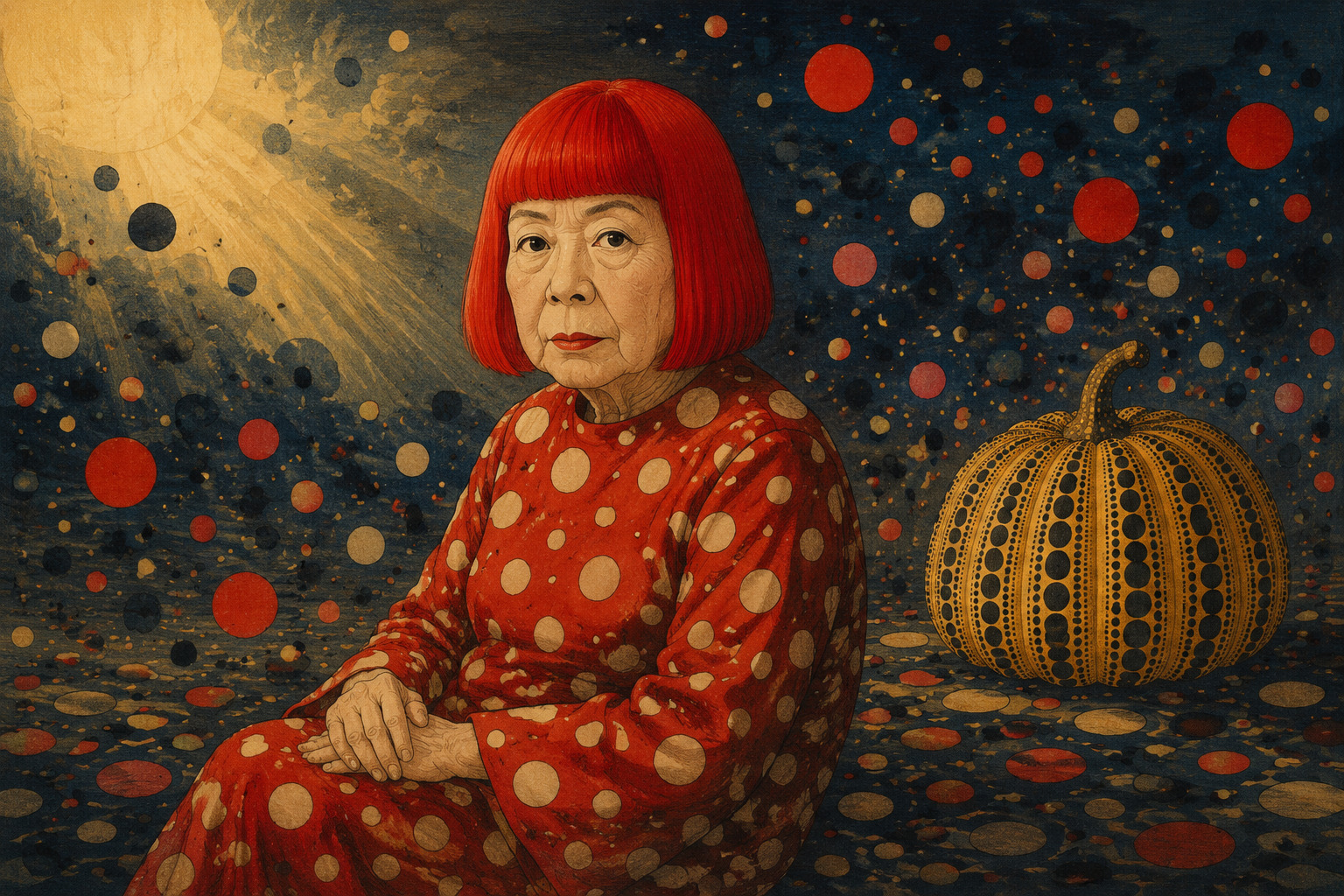
Two museums remained open around an absence. In Tokyo, the Yayoi Kusama Museum said its exhibition Kusama’s Pop would continue through August 30. In Matsumoto, the city museum placed a flower stand beside Kusama’s outdoor sculpture 《幻の華》 (The Visionary Flowers) and temporarily opened its permanent Kusama presentation free to local residents. The institutions did not suspend the work to mark the artist’s death. They let people enter it.
The Tokyo museum and the Yayoi Kusama Foundation announced on August 27 that their founder had died in a Tokyo hospital on August 14. She was 97. Their notice said she had devoted her life to an international avant-garde practice extending through visual art, performance, novels and poetry, and that she continued holding a paintbrush until shortly before death. It described love as the belief through which she sought the world’s salvation.
The announcement disclosed no cause of death. It gave no funeral or family information and did not name the last work on her easel. No independent studio record accompanied the statement about her final days. Those limits matter in an obituary of an artist whose public image was exceptionally controlled and whose working life has often been turned into legend.
Before the icon, a young artist in Shinshū
Kusama was born in Matsumoto, Nagano Prefecture, in 1929. Her official biography says that visions and hallucinations experienced from childhood generated early drawings of dots and nets. That is an autobiographical and institutional account of the origins of her art, not an invitation for posthumous diagnosis. The consequential fact is what she did with the experience: she translated it into a disciplined vocabulary using watercolor, pastel and oil.
The exhibition record begins earlier than the familiar leap to New York. Kusama’s official archive lists her in the 1945 All-Shinshū Art Exhibition, when she was still a teenager, and again in 1946. A 1949 exhibition traveled from Tokyo to Nagoya, Osaka and Kyoto. In 1952 she held two solo shows in Matsumoto. Her radius widened through regional institutions and Tokyo galleries before it crossed the Pacific.
Matsumoto later made her an honorary citizen in 2008. The city museum’s continuing display, 「草間彌生 魂のおきどころ」—literally, a place to put the soul—does not freeze her at the point of departure. Its summer 2026 checklist moved from Mirrored Corridor of 1996 and the repetitive vision of The Galaxy in 2002 to works dated 2011, 2014 and 2023. The hometown gallery held a lifetime in the present tense.
The net arrives in New York
Kusama participated in the Brooklyn Museum’s international watercolor biennial in 1955. She moved to the United States in 1957 and held a Seattle solo exhibition that December. By the following year she was based in New York; in October 1959, a solo show at Brata Gallery presented work that made repetition physically difficult to ignore.
Her net paintings accumulate minute arcs until figure and ground begin to fail. One mark is modest. Thousands become a surface without a natural center, larger than the action that produced any single part. The repetition is not mechanical: every arc contains the tiny difference of a moving hand. Time is visible because sameness never quite succeeds.
Kusama pushed that logic off the canvas. Sewn protrusions multiplied over chairs, shoes and other objects in her soft sculptures. Mirrors and electric lights replicated forms into apparent distance. Dots traveled across bodies, clothing and rooms. She organized fashion shows and anti-war happenings, made films and issued publications. Her official biography treats these activities as one expanding field. The medium changed; proliferation remained.
What “self-obliteration” actually means
The Yayoi Kusama Museum defines self-obliteration as the sensation that the boundary between self and other disappears through the obsessive repetition and proliferation of a single motif. This is the hinge of her art. A field of dots makes the author instantly identifiable to the public; within the work, the same field threatens the distinctness of author, object and viewer.
In 1965, Infinity Mirror Room—Phalli’s Field transformed the repeated image into an environment. The Hirshhorn Museum describes it as Kusama’s breakthrough: mirrors carried the intensity of her paintings and works on paper into perceptual space. Objects return as reflections, then reflections of reflections. The visitor enters not as a sovereign observer but as another element to be multiplied.
That condition became uncannily suited to the smartphone era. Mirror rooms produce images people want to keep and share. Yet treating them as premium selfie chambers reverses part of their force. A camera secures a personal image. Kusama’s mirrors generate so many versions that the privilege of the original begins to erode. Seduction and unease are simultaneous.
| Repeated form | Medium | What it does | What the icon can conceal |
|---|---|---|---|
| Net or arc | Net paintings | Builds a centerless field from accumulated hand movements | Labor and duration beneath “pattern” |
| Sewn protrusion | Soft sculpture | Overtakes the outline and function of ordinary objects | Fear, embodiment and compulsion beneath novelty |
| Reflected image and light | Infinity Mirror Rooms | Makes the visitor one unit in an apparently endless space | Destabilization of the self beneath spectacle |
| Dot | Painting, bodies, clothes, rooms | Crosses the boundary between object and background | Self-obliteration beneath a visual logo |
| Pumpkin | Painting, print, sculpture, mirrors | Joins a familiar mass to an unbounded surface | A long formal inquiry beneath merchandising |
Venice: outside the gate, then inside the pavilion
Kusama’s two crucial appearances in Venice tell a story about institutions catching up with practice. The Japan Foundation’s official history of the Japanese Pavilion records that in 1966 she staged an unauthorized action at the Biennale, laying approximately 1,500 mirrored balls on the ground. Narcissus Garden turned the surrounding world and each onlooker into a saleable reflection. She entered the event from its margins.
Twenty-seven years later, Kusama returned as Japan’s representative for the 45th Venice Biennale. Commissioner Akira Tatehata assembled work from the early net paintings and soft sculptures through recent pieces. At the center was Mirror Room (Pumpkin), a yellow, black-dotted space containing a mirrored cube in which pumpkins appeared to proliferate without end.
The official pavilion history says the 1993 presentation helped propel an international reassessment. “Rediscovery,” however, is an imprecise word. Kusama had not ceased working, and she had already occupied the New York avant-garde decades earlier. What returned was sustained institutional attention. The 1998 survey Love Forever: Yayoi Kusama 1958–1968, organized at the Los Angeles County Museum of Art and shown at the Museum of Modern Art, made the radical first American decade visible to another generation.
Return did not mean retreat
Kusama went back to Japan in 1973. Her official biography places new emphasis after the return on poetry and fiction, alongside outdoor sculpture, large installations and further mirror rooms. In 1983 her novel 『クリストファー男娼窟』, officially translated as Hustlers Grotto of Christopher Street, received the tenth Yasei Jidai New Writers’ Prize.
Calling Kusama “the polka-dot artist” omits a novelist, poet, filmmaker, publisher, organizer and fashion producer. It also obscures how language shares a structure with the images. Where marks occupy pictorial space through recurrence, sentences give memory, desire, loneliness and death duration. Literature was not a hobby beside the art; it was another surface on which experience could repeat and change.
The pumpkin became especially public in later decades. Its stable, familiar volume gave her dots a body. Enlarged outdoors or multiplied inside mirrors, it quietly defeats ordinary scale. Kusama could place infinity inside a form associated with touch, cultivation and domestic life. Accessibility was not the opposite of seriousness; it was the lure through which a stranger spatial problem became approachable.
When radical language becomes popular language
Japan named Kusama a Person of Cultural Merit in 2009 and awarded her the Order of Culture in 2016. She had already received the Order of the Rising Sun, Gold Rays with Rosette, and the Praemium Imperiale for painting in 2006. In 2017, the museum she founded opened in Tokyo’s Shinjuku Ward. That same year the Hirshhorn launched Yayoi Kusama: Infinity Mirrors, gathering six mirror rooms in an exhibition that later traveled across North America.
Her ascent is sometimes described as a collision between difficult art and commercial branding. The division is too neat. In the 1960s Kusama had already moved between painting, events, fashion and her own publications, and she made her public persona part of the work’s distribution. Crossing the border between museum, street, body and printed page was not a corporate afterthought.
Popularity nevertheless compresses. A red wig, yellow pumpkin and dotted surface can summon Kusama’s name before the viewer has encountered a painting. The speed of recognition may hide the minute labor of white nets, the politics of her anti-war actions, the sexuality and anxiety of soft sculpture, the decades of literary work, or the late paintings crowded with eyes, cells, faces and organisms.
The contradiction cannot be solved by dismissing the crowds. Mass recognition was a historic achievement for a Japanese woman who entered a male-dominated New York art world in the 1950s. The better response is to use the icons as doors rather than conclusions.
- Nets and the accumulated motion of the hand are as foundational as dots.
- Soft sculptures made repetition bodily, tactile and unsettling.
- Mirror rooms dissolve the privileged viewer as much as they entertain one.
- Performance, anti-war happenings, film, fashion and publishing widened the work’s politics.
- Fiction and poetry became major practices after her return to Japan.
After 900 paintings, another beginning
Kusama began My Eternal Soul in 2009. By the time she concluded it in 2021, the official count was approximately 900 paintings. The square canvases swarm with faces, eyes, profiles, cells, plants, vessels and signs that feel both invented and remembered. A limited vocabulary keeps producing new social arrangements. Repetition here is not a copy of an original; it is the engine of difference.
In the same year that she ended the series, she began Every Day I Pray for Love. The title changes the relation between repetition and time. “Every day” is neither an anniversary nor a final masterpiece. It is a practice renewed after sleep. Ending a 12-year sequence did not become retirement; it created the edge from which another sequence could start.
Her exhibition calendar remained active in 2026. Kusama’s Pop opened at her Tokyo museum in April. Yayoi Kusama: Every Day I Pray for Love opened in Singapore in March. Her official listings also included the September continuation of a European retrospective at Amsterdam’s Stedelijk Museum. The shows will now outlive their maker, but they were planned while her practice was still current.
The claim that she painted until shortly before death should not become a demand placed on every elderly artist. Work is not proof of moral worth, and relentless production can be romanticized at the cost of care. In Kusama’s case, however, the statement belongs to the museum and foundation she created, and it aligns with a lifelong structure. Repetition was not a race for output. It was a way to make one day call the next.
1929 — Born in Matsumoto, Nagano Prefecture.
1945 — Participates in the All-Shinshū Art Exhibition.
1952 — Holds two solo exhibitions in Matsumoto.
1957 — Relocates to the United States; shows in Seattle.
1959 — Holds a solo exhibition at Brata Gallery in New York.
1965 — Makes her first Infinity Mirror Room.
1966 — Stages Narcissus Garden unofficially in Venice.
1973 — Returns to Japan and expands her literary work.
1983 — Wins the Yasei Jidai New Writers’ Prize.
1993 — Represents Japan at the Venice Biennale.
2009 — Begins My Eternal Soul; named a Person of Cultural Merit.
2016 — Receives the Order of Culture.
2017 — The Yayoi Kusama Museum opens in Tokyo.
2021 — Begins Every Day I Pray for Love.
August 14, 2026 — Dies at a Tokyo hospital, aged 97.
A flower stand in Matsumoto
From August 28 to 30, Matsumoto City Museum of Art placed a memorial flower stand near The Visionary Flowers. During the same period, it offered Matsumoto residents free entry to Yayoi Kusama: The Place for My Soul. Tokyo’s museum continued Kusama’s Pop. Mourning took the form of proximity: stand beside a flower grown beyond human scale; pass through rooms containing several decades; look again.
The last painting remains unidentified. The absence of a final title may be appropriate. Kusama’s nets stop at the edge of the canvas but imply continuation. A mirrored light vanishes when the visitor leaves the room but survives as an afterimage. Her achievement was not to picture infinity as a distant cosmic fact. She showed how a finite body approaches it: place one mark, then another, then refuse to treat the next as redundant.
The hand has stopped. The sequence has not.
- Yayoi Kusama Museum and Yayoi Kusama Foundation — death announcement, date, place, age, final-period painting and exhibition continuation
- Yayoi Kusama official site — official biography, self-obliteration, media, return to Japan, painting series and honors
- Yayoi Kusama official site — selected exhibition history from 1945 through 2026
- Yayoi Kusama Museum — institutional definition of self-obliteration and its development across media
- Yayoi Kusama Museum — official title and date for Narcissus Garden
- Yayoi Kusama Museum — dates for Kusama’s Pop
- Japan Foundation, official Japanese Pavilion history — 1966 action, 1993 pavilion, Mirror Room (Pumpkin) and reassessment
- Hirshhorn Museum — the first Infinity Mirror Room in 1965 and the series’ development
- Hirshhorn Museum — 2017 Infinity Mirrors exhibition
- Museum of Modern Art — records for the 1998 Love Forever: Yayoi Kusama 1958–1968 exhibition
- Matsumoto City Museum of Art — death notice
- Matsumoto City Museum of Art — memorial flower stand beside The Visionary Flowers
- Matsumoto City Museum of Art — temporary free admission for Matsumoto residents
- Matsumoto City Museum of Art — continuing Kusama collection display
- Matsumoto City — Kusama’s 2008 honorary citizenship