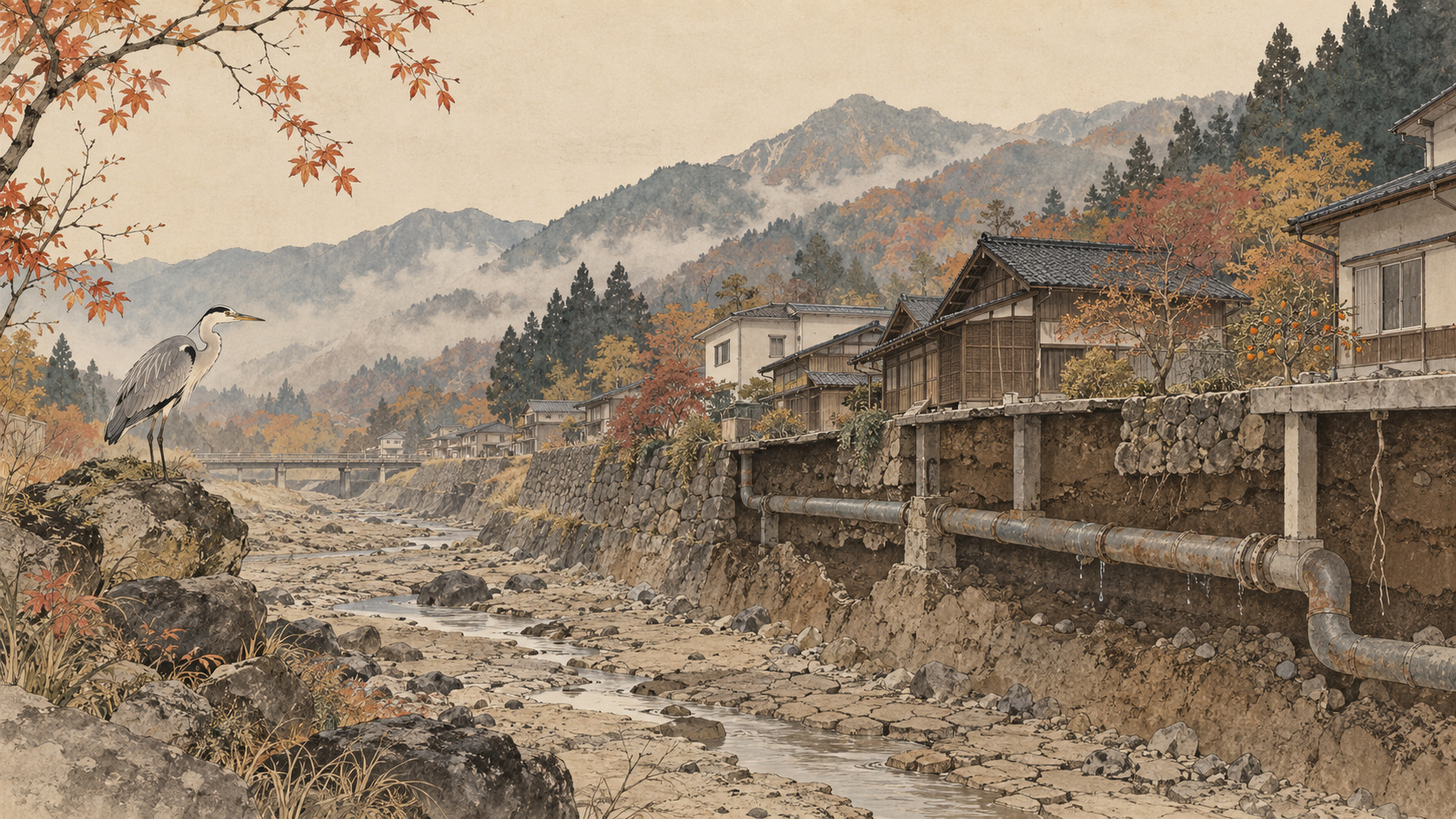
A town surrounded by water loses its tap supply
Oguni sits between the Iide and Asahi mountain ranges in Yamagata Prefecture, where snowpack and beech forests shape the landscape. On October 9, water stopped reaching thousands of taps. This was not a drought. A failure in the infrastructure connecting a water-rich landscape to homes had depleted a distribution reservoir. The distinction matters: abundant natural water does not guarantee reliable drinking-water service.
First, the essential update: the water is back
Oguni was not still without water when this report was prepared for October 16. Local broadcaster YBC reported that the town announced full restoration at 6 p.m. on October 11, after repairs and checks of water safety. Describing a current emergency would be misleading. The more consequential story is what a short but disruptive outage reveals about the ageing distribution networks that many Japanese communities must maintain with shrinking populations and constrained budgets.
How the failure unfolded
The town’s October 9 notice traced the emergency to leaks identified on October 8. Escaping water reduced the level in the distribution reservoir and cut supply. A Sakuranbo TV report put the number of affected households at 1,816 in the central area at 5 p.m. on October 9; other reports used the rounded figure of about 1,800. Officials established temporary distribution points at the town office parking lot, municipal hospital and Asmo shopping center. Those are time-specific figures, not the number of customers still without service today.
Repairing a pipe is not the same as restoring drinking water
Reports identified at least two leaks. Work progressed on separate sections before trial water service resumed on the morning of October 11. Residents were initially warned that the water might appear cloudy and to limit its use, including to toilets, pending safety checks. By 6 p.m., the town had announced full service restoration. The sequence captures an often overlooked feature of water emergencies: pressure can return before operators are ready to certify the water as safe for normal use.
The significance of a 51-year-old pipe
According to YBC, municipal officials attributed the leak to corrosion that had perforated a pipe installed 51 years earlier. A half-century is a striking number, but age alone cannot establish the failure risk of an entire network. Pipe material, surrounding soil, joints, water chemistry and maintenance history also influence performance. There is no basis for saying every pipe in Oguni is in equivalent condition. What the failed section does illustrate is the long financial afterlife of postwar public works: infrastructure built for an earlier generation eventually demands a new investment decision.
Emergency water, bathing and mutual aid
The emergency response reached well beyond bottled water. Oguni provided temporary water points and free access to baths at Iide Onsen Baikaso and Shiroi Mori Exchange Center Rifre. Residents could also use Yu-mu, a bathing facility across the prefectural border in Sekikawa, Niigata. That cross-border arrangement is a practical expression of rural mutual assistance. But outages place disproportionate burdens on people without transport, residents receiving care at home and businesses requiring sanitary water. Specific impacts on those groups in this incident remain to be documented through direct interviews.
The history behind the “White Forest”
Oguni describes itself as Shiroi Mori—the White Forest—after its beech woods and snowy winters. The town covers 737.56 square kilometers, around 90% of it forested, according to municipal information. Water helped power industrial development, including hydroelectric generation and the location of manufacturers in the early twentieth century. Residents have also endured major natural hazards, notably the severe snow of 1963 and the Uetsu floods of 1967. A modern water system was a means of converting a powerful natural resource into a dependable public service.
Fewer people do not mean shorter pipes
Oguni listed 6,104 people and 2,805 households as of September 30, 2026. While usage and revenue can decline, a municipality may still need to maintain long lengths of pipe, pumping facilities, reservoirs and treatment works. The engineering challenge is fixed geography paired with changing demographics. The result can be higher costs per customer, although specific cost increases, tariff consequences and the financial impact of this outage cannot be quantified from the materials reviewed for this report.
Oguni was planning before the emergency
In April 2026, Oguni published revised ten-year management strategies for its municipal water, simplified water, industrial water and wastewater businesses, covering fiscal 2025 through fiscal 2034. The plans establish that officials had already been considering long-term service sustainability. The unanswered question is how investment priorities, asset-condition monitoring and financing align with the sections posing the greatest consequences if they fail. The existence of a plan, important as it is, should not be mistaken for proof that renewal work has been completed.
Beyond replacing the oldest pipe first
There is no simple rule that makes the oldest segment necessarily the most urgent. Engineering priorities can also consider past leak frequency, pipe material, exposure to corrosive conditions, supply to hospitals and shelters, availability of bypass routes and the number of customers whose water could be lost in one failure. Network isolation valves, emergency storage, inspection and public communications can mitigate consequences even where replacement must proceed over many years. These are policy and engineering considerations, not claims that Oguni has already adopted each intervention.
The importance of telling residents what is known
In its original emergency notice, the town cautioned that its website might not always display the latest status and directed residents to its official LINE account. A modern utility must not only produce safe water but communicate clearly when something goes wrong: where it can be collected, when restored flow can be used for drinking, and which neighborhoods remain affected. The distinction between repairs, trial service and safe full restoration deserves precise public reporting.
An outage ends; an infrastructure question remains
The October outage is over. Its lesson is not that Oguni lacks water, or that the town has failed to act. Rather, a corroded pipe demonstrated how easily an essential network can turn a local fault into a community-wide disruption. Japan’s mountain towns will need credible inspection, renewal priorities, stable financing and mutual assistance as they navigate the next generation of infrastructure maintenance. The water may be flowing again, but the question of what to replace next will remain.
Sources and reporting notes
- 町上水道の断水状態における対応について — www.town.oguni.yamagata.jp
- 10月11日午後6時の全面復旧、水質確認、51年前の配水管 — news.livedoor.com
- 10月9日現在1816世帯の断水 — www.sakuranbo.co.jp
- 水道・簡易水道・下水道事業経営戦略(2026年改定) — www.town.oguni.yamagata.jp
- 白い森とは — www.town.oguni.yamagata.jp
- 位置と気候と特色 — www.town.oguni.yamagata.jp
- 人口・世帯数と町の概要 — www.town.oguni.yamagata.jp
- 錆びた51年前の配水管(10月14日放送) — tver.jp
- 近代のあゆみ(豪雪・羽越水害) — www.town.oguni.yamagata.jp
Based on materials available through October 15, 2026. Reports confirm full restoration October 11; snapshot household counts are dated and not current outage figures.