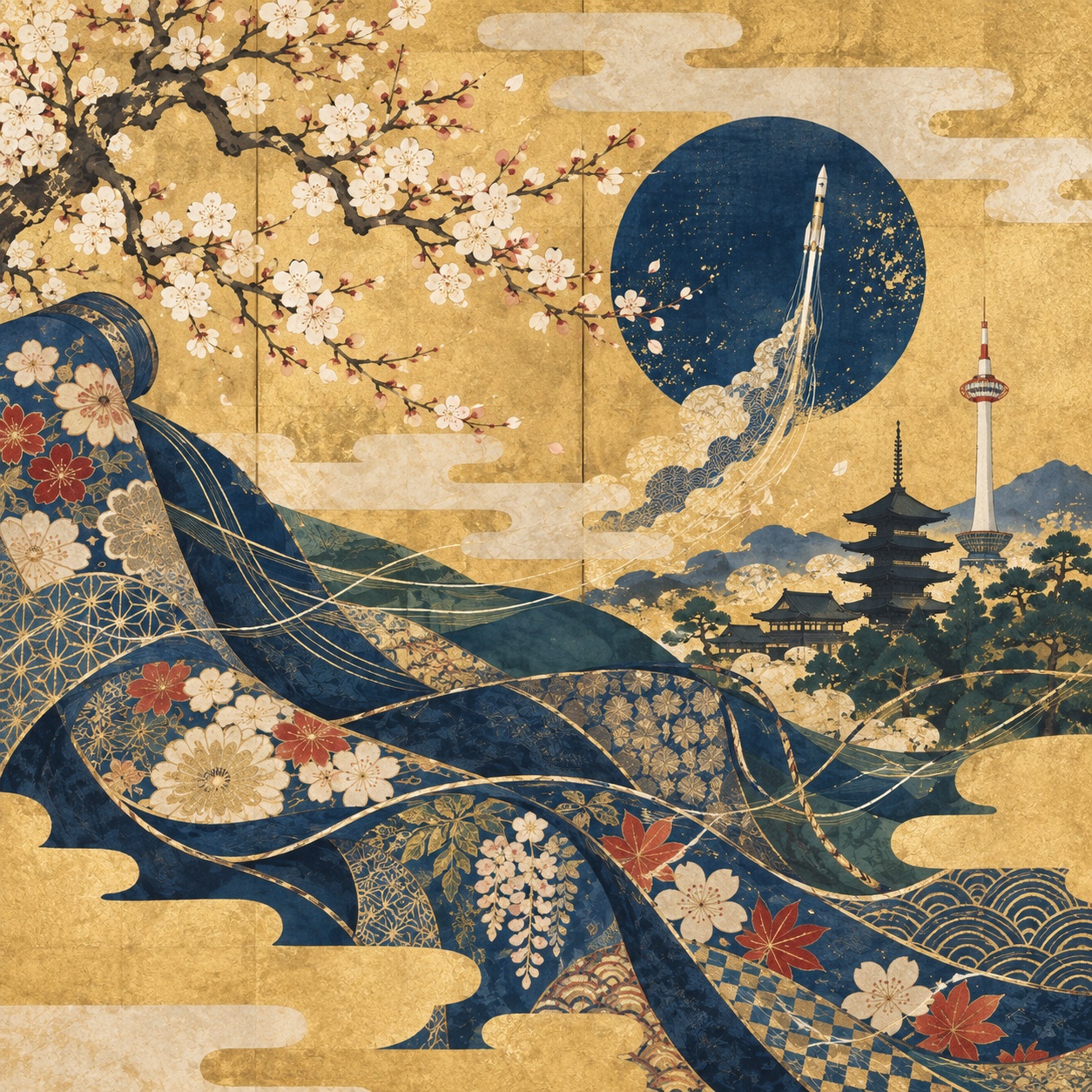
Locomotives. Rockets. Tokyo Tower. These are not subjects one normally associates with traditional Kyoto textiles. Yet Yamaga Seika (1885–1981) wove them into handwoven brocade. The Kyoto City KYOCERA Museum of Art has now opened Yamaga Seika: Boundless Imagination in Textile Art, the first major retrospective of his work in 40 years. The exhibition runs from September 19 through December 20, 2026.[1]
At the center is Yamaga’s self-defined practice of teori-nishiki, or handwoven brocade. Rather than separating design, yarn selection and weaving among specialist craftsmen, Yamaga personally controlled the entire process. He came out of Kyoto’s highly sophisticated textile culture, yet reassembled that culture around the authorship of a single artist. The museum identifies this integration of conception and execution as one reason he became a pioneer of modern textile art.[1]
From a Kyoto printing family into Nishijin design
Yamaga was born in Kyoto in 1885 as the seventh child of a family that operated what the museum describes as the city’s oldest letterpress-printing business. At 15, in 1900, he began studying under a Nishijin textile designer and also trained in Japanese painting.[1]
In 1910 he became a student of Kamisaka Sekka, the designer and painter often associated with the modernization of Rinpa aesthetics. Yamaga joined Sekka’s Katsumikai and showed designs, paintings and textiles there. The relationship matters because Sekka treated decorative composition not as a relic of the past but as a language that could move through publishing, craft and design. Yamaga would later make a similarly expansive move with textiles.[1]
The National Diet Library authority file confirms his official name reading as Yamaga Seika and dates his life to 1885–1981.[2]
Teori-nishiki was as much a declaration of authorship as a technique
The museum stresses that teori-nishiki was Yamaga’s own term. It did not simply designate one pre-existing weaving method. It described a production system in which the artist conceived the design, prepared drawings, chose the yarns and wove the work himself.
That was a significant departure from the highly specialized division of labor associated with Nishijin production. Yamaga retained sophisticated tapestry-weaving knowledge but concentrated creative control in one person. The result could behave more like painting: color, volume and surface were adjusted directly during weaving rather than predetermined only through a design handed to others.[1]
He also experimented with materials. The museum notes his use of cellophane and metallic gold and silver threads. Traditional textile knowledge, in his hands, became a platform for material experimentation rather than a fixed rulebook.[1]
The 1927 Dutch Ship changed his career
A major turning point came in 1927. That year, the Imperial Art Exhibition, or Teiten, had newly established an Arts and Crafts category. Yamaga entered Handwoven Brocade: Dutch Ship and received a Special Prize. According to the Kyoto museum, the 42-year-old artist took the recognition as the moment to commit himself fully to textile art.[1]
The timing was significant beyond Yamaga’s biography. Modern Japan had spent decades redefining the status of craft through world fairs, export industries, design education and state exhibitions. The addition of a crafts division to Teiten gave textile and decorative artists a new institutional route into the category of “fine art.” Yamaga’s prize arrived at precisely that transition.
In 1958, he wove Tokyo Tower and a rocket
The postwar works are the ones most likely to stop a contemporary viewer. Kyoto City Museum of Art collection records include Yamaga’s 1958 Handwoven Brocade Wall Hanging: Tokyo Tower and Handwoven Brocade Wall Hanging: Constellation, Moon, Rocket. The latter rises more than three meters high and serves as a key image for the current retrospective.[3][1]
Tokyo Tower itself was completed in 1958. Japan was moving from postwar reconstruction toward high growth, and technology, communications, urban verticality and space exploration were becoming visual symbols of the future. Yamaga translated that future into thread.
The museum emphasizes the contrast in his subjects. Festival hangings might carry celestial maidens or cloud dragons; official-exhibition wall hangings might show locomotives, rockets or Tokyo Tower. Modern machinery and inherited iconography coexist inside the same artist rather than occupying separate phases of his career.[1]
Why weave a rocket?
Textile is a slow medium. Each region of color is accumulated through interlaced threads. That makes a rocket—an icon of speed and ascent—an especially striking subject.
A painter can draw a hard line directly. A photographer can stop an instant. A weaver has to translate steel, light, motion and geometry into fiber. How does a soft material represent a tower’s rigid structure or a rocket climbing through space? Yamaga’s modern subjects therefore were more than curiosities. They were tests of what textile itself could represent.
His work still moves through Kyoto’s festivals
Yamaga did not abandon textiles designed for use. He produced decorative hangings for the Gion Festival in Kyoto and the Nagahama Hikiyama Festival in Shiga. The museum describes him as a central figure in modernizing festival textiles for the revived and renewed floats of the Showa era.[1]
Festival textiles live under very different conditions from museum objects. They move through streets, hang high on floats, face sunlight and weather, and carry stories associated with specific neighborhoods and religious traditions. Yamaga’s work in that context had to serve public ritual as well as visual invention.
That dual life is important. As Japanese craft was becoming more autonomous and exhibition-oriented in the twentieth century, Yamaga continued making works embedded in communal use. His career therefore crosses both the museumization of textiles and the persistence of living festival art.
From wall hanging to architecture
Yamaga pushed textiles into interior space as well. The museum highlights collaborations with architect Togo Murano, including work connected with the Miyako Hotel, as well as interior decoration for the large passenger ship Brasil Maru. Many of those spaces no longer survive, making photographs, drawings and surviving textile elements especially important to the retrospective.[1]
In contemporary language, this approaches spatial design. Textiles become part of an environment alongside architecture, furniture, lighting and circulation. Yamaga was no longer simply making something to hang on a wall; he was helping shape what a room felt like.
What Kamisaka Sekka gave him
Yamaga’s relationship with Kamisaka Sekka provides one of the exhibition’s strongest historical anchors. Sekka had already demonstrated that Rinpa composition could be translated into modern books, decorative arts and design. Yamaga studied with him from 1910 and presented works through Sekka’s circle.[1]
The retrospective places Yamaga’s early works beside those of his teachers in order to trace the foundations of his drawing and design practice. The museum emphasizes his formidable sketching ability. That is important because the rockets and towers can make him appear to be a novelty-driven modernist. In fact, the freedom of his subject matter rested on close observation and a disciplined ability to reduce objects into designs that could survive translation into thread.[1]
A wider world after his 1929 travels
The museum points to Yamaga’s sketches from a 1929 trip through Asia as one source for the expansion of his visual vocabulary. Travel was not merely a collection of exotic motifs; it enlarged the range of things he believed could become textile subjects.[1]
Ships, locomotives, towers and rockets recur in a career repeatedly drawn to movement, distance and modernity. Even the retrospective’s Japanese subtitle—roughly “Imagination Flying Through Space”—captures that outward momentum.
Expanding the category of textile art
For much of Yamaga’s lifetime, textiles remained strongly associated with clothing, obi, festival decoration and interiors. Yamaga worked within all of those functional traditions while also producing large wall hangings whose primary purpose was visual contemplation.
A related museum lecture describes his achievement as elevating textiles from the “beauty of utility” toward works viewed as art in their own right. That is the museum’s interpretation rather than a neutral fact of art history, and other scholars may frame the development differently. What is clear is that Yamaga crossed official exhibitions, festivals, hotels and passenger ships rather than remaining inside one definition of craft.[4]
- Design: His training began with Nishijin textile design and Japanese painting.
- Handwoven brocade: He controlled the entire process from conception to weaving.
- Official exhibitions: Works ranged from Dutch Ship to Tokyo Tower and Constellation, Moon, Rocket.
- Festivals: He created hangings for the Gion Festival and Nagahama Hikiyama Festival.
- Interior space: He extended textile into hotels, ships and architectural environments.
A Person of Cultural Merit in 1969
Yamaga also taught and contributed to the development of modern Japanese craft. The museum biography records that he was named a Person of Cultural Merit in 1969. He died in 1981.[1][2]
Yet major opportunities to see his work together have been rare. The Kyoto museum says the last comprehensive retrospective was the 1985 exhibition Founder of Modern Textile Art: Yamaga Seika. For many visitors today, the museum acknowledges, Yamaga may effectively be an unknown artist despite his stature during his lifetime.[1]
Why a 40-year retrospective matters now
The timing feels contemporary because many of the categories Yamaga crossed are again unstable: art versus craft, tradition versus contemporary design, handwork versus technology, regional identity versus global imagery.
Yamaga was already crossing those boundaries in the Showa era. He created festival textiles while weaving rockets, studied a modern Rinpa master while depicting Tokyo Tower, and built on Nishijin knowledge while designing for hotels and ocean liners.
That does not mean he should simply be recast as a twenty-first-century designer born too early. He worked inside the institutions, politics and social changes of Meiji, Taisho and Showa Japan. The value of the retrospective is that it shows how radical his choices were within those conditions, rather than merely making him look modern by today’s standards.
Was Constellation, Moon, Rocket a hymn to the future?
It would be tempting to read the 1958 Constellation, Moon, Rocket simply as a celebration of the space age. The museum says Yamaga’s works reflect both prewar social conditions and postwar peace movements, but it does not assign one fixed political meaning to each work.[1]
That ambiguity makes the object more interesting. Moon, constellation and rocket are rendered not in industrial materials but in woven fiber. Postwar technological ambition and Kyoto textile knowledge occupy the same surface.
Yamaga’s career resists an easy label. He was neither simply a conservator of tradition nor simply a rebel against it. He used traditional processes to depict what was new in his own time.
Seeing Showa through thread
The exhibition continues through December 20 in the museum’s Main Building South Wing and is scheduled to travel to Tokyo Station Gallery from February 20 to April 11, 2027.[1]
The retrospective’s larger achievement may be to make Yamaga’s range visible again: design training, textile authorship, official exhibitions, festival hangings, architectural collaboration and teaching.
Teori-nishiki was an extraordinarily slow way to work, one thread at a time. Yamaga’s subjects, however, kept chasing the speed of his era—locomotives, towers, rockets. That tension between slow handwork and fast modernity is what makes his work feel unexpectedly current four decades after Japan last had a major chance to see it together.
Sources
- Kyoto City KYOCERA Museum of Art: Yamaga Seika: Boundless Imagination in Textile Art
- National Diet Library authority file: Yamaga, Seika, 1885-1981
- Kyoto City Museum of Art collection list: Tokyo Tower and Constellation, Moon, Rocket
- Kyoto City KYOCERA Museum of Art lecture: Yamaga Seika—Creativity Reflecting His Era
- Kyoto City KYOCERA Museum of Art exhibition press release
