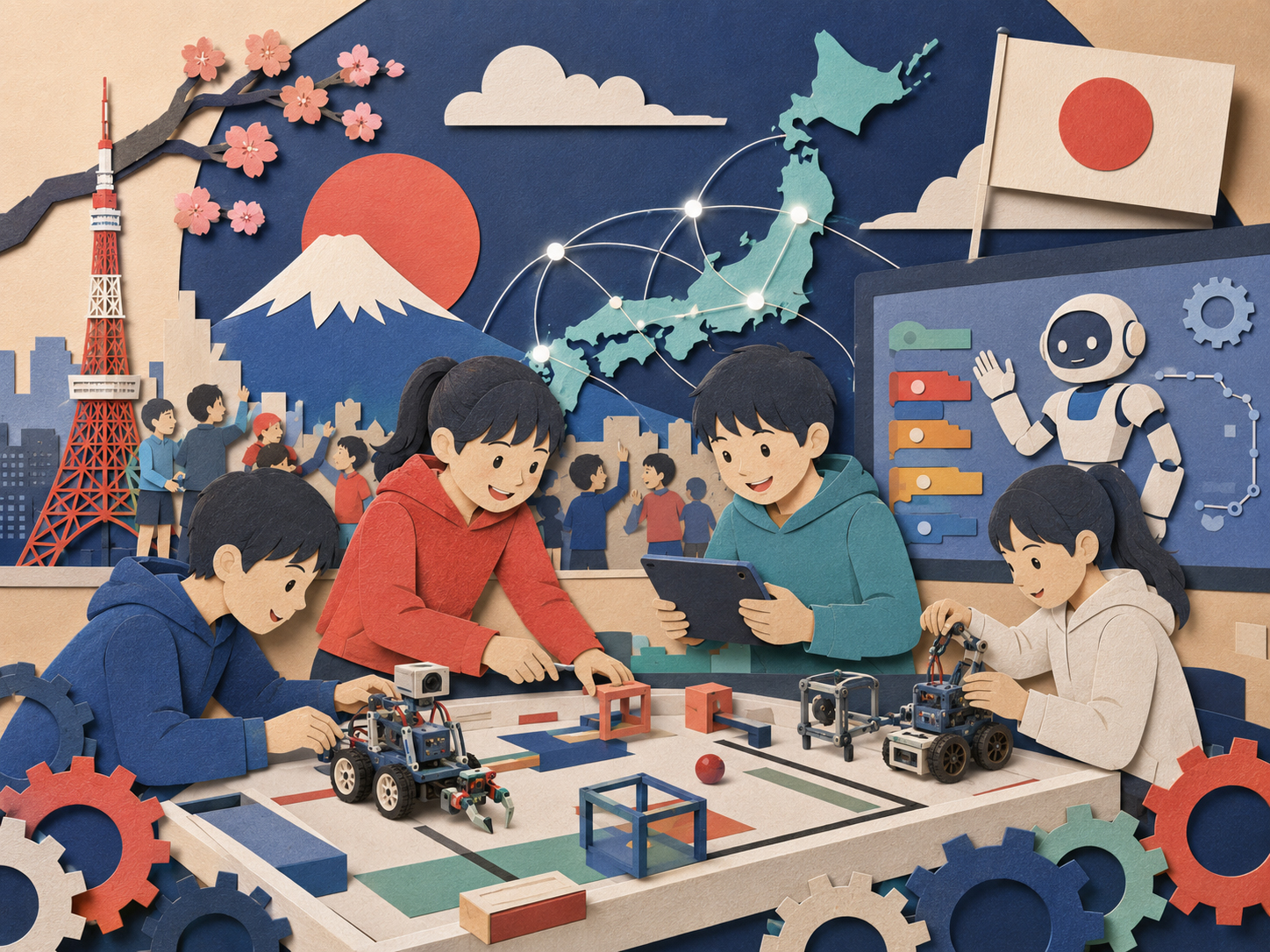
As summer approaches in Japan, small robots are beginning to move across gym floors, university rooms, technical high schools and regional halls. On July 8, WRO Japan announced that official qualifying tournaments for the WRO 2026 Japan Final will begin July 11 across 31 districts nationwide. The Robo Mission category, the competition with the largest number of participating teams, will hold regional qualifiers, and four districts will also stage qualifiers for Robo Sports, the more head-to-head competitive category. Teams selected through the regional events will advance to the Japan Final on August 22 and 23 at the Tokyo Metropolitan Industrial Trade Center Hamamatsucho-kan. The best teams will then aim for the WRO international competition in Puerto Rico in December.
This is not merely a children’s contest. It is a small national laboratory for the engineers, researchers, entrepreneurs, factory improvers, AI-literate citizens and regional problem-solvers Japan will need next. Children build autonomous robots, write programs, watch the machines fail, diagnose what happened, and try again under time pressure. That experience is different from science or mathematics on a blackboard. Sensors drift. Wheels slip. Code behaves differently from expectation. Team members disagree. Then the children put the robot back on the course and try again.
The 2026 WRO theme is “Robots Meet Culture.” It asks teams to explore how robots can shape, protect and grow art and culture. For Japan, that theme lands with unusual force. This is a country of industrial robots and anime robots, factory automation and regional festivals, manufacturing pride and pop culture imagination. If children learn to see robots not only as machines but as tools that connect engineering with society and culture, WRO becomes more than a STEM tournament. It becomes a preview of public education in the age of AI.
A summer of regional qualifiers
According to WRO Japan, the 2026 official qualifiers will be held in 31 districts across the country. Robo Mission is the core autonomous robotics challenge: participants design robots and program them to complete tasks on a defined field. The robots are not remote-controlled during the run. They must act according to the program prepared by the team. That means the contest rewards not only courage in the moment, but planning, testing, debugging, design discipline and teamwork.
Robo Sports adds a more competitive, match-style dimension. Autonomous robots must respond to the field, the rules and the presence of another side. It tests not only precision but strategic design and robustness. Four districts will hold Robo Sports qualifiers in 2026.
The Japan Final will take place on August 22 and 23 in Tokyo’s Hamamatsucho district. The path is simple to describe but difficult to travel: local qualifier, national final, then the international stage in Puerto Rico. For children, it is a tournament. For parents and coaches, it is a summer of late adjustments and long weekends. For Japan, it is a visible measure of whether the next generation is being invited into technology early enough.
What WRO is
World Robot Olympiad is an international educational robotics competition in which young people use robot building and programming to develop creativity and problem-solving skills. The WRO Association describes itself as an independent nonprofit organization dedicated to STEM education, running multiple competition categories for students, primarily ages 8 to 19. WRO Japan emphasizes that commercially available robot kits make participation accessible and give children a hands-on way to experience science and technology.
That accessibility matters. WRO is not a craft show where a robot is built once and displayed. The robot must act within constraints: sensors, motors, weight, battery life, field conditions, rules, time and scoring. Participants read the problem, create a strategy, build the robot, write the code, test the system and revise. It is a miniature development project.
In adult language, this is requirements definition, prototyping, debugging, quality improvement and team engineering. Children do not need those words to learn the habits. A robot that refuses to work is not simply a failure. It is a lesson in evidence. The educational value begins when the machine does something unexpected.
Why robotics education matters so much in Japan
Japan has long been described as a robot nation. Industrial robots in automobile plants, care-support robots, disaster-response machines, service robots, robot heroes in anime and manga — the country’s imagination includes machines not only as replacements for people but as helpers and companions. That cultural familiarity gives robotics education a strong base.
But being known for robots is not the same as ensuring that children understand robotics. Japan’s challenge is to move from consuming finished technologies to cultivating people who can design, operate, improve and deploy them. WRO gives children a practical doorway into that world.
The government has also recognized the long-term challenge. Japan’s 2015 New Robot Strategy framed robotics not only as a manufacturing technology but as a response to demographic pressure, care needs, infrastructure work, agriculture and service-sector labor shortages. Society 5.0 connected robotics, AI and data to national challenges such as aging, regional decline and energy constraints. AI Strategy 2019 made human-resource development and education central pillars. WRO’s regional qualifiers are where those large policy words meet a child’s small robot.
The foundation laid by programming education
Japan made programming education compulsory in elementary schools beginning in the 2020 academic year. The goal was not to turn every child into a professional programmer. It was to cultivate “programming thinking”: the ability to divide a problem into steps, understand conditions, test procedures and improve solutions through trial and error.
Yet schools cannot do everything alone. Teacher workload, uneven access to equipment, regional gaps, differences among households and limited practice time all matter. A curriculum can introduce programming, but deep experience often requires clubs, regional events, nonprofit support, corporate sponsorship, universities, technical colleges and local volunteers.
Competitions like WRO open the classroom to the outside world. Children work in teams, visit regional venues and see how other teams solved the same problem. They discover that their approach is not the only possible answer. A robot becomes a vehicle for learning from other people’s ingenuity.
“Robots Meet Culture”
The 2026 theme, “Robots Meet Culture,” makes the competition richer. What does it mean for robots to meet culture? It can mean preserving old art, helping museums present collections, making crafts easier to study, supporting traditional performance, connecting architecture, fashion, music, festivals and digital art. It is a meeting point of science and society, engineering and art, code and story.
Japanese teams have fertile material to draw from: Kyoto temples, Tohoku festivals, Okinawan music, Setouchi craft traditions, Tokyo digital culture, anime, games, local museums and regional performing arts. WRO 2026 is not only about making a robot move fast and accurately. It is also about asking why a robot should exist in human society.
That question is crucial in the AI age. The more powerful AI and robots become, the more engineers need cultural judgment. If robots are used around cultural heritage, conservation ethics matter. If digital systems are introduced into a local festival, community consent matters. If educational robots are used with children, learning goals matter. A culture theme trains students to think from the human side of technology.
The basic fitness of the AI era
When generative AI can write code and robots can perform physical tasks, does it still matter for children to build robots themselves? It may matter more than ever. As AI becomes a tool, human beings need to ask better questions, verify outputs and recognize malfunction. Robotics teaches those habits physically.
A robot contest cannot stay inside the screen. The floor matters. Friction matters. Lighting matters. Distance matters. Motors vary. Tires wear. Parts loosen. That is precisely the lesson. A model can produce an answer, but reality still has to be tested. Robotics teaches the gap between digital intention and physical behavior.
When a child asks why the same code worked yesterday but failed today, real engineering begins. The team checks sensor values, suspects floor reflection, examines tire wear, changes a condition in the program or rebuilds the mechanism. Those small acts are the foundation of deploying AI and robotics in the real world.
Why regional qualifiers matter
The number 31 matters. A national talent pipeline cannot live only in Tokyo, Nagoya and Osaka. Regional qualifiers give children outside the largest metropolitan areas a path to the national final. That has implications for educational equity and regional renewal.
Many of the places that most need robotics are regional: agriculture, fisheries, forestry, elderly care, rural medicine, disaster response, infrastructure inspection, tourism and small factories struggling with labor shortages. When children in those regions learn robotics, they are not just entering a contest. They may be learning tools that can eventually solve local problems.
The team format is also important. Japanese education often emphasizes individual test performance, but robotics development is rarely a one-person activity. One child may be strong at mechanical design, another at code, another at observation, another at explanation. WRO gives children a reason to combine different strengths. That is closer to real technical work than a solitary exam.
The long story of Japanese robot culture
Japan’s robot culture grew from a mix of postwar manufacturing, factory automation, electronics, toys, animation and household technology. During the high-growth era, precision machinery, automobiles and consumer electronics placed machines at the center of industrial pride. Industrial robots later became emblems of Japanese manufacturing competitiveness.
At the same time, children’s culture often imagined robots as friends or heroes. That differs from some traditions in which machines are mainly threats. Japan certainly has anxiety about automation, but it also has a powerful habit of imagining robots as social partners. That helps explain why educational robotics feels culturally natural here.
Still, affection is not enough. Real robots are fussy, fragile and difficult. They require calibration, maintenance and patience. WRO connects the dream robot to the actual robot. Children learn that machines do not become intelligent by magic. They become useful through repeated design, testing and correction.
What parents and teachers should watch
At a WRO venue, adults should not watch only the winning run. Watch the robot that stops halfway, the team that keeps adjusting until the final minute, the child who explains what went wrong, the teammate who notices a loose part. The learning is often most visible in the imperfect moments.
For parents, a robotics competition does not have to determine a child’s career. It can simply reveal a direction of curiosity. Some children will love programming. Others will prefer mechanical design, strategy, presentation or team leadership. The robot is a mirror in which children can see their own strengths.
For teachers and community mentors, WRO is a cross-disciplinary teaching resource. Mathematics, science, technology, information studies, art, social studies and English can all connect. International competition adds language and cultural exchange. The 2026 culture theme adds local history and regional identity. Robotics lowers the walls between subjects.
The hard parts
There are real challenges. Robot kits, parts, travel, coaching, practice space and time are not equally available. Teams with stronger family or school support can gain an advantage. Regions differ in mentors and venues. As competitions grow, accessibility and fairness become more important.
There is also a risk that adults become too involved. If winning becomes the only goal and children merely present robots largely built by adults, the educational value weakens. The point is not to produce a perfect machine at any cost. The point is for children to think, test, fail, revise and explain.
Generative AI introduces another question. Asking AI for a coding hint can support learning. Using it to obtain an answer without understanding can remove the very struggle that makes robotics valuable. The key is whether the child can still explain the mechanism, the program and the decision.
Japan.co.jp view
The start of WRO Japan 2026 qualifiers is cheerful education news, but it is also hard national news in a softer form. Japan faces aging, regional decline, labor shortages, disaster risk, infrastructure maintenance and global AI competition. Buying robots will not be enough. The country needs people who understand robots, adapt them to real settings and rebuild them when necessary.
Those people do not appear suddenly in graduate school or corporate training. They begin as elementary, junior-high and high-school students who touched a robot, watched it fail and learned to try again with friends. The small robots at WRO qualifiers may not yet change society. The children around them might.
In the summer of 2026, Japanese robotics education meets culture. Machines are not only racing for points; they are being imagined as tools for memory, art, regional pride and everyday life. Across 31 districts, the tournament is selecting competitors. It is also asking a larger question: how will Japan teach its children to use technology humanely?
Reader guide
| Item | Meaning |
|---|---|
| What is starting? | Official WRO 2026 Japan qualifying tournaments begin July 11 across 31 districts. |
| Competitions | Robo Mission qualifiers will be held nationwide, with Robo Sports qualifiers in four districts. |
| Japan Final | The national final is scheduled for August 22 and 23 at the Tokyo Metropolitan Industrial Trade Center Hamamatsucho-kan. |
| International path | Top teams can qualify for the WRO international competition in Puerto Rico in December. |
| Why it matters | Robotics education links Japan’s AI talent needs, regional DX, manufacturing culture and creativity education. |
Sources and reference materials
This article draws on WRO Japan’s 2026 qualifier announcement, WRO Association materials on the 2026 theme, WRO Japan’s official competition pages, Japanese government materials on AI and next-generation science and technology talent, Society 5.0 background, and research on educational robotics.
- PR TIMES / WRO Japan: announcement of official WRO 2026 Japan qualifying tournaments.
- WRO Japan official site: competition overview.
- WRO Japan 2026 Final overview: final dates, venue and international path.
- WRO Association: 2026 theme, “Robots Meet Culture.”
- Cabinet Office: AI Strategy 2019.
- MEXT: next-generation science and technology talent development materials.
- UNESCO: Society 5.0 and Japan’s social challenges.
- International Journal of STEM Education: research on the effects of educational robotics in STEM learning.