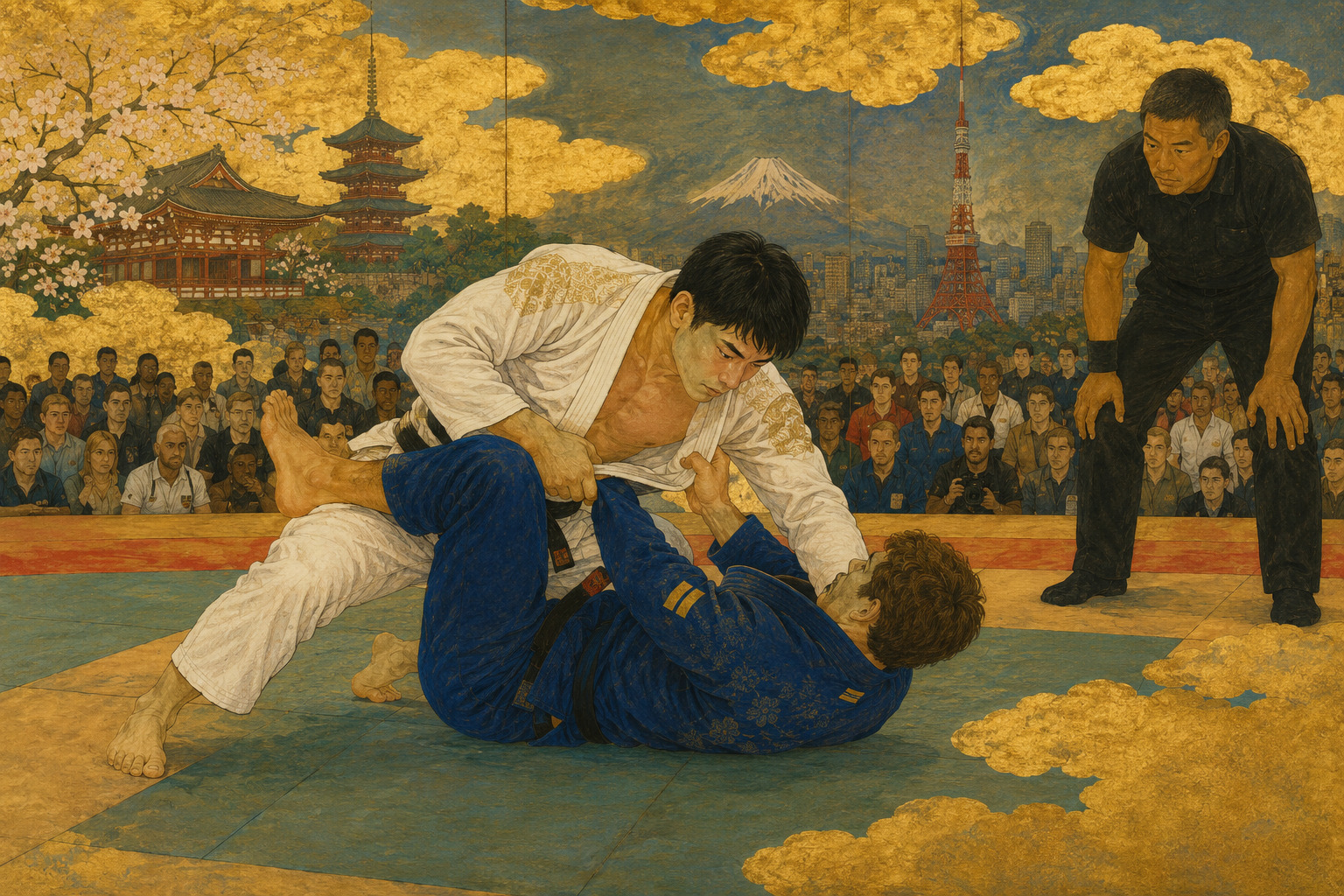
On the final morning at Yoyogi, the most important distinction is not between guard and top position. It is between the event spectators may imagine and the program the organizer has actually published. The senior black-belt open-weight showcase is not being saved for Sunday night. That title was decided earlier in the four-day championship. September 6 belongs chiefly to children, juveniles and three disability-sport competitions, followed by awards and the closing ceremony.
The SJJIF World Jiu-Jitsu Championship 2026 began Thursday at the First Gymnasium of Yoyogi National Gymnasium in central Tokyo. It is organized by the Sport Jiu-Jitsu International Federation, or SJJIF, with the Asian Sport Jiu-Jitsu Federation and the Sport Jiu-Jitsu Japan Federation. The Japanese federation’s official name is 特定非営利活動法人SJJJF スポーツ柔術日本連盟. SJJIF designates the tournament a 15-star ranking championship.
Sunday’s announced program includes gi competition for Kids 1 through Kids 6, for boys and girls across the permitted belts and weight classes. Juvenile athletes aged 16 and 17 are scheduled for gi weight and open-weight divisions. The organizer also lists Para jiu-jitsu, Deaf jiu-jitsu and what it formally calls “Special jiu-jitsu,” followed by awards and a closing ceremony.
That program makes the closing day less a conventional climax than a statement about what a world championship is meant to contain. Elite adult medals remain central to the sport’s prestige. Yet a federation’s durability depends on the children learning to compete safely, the teenagers crossing into adult ranks and the athletes whose participation requires classifications, communication access or adapted competition design. They are not an exhibition attached to the main event; on the published schedule, they are the main event.
What remains on the mats
The six children’s bands are based on birth year rather than a child’s age on the day. For this tournament, Kid 1 covers those born in 2021–22 and Kid 6 those born in 2011–12, with intermediate two-year bands. Belt eligibility expands with age: Kid 1 is limited to white and gray belts, while older groups can include yellow, orange and green. Juveniles born in 2009–10 may enter at white, blue or purple belt.
The divisions are further separated by sex and weight. The event page says athletes cannot be transferred between boys’ and girls’ divisions, even when entries are sparse. It also requires every competitor to be affiliated with a black-belt instructor. A judo black belt, an athlete with an official amateur mixed-martial-arts record, a professional MMA athlete or a wrestler with competitive experience may not enter as a white belt. Those rules are intended to stop prior expertise from being hidden inside a novice bracket.
The official weigh-in is unusually unforgiving in its wording: one attempt only, with immediate disqualification for exceeding the registered limit. A test scale is available, but it does not replace the official measurement. For younger competitors, that policy makes responsible coaching and ordinary hydration more important than last-minute weight manipulation. The event page does not publish a youth-specific weight-management protocol, and this report does not infer one.
| Date | Published emphasis | Editorial note |
|---|---|---|
| Sept. 3 | Opening; adult and masters no-gi divisions, weight and open weight | No-gi replaces the jacket-and-trouser grips of gi competition with tighter athletic clothing and body controls. |
| Sept. 4 | Adult black-belt gi open weight; masters gi divisions | The leading adult open-weight title was decided before the final day. |
| Sept. 5 | Kids and juvenile no-gi; adult gi weight divisions; masters black-belt open weight | Results were still accumulating when this edition closed. |
| Sept. 6 | Para, Deaf and “Special” jiu-jitsu; Kids 1–6 gi; juvenile gi weight and open weight; awards and closing | The organizer warned that capacity could push some Sunday matches onto Saturday. |
A result, and a limit on what it proves
SJJIF’s results database listed Brazil’s Anderson Marinho of Infight Japan as the men’s adult black-belt gi open-weight champion when this edition was prepared. Santos Jean, representing Top Brother China, was second, and Grant Bogdanove of Life Jiu Jitsu Academy in the United States was third. The same database showed medalists from a wide range of countries across the gi and no-gi brackets.
Those entries demonstrate an international field. They do not establish a final number of competitors, countries or spectators. In advance publicity, the Japanese organizer said athletes from more than 60 countries were expected. A separate promotional target of 8,000 entrants also circulated. Neither number was a verified final attendance count at our reporting cutoff, so neither is presented here as an accomplished fact.
Results pages also require care. A federation database can be updated after weigh-ins, withdrawals, bracket mergers, corrections or appeals. A bracket with one athlete may produce a champion without a contested match; SJJIF’s event rules explicitly allow that outcome when an athlete elects to remain in a division without an opponent. A medal table therefore cannot always be read as a list of bout victories.
One “world championship,” among several
The name needs another qualification. This is the SJJIF World Jiu-Jitsu Championship. It is not the International Brazilian Jiu-Jitsu Federation’s World Jiu-Jitsu Championship, whose official results archive begins in 1996, and it is not a world championship of the Ju-Jitsu International Federation, a separate international body whose events include fighting, duo and ne-waza formats. The organizations have similar abbreviations and overlapping vocabulary, but they are not interchangeable.
Brazilian jiu-jitsu does not operate under a single world-title monopoly. Federations publish their own rules, membership systems, rankings and championships. “World champion” therefore carries the name of the sanctioning body, the division, belt, age, weight and gi or no-gi format. Removing those qualifiers may make a headline shorter, but it makes the achievement less precise.
SJJIF itself is comparatively young. Its institutional history says João Silva, Patricia Silva, Samuel Aschidamini, Edison Kagohara and Cleiber Maia founded it in June 2012. The federation describes its mission as unifying sport jiu-jitsu organizations, standardizing rules and working toward inclusion in the Olympic movement. That is an aspiration, not evidence that the sport or SJJIF currently has Olympic status.
Jiu-jitsu is, however, part of the 2026 Aichi-Nagoya Asian Games sports program. Regional multisport inclusion gives the discipline a significant platform, but it should not be confused with a place on the Olympic Games program. The gap between the two is precisely why governance, transparent qualification, safeguarding, classification and reliable results matter.
From Japan to Brazil—and back to Tokyo
The Tokyo setting completes a historical arc often compressed into a single origin story. Japan’s National Diet Library records that Mitsuyo Maeda, born in Aomori in 1878, trained at the Kodokan, fought and demonstrated abroad, and became known as Conde Koma. He reached Brazil in 1914 and later settled in Belém. Brazilian jiu-jitsu histories commonly connect Maeda’s teaching with Carlos Gracie and the Gracie family’s subsequent development of the art.
That lineage matters, but it should not become a myth of solitary invention. Brazilian jiu-jitsu was shaped over decades by many Japanese migrants, Brazilian teachers, competitors and academies, by challenge matches and sporting rules, and by later international institutions. Maeda is a crucial bridge, not the whole bridge.
The language reflects the crossing. Japan’s domestic community commonly uses ブラジリアン柔術 for Brazilian jiu-jitsu and 柔術 for the competition discipline. Internationally, “jiu-jitsu” and “Brazilian jiu-jitsu” coexist with federation-specific terminology. SJJJF’s Japanese name, スポーツ柔術日本連盟, places the sport framing in the institution itself.
1878 — Mitsuyo Maeda is born in Aomori Prefecture.
1914 — Maeda arrives in Brazil, according to the National Diet Library chronology.
1996 — The IBJJF archive begins listing its World Jiu-Jitsu Championship results.
2012 — SJJIF says it was founded in June by five professors.
2021 — Yoyogi National Gymnasium is designated an Important Cultural Property.
2026 — The SJJIF Worlds run for four days in the First Gymnasium.
Yoyogi is more than a large room
The venue adds another layer of Japanese sporting history. The First Gymnasium was designed by architect Kenzo Tange and built for swimming and diving at the 1964 Tokyo Olympics. Its suspended roof uses the logic of a bridge to create a vast interior with few visual obstructions. The Japan Sport Council says Tange sought a space in which the movement of 15,000 spectators would work both functionally and psychologically.
The arena later hosted sports, concerts and Tokyo 2020 handball. Japan designated the complex an Important Cultural Property in 2021, recognizing both its design and its engineering. A grappling championship spreads temporary mats beneath a roof conceived for a different Olympic era: bodies working in close contact inside one of Japan’s most expansive modern interiors.
The Japanese organizer has promoted the event as the first jiu-jitsu world tournament in the First Gymnasium. That is the organizer’s claim, not an independently exhaustive survey of every past event at the venue. What is certain is that the building gives the SJJIF championship an address with global recognition and a demanding scale.
Inclusion requires more than three labels
Para, Deaf and “Special” jiu-jitsu appear separately on the SJJIF calendar and final-day program. The distinction is important. Deaf sport has its own institutions and communication practices; para sport can involve physical or visual impairments and classification systems; “Special jiu-jitsu” is the federation’s own published English label. These categories should not be collapsed into a single undifferentiated idea of disability.
Yet the Tokyo event overview available at our cutoff did not explain the classification criteria, eligible impairments, communication accommodations, match modifications or exact brackets for all three programs. The respectful approach is to retain the organizer’s official names, avoid guessing whom each category includes, and judge inclusion by the operational detail eventually published—not by the presence of a label alone.
For Deaf athletes, for example, a competition must ensure that a referee’s commands and stoppages are visually accessible. For para athletes, fairness may depend on classification and a ruleset that accounts for functional difference without erasing competitive skill. For athletes entered under “Special jiu-jitsu,” the federation should make eligibility and safety procedures clear in language athletes, families and coaches can use. Those are governance questions, not side notes.
The pressure behind a polished bracket
A major open tournament is a logistics system disguised as a succession of bouts. Athletes are sorted by age, sex, belt and weight, then assigned to a mat and time. They must clear identification, uniform and weight checks. A missing opponent can trigger a transfer, refund request or uncontested championship. A delay on one mat can collide with a second division or a coach’s schedule elsewhere.
SJJIF tells athletes to be ready at least 40 minutes before their scheduled match and warns that, except for the day’s first bout, competition may run 30 minutes early. Competitors have five minutes to report after being called. The tournament also requires a clear bag for most spectators, permits competitors to bring larger bags and says there is no baggage storage. General admission at the venue is listed at ¥3,000 per day, cash only; availability on the final morning should be checked with the organizer.
The ranking stakes add another layer. Under the published 15-star system, a division champion receives 225 points, a runner-up 105 and third place 49. Each submission victory adds three points; other wins add one. An uncontested single winner receives 105 individual points but no team points. The system rewards both placement and actual match outcomes, while preserving a formal result for an athlete left without an opponent.
What Sunday should leave behind
The visible finale will be medals and a closing ceremony. The more important legacy will be less photogenic: whether youth safeguarding is strong enough for a field of children, whether disability divisions have credible classification and access, whether results remain transparent, and whether a four-day international event strengthens everyday competition in Japan rather than merely passing through it.
There is also a cultural question. Jiu-jitsu returns to Tokyo carrying a century of Brazilian adaptation and worldwide growth. It does not return unchanged, and it should not be claimed as a simple national homecoming. Its identity is now transnational: Japanese techniques and institutions, Brazilian innovation, and academies and competitors from many countries meeting under multiple federation systems.
When the last bracket closes at Yoyogi, the championship will have done more than choose winners. It will have shown what SJJIF believes belongs inside its version of a world event. On Sunday, that answer is unusually visible: small gis, juvenile open weights, communication and classification questions, and a closing ceremony beneath Kenzo Tange’s roof. The future of the sport is not waiting outside the arena. It is already on the mat.
Primary sources and references
- SJJIF, “SJJIF World Jiu-Jitsu Championship 2026 in Tokyo” — Official dates, venue, daily division plan, age and belt bands, admission, weighing, schedule cautions and ranking points.
- SJJIF, 2026 gi results — Published medal entries, including the men’s adult black-belt open-weight division.
- SJJIF, 2026 no-gi results — Published no-gi divisional results used to assess the international spread of medalists.
- NPO SJJJF Sport Jiu-Jitsu Japan Federation — Official Japanese organization name, tournament dates, venue and the concurrent gi, no-gi, Deaf, Para and Special championship listings.
- SJJJF organizer announcement — Advance claims about the venue, expected country participation and sponsorship. Promotional claims are attributed, not treated as final counts.
- SJJIF, “History of the SJJIF” — Founding date, founders and the federation’s stated mission.
- Japan Sport Council, detailed history of Yoyogi National Gymnasium — Kenzo Tange’s design, the suspended roof and the 1964 construction history.
- Japan Sport Council, Important Cultural Property announcement — The 2021 designation and the architectural and engineering basis for it.
- National Diet Library, “The Undefeated Conde Koma Who Challenged the Amazon” — Mitsuyo Maeda’s birth, Kodokan background and Brazil chronology.
- Japan Brazilian Jiu-Jitsu Federation, history of Brazilian jiu-jitsu — Japanese federation account of Maeda, Brazil and the Gracie lineage.
- International Brazilian Jiu-Jitsu Federation, results archive — Used to distinguish the IBJJF World Championship from the SJJIF event.
- Ju-Jitsu International Federation — Used to distinguish JJIF and its formats from SJJIF.
- Olympics.com, Aichi-Nagoya 2026 sports list — Confirms jiu-jitsu on the Asian Games program; this does not imply Olympic-program status.
Reporting note: This report was prepared from material available by 8:00 a.m. JST on September 5, 2026. Event names, dates, venue, organizer names, divisions, age and belt terminology, weighing rules and ranking values were checked against SJJIF and SJJJF pages. The Japanese federation’s legal name and the venue’s Japanese name were verified in Japanese primary sources. Results are described as database entries at the reporting cutoff, not immutable final records. The organizer’s claims of participation from more than 60 countries and its earlier 8,000-entry target were not independently verified as final totals. Bout-by-bout changes, confirmed final entries in the Para, Deaf and Special divisions, classifications and accommodations, withdrawals, attendance, final team and country standings, and any post-cutoff results remain unresolved. The Japanese and English editions were structured and written independently.
Image rights: © 2026 Japan.co.jp. AI-assisted editorial illustration. No unauthorized reproduction or reuse. For licensing, see the contact page.