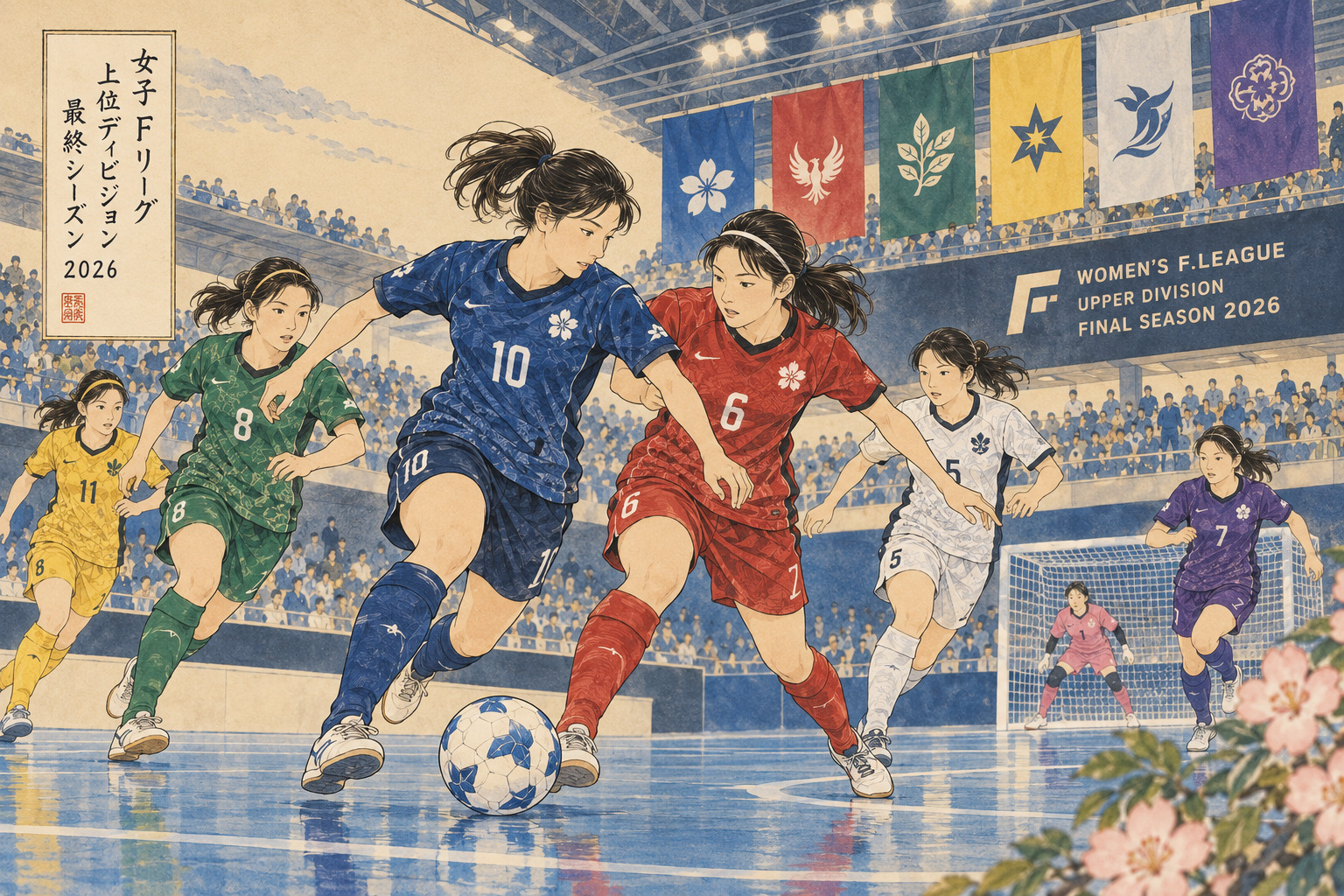
Japan's top women's futsal competition is about to stop being an 11-team race. The 2026-27 regular season ended on September 20, locking six clubs into the upper group for the Final Season: Bardral Urayasu Las Bonitas, SWH Ladies Nishinomiya, ARCO KOBE, Fugador Sumida Ladies, Tachikawa Athletic FC Ladies and Fukui Maruoka RUCK. The other five clubs move into a lower group. [1]
This is more than a cut line. The upper six contains every championship lineage in the history of the national women's league. Fukui Maruoka won the 2016 pre-tournament; Kobe won the first three official seasons from 2017 through 2019-20; Urayasu then won four consecutive championships from 2020-21 through 2023-24; and Nishinomiya has won the last two. Sumida and Tachikawa join those four former or current champions in the title group. [5][6][7][8]
Urayasu and Nishinomiya finish 9-1-0—and cannot be separated by points
The top of the table ended level. Urayasu and defending champion Nishinomiya each finished 10 matches with nine wins, one draw and no defeats for 28 points. Their September 20 head-to-head also ended 1–1. [1][4]
The difference is goal difference. Urayasu scored 67 and conceded seven for +60. Nishinomiya scored 47 and conceded nine for +38. Under league rules, ties on points are broken first by overall goal difference, then total goals, then head-to-head measures and finally a draw if necessary. [1][2]
That detail matters because points are carried into the Final Season. Urayasu does not begin the second phase with a two-point advantage over Nishinomiya; both start with 28. Urayasu sits first only because its regular-season scoring margin was 22 goals better. [1][2]
The champion is defending two straight titles; Urayasu wants the crown back
SWH Ladies Nishinomiya won its first league title in 2024-25 and repeated in 2025-26, securing a second consecutive championship. [5][6]
Before Nishinomiya's run, Urayasu owned the league for four years: 2020-21, 2021-22, 2022-23 and 2023-24. The league archive lists the 2023-24 title as Urayasu's fourth consecutive and fourth overall. [5][7]
This regular season, Urayasu's 67 goals and seven conceded stand beside Nishinomiya's 47 and nine. Both defenses were dominant; Urayasu's much larger attacking output is what created the table tiebreak. Their direct meeting ended 1–1, so the championship phase begins with the reigning champion and the previous dynasty level on points. [1][4]
Kobe is the original official-league champion
ARCO KOBE finished third at 8-0-2, with 24 points, 53 goals scored and 16 conceded. Its only two defeats came against the two unbeaten teams above it: 2–4 to Urayasu and 0–4 to Nishinomiya. [1][4]
Kobe also represents the league's first era. As arco-iris KOBE, it won the inaugural official league season in 2017 and followed with titles in 2018 and 2019-20. The championship then passed to Urayasu. [5][8]
A four-point gap to the top two is meaningful, but the structure of the Final Season makes direct games especially valuable: when contenders play one another, one club's gain can be another's lost opportunity in the same match.
The sixth and final place was decided by a 0–0 draw
The sharpest cutoff drama involved Fukui Maruoka RUCK and Espolada Hokkaido Irneve. They met on September 19 and drew 0–0. Both finished the regular season at 4-1-5 and 13 points. [1][4]
The draw did not leave them tied in the table. Goal difference is the league's first tiebreaker. Maruoka finished with 27 goals for and 24 against, +3; Hokkaido finished 20 for and 31 against, -11. That 14-goal season-long difference placed Maruoka sixth and Hokkaido seventh before head-to-head criteria were even needed. [1][2]
The consequences are larger than one line in the standings. League rules state that upper-six and lower-five teams cannot cross those group boundaries in the final annual ranking. Maruoka is now guaranteed to finish no lower than sixth. Hokkaido cannot finish higher than seventh even if it wins every lower-group match. [2]
Why does an 11-round regular season produce only 10 matches per club?
The standings show each club with 10 matches even though the league calls the regular season 11 rounds. That is a consequence of an 11-team single round-robin. Each team faces the other 10 once and has one round without a match. [1][2]
Wins are worth three points, draws one and losses zero. After those 10 matches, the league splits into an upper six and a lower five. The upper group plays five additional matches; the lower group plays four. [2]
The second phase is a round-robin among the strongest teams—not a knockout
The carried-over upper-group table begins: Urayasu 28, Nishinomiya 28, Kobe 24, Sumida 18, Tachikawa 15 and Maruoka 13. Each club now plays the other five once, so the maximum additional haul is 15 points. [1][2]
| Pos. | Club | Points | Goal diff. |
|---|---|---|---|
| 1 | Bardral Urayasu Las Bonitas | 28 | +60 |
| 2 | SWH Ladies Nishinomiya | 28 | +38 |
| 3 | ARCO KOBE | 24 | +37 |
| 4 | Fugador Sumida Ladies | 18 | +6 |
| 5 | Tachikawa Athletic FC Ladies | 15 | +8 |
| 6 | Fukui Maruoka RUCK | 13 | +3 |
Standings are those published after the September 20 completion of the regular season. [1]
This is not a bracket. A single loss does not eliminate a club. The question is whether the gaps accumulated during the first 10 matches can survive five games against only upper-level opposition.
The same six clubs reached the upper group last season
The 2026-27 upper six are exactly the same six clubs that qualified in 2025-26: Urayasu, Sumida, Tachikawa, Maruoka, Nishinomiya and Kobe. The order has changed, but the membership has not. [1][13]
That continuity shows a stable competitive top tier. It also frames the task for Hokkaido, Minerva Ube, Anilla Shonan, RKU Menina Ryugasaki and Saitama Saicolo: how to break into a top six that has now reproduced itself for two straight seasons.
Hokkaido came closest this time. Its 13 points matched Maruoka's. The separation was not a single head-to-head goal; it was the cumulative difference between +3 and -11 across the entire regular season.
The entire history of league champions is concentrated in the upper group
Fukui Maruoka won the 2016 pre-tournament. When the official national league began in 2017, arco-iris KOBE won three straight titles. Urayasu followed with four straight championships. Nishinomiya has now won two straight. [5][6][7][8]
That means every club that has ever won the pre-tournament or official league is in this season's upper six. Sumida and Tachikawa are the two upper-group clubs without a league title, placed alongside the four championship programs.
The pattern can be read two ways. The league has been concentrated among a small number of powerful clubs. But the dominant club has also changed—from Kobe to Urayasu to Nishinomiya. The Final Season will test whether another transition occurs or whether the current leading programs retain control.
Mika Eguchi's 100th appearance links the league's first season to the present
The September 20 Nishinomiya-Urayasu match also produced a milestone: Urayasu's Mika Eguchi reached 100 Japan Women's Futsal League appearances. Her first league appearance was on May 20, 2017, in the first round of the inaugural official season, when she played for arco-iris KOBE. [11]
Eguchi later moved to Urayasu, making her career a bridge from Kobe's opening dynasty into Urayasu's four-title era. Her 100th appearance arrived in a 1–1 match between the current two-time champion and the four-time former champion, with both ending the regular season on 28 points. [11]
The upper-six cut also affects individual awards
League rules state that the top-scorer award is selected from players on upper-six teams. If a player from the lower five finishes with the most goals in the entire league, that player can instead be recognized with the Fighting Spirit Award. [2]
The split therefore changes more than club ranking. It changes opponents, remaining match count, maximum annual finishing position and the framework for individual scoring honors. Maruoka and Hokkaido's goalless draw decided all of those consequences at once.
Urayasu's 67 goals and seven conceded need to be read carefully
Urayasu averaged 6.7 goals scored and 0.7 conceded across 10 regular-season matches. Nishinomiya averaged 4.7 scored and 0.9 conceded. Kobe scored 53 and conceded 16. [1]
Those averages should not simply be projected into the Final Season. Matches against lower-ranked clubs disappear. Urayasu's regular season included a 16–0 win over RKU Menina Ryugasaki and an 11–0 win over Saitama Saicolo. Those pairings do not exist in the upper group. [4]
The second phase therefore compresses the competitive environment. Urayasu's +60 is evidence of what it did over the full regular season; the Final Season asks whether the same dominance holds when every opponent is top six.
The Final Season travels around Japan
The league's current competition outline lists the Final Season from November 14, 2026 through February 14, 2027. An earlier May schedule announcement reserved a November 13–15 window for Round 12, with venues including Higashin Arena in Tokyo, Seiren Dream Arena in Fukui and Kobe Central Gymnasium. Later rounds are scheduled across Sapporo, Urayasu, Tokyo, Fukui and Yamaguchi. [2][3]
The September 20 upper-six announcement says detailed upper- and lower-group match pairings will be announced later. The group membership and format are set; the final detailed pairing schedule remains subject to the league's subsequent announcement. [1]
The lower group is not meaningless
The lower-five starting points are Hokkaido 13, Ube 9, Shonan 9, Ryugasaki 6 and Saitama 0. They cannot overtake the upper six in the annual ranking, but they will play a four-match round robin to settle places seven through 11. [1][2]
For developing players and newer squads, those are still official national-league matches. For Hokkaido in particular, the lower phase becomes an opportunity to test whether the gap to the upper six was truly structural or whether this season's exclusion came down mainly to the 14-goal difference separating it from Maruoka.
From seven clubs in 2017 to 11 today
The national women's league held a pre-tournament in 2016 and launched formally in 2017 with seven clubs. It now operates an 11-team regular season before splitting into two groups. [5][8]
The competition is still young enough that a 100-appearance player can have participated in its first official round. Yet it already has distinct championship eras, a nationwide club map and enough competitive depth to separate its season into a high-intensity upper group.
Women's futsal remains less visible than women's football in Japan, but the sport's structure is different: four outfield players and a goalkeeper on a small court, constant substitutions and rapid transitions make momentum highly volatile. An upper-six round robin intensifies exactly those characteristics.
What is not yet decided
As of September 22, the league has confirmed the six upper clubs, five lower clubs, carried-over points and competition format. The annual champion, runner-up, top scorer and other awards remain undecided. [1][2]
The standings show Urayasu and Nishinomiya level on 28 and Kobe four points behind, but those facts do not establish who will win the title. The competitive environment changes when every remaining upper-group match is against another top-six club.
Making the top six was the first half. Deciding the champion begins now
Maruoka reached the upper group because 13 points plus a +3 goal difference were enough after a 0–0 final-round draw. Urayasu and Nishinomiya arrive unbeaten and level on 28. Kobe starts four points back. Sumida, Tachikawa and Maruoka carry every point they earned into winter.
An 11-team season has now become six and five. The upper six happen to contain every champion in league history.
The format's defining feature is that nothing from summer is erased. Great results stay valuable. Dropped points remain expensive.
The Final Season is not a second tournament layered on top of the first. It is the same 2026-27 season, distilled into five matches where almost every opponent already knows what it feels like to play at the top of Japanese women's futsal.
Sources & documents
- Japan Women's Futsal League: Regular season ends and upper six are confirmed (Sept. 20, 2026; Japanese primary source)
- Japan Women's Futsal League: 2026-27 competition format and tiebreak rules
- Japan Women's Futsal League: 2026-27 Final Season outline (May 12, 2026)
- Japan Women's Futsal League: Match schedule and final regular-season results
- Japan Women's Futsal League: Historical champions archive
- Japan Women's Futsal League: 2025-26 final results—SWH Ladies Nishinomiya wins second straight title
- Japan Women's Futsal League: 2023-24 final results—Urayasu completes four straight titles
- Japan Women's Futsal League: 2017 annual champion—Arco-Iris Kobe
- Japan Women's Futsal League: Urayasu and Kobe clinch upper-group places in Round 7
- Japan Women's Futsal League: Nishinomiya clinches upper-group place
- Japan Women's Futsal League: Mika Eguchi reaches 100 league appearances (Sept. 21, 2026)
- Japan Women's Futsal League: Fukui Maruoka RUCK club profile
- Japan Women's Futsal League: 2025-26 regular-season upper six
- Japan Women's Futsal League: Standings and final regular-season results