- The Universe Is Hiding in Its Own Dust
- What NASA Actually Decided
- Why Far-Infrared Light Matters
- A Very Cold Telescope for a Cold Universe
- Between Webb and ALMA
- Japan Has Been Here Before: The Akari Legacy
- Herschel and the Long Pause
- Japan’s Working Group: Participation Is Still a Proposal
- The Search for Water’s Snowline
- A Distributed Japanese Research Team
- Galaxies, Black Holes and the Hidden History of Star Formation
- Why the Most Important Answers Are Still in the Future
The Universe Is Hiding in Its Own Dust
A star can be born in plain sight and still remain invisible. The dense clouds that cradle young stars absorb much of their light, hiding the earliest stages of stellar evolution from ordinary optical telescopes. But the dust does not simply extinguish the light. It warms and radiates, often at far-infrared wavelengths. The apparently blank regions between brilliant objects contain an archive of physical processes that astronomers have struggled to read consistently.
That is the promise of PRIMA, a proposed NASA far-infrared space observatory whose progress is now drawing coordinated scientific attention across Japan. On November 6, 2026, ten Japanese universities and research institutions announced that their three-year effort to explore possible participation would enter another stage, after NASA’s September decision to advance PRIMA into Phase B. The announcement is an important milestone—but it is not approval of Japan as a confirmed hardware partner, nor a guarantee the telescope will fly.
What NASA Actually Decided
The PRobe far-Infrared Mission for Astrophysics, or PRIMA, has become the first project selected to advance in NASA’s new Probe Explorers astrophysics mission class. In October 2024, NASA chose PRIMA and the competing X-ray concept AXIS for more detailed concept studies. On September 23, 2026, it announced that PRIMA would move to Phase B, the period for preliminary design and technology maturation. Japan’s November 6 release responds to that decision; it should not be mistaken for a second, separate NASA selection.
Phase B is a gate, not the finish line. NASA requires a subsequent confirmation review of technical readiness, management and costs before an implementation decision in Phase C. The current goal is launch in 2033, followed by five years of science observations. NASA says the project will have a cost cap of $1.2 billion if confirmed, excluding launch and certain other expenses. That is NASA's conditional project cap, not a Japanese budget commitment or the final all-in mission price.
Why Far-Infrared Light Matters
Astronomers use light beyond the visible spectrum because different wavelengths expose different physical conditions. Far-infrared light comes from comparatively cool material and can include emission from dust that has absorbed ultraviolet and visible radiation. It also carries spectral signatures that help trace gas, chemical elements and the state of matter in regions where stars and planets form.
PRIMA’s science plan is organized around three questions: the birth of planets and atmospheres; the intertwined evolution of galaxies and their central supermassive black holes; and the accumulation of heavy elements and cosmic dust through time. These are not isolated topics. Stars manufacture many of the elements used in planets and living systems; those elements move through gas and dust before being assembled into another generation of stars or planetary bodies. A far-infrared observatory seeks to recover portions of that cycle obscured at other wavelengths.
A Very Cold Telescope for a Cold Universe
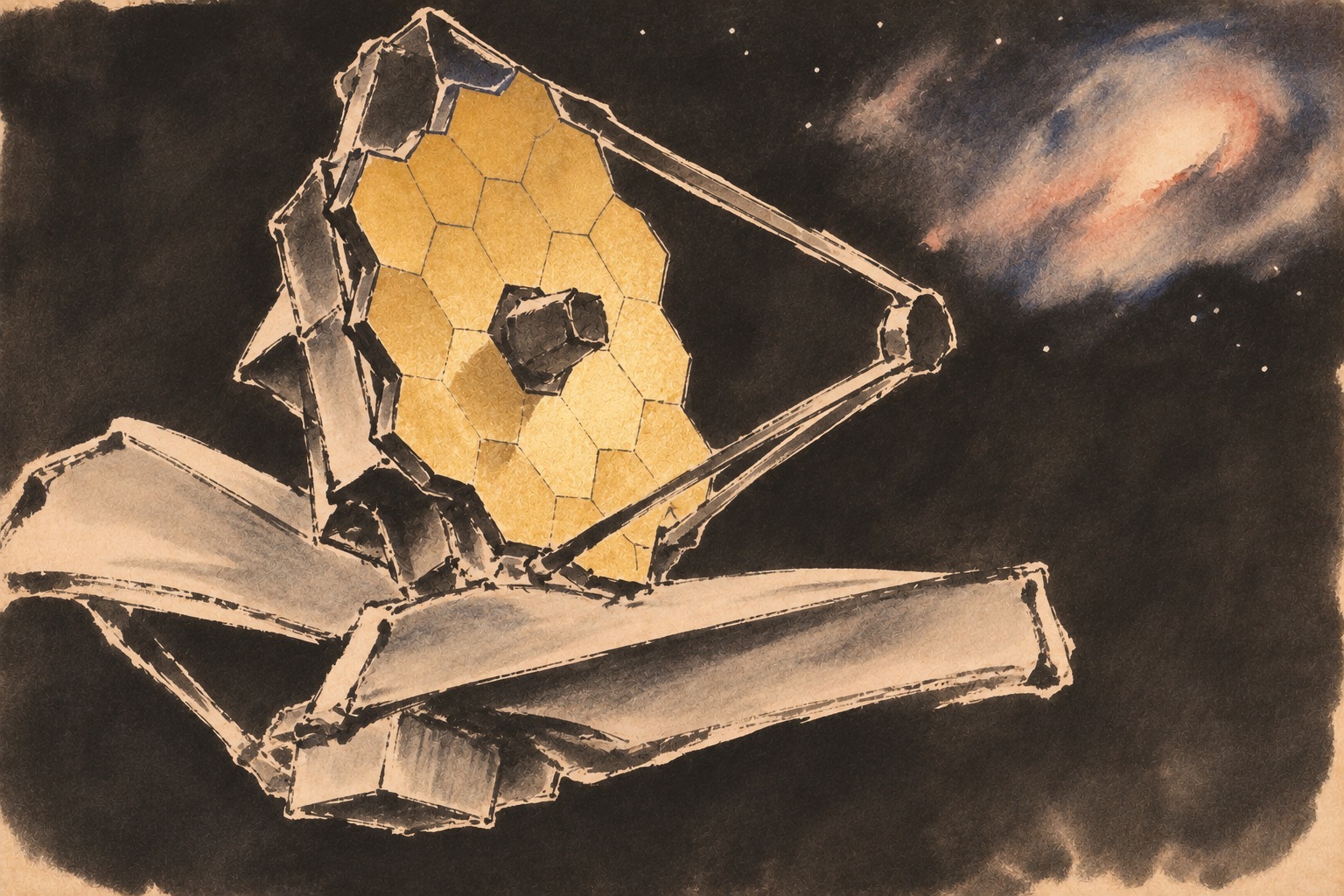
The design described by NASA and Japan’s research institutions calls for a mirror 1.8 meters across cooled to about 4.5 kelvins, approximately minus 268 degrees Celsius. Extreme cooling is essential, because a warmer telescope radiates infrared light of its own. Without careful thermal control, an observatory attempting to measure whisper-faint emission from distant dust clouds would partly be observing the heat of its instruments.
PRIMA is planned to combine an imaging instrument capable of mapping dust emission and polarization with a spectrometer able to separate light by wavelength and identify characteristics of gas and heavy elements. Images establish structure; spectra help explain composition and physical conditions. Those complementary methods could turn diffuse infrared glow into quantitative evidence about star formation and planet-building material. Specifications may evolve as the mission moves through engineering reviews.
Between Webb and ALMA
The James Webb Space Telescope reaches from near- to mid-infrared wavelengths, bringing extraordinary detail to distant galaxies and exoplanet atmospheres. ALMA, the international observatory in Chile, operates principally in millimeter and submillimeter bands and has become indispensable for studying cold gas and dust. Their scientific domains overlap in important ways, but neither fully covers the far-infrared interval PRIMA has been designed to investigate.
Calling PRIMA 'the next James Webb' would blur this distinction. Its value is complementarity rather than replacement. It would measure a different part of the electromagnetic spectrum, allowing scientists to connect radiation from luminous stars with signals from cold material. Earth's atmosphere absorbs much of the far-infrared radiation astronomers want to detect, which makes a space observatory particularly valuable despite the expense and engineering challenges.
Japan Has Been Here Before: The Akari Legacy
Japan's infrared astronomy story did not begin with a NASA announcement. JAXA launched Akari, also known as ASTRO-F, on February 22, 2006. Its 68.5-centimeter telescope surveyed the sky in infrared bands, producing catalogs and observations relevant to star formation, galaxy evolution and interstellar matter. The spacecraft carried both a near- and mid-infrared camera and a far-infrared surveyor.
Liquid-helium-cooled observations continued into 2007, with some additional observations afterward, before the mission's scientific operations concluded in 2011. Akari's scientific legacy includes extensive sky surveys and a community of researchers experienced in cooling, instrument calibration and interpretation of infrared data. A possible Japanese role in PRIMA therefore fits into an established scientific tradition rather than a sudden decision to join an unfamiliar field.
Herschel and the Long Pause
Europe's Herschel Space Observatory, launched in May 2009, carried a 3.5-meter mirror and transformed the study of cool cosmic matter. It made extensive far-infrared and submillimeter observations until April 29, 2013, when the helium cooling its instruments was exhausted. Herschel's archived observations remain scientifically productive, but a broadly comparable dedicated space mission has not continuously operated over its former wavelength range.
That absence matters because astronomy advances through multiple generations of instruments. Researchers use old catalogs to select targets, new observatories to test interpretations, and instruments at other wavelengths to uncover missing pieces. PRIMA is not a restoration of Herschel's hardware. Its ambition is to exploit newer technology to revisit major questions at sensitivities and observing capabilities relevant to today's research priorities.
Japan’s Working Group: Participation Is Still a Proposal
Organized Japanese PRIMA activities began in June 2023. In December 2024 they became a working group of the Institute of Space and Astronautical Science, within JAXA, examining possible national participation. Hiroshima University astronomer Hanae Inami chairs that working group and is also a PRIMA co-investigator. Her research on dust-obscured star formation makes the mission scientifically relevant to her field.
The November 6 joint announcement lists Hiroshima, Ehime, Tokyo, Waseda, Tokyo City, Tsukuba, Nagoya and Tsukuba University of Technology, together with the National Astronomical Observatory of Japan and RIKEN. That breadth does not mean each organization has secured an equipment contract. Japan's contribution, financial obligations and formal level of involvement remain subject to domestic reviews and decisions. The collaboration is currently strongest as a coordinated scientific and technical effort.
The Search for Water’s Snowline
A concrete example comes from RIKEN. Researchers Yao-Lun Yang and Kenji Furuya, of the Star and Planet Formation Laboratory, are working on possible scientific applications of PRIMA observations. They aim to use emission from HD—hydrogen deuteride, containing one ordinary hydrogen atom and one deuterium atom—and from water molecules to constrain gas masses in protoplanetary disks and locate snowlines.
A snowline marks a region where temperature conditions allow a volatile substance such as water to freeze into ice. Its position can influence the distribution of planet-building solids. Determining how much gas a disk contains is another crucial piece of the planet-formation puzzle. These are proposed measurements, not a claim that PRIMA has already located new planetary water reservoirs or proved the origin of Earth's water. Such conclusions would require observations and careful modeling.
A Distributed Japanese Research Team
Waseda University's announcement highlights Ken Mawatari, an early-universe galaxy researcher who was at Waseda when PRIMA was selected and is now an assistant professor at Tsukuba University of Technology. He participates in the PRIMA science team and is examining how far-infrared measurements could illuminate galaxy formation and evolution. Identifying his current affiliation accurately matters: Waseda is one part of a much wider collaboration, not the sole Japanese headquarters of the project.
The University of Tokyo separately identifies scientists including Shota Notsu, Shogo Tachibana, Aki Takigawa and Hanako Enomoto as contributors to a November 2025 science white paper discussing what PRIMA observations might accomplish. Their interests extend from protoplanetary disks to the chemistry of cosmic dust. Across Japan, specialists are also contributing to scientific workshop programs and mission-related publications while the case for national involvement develops.
Galaxies, Black Holes and the Hidden History of Star Formation
The rate at which stars formed over cosmic history is one of astronomy's central questions. Visible and ultraviolet observations capture some of the activity, but dust obscures another portion, absorbing energy and re-emitting it in infrared wavelengths. A powerful far-infrared survey could help researchers account for that hidden star formation, compare galaxies across epochs and assess how stellar growth relates to activity near central black holes.
Hiroshima researchers also envision combining PRIMA results with optical and near-infrared measurements from facilities such as the Kanata telescope. The scientific gain would come not from a single spectacular photograph but from measurements joined across wavelengths and time. That approach could reveal populations of objects and physical relationships that are difficult to identify using any one telescope.
Why the Most Important Answers Are Still in the Future
There are formidable steps between Phase B and a launched space observatory: validating cryogenic technology, completing instruments, controlling technical and financial risk, and passing NASA's confirmation review. Japan's agencies and institutions must also determine what, if any, formal contributions they will commit. The 2033 target is a plan, not a launch date written in stone.
PRIMA's scientific questions are nonetheless concrete. Where did the ingredients of planets accumulate? How did dust conceal and shape the history of star formation? How are galaxies and black holes connected? Japan's experience with Akari gives its astronomers a meaningful history in this wavelength range. Whether they ultimately fly hardware, help shape the observing program or contribute mainly through science remains to be settled. The invisible universe is waiting; this week's news is that a proposed way of seeing it has cleared an important, but not final, hurdle.
Sources and reporting method
Checked the November 6 Japanese consortium announcement against NASA’s selection record and the official JAXA Akari and ESA Herschel mission histories. Planned science, proposed participation and confirmed approvals are distinguished throughout.
- NASA, September 23, 2026: PRIMA selected to enter Phase B
- Waseda University, November 6, 2026 joint announcement
- Hiroshima University: Hanae Inami and Japan’s participation studies
- RIKEN: potential science contributions and water snowlines
- University of Tokyo: Japanese research participation and white paper
- NASA: Probe Explorers competitive mission-class background
- JAXA ISAS: Akari mission and infrared surveys
- ESA: Herschel operations and 2013 conclusion