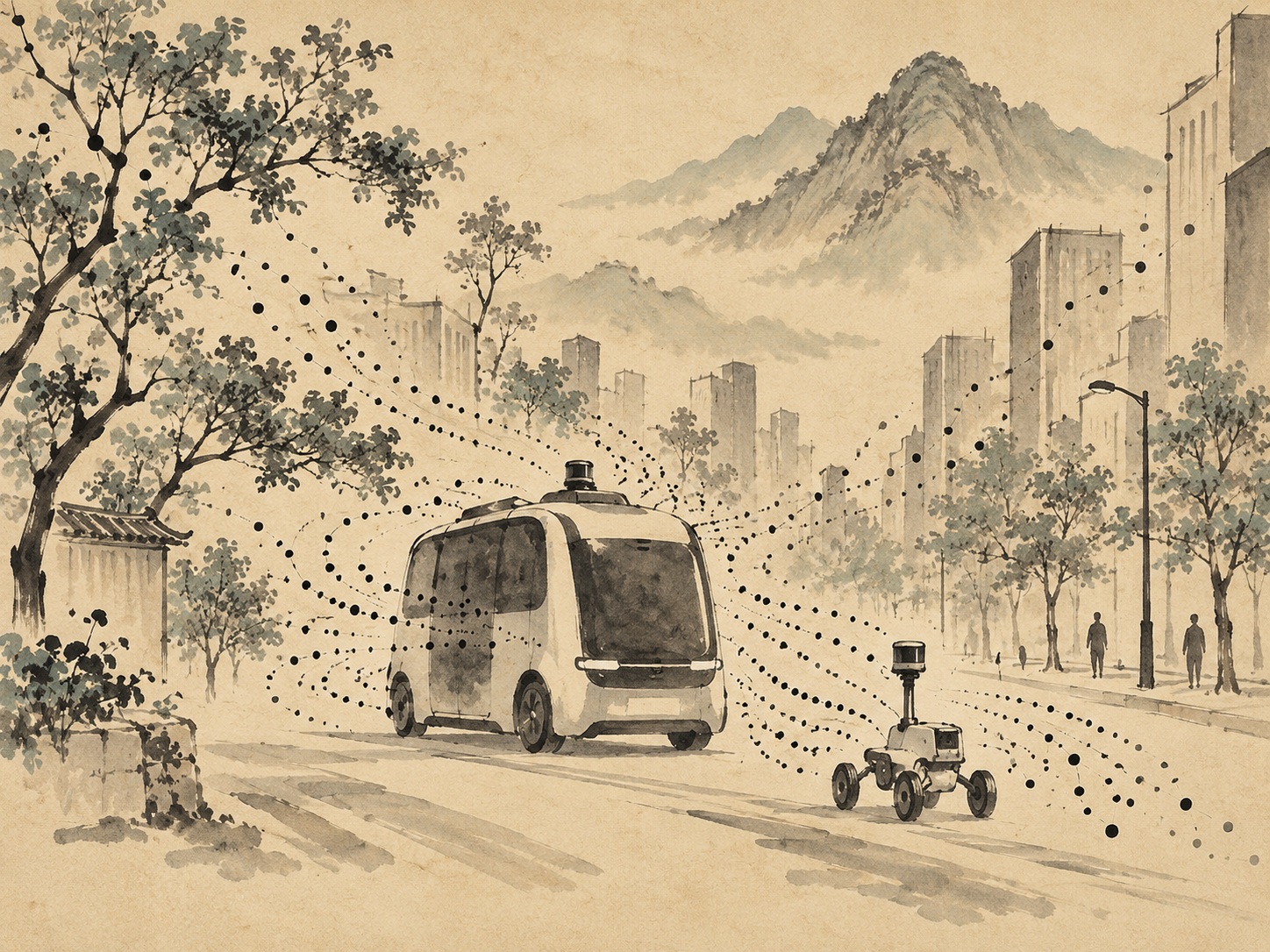
A conventional camera decides when the world should be observed: frame one, frame two, frame three. An event camera lets every pixel decide for itself. When the brightness at a pixel changes beyond a threshold, that pixel asynchronously emits an event carrying location, time and polarity. The result is a sensor that can react on microsecond timescales, avoid repeatedly transmitting unchanged regions and operate with low latency and relatively low power.[1]
That unusual way of seeing creates an unusual problem for artificial intelligence. Event cameras remain far less common than ordinary RGB cameras, and building large, varied event datasets is difficult. A Japanese research team led by Chiba University, with collaborators at Waseda University and Hitotsubashi University, has developed a simulator intended to make synthetic event data both more realistic and less computationally wasteful. The paper appeared online in IEEE Transactions on Visualization and Computer Graphics on September 17, 2026.[2]
A camera that does not make frames
A 30-frame-per-second camera reads an entire image 30 times each second whether most of the scene changed or not. An event camera instead monitors local brightness continuously. Each pixel independently emits data only when its brightness change crosses a preset positive or negative threshold.
Sony Semiconductor Solutions describes event output as a combination of pixel coordinates, timestamp and polarity. Because the pixels operate asynchronously, static regions generate little or no traffic while sudden motion can be reported immediately.[3]
The paradox: a data-efficient sensor with a data-hungry AI problem
Event cameras are attractive for fast-object tracking, robot navigation, 3D measurement, industrial vibration monitoring and potentially autonomous driving. Yet the hardware is still much less ubiquitous than standard cameras, making it harder to collect large datasets across many environments and edge cases.[1]
That is a problem for machine learning. Rare near-crashes, extreme lighting, rapid rotations, unusual reflections or unusual motion are expensive or dangerous to reproduce repeatedly in the real world. A virtual 3D environment can generate those cases safely and automatically—if the simulator can reproduce how the event sensor would actually respond.
The obvious simulation method wastes enormous work
A straightforward simulator renders a 3D scene at an extremely high frame rate and compares successive frames for brightness changes. The difficulty is that event cameras are valuable precisely because they register changes between conventional frame times. Reducing the rendering rate misses events; increasing it drives computation upward.
In the reported evaluation, the researchers used scenes with 20 keyframes over 0.1 seconds and rendered 20,480 frames to create a high-temporal-resolution reference. That reference is useful for evaluation, but it illustrates why brute-force dense rendering does not scale well to large training datasets.[1]
Using path tracing as a time-search engine
Path tracing is a physically based rendering technique that estimates pixel brightness by tracing possible light paths through reflections and scattering in a scene. It is famous for realistic computer graphics—and for being computationally expensive.
The new simulator uses that realism differently. Instead of rendering a dense sequence of complete frames, it can evaluate brightness at arbitrary times. A bisection-like temporal search progressively narrows the interval in which a pixel reaches the contrast threshold required to trigger an event.
Pixels with little change do not need the same temporal refinement as pixels undergoing rapid change. That “event-adaptive time refinement” aligns the computation with the asynchronous behavior of the sensor itself.
Path tracing is noisy, so threshold detection becomes statistical
Path tracing is stochastic: with finite samples, repeated estimates of the same pixel brightness contain noise. Near an event threshold, that noise could be mistaken for a real luminance transition and create a false event or timing error.
The researchers therefore incorporated statistical hypothesis testing to decide whether more samples were needed. On the GPU, stream compaction lets the implementation continue processing only pixels that still require evaluation. Waseda’s release says the optimized implementation reduced computation time to as little as one-third of a path-tracing implementation using bisection alone.[1]
Three small virtual worlds, three different problems
The team evaluated the simulator with a dynamic Cornell box containing a rapidly moving box, a bouncing-ball scene and a fireplace. Together they test smooth rigid motion, multiple moving objects and irregular time-varying illumination.
Waseda’s Japanese release says frame-based simulation can produce false detections or missed events because changes occurring between frames are not captured. The proposed method produced temporally coherent event streams closer to the high-resolution reference.[2]
The limits matter. These are controlled synthetic scenes, not proof that the simulator already reproduces every effect found in a real automotive sensor. Real hardware adds threshold variation, circuit noise, temperature behavior, lens artifacts, background activity and flicker.
The idea of throwing away frames is nearly two decades old
Modern event vision grew out of neuromorphic engineering. A landmark 2008 paper by Patrick Lichtsteiner, Christoph Posch and Tobi Delbrück described a 128×128 asynchronous temporal-contrast sensor in which every pixel continuously quantized relative intensity change and emitted address-events. The device reported more than 120 dB of dynamic range and minimum latency around 15 microseconds under bright conditions.[4]
The biological inspiration is important. Rather than treating vision as a succession of complete photographs, neuromorphic systems borrow from retinal and neural processing by emphasizing changes and sparse activity.
Japan helped move event vision from research to industrial hardware
Sony Semiconductor Solutions and France’s Prophesee jointly developed stacked event-based vision sensors and commercialized the IMX636 and IMX637 in 2021. Sony says the design combines a pixel layer and logic layer with Cu-Cu connections, enabling 4.86-micrometer pixels, asynchronous change detection, low-latency output and relatively low power consumption. The IMX636 provides 1280×720 effective pixels.[5]
Sony now positions event sensors for industrial vibration monitoring, spark detection in machining and welding, 3D measurement and fast-motion sensing. The hardware has therefore moved beyond the “silicon retina” research stage into commercially available machine-vision components.[3]
Why autonomous driving needs synthetic events
Autonomous systems already combine multiple sensor types—cameras, radar and lidar among them. Event cameras could add a fast, high-dynamic-range stream that reacts strongly to sudden motion. But perception AI requires labeled data.
A simulator has one major advantage: it knows the ground truth. The true position, speed, depth and identity of every virtual object are available automatically. Engineers can vary traffic, lighting, trajectories and camera motion without staging dangerous scenarios in the real world.
The new work addresses one piece of that synthetic-data pipeline: producing event streams that better respect the timing physics of the sensor. It does not by itself prove that an autonomous-driving model trained on those synthetic events will perform safely on public roads. That sim-to-real step still requires validation against physical cameras.
For robots, latency can matter more than image quality
A robot arm, drone or mobile robot may not need a beautiful image. It may need to know immediately that something moved. Waiting for the next frame, transmitting the entire frame and then processing it can add avoidable delay.
Event cameras offer a different control loop: motion itself becomes the message. But taking advantage of that hardware requires algorithms trained on asynchronous time-series data rather than ordinary image batches. The data infrastructure has to evolve with the sensor.
What “one-third the computation time” does—and does not—mean
The reported speedup does not mean all event-camera AI development becomes three times faster. It refers to the authors’ implementation under their evaluated conditions, where statistical testing and GPU optimization reduced runtime to as little as one-third of a path-tracing simulator using bisection alone.[1]
The more important result is conceptual. High-fidelity event simulation seems to demand extremely dense time sampling because event cameras operate at such fine temporal scales. The proposed method reduces that contradiction by concentrating computation on times and pixels where events may actually occur.
The next challenge is measuring the simulation gap
For the method to become a practical training-data engine, researchers will need broader scene complexity and systematic comparison with real sensors. Sensor-specific contrast thresholds, mismatch between pixels, background events, temperature effects, optics and electronic noise may need explicit models.
But the direction is compelling. Building a new sensor is only half of an AI ecosystem. Developers also need ways to manufacture the sensor’s experience in software—especially rare, dangerous or expensive experiences that cannot easily be collected on demand.
Event cameras abandon the frame as the fundamental unit of vision. This research asks the simulator to make the same intellectual move. If the camera cares only about change, perhaps the renderer should spend its effort only where change is about to become an event.
Sources and references
- Waseda University, “How a Path-Tracing Method Could Help Train Next Generation Event Cameras,” October 1, 2026.
- Waseda University research release, Japanese-language detailed announcement, September 30, 2026.
- Sony Semiconductor Solutions, Event-based Vision Sensor technology overview.
- Patrick Lichtsteiner, Christoph Posch and Tobi Delbrück, “A 128×128 120 dB 15 μs Latency Asynchronous Temporal Contrast Vision Sensor,” IEEE Journal of Solid-State Circuits, 2008.
- Sony Semiconductor Solutions, launch of stacked event-based vision sensors IMX636 and IMX637, September 9, 2021.
Paper: Yuichiro Manabe, Tatsuya Yatagawa, Shigeo Morishima and Hiroyuki Kubo, “Path-Tracing-Based Event Camera Simulation via Event-Adaptive Time Refinement,” IEEE Transactions on Visualization and Computer Graphics, DOI 10.1109/TVCG.2026.3726999. Reporting cutoff: October 4, 2026. The study does not establish real-world autonomous-driving safety or prove sim-to-real performance for AI trained on the synthetic data.