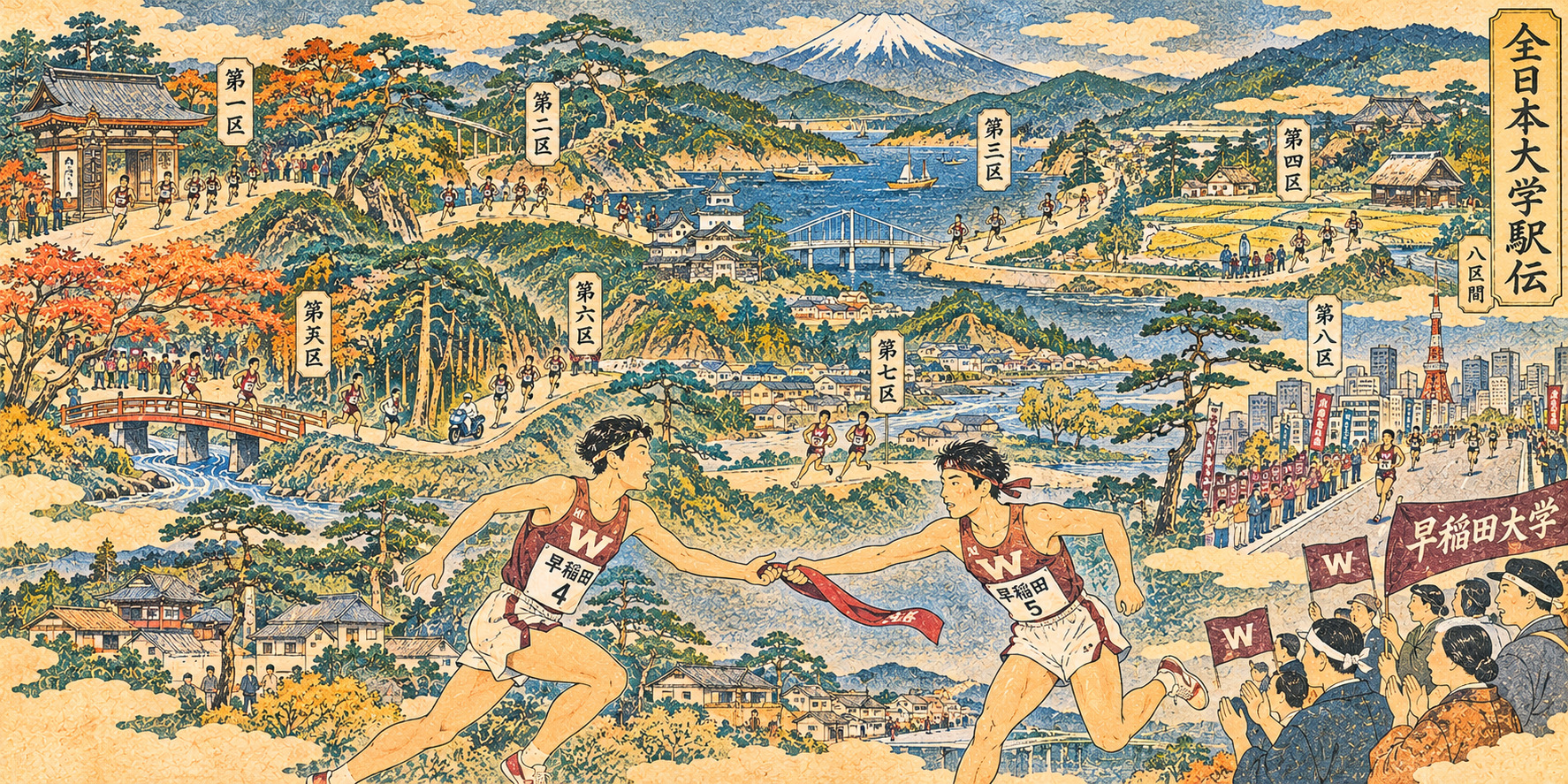
The record was built long before the anchor reached Ise
The finishing time was astonishing: 5 hours, 3 minutes and 31 seconds over 106.8 kilometers. On November 1, 2026, Waseda University won the 58th All-Japan University Ekiden by 3 minutes 34 seconds, taking 3 minutes 16 seconds off the previous competition record. It was the university’s sixth title and its first in sixteen editions. But the most revealing number may not be the time. It may be three—the number of freshmen Waseda placed at the start of an eight-man road relay, turning an ambitious opening into a lead its experienced runners could protect all the way to the sacred city of Ise.
An ancient route and a distinctly modern championship
The race starts beside Atsuta Shrine in Nagoya and ends near the entrance to the Inner Shrine of Ise in Mie Prefecture. The shrines are historic landmarks, but the race is a thoroughly contemporary sporting contest: eight separate legs, 25 competing universities and two additional open-entry selection teams in 2026. The All-Japan University Ekiden is one of Japan’s three premier collegiate relays, together with the Izumo Ekiden and the Hakone Ekiden. Unlike a conventional road race, individual times are inseparable from decisions made about who runs which segment, when the team attacks and how safely it can carry a lead into the long closing legs.
The first relay handoff that made the rest possible
Freshman Ojiro Honda covered the opening 9.5 kilometers in 27:47, second on the leg. There was no early victory parade. Instead, Honda kept Waseda within striking distance. That mattered because the first leg can punish a team that loses contact before its strongest runners have even taken the road. The opening result became the foundation for an unusually aggressive sequence: three first-year students in the first three stages. The official organizer singled out their impact in its race review.
Stage two: the moment Waseda became the hunted
Fellow freshman Yota Masuko took the sash for the 11.1-kilometer second leg and delivered 30:51, the fastest time in the stage and a new leg record. Waseda moved into first place. Then came another first-year runner, Haruki Niizuma, inserted into stage three through a race-day entry adjustment. Niizuma covered 11.9 kilometers in 32:45, also a stage record. The organizer reports that Waseda’s lead over then-second-place Komazawa had expanded beyond one minute by the end of the third leg. Niizuma was named the competition’s most valuable athlete. Rather than waiting for the closing sections, Waseda had forced every rival to chase early.
Why middle-distance stability is as valuable as headlines
The next assignments were different. Fourth-year Atsuyuki Kodaira ran the fourth leg in 33:24, fourth-fastest on the section, and preserved the overall advantage. Second-year Ruin Suzuki then produced 34:31 for 12.4 kilometers on the fifth leg, a third stage record for Waseda. This sequence matters tactically. A team that attacks successfully in stages two and three can still squander its gain through a hesitant middle. Waseda instead combined a steady transition with another burst of speed. Four of its eight runners eventually won their individual stages; three established new stage records.
Every stage, every runner
The following times and leg standings come from coach Katsuhiko Hanada’s November 3 published team account, checked against the organizer and contemporary competition reporting. An asterisk marks a new stage record; no asterisk means the athlete may have won the stage without breaking its record. Japanese-script names are retained for precision.
| Stage | Distance | Runner (year) | Stage time | Leg rank |
|---|---|---|---|---|
| 1 | 9.5 km | 本田桜二郎 (1) | 27:47 | 2 |
| 2 | 11.1 km | 増子陽太 (1) | 30:51 | 1 (record) |
| 3 | 11.9 km | 新妻遼己 (1) | 32:45 | 1 (record) |
| 4 | 11.8 km | 小平敦之 (4) | 33:24 | 4 |
| 5 | 12.4 km | 鈴木琉胤 (2) | 34:31 | 1 (record) |
| 6 | 12.8 km | 堀野正太 (2) | 36:55 | 3 |
| 7 | 17.6 km | 山口竣平 (3) | 50:58 | 3 |
| 8 | 19.7 km | 工藤慎作 (4) | 56:20 | 1 |
The decisive distance after the early fireworks
Shota Horino ran the sixth leg, 12.8 kilometers, in 36:55, third on the stage. Shumpei Yamaguchi then handled 17.6 kilometers in 50:58, also third. The two runs preserved the margin for fourth-year anchor Shinsaku Kudo, who completed the final 19.7 kilometers in 56:20 and took the stage victory. Kudo had already earned attention in 2025 for a remarkably fast anchor performance. In 2026 his task was not to rescue an endangered lead; it was to turn accumulated strength into a landmark finishing time.
Exactly what a 3:16 record means
The old overall record stood at 5:06:47, set by Komazawa University in 2022. Waseda improved it by 196 seconds on the current 106.8-kilometer course. That qualification matters. The competition began with a longer route and has changed its segment structure over decades, making direct stopwatch comparisons across every historical edition misleading. The 2026 result is a competition record in the present course configuration, created through sustained performance rather than a single spectacular leg.
The chase was real, even if the contest looked one-sided
Kokugakuin University finished second in 5:07:05. Its Shinta Iikuni won stage four, while Kuranosuke Yoshida recorded a new stage mark in stage six. Soka University was third in 5:09:28 after climbing from eighth following stage six. Aoyama Gakuin finished fourth, followed by Chuo and Komazawa. The first eight teams secured seeding for the next edition. Waseda’s advantage was exceptional; it was not evidence that its opponents ran without distinction. A credible account of a dominant victory must still make room for the efforts that failed to overcome it.
A championship older than most of its competitors’ coaches
The first All-Japan University Ekiden was held on March 1, 1970. It covered eight stages totaling 118 kilometers and was won by Nippon Sport Science University. The competition has since changed its distances and format, while building a national following around the exchange of the tasuki, the relay sash. Waseda last won this championship in 2010, during the academic year in which it also completed the celebrated collegiate “triple crown.” Its 2026 victory therefore ended a 16-edition drought and restored a place in the history books that Waseda had not occupied for more than a decade and a half.
The bigger question is waiting in January
Waseda also won the Izumo Ekiden in October 2026. Two legs of the three-event collegiate calendar are now complete, leaving the January 2027 Hakone Ekiden between the team and another sweep. But Hakone brings ten stages, challenging elevation changes and a different selection problem. Hanada, speaking after the All-Japan victory, emphasized the need for a deep group of athletes ready to compete. That is a reminder that the next title cannot simply be inferred from this one, however impressive the record looks.
What eight runners proved
The striking aspect of Waseda’s performance was the distribution of responsibility. Freshmen took early risks and produced record-breaking speed. A senior kept the midrace lead intact. A second-year runner accelerated again, and the final three athletes carried the work to Ise. The relay’s message was not that individual brilliance no longer matters. It was that individual brilliance only becomes a championship record when the next runner can use it. Waseda’s 5:03:31 belonged to all eight.
Sources and reporting method
This report draws on the event organizer, Waseda and Kokugakuin athletics records, the coach’s November 3 account and contemporary sports reporting. No independent onsite reporting or direct athlete interview was conducted. Japanese names are retained where official romanization was not independently established.
- Organizer: November 1 race report
- Organizer: course and competition structure
- Organizer: historical results
- Waseda University athletics: championship account
- Coach Katsuhiko Hanada: November 3 split-by-split account
- Kokugakuin athletics: verified top-eight results
- Rikujyo Kyogi: competition results
- Nikkan Sports: splits and competition record
- Nikkan Sports: Hanada remarks