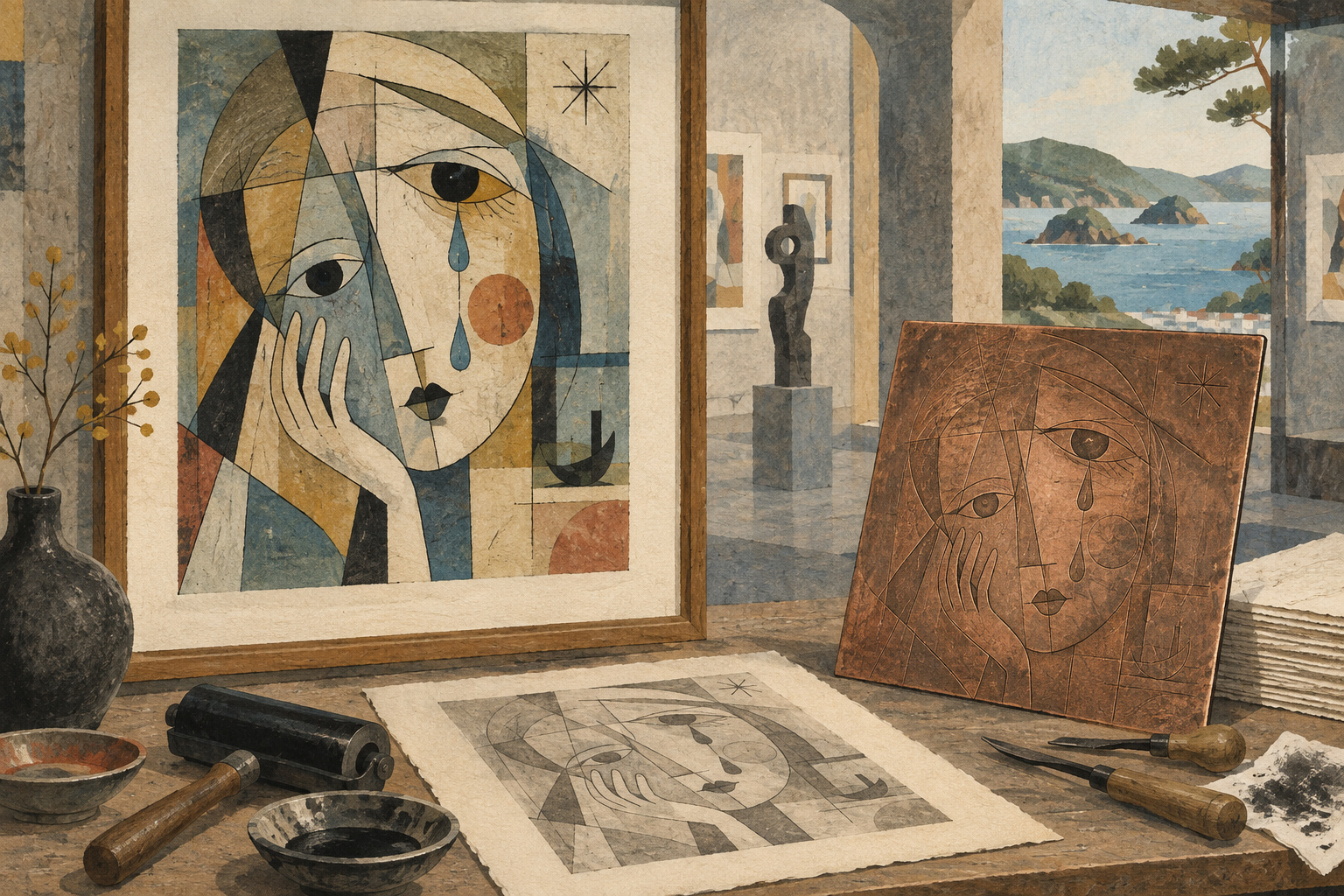
A famous name can bring visitors into a gallery. A closer look at a line can give them a reason to stay. At the Museum of Modern Art, Wakayama, Picasso’s Weeping Woman is the starting point for an exhibition about intaglio printmaking: how marks cut or bitten into a plate become images, and how artists make that process expressive. The display runs from September 12 to October 18, 2026. [1]
The museum’s checklist identifies its work as a 1937 print combining etching, aquatint and drypoint. That identification matters. “Weeping Woman” is a subject associated with more than one Picasso work; the object in this display is a print, not an oil painting. Its medium is part of its meaning. [2]
Three techniques, three ways to make a mark
Intaglio printing transfers ink held in recessed areas of a plate onto paper under pressure. In etching, the artist draws through a protective ground, exposing metal that a chemical solution can bite. The resulting recesses hold the ink. Musashino Art University’s technical account explains the distinction between drawing through that coating and cutting directly into metal. [4]
This introduces a productive distance between the hand and the finished print. The initial drawing is followed by changes to the plate, then inking and printing. A line on paper is the visible outcome of several decisions rather than simply the trace of a pencil moving across the sheet.
Drypoint works differently. A needle scratches directly into the plate, pushing up a metal burr beside the incision. Ink retained around that burr can give the printed line a soft, rich edge. Musashino’s explanation also notes that the burr is vulnerable to wear and pressure. The character of a mark therefore depends on a physical feature of the plate, not just the outline drawn by the artist. [5]
Aquatint extends the vocabulary toward areas of tone. A granular resist allows the plate to be bitten in a fine pattern, producing passages of light and dark rather than only narrow lines. It can suggest the tonal breadth of a wash while remaining a printed image. [6]
None of this requires a visitor to become a technician. The practical benefit is a more attentive eye: where does a line stay crisp, where does its edge soften, and where does darkness spread across an area? In a work combining methods, individual marks cannot always be assigned confidently to one process by sight alone. The label offers a starting point for looking, not an answer to every visual question.
What the year 1937 brings into view
The date places the print in the same year as Guernica. The Museo Reina Sofía’s account describes that painting as a commission for the Spanish Pavilion at the 1937 Paris exposition, made in response to news of the bombing of the Basque town during the Spanish Civil War. It interprets the work’s symbolic imagery as a protest against the terror of war, rather than a literal reconstruction of a single scene. [8]
This is historical context for Picasso’s work in that year, not a claim that Guernica is on view in Wakayama. Nor should the context substitute for examining the print. Knowing that an image concerns grief is different from asking how its marks convey distress. Where does the eye hesitate? What happens when dense lines meet an open area of paper? Those questions keep the encounter with the object active.
Before the image: a plate and a press
The checklist includes an etching press made by the Japan Etching Institute, together with Tetsuro Komai’s Fukokuga, its original plate and an impression from the canceled plate. These materials make the exhibition more than a sequence of finished pictures. They invite visitors to consider the working surface that produced a print. [2]
A plate is not merely an image rendered in a tougher material. It must receive ink, release it to paper and withstand the conditions of printing. Comparing a plate with an impression can shift attention from what is depicted to how the depiction becomes possible. The apparent immediacy of a finished line has a material history behind it.
That also complicates the casual description of prints as copies. A print conceived through work on a plate is an artistic object made through that process. Its capacity for more than one impression does not eliminate the decisions involved in creating the matrix or printing from it. Repetition and invention can belong to the same medium.
How a technique becomes a local artistic language
The exhibition connects European intaglio with its reception in Japan. Its account points to the art and literary magazine Shirakaba, founded in 1910, and to Takeo Nishida’s establishment of the Japan Etching Institute in 1931. These developments concern the circulation of knowledge and opportunities to learn as well as the production of individual works. [1]
A medium does not travel only in the luggage of an accomplished artist. It also travels through printed discussion, access to equipment, instruction and the chance to see other people’s results. Reading dates on publications alongside dates on artworks can reveal those different rhythms: the time needed to make an image and the longer time through which a practice takes root.
Working from darkness toward light
Mezzotint provides a particularly striking change of perspective. The plate is first roughened so that it will retain ink and print dark. Scraping and burnishing selected areas reduces that texture, creating lighter tones. The French term manière noire, also used in Japanese accounts, points toward this relationship with black. Musashino Art University emphasizes the method’s rich tonal gradations. [7]
For someone accustomed to drawing dark marks on white paper, the idea can feel reversed. Light is achieved by reducing a surface’s ability to carry ink. With that in mind, darkness becomes something to inspect rather than an empty background to pass over. Does it enclose an object, soften its boundary or make a small patch of color more intense?
The checklist includes Kiyoshi Hasegawa’s Time—Still Life (1969) and Yozo Hamaguchi’s Roofs of Paris (1956), the latter recorded as color mezzotint. English titles here are descriptive translations of the museum’s Japanese titles. These works extend the visit beyond Picasso toward other subjects and other uses of tone. [2]
Why this collection is in Wakayama
The museum opened in 1970 and developed its holdings around artists connected with Wakayama. It identifies figures including Yozo Hamaguchi, Kyokichi Tanaka and Koshiro Onchi as part of the regional foundation for a stronger commitment to modern and contemporary prints from around 1980. International holdings, including Picasso, sit within that collecting history. [3]
This gives the exhibition a significance beyond borrowing the visibility of a celebrated artist. A local collection can connect regional careers with a wider history of artistic exchange. Visitors may arrive to see Picasso and leave remembering a different artist’s way of making darkness visible.
A useful final exercise is to return to the first work after walking through the display. Choose one feature—a line’s edge, an area of tone, a contrast with the paper—and see whether it now attracts attention differently. The purpose is not to master all the terminology in one visit. It is to discover that knowing a little about making can change the experience of looking.
Planning a visit
| Item | Visitor information |
|---|---|
| Venue and dates | MOMAW, first-floor galleries / September 12–October 18 |
| Hours | 09:30–17:00; last admission 16:30 |
| Closures during this display | Mondays except September 21 and October 12; also September 24 and October 13 |
| Standard admission | Adults ¥400; university students ¥250 |
| Main free-admission categories | High-school age and below; age 65+; disability-certificate holders. Companion eligibility varies |
| Curator lectures | September 20 and October 4, from 14:00, approximately one hour |
The holiday calendar changes the normal Monday closure pattern. Check the museum’s current information before traveling, especially for concession eligibility, companion admission and any changes to the announced lectures. All times above are Japan Standard Time. [1][9]
- MOMAW: exhibition announcement
- MOMAW: exhibition checklist (PDF)
- MOMAW: collection history
- Musashino Art University: Etching
- Musashino Art University: Drypoint
- Musashino Art University: Aquatint
- Musashino Art University: Mezzotint
- Museo Reina Sofía: Guernica collection record
- MOMAW: visitor information
Based on museum records and educational materials checked through September 17. Viewing suggestions and interpretation are Japan.co.jp analysis.