- A monster too large for a single sheet
- Learning from Kuniyoshi, finding a voice of his own
- The serpent, the outlaw and the politics of 1858
- The Earth Spider: making fear visible
- Kabuki: carrying the theatre home
- Legends as a language of political uncertainty
- The business behind the woodblock
- From printed heroes to contemporary character worlds
- Why Yoshitsuya matters today
A monster too large for a single sheet
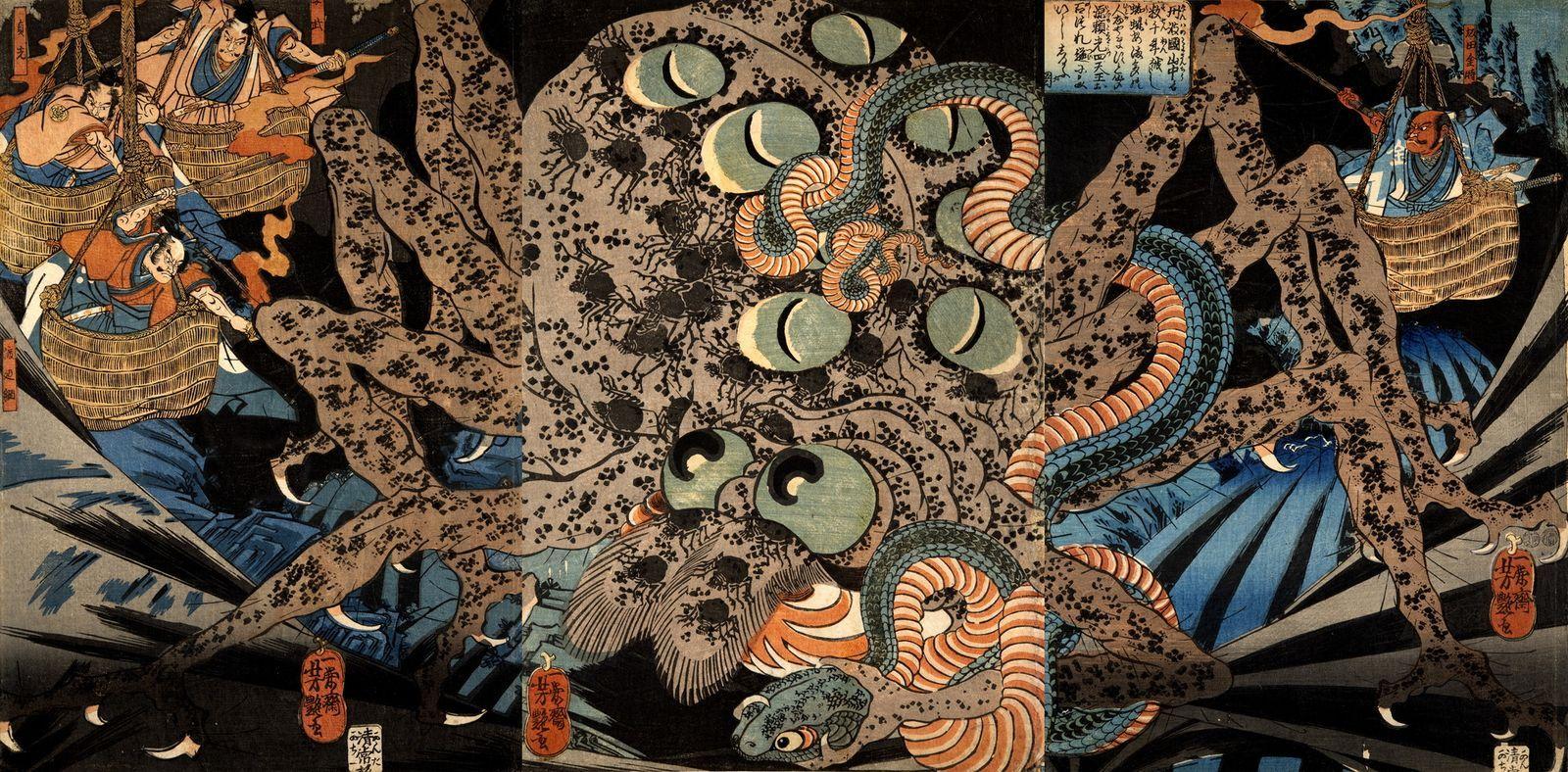
The spider in Yoshitsuya’s remarkable print seems to have outgrown the medium that contains it. Its mottled limbs stretch across the joins of three sheets; pale green eyes and coiling snakes interrupt the dark mass of its body. Human warriors are reduced to small figures suspended in woven baskets. The picture conveys the scale of the danger before a reader has deciphered a single inscription.
Utagawa Yoshitsuya (1822–1866) belonged to the last generation of artists to work entirely within the Edo period. This JAPAN.co.jp Art Choice, published in the 160th anniversary year of his death, examines three works as evidence of a visual storytelling culture in which entertainment, publishing and imagination were already closely intertwined.
Learning from Kuniyoshi, finding a voice of his own
Yoshitsuya entered the studio of Utagawa Kuniyoshi (1797–1861) at about fifteen, according to the Lavenberg Collection biography. He used the art name Ichieisai, among others, and became known for warrior subjects and tattoo designs in the 1840s and 1850s. Surviving prints offer firmer evidence of his creative practice than the sparse details of his private life.
Kuniyoshi’s celebrated heroes from the Chinese novel Water Margin helped establish a market for powerful warrior imagery. Yoshitsuya inherited a language of patterned costumes, sharply articulated gestures and fantastical opponents. His particular achievement was often to make the entire triptych behave as a single dramatic space: a creature could cross the boundaries that normally divide a printed image.
The serpent, the outlaw and the politics of 1858
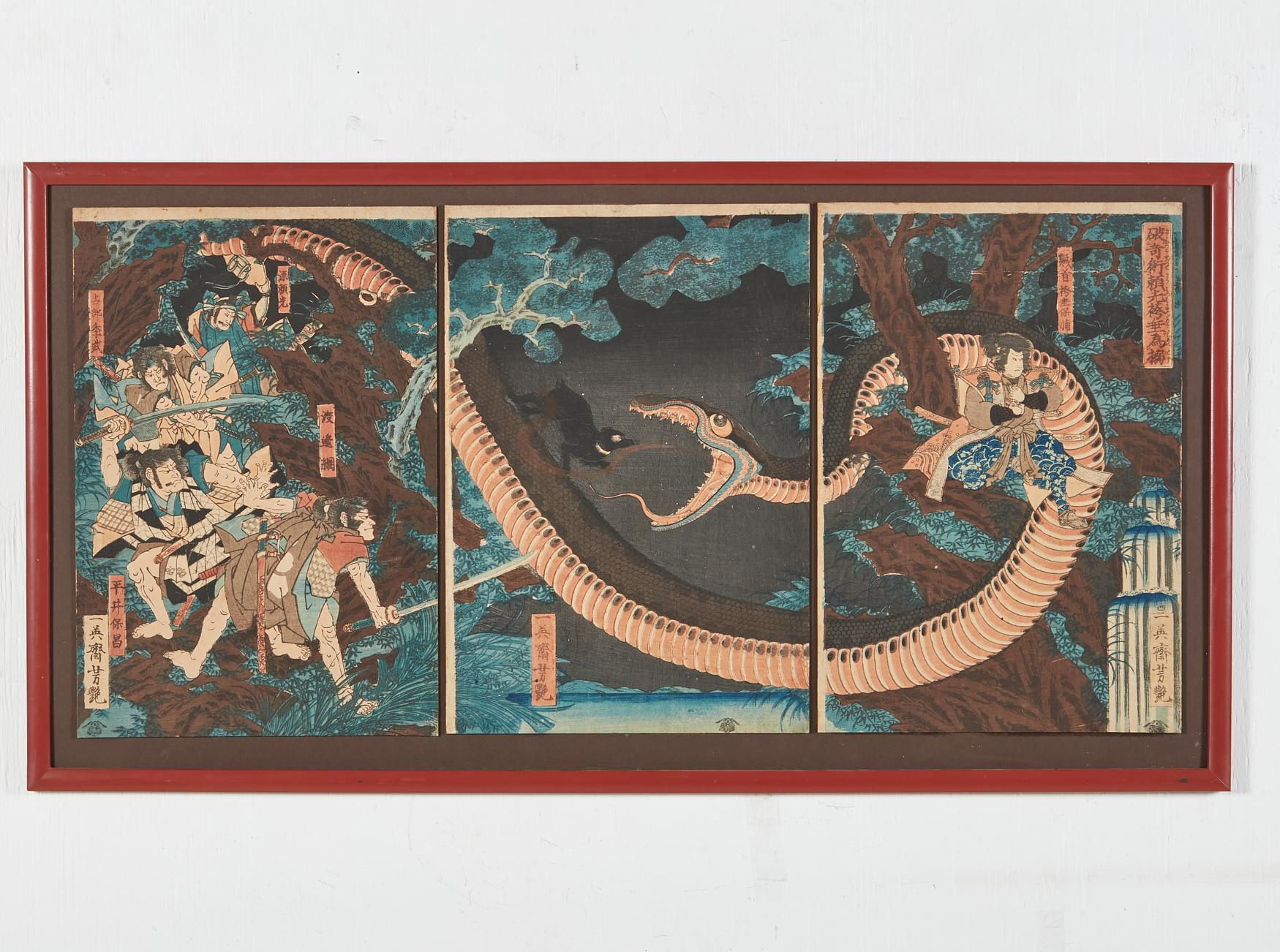
Japan’s Cultural Heritage Online identifies the serpent composition as 破奇術頼光袴垂為搦, read Kijutsu o yabutte Yorimitsu Hakamadare o karamen to su: Yorimitsu tries to capture Hakamadare by overcoming his magic. The Japanese catalogue dates it to 1858, and the Lyon Collection records an April 1858 date seal on its impression. The story pits the legendary warrior Minamoto no Yorimitsu and his companions against the magical outlaw Hakamadare.
Look at the orange underside of the serpent, the dark scales on its back, and the small armed figures among the trees. A dark animal confronts the snake; the Lyon catalogue explains the confrontation as involving a giant bear under the outlaw’s magic. The curving creature binds the three sheets together, turning the forest into a stage for competing forces. This is a narrative of sorcery and confrontation rather than a naturalistic study of wildlife.
The Earth Spider: making fear visible
The Ota Memorial Museum of Art identifies this giant-spider design under a long Japanese title describing Yorimitsu and his Four Guardian Kings overcoming a spider that has troubled people in the mountains of Tanba. It appeared in the museum’s 2024 exhibition of supernatural prints. The Spencer Museum of Art catalogues an Earth Spider triptych, dated approximately 1847–1852, with accession number 1984.0034.a,b,c.
Yorimitsu, also known as Raiko, became the hero of many later legends. The spider narrative exists in varying literary and theatrical forms. In the supplied composition, the disproportion between tiny warriors and enormous limbs is the central visual device. The patterned skin, multiple eyes and entangled serpents make the monster a composite invention rather than an enlarged ordinary spider. The picture asks the viewer to experience a world in which familiar natural forms have become strange.
See the opening image for the full composition. The museum records identify the subject and comparable works; they do not establish ownership of the particular supplied reproduction.
Kabuki: carrying the theatre home
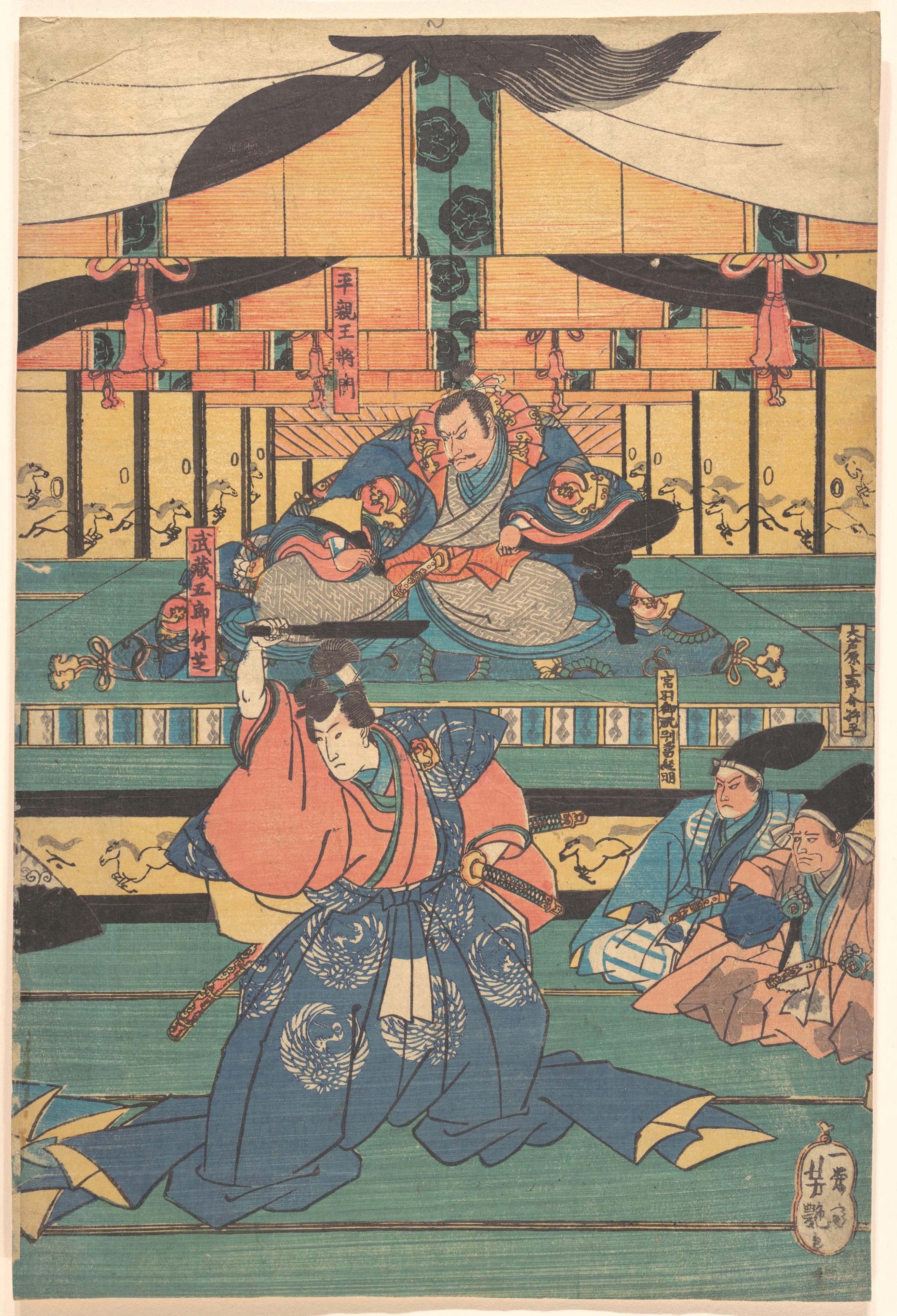
The third image is a vertical print of dramatic figures in an interior. The Metropolitan Museum of Art catalogues a Yoshitsuya woodblock of actors playing roles including Tairano Shinnō Masakado and Musashi Gorō Takeshiba, together with Ōashibara Ueno no kami Masahira and Tokiwa Mikuriya Bettō Tsuneaki. Its record, JP1093.3, dates the work to the mid-nineteenth century and gives image dimensions of 36.2 by 24.1 centimetres.
The arrangement is strikingly different from the monster scenes. A seated figure dominates the raised platform, while a foreground figure raises a sword. Screens, blinds and the patterned floor establish the architecture of performance. Actor prints helped audiences retain a visual memory of theatrical entertainment. The named roles should not be confused with the identities of the performers themselves; the exact cast and performance date are not established here.
Legends as a language of political uncertainty
In 1858 the Tokugawa government faced disputes over foreign relations and succession. The Lavenberg Collection discusses the serpent print as a possible caricature of the contest over the succession of the thirteenth shogun, Tokugawa Iesada. The Lyon Collection likewise records a political reading. Such interpretations are valuable, but a print’s historical setting is not proof that each character stands for an identifiable official.
There was a precedent within Yoshitsuya’s artistic circle. Keio University’s catalogue of Kuniyoshi’s 1843 print of Yorimitsu and the Earth Spider describes its satirical relationship to the Tenpo reforms. Legendary subject matter could become a means of addressing contemporary anxieties. The comparison illuminates the possibilities of the medium without establishing that Yoshitsuya intended the same political message in every supernatural print.
The business behind the woodblock
An Edo-period colour print was not the work of an illustrator alone. Publishers organized production and distribution, designers supplied the artwork, carvers prepared blocks, and printers aligned and applied successive colours. The join between adjacent sheets of a triptych was itself a practical production challenge. The serpent’s continuous curves show why successful composition depended on coordination between these trades.
Yoshitsuya also designed commercial advertising, including promotions for tooth-cleaning products and eye remedies, according to the Lyon Collection. The International Research Center for Japanese Studies preserves a three-sheet print of Mount Oe in Tanba with identifiable publisher marks. These records remind us that the imagery now encountered in museums once circulated as a commercial product, created within a network of specialist labour.
From printed heroes to contemporary character worlds
Modern manga, animation and games employ many of the same broad storytelling resources: recognizable silhouettes, unusual adversaries, heightened gestures and deliberate control of the viewer’s attention. This is an analytical comparison, not evidence that a particular modern artist borrowed from Yoshitsuya. The nineteenth-century print and the digital game belong to different institutions and technologies.
Today’s JAPAN.co.jp exclusive interview with Kohei Fukui provides a contemporary counterpart. His Twinkii project brings together manga, game development, illustration, animation and music around an original pink space rabbit. Fukui describes the financial risks of cancelled projects and the difficulty of reaching audiences. Edo publishers and modern IP ventures are not equivalent businesses, but both illuminate the often invisible work required to bring a compelling imaginary world into circulation.
Related exclusive: Kohei Fukui and the creation of Twinkii
Why Yoshitsuya matters today
The most useful way to appreciate these prints is to follow the movement of the eye. The serpent leads it across the forest; the spider overwhelms it with scale; the kabuki composition directs it between the raised platform and foreground performer. Yoshitsuya’s inventiveness lies not just in what he depicts but in how he arranges the experience of looking.
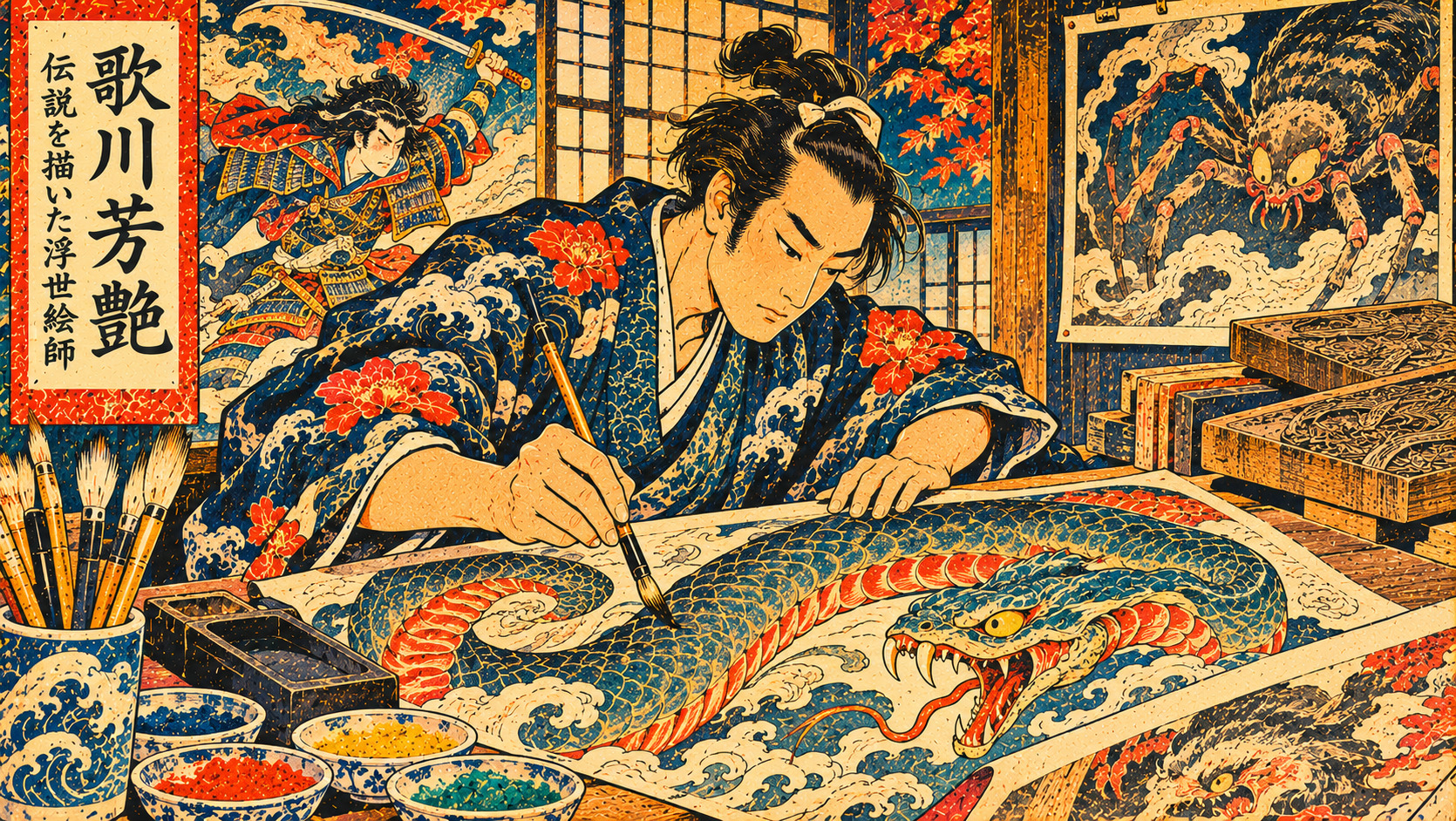
For this edition, JAPAN.co.jp has used his visual vocabulary as inspiration for new editorial illustrations of contemporary subjects. These generated images are explicitly distinguished from the historical prints. The original works are not merely decorative references: they invite readers to consider how visual narratives can make complex ideas memorable, and why imaginative design remains central to publishing.
Primary sources and references
- 文化遺産オンライン — 破奇術頼光袴垂為搦
- 太田記念美術館 — 浮世絵お化け屋敷(2024年)
- Spencer Museum of Art — Tsuchigumo (Earth Spider), 1984.0034.a,b,c
- The Metropolitan Museum of Art — Kabuki actors, JP1093.3
- University of Oregon — Lavenberg Collection: Utagawa Yoshitsuya
- Lyon Collection — Yorimitsu tries to capture Hakamadare
- 慶應義塾大学 — 源頼光公舘土蜘作妖怪図(歌川国芳)
- 国際日本文化研究センター — 丹波國大江山之圖
- 田中本家博物館 — 浮世絵の制作工程
- Lyon Collection — Artist biography and advertisements