- A character whose creator knows what disappointment feels like
- From character collector to character creator
- Kawaii without a comfortable life
- A market built over generations
- The team behind the rabbit
- The cost of work that never reaches an audience
- From drawn expressions to playable and animated experiences
- A competition designed to make discovery participatory
- Merchandise, licenses and the challenge of crossing borders
- What a decade of small encounters might achieve
- The complete JAPAN.co.jp interview: seven questions
A character whose creator knows what disappointment feels like
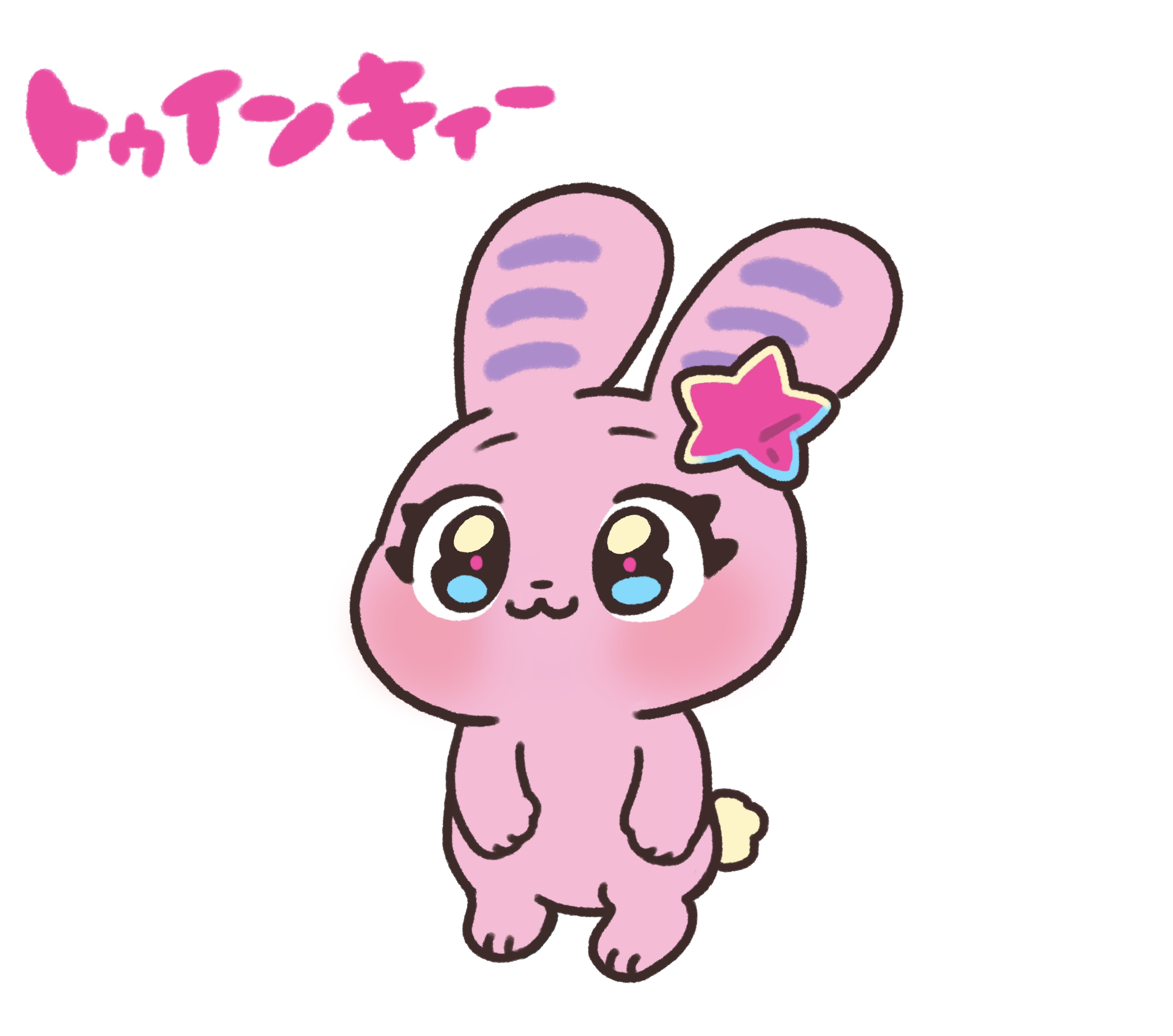
Twinkii has a pink body, a star-shaped ear accessory and an unusually precarious existence for a character designed to be cute. The rabbit has come from space, has no fixed address and cannot always count on finding food. Looking for work can lead to trouble. Yet the character keeps going, finding pleasure in small things rather than waiting for life to become comfortable.
On November 27, the Shibuya-based Twinkii Project Co., Ltd. is scheduled to begin its third high-score competition for its smartphone game. The event prompted JAPAN.co.jp to ask a larger question: what does it take to create an original character business in a country already home to some of the world's most recognizable fictional personalities?
In a seven-question written interview, founder and representative director Kohei Fukui offered an unusually candid account of the work involved. He spoke not only about collaborators and ambitions but about unanswered sales messages, disappointing download growth and a game project abandoned after money had already been spent. This is the story of an emerging business, not a retrospective on an established franchise.
From character collector to character creator
Fukui was a fan before he was a founder. Playing games and collecting merchandise made him wonder whether he might give others the same pleasure by inventing a character of his own. He says he began the project around the age of 29; that is his age at the time, not a verified current age or incorporation date.
The distinction between consuming a character and building one is considerable. A fan may encounter a finished illustration, but a creator has to decide how the character looks in different situations, what kind of world it inhabits and why someone would return to it. A business must also find people able to produce the work and channels through which to distribute it.
Fukui's ambition is to provide several entry points. A reader who encounters a manga might discover a game; a player might become interested in the character's everyday adventures. Merchandise could eventually provide another way for fans to keep the character close. The value of that strategy depends on whether audiences actually make those transitions.
Kawaii without a comfortable life
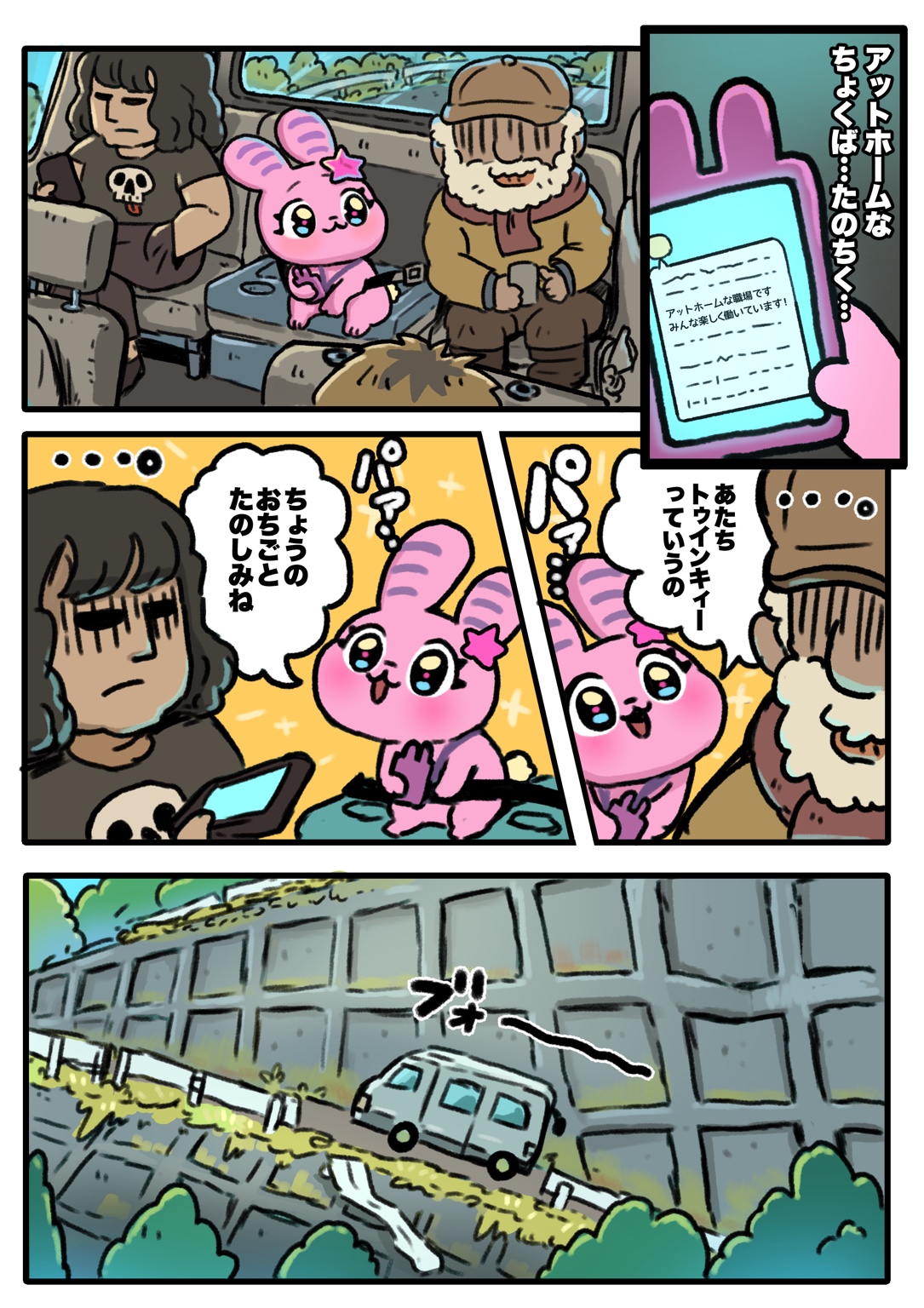
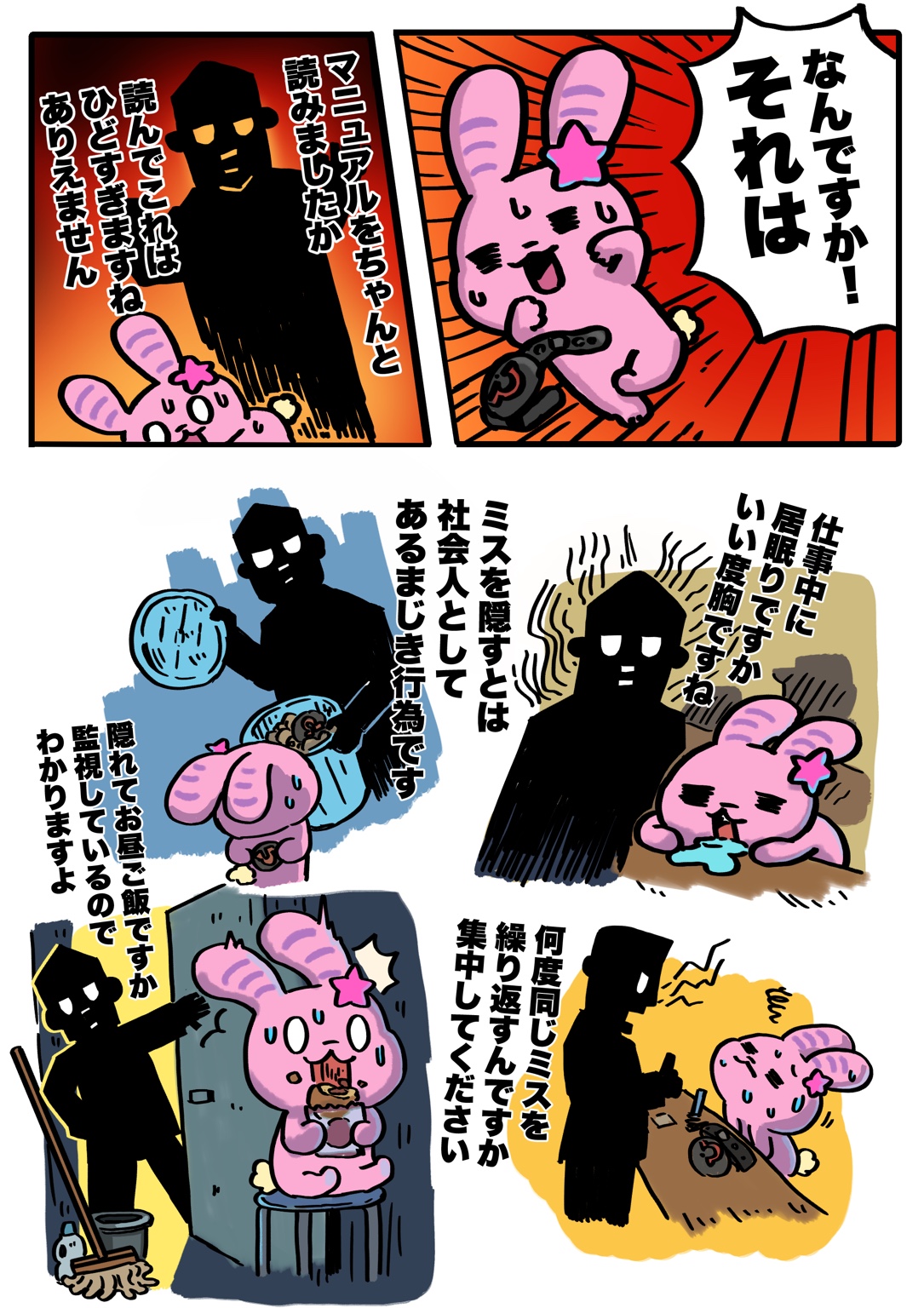
The second manga episode, released on November 9, is titled Atachi no Chokuba, roughly “My Workplace” in Twinkii's childlike pronunciation. In the supplied excerpts, an enthusiastic job seeker becomes a worker repeatedly reprimanded. The gap between the rabbit's appealing appearance and the workplace's demands is central to the humor.
Fukui says the character originally had a gentler tone. The difficulties of distributing creative work and running a business helped change the kind of stories he wanted to tell. “But reality does not wait until we are ready,” he explains in the interview. Twinkii's ability to resume life at her own pace after setbacks is something he himself admires.
For international readers, kawaii is often understood simply as cuteness. Here it is also a storytelling device: a vulnerable-looking protagonist makes an uncomfortable situation easier to approach without removing its discomfort. Fukui hopes readers may feel a little lighter after reading the manga. That is an artistic intention, not a measured psychological outcome.
A market built over generations
Japan's character industry offers several historical models for building a recognizable identity across products and media. Sanrio dates Hello Kitty's original design to 1974. Pokémon began with Game Boy titles in 1996, added a trading card game that year and a television anime in 1997. The Pokémon Center company was established in 1998 and became The Pokémon Company in 2000, widening its brand-management role.
These precedents illustrate that a character may become familiar through different forms of participation. They are not evidence that a small studio will follow the same trajectory. Established franchises have distribution networks, budgets and accumulated recognition that a new business does not.
Yano Research Institute estimated Japan's character business market, defined around merchandising and licensing rights, at ¥2.8767 trillion for fiscal 2025 in its July 2026 release. Its forecast for fiscal 2026 was ¥2.9635 trillion. These are market-wide figures, not licensing revenue available to Twinkii. The challenge for a new entrant is to convert a tiny share of public attention into durable engagement.
The team behind the rabbit
Fukui initially recruited collaborators on the Japanese freelance platforms CrowdWorks and Lancers. Later, he began approaching artists directly on social media after encountering work that he admired. His account describes a network assembled around creative affinities rather than a single large in-house production department.
The company's supplied portfolio names OBOtto as main art director; 内田清輝・グ弍 as an animation collaborator; よわいさかな as a music creator; and 南海 as an illustration contributor. It also describes collaborations with more than a dozen illustrators. The official website announced a live manga-production broadcast by OBOtto on October 3. These credits describe creative roles, not confirmed employment relationships.
A character appearing in different media needs a degree of visual and narrative continuity while allowing individual artists to contribute their own strengths. Clear agreements about usage, credit, compensation and reuse are important to that process. The terms of individual contracts were not disclosed, and the portfolio identifies some unreleased material that is not authorized for reproduction in this report.
The cost of work that never reaches an audience
The most revealing detail in Fukui's account is a game that readers cannot download. He says an entire project was cancelled after expenditure had already been incurred, resulting in a substantial business loss. No amount was disclosed.
A digital product can be distributed repeatedly without manufacturing another physical copy, but that does not make production free. Artwork, programming, sound, testing and subsequent maintenance all require resources. A founder may need to abandon a technically ambitious feature or an entire project if the cost of continuing becomes too high.
Fukui also acknowledges that downloads of the released game have not grown as he hoped. The company has not supplied a download total, retention figures or revenue data. A score competition and an active creative network are signs of activity; neither establishes profitability. For an independent studio, determining which creative experiments justify further investment is as important as completing them.
From drawn expressions to playable and animated experiences
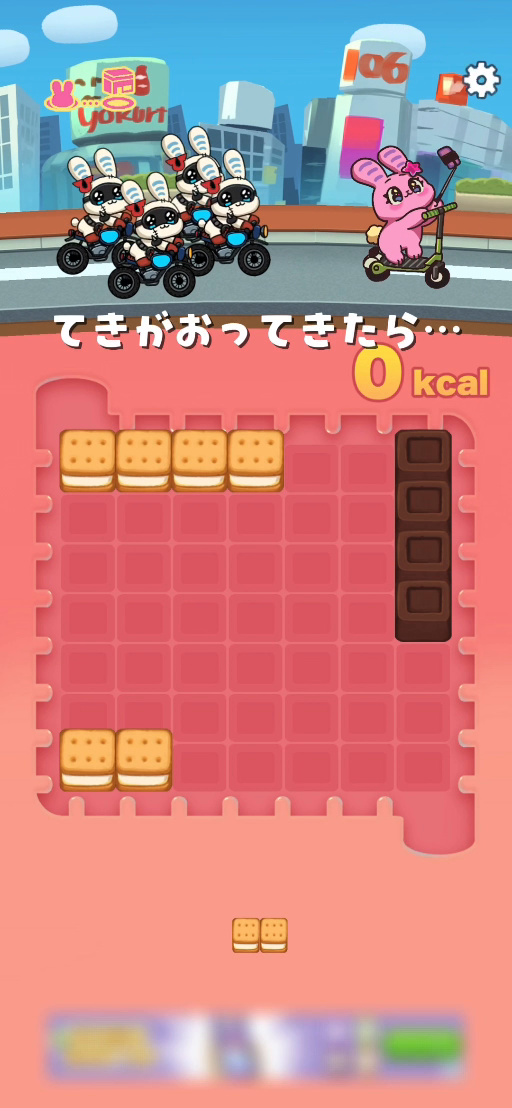
Twinkii no Puzzle Puripuri Chase is a free smartphone game combining food-themed block puzzles with a chase sequence. The supplied portfolio also describes environments inspired by Shibuya. The game gives the character a different mode of expression from the manga: players participate in its predicament instead of only reading about it.
Fukui says more than 100 people applied for voice roles in an animation under production. He reports that audition selection is behind schedule but production continues. The figure is an interview statement about applications, not independently audited audience demand or a count of cast members.
Animation introduces new decisions about timing, voice and movement. It can deepen a character's identity but also expands production requirements. No release date or completed audience response for the work in progress has been established. Earlier animation collaborations described in the portfolio should not be confused with the current voice-casting project.
A competition designed to make discovery participatory
The third Twinkii High Score King event is scheduled for November 27 through December 6. According to the company's official November 15 notice and November 20 release, participants post a screenshot of their game score on X with the designated Japanese hashtag #トゥインキィーチャレンジ. The announced prize pool consists of ¥11,000 in Amazon gift cards. Detailed judging and eligibility conditions are to be communicated by the organizer.
The company also permits monetized gameplay commentary and streaming within the announced scope; that permission does not extend to independent distribution of its music or unauthorized sale of game assets. A possible in-game item modeled on the winner is under consideration, not a promised prize.
For a small studio, a competition can create a reason for players to return and share a concrete experience. Whether it produces sustained engagement rather than a temporary increase in attention is an open question. No participation totals or subsequent retention measures were supplied.
App Store · Google Play · Official X account
Merchandise, licenses and the challenge of crossing borders
Fukui says the company is communicating with overseas OEM manufacturers and hopes to develop products with Japanese licensees. Neither signed agreements nor confirmed merchandise launch dates were disclosed. He intends to establish a stronger audience in Japan before pursuing overseas expansion in earnest.
Manufacturing and licensing are different ways to turn intellectual property into products. An OEM relationship involves making goods to a client's specifications; a licensing agreement grants defined rights to use intellectual property. Quality control, inventory, distribution, payments and the permitted scope of use are consequential business questions. They remain especially important when multiple creative contributors are involved.
International distribution raises another issue: how to preserve the voice of a character whose humor is rooted partly in Japanese language and everyday workplace conventions. Localized dialogue, product safety requirements and intellectual property protection would all deserve attention. These are potential challenges, not evidence that specific foreign market plans have already been finalized.
What a decade of small encounters might achieve
Asked what he wants Twinkii to become in ten years, Fukui does not offer a sales forecast or claim that his rabbit will become the next global icon. He hopes people will recognize the name and remember having read a manga, played a game or kept a piece of merchandise.
That modestly framed ambition is worth placing beside the large market estimates. Building a fictional identity that endures requires much more than producing a recognizable design. It requires audiences to find the work, value it and choose to return, while the people making it find a way to sustain their efforts.
Twinkii's future is uncertain, and the financial viability of the enterprise cannot be assessed from the information available. What the interview reveals is a creator attempting to transform his own experience of frustration into stories that other people might recognize. The next measure of progress will be found in the work itself and the relationships it forms with readers and players.
The complete JAPAN.co.jp interview: seven questions
The following is the complete seven-question written interview, translated from Japanese by JAPAN.co.jp. Paragraph divisions are retained.
Q1. What inspired the creation of Twinkii and the founding of your company?
I started Twinkii Project when I was around 29. I had always loved characters. Playing games and collecting merchandise featuring my favorite characters were hobbies of mine.
As I enjoyed those things, I began thinking, “Perhaps other people could enjoy the things I find so much fun,” and “This time, I want to create a character myself and share that enjoyment with someone else.” That was what inspired me to create Twinkii, the pink rabbit from outer space.
Some people fall in love with a character when they see an illustration; others grow attached to one as they play a game. That was how I enjoyed characters myself, so I decided to establish a company and work toward giving people ways to enjoy Twinkii through manga, games and, someday, merchandise.
Q2. Why depict the harsh realities of modern work and everyday life through a cute character?
Originally, Twinkii was a softer, more carefree character who would make you feel happy just by looking at her. I think I began depicting the difficulties of work and everyday life because I repeatedly experienced the harshness of reality while pursuing my own creative work.
Something I spent a great deal of time making would hardly reach anyone. I would contact people about business opportunities and receive no reply. People around me would tell me I was doing something unusual. These were difficulties I only came to know after I began making things myself and putting them out into the world.
To be frank, there are days when I do not want to work, and I would rather avoid hardship whenever possible. But reality does not wait until we are ready. Even when reality knocks her around, somehow the Twinkii in today's manga gets moving again at her own pace. I often get discouraged myself, so perhaps that is something I aspire to.
I hope people can watch Twinkii going about life at her own pace despite her difficulties, laugh a little, and think, “Maybe I could try doing things a little more at my own pace, too.” I want to make work that lightens the feelings of those who read it, even just a little.
Q3. What opportunities do you see as an independent company in a Japanese character market populated by major corporations?
Being independent gives us the possibility of bringing directly into the work the things I find funny or cute. While drawing a cute space rabbit, we can also depict the feeling of not wanting to go to work and the frustration of life not going as planned. I think there are stories we can tell through Twinkii precisely because they reflect my own experiences.
People who discover the manga might go on to play the game, and those who discover us through a game competition might read the manga. We value having something else for people to enjoy, wherever they first encounter us.
In practice, alongside creating the work, we also have to build the website, update social media, handle company procedures and undertake sales outreach. All of these take time. As we continue making things, we are also working out and testing our own ways of getting them to people.
Q4. How did your collaborations with illustrators, game developers, animators and music creators begin?
At first I recruited people to help with production on CrowdWorks and Lancers. As I encountered different works, I increasingly found myself thinking, “I would love to see Twinkii drawn by this person,” and I began approaching creators directly through social media. Many of the people we work with now are people I contacted because I was drawn to their work. Getting to create Twinkii alongside people whose work I absolutely love is one of the things that makes me truly happy about this job.
With games, we repeatedly spent time making and revising things, from developing the concept to discussing the artwork and producing the music. Some systems had to be dropped for production reasons, and we once cancelled an entire game project into which we had already put money. It was a major loss for the business.
For the manga, too, I had many meetings with the illustrator we commissioned. We discussed how to present my ideas in a way that would make them interesting as manga, then revised them again. Those repeated efforts are what allowed us to publish the work in its present form. It is difficult to see this from the finished product, but bringing each piece of work into the world took more time and trial and error than I had imagined.
Q5. What results can you share, such as game downloads and feedback from users?
Our smartphone game, Twinkii no Puzzle Puripuri Chase, is currently available. Downloads have not yet grown as we had hoped, and our immediate challenge is getting people to discover the work.
Against that background, we have held the Twinkii High Score King competition twice and are now able to hold a third edition. We have been able to continue because people played the game and took part by posting their scores.
We also received applications from more than 100 people for voice roles in the animation currently in production. I am truly grateful that they took an interest in Twinkii and wanted to be involved in the work. Selection for the voice auditions is running a little behind our original schedule, but animation production is continuing and the project is gradually taking shape.
Q6. What are your plans for merchandise, licensing and international expansion?
Regarding merchandise, we are currently in contact with overseas OEM manufacturers. In the future, we would also like to conclude licensing agreements with Japanese companies and jointly plan and develop products that fit Twinkii's world.
I personally enjoyed getting my hands on merchandise featuring characters I loved, so I would be happy if we could make Twinkii products that people wanted to keep around them in everyday life. I would encourage companies planning and developing products compatible with Twinkii to contact us through the official website.
As for international expansion, we want to first build awareness of our work in Japan and increase the number of people supporting us before seriously pursuing it. Eventually, I would like Twinkii to become a character born in Japan that people overseas can grow to love through manga, games and other media.
Q7. What would you like Twinkii to become in ten years?
In ten years I want Twinkii to be sufficiently well known that people say, “I've heard of Twinkii somewhere.” I would be happy if among them there were as many people as possible who could say, “I read the manga and fell in love with the character,” “I used to play the game,” or “I've kept this piece of merchandise for years.”
We are still at the beginning, so first we need people to read the manga and try the game even once. I want to steadily increase those individual encounters and nurture Twinkii, a character born in Japan, into one with many fans who will continue to love her for a long time.
Interview materials and sources
Primary reporting: written replies from Kohei Fukui received November 24 JST, a 22-page company-supplied portfolio and explicit image publication permission.