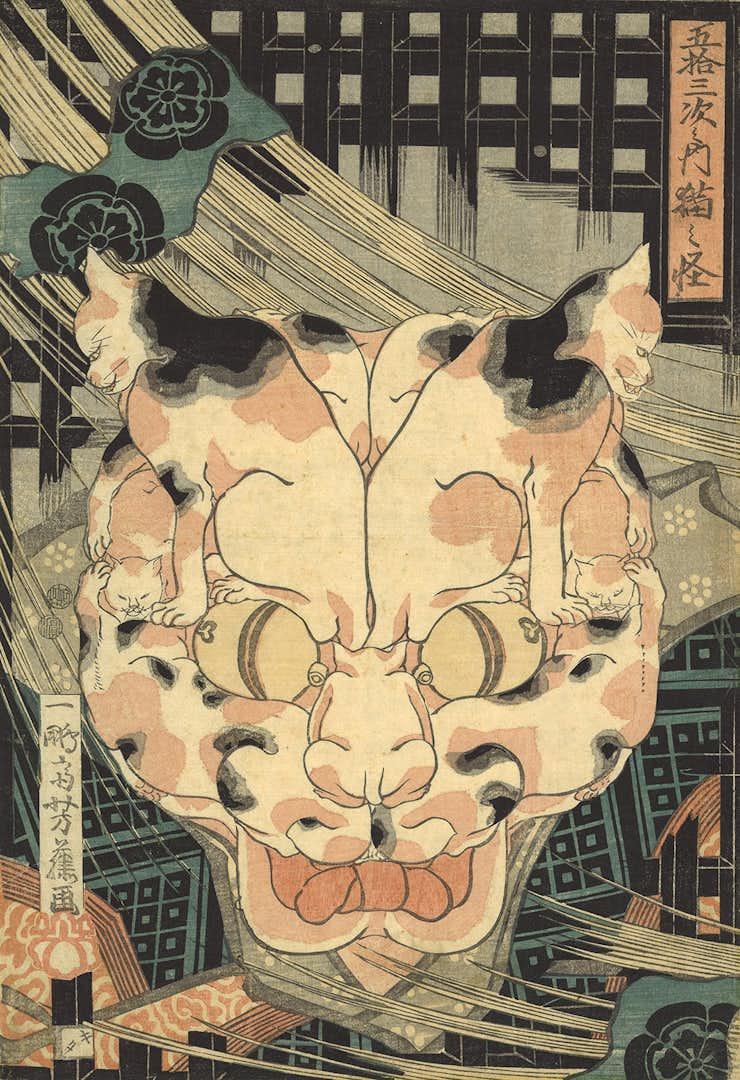
Before counting cats, stand back. What do you see first?
A monster appears. Then the monster becomes cats.
At first glance, a face stares back with the eyes of a supernatural creature. Move closer and the face starts to fall apart into living pieces: cats curled, stretched, crouched and turned, their bodies working together to make a larger animal. Even the eyes are cat bells. The print, preserved by Fukuoka City Museum, is a compact demonstration of something Utagawa Yoshifuji understood about an audience: people enjoy discovering that a picture has been looking back at them in more than one way.
The museum record matters
The work is catalogued as *Gojūsantsugi no uchi Neko no Kai*, usually translated *A Cat Monster Made up of Many Cats*. Fukuoka City Museum dates its copy broadly to 1847–1852, identifies the medium as a multicolour woodblock print and gives dimensions of 35.7 by 23.9 centimetres. Its collection identifier is 1993B04642. That record is a more reliable place to start than a reposted image circulating without provenance. The museum provides a viewable catalogue image, although its distribution service warns that reuse may require permission.
A specialist in play, not just a painter of cats
Yoshifuji was born in Edo in 1828, died in 1887 and trained under Utagawa Kuniyoshi. His birth name was Nishimura Tōtarō, according to the National Diet Library. He worked in the busy commercial world of woodblock publishing, making prints of warriors, contemporary life and encounters with foreigners as well as toys. Japanese collections remember him as *Omocha Yoshifuji*—Toy-Print Yoshifuji. That nickname points to an aspect of popular art easily overlooked by museums: the buyer was sometimes expected to change the print rather than simply preserve it.
First invention: pictures that require a second look
The cat monster belongs to the tradition of *yose-e*, composite pictures that make one large image from smaller figures. Yoshifuji learned in an artistic circle where playful distortions, witty associations and animals were already central. Yet the pleasure of his cat print is unusually immediate: from a distance, a threatening apparition; up close, an assembly of ordinary animals. The viewer supplies the final transformation by changing perspective. It is an optical trick, not a photograph, and not a demonstration of anything supernatural.
Second invention: figures made for scissors
The play did not stop at visual riddles. In *ryōmen awase-e*, printed front and back views could be cut out and joined to create figures. Tokyo Metropolitan Library holds Yoshifuji’s 1862 *Shinpan matoi ryōmen awase*. Tamagawa University Museum describes *Shinpan Genji sugata*, featuring characters from *The Tale of Genji*, whose two sides were designed to become joined figures. Its surviving edition is dated 1895, eight years after Yoshifuji’s death—a reminder that a print’s edition date need not be the date an artist originally designed it.
Third invention: the flat sheet as a miniature theatre
Yoshifuji also helped turn a sheet of printed paper into a three-dimensional object. Tamagawa University Museum describes his *Shinpan sakana-tsuri kumitate-ga asobi*, a fishing-scene construction print: cut the figures, back and assemble the pieces, and a small world stands on the table. Known broadly as *kumiage-e*, such works demanded both a designer’s precision and a child’s curiosity. The arrangement of parts on the sheet mattered, as did the order in which the user assembled them. These were products engineered for participation.
A lantern full of friendly monsters
Another Fukuoka City Museum work, *Atari no kawari andon*, contains six panels intended to form a small lantern. Its characters include a one-eyed childlike figure, a fox, a three-eyed monk, a supernatural rat, a monster cat and a tanuki-themed creature. The museum’s description suggests the figures could be assembled as an *andon*. Far from being only solemn mythological subjects, these creatures became household entertainment—strange, funny, portable, and close to hand.
What childhood play does to the historical record
Why are toy prints harder to find than many celebrated landscapes? The answer is partly built into their purpose. A paper doll is cut away from its sheet. A miniature stage is folded and glued. A game board is passed around, handled and worn. Masao Fukazawa of Miyagi Gakuin Women’s University observes that toys produced for children to use were inherently less likely to survive. Museums preserve precious intact sheets today, but their survival can obscure how most were originally consumed: with scissors, hands, laughter and wear.
Researchers are still decoding the jokes
In 2026, Fukazawa published an installment in a study of Yoshifuji’s cat-themed *Hiza no ue neko no sugoroku*, preserved by Tokyo Metropolitan Central Library. *Sugoroku* is a family of board games, and printed versions could pack stories, puns and familiar visual references into their squares. Reading one today involves reconstructing references that contemporary buyers might have understood immediately. This is not proof that Yoshifuji invented modern comics or video games. Rather, his work challenges the easy assumption that inexpensive, participatory media are a distinctly modern idea.
Can you count all the cats?
There is a final complication in turning the famous monster into a reader challenge. Independent popular commentaries disagree on the number of individual cats—some say nine, others ten. Fukuoka City Museum’s object description does not give an authoritative numerical answer. So Japan.co.jp will not print an invented official count. Open the museum record, enlarge the original and trace each body: is that one cat, or two overlapping forms? The uncertainty itself makes a better invitation to look closely.
See the original, not a misleading substitute
Our contemporary Yoshifuji-inspired lead illustration should be labeled as an interpretation, not as the nineteenth-century print. For the actual historical object, follow Fukuoka City Museum’s catalogue link. For an additional securely reusable example of Yoshifuji’s optical ingenuity, the Metropolitan Museum of Art lists his 1861 *Five Heads but Looks Like Ten People* as a public-domain image. Properly identifying each object, owner and reuse status makes the story both more useful and more trustworthy.
Examine the original and explore the collections
Follow these verified catalogue pages to view actual collection images. Reproduction conditions vary by institution.
- 福岡市博物館・作品台帳/Fukuoka City Museum collection
- 福岡市博物館・画像提供条件/Fukuoka reproduction terms
- 玉川大学教育博物館:魚つり組立画/Tamagawa fishing paper toy
- 玉川大学教育博物館:新版源氏姿/Tamagawa double-sided paper dolls
- 国立国会図書館・典拠データ/NDL artist authority
- くもん子ども浮世絵ミュージアム/Kumon Children’s Ukiyo-e Museum
- 東京都立図書館:新板まとい両面合/Tokyo Metropolitan Library
- 宮城学院女子大学:膝の上猫の寿古六/Miyagi Gakuin University research
- メトロポリタン美術館:五人のあたまで十人に見ゆる/The Met Open Access
- 福岡市博物館:当りのかわりあんどん/Fukuoka lantern print
- Wikimedia Commons:Newly Published Comic Picture of Cats