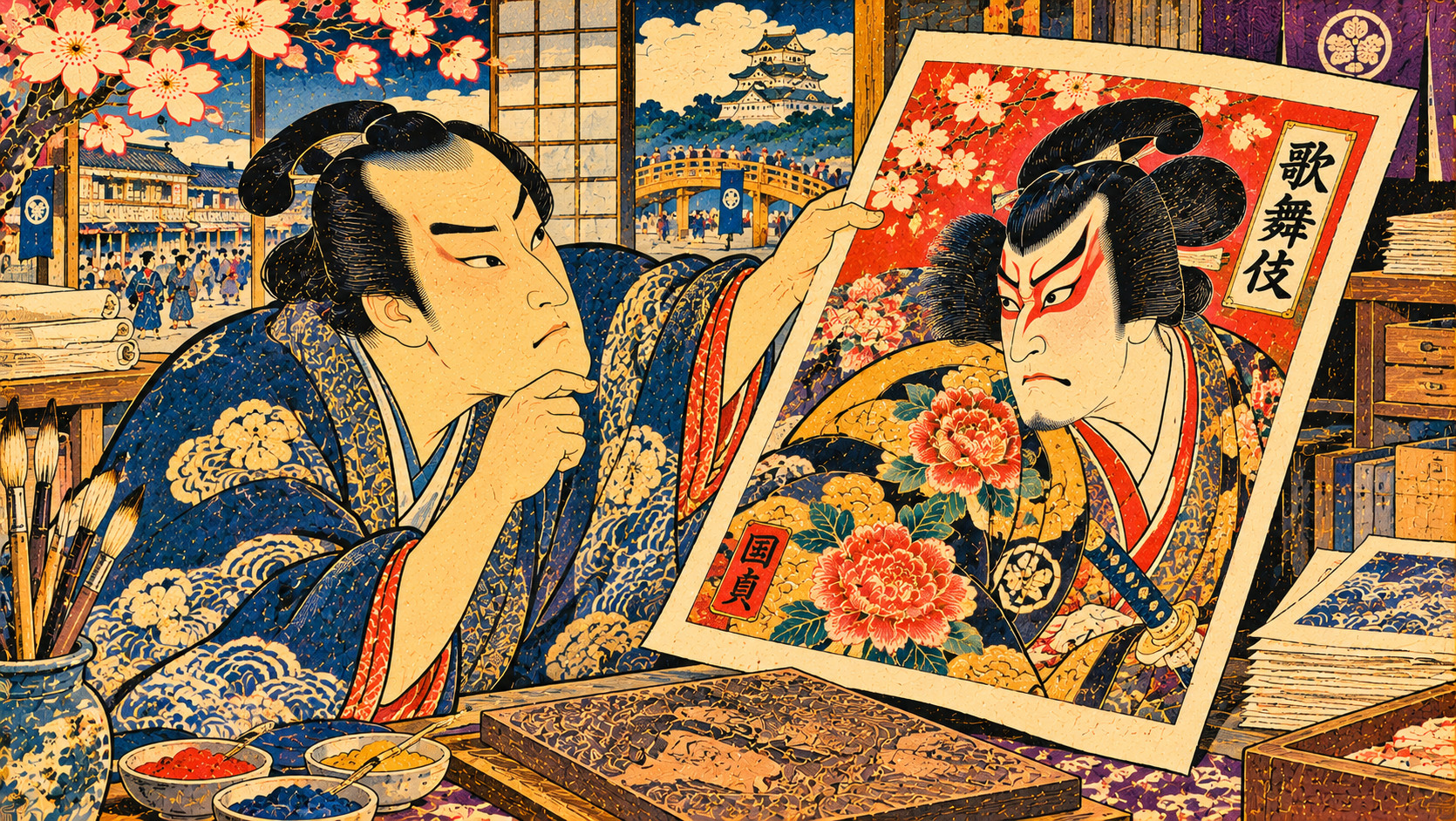
| Selected artist | Utagawa Kunisada, later Toyokuni III |
|---|---|
| Dates | 1786 – 15th day of the 12th month of Genji 1 (1864; often rendered 1865 in Gregorian conversion) |
| Core genres | Actor prints, bijin-ga, illustrated fiction, Genji imagery, historical and literary nishiki-e |
| Artist names | Ichiyūsai, Gototei, Kōchōrō, Toyokuni, Ichiyōsai, Kiō and others |
| Why choose him | His dramatic focal compositions, dense patterning, expressive figures and instant legibility suit homepage thumbnails and social-sharing images. |
| Editorial rule | Adapt Kunisada’s visual grammar, but keep modern architecture, science, clothing, transport and technology visibly modern. |
- Why Kunisada, why now
- An image-maker for mass culture
- What actor prints taught him about focus
- Pattern, fashion and the human surface
- Popular fiction and the power of narrative pictures
- The Toyokuni succession and the date problem
- How to adapt Kunisada for a modern newsroom
- Applying the system across 15 stories
- Tribute, not pastiche
- A coherent November 5 visual identity
Why Kunisada, why now
A daily news edition needs more than a pleasant style. It needs an image system that works at thumbnail size, holds together across unrelated subjects and still gives each story a clear center of gravity. That is why Utagawa Kunisada is such a strong choice for JAPAN.co.jp’s November 5 visual identity.
Kunisada excelled in actor prints, pictures of beautiful women and illustrated popular fiction. Across those genres he repeatedly solved the same editorial problem: how to make a viewer immediately identify the main figure, feel the emotional temperature of the scene and remain attracted long enough to absorb the surrounding detail. That is exactly what a homepage image and a social-share card must do.
The point is not to pretend that modern semiconductor plants, football squads or biomedical laboratories belong to the Edo period. The point is to borrow Kunisada’s visual grammar—bold contours, theatrical poses, rhythmic patterning, dense but legible surfaces, and a forceful focal arrangement—while keeping architecture, clothing, science and technology unmistakably contemporary.
An image-maker for mass culture
Official Japanese artist records place Kunisada’s life between 1786 and the 15th day of the 12th month of Genji 1, with activity beginning by 1807. The National Theatre’s digital library identifies him as Sumida Shōzō and lists a sequence of artist names including Kunisada, Ichiyūsai, Gototei, Kōchōrō and, after 1844, Toyokuni. Odawara City’s explanatory page similarly notes that he became famous for fresh bijin-ga and lively actor prints before inheriting the Toyokuni name.
These biographical facts matter because Kunisada was not simply a painter later admired by museums. He was one of Edo’s central producers of commercial imagery. Actor prints were part celebrity portrait, part fan culture and part visual advertising. Bijin-ga registered fashion, aspiration and gesture. Book illustration helped drive popular publishing. Kunisada worked at the point where images met demand.
Kawasaki Ukiyo-e Gallery’s 2026 exhibition announcement calls Kunisada and Kuniyoshi the two star artists of the late Utagawa school, emphasizing Kunisada’s elegant and gorgeous bijin-ga and actor prints. The Nakagawa-machi Bato Hiroshige Museum goes further, describing the illustrated Nise Murasaki Inaka Genji as a major factor in his rise and noting that his surviving output is often treated as one of the largest among ukiyo-e artists. The precise superlative can be debated; the scale of his productivity and popularity cannot.
What actor prints taught him about focus
The strongest news illustration tells the viewer, at once, where to look. Kunisada’s actor prints are masterclasses in that discipline. A Bunkamura curatorial essay explains that he established himself early with actor imagery, including the close-up series Yakusha Hanjimono and Ōatari Kyōgen no Uchi. These prints combined dramatic heads and gestures with luxurious surfaces and backgrounds, showing that publishers already recognized his commercial power.
What matters editorially is not just that the prints are beautiful. They are organized. Face, hands, gaze, diagonal movement, costume and background all point toward the star. Even when the image is dense, the focal hierarchy is never in doubt. In a modern news environment, that quality is gold.
A business story can therefore center a chief executive or lead engineer without losing the industrial setting. A science story can center the researcher, a microscope image or a key instrument. A sports image can pivot on the single decisive motion. Kunisada’s lesson is simple and durable: let the person carry the narrative, then let the surrounding design intensify it.
Pattern, fashion and the human surface
Kunisada’s other great strength is surface richness. Official and museum explanations repeatedly emphasize his bijin-ga, his attention to fashion and the visual pleasure of patterned textiles and accessories. Odawara City’s note points to the popularity of his later beautiful-woman type; Bunkamura highlights the extraordinary carved and printed detail visible in hairlines, garments and adornment.
This matters for editorial work because visual attraction does not come only from likeness. It also comes from the way an image rewards looking. Factory grids, circuit traces, laboratory glassware, sports uniforms, train lines, illuminated city windows—these can all become patterned surfaces that carry information while also giving the page a memorable look.
Kunisada teaches a useful newsroom lesson here as well. Decorative density need not fight clarity. If properly organized, it can support mood, imply context and make the image more shareable without sacrificing readability.
Popular fiction and the power of narrative pictures
The Nakagawa-machi Bato Hiroshige Museum identifies Kunisada’s illustrations for Ryūtei Tanehiko’s Nise Murasaki Inaka Genji as a turning point. The work became a bestseller from its first publication in 1829 through the Tenpō years, and Kunisada’s contribution was not merely explanatory. He translated story, costume, interior space and social intrigue into scenes people wanted to see, collect and revisit.
He then pushed that narrative world back into print culture as independent pictorial products. In other words, he understood how a scene from a longer story could become a marketable image in its own right. That is strikingly relevant to digital journalism. Every reported article must be represented by a single picture that opens the door to a much larger narrative.
In that respect, Kunisada was not only an artist but also a designer of entry points. He knew how to isolate a dramatic moment and let it stand for a broader world. That is exactly the challenge of a modern homepage thumbnail.
The Toyokuni succession and the date problem
Any serious feature on Kunisada has to deal with naming. Official Japanese records show that from 1844 he used the name Toyokuni, yet modern scholarship generally counts him as Toyokuni III rather than II. Odawara City and Tokyo Fuji Art Museum both explain the point clearly: he claimed the second-generation title, but by present convention he is treated as the third.
That is why this feature uses both names. “Utagawa Kunisada” is the most immediately recognizable artist name for modern readers, while “Toyokuni III” is essential for museum and collection literacy. The same problem appears in his death year. Japanese institutional records cite the old-calendar date in 1864, while some English-language museum references present the Gregorian-converted date as 1865. The discrepancy is calendrical, not biographical.
For an online publication, this is not pedantry. Readers often arrive through search. Clear naming is part of serving them well.
How to adapt Kunisada for a modern newsroom
The November 5 plan uses Kunisada as an influence, not a costume shop. Modern buildings remain modern. Laboratories keep their current instruments. Executives wear suits, researchers wear contemporary work clothes, footballers wear kits rather than Edo dress. The adaptation happens in line, layout, color masses, patterning, figure emphasis and the treatment of space.
This middle path is important. If the images were transformed into faux-Edo reconstructions, they would blur the modern reality of the reported events. If they were simply generic digital illustrations, the edition would lose the cultural coherence that makes a special package memorable. Kunisada offers a practical answer: he provides a robust formal system, not a requirement to historicize the subject.
That is also why he works across a general-news package rather than only in arts coverage. The value lies in his image architecture—his method of commanding attention—not only in the historical prestige of his name.
Applying the system across 15 stories
Kunisada’s flexibility is the main reason he can hold an entire edition together. In business coverage, his theatrical sense helps stage chief executives, industrial plants and strategic investment. In science, his strong figure-ground relationships help translate abstract research subjects into legible editorial scenes. In community stories, his human-centered approach suits townscapes and everyday movement. In sports, his dramatic poses and kinetic diagonals naturally support moments of competition. In culture, of course, he is exceptionally well suited to portraits, historical subjects and museum stories.
The goal is not repetition. The goal is family resemblance. Each of the fifteen illustrations can differ in setting and subject matter while still sharing certain structural traits: one unmistakable focal point, a bold figure or object, ornamental richness used in support of narrative, and a palette grounded in indigo, vermilion, ochre and green.
The additional featured-artist tribute image performs a special editorial job. It explains the source of the edition’s visual language and tells readers that the coherence across the package is intentional. In effect, it acts as a key to the day’s illustrated system.
Tribute, not pastiche
There is an ethical side to this choice. Kunisada’s prints were collaborative commercial products involving publishers, carvers, printers, theatrical culture and audience appetite. A digital editorial illustration made in 2026 does not share the same production conditions. That is why the correct framing is “inspired by Kunisada” rather than any suggestion of historical reproduction.
Respect means understanding what is being adapted. From Kunisada we borrow focal strength, expressive human presence, ornamental surface, and the capacity to turn narrative into a compelling single image. We do not pretend to re-create the market, materials or exact hand of nineteenth-century ukiyo-e.
Handled well, that distinction makes the project stronger. Instead of consuming the past as décor, the edition enters into a dialogue with Japanese visual history and asks what remains useful in it for the design of contemporary news.
A coherent November 5 visual identity
The simplest reason to choose Kunisada is that he gives a news package a face. He makes it possible to be dramatic without becoming obscure, decorative without becoming cluttered, and historically grounded without turning modern stories into period theater.
Kunisada was, in practical terms, an editor of attention. He knew whom to foreground, which gesture to privilege, how to let costume and background intensify the subject, and how to make a single sheet carry a whole narrative charge. Those are newsroom problems as much as they are art-historical ones.
That is why Kunisada is the right featured artist for JAPAN.co.jp’s November 5 edition. His work offers not just beauty but method: a way to give fifteen unrelated stories a shared visual grammar while allowing each one to remain unmistakably itself.
Sources and reporting method
Documentary feature based on primary-source research, museum collections, curatorial essays and official artist records.
- National Theatre of Japan, Digital Library: Artist record for the first Kunisada / Toyokuni III
- Odawara City: Utagawa Kunisada = Toyokuni III
- Nakagawa-machi Bato Hiroshige Museum: Artist data for Kunisada / Toyokuni III
- Kawasaki Ukiyo-e Gallery: Kunisada and Kuniyoshi exhibition notice
- Bunkamura Museum curatorial essay on Kunisada and Kuniyoshi
- Tokyo Fuji Art Museum: The Tale of the Soga Brothers: The Tenth Cut and artist profile
- Odawara City: Detailed commentary on Soga Jūbangiri no Zu
- Cultural Heritage Online: Kunisada works search portal