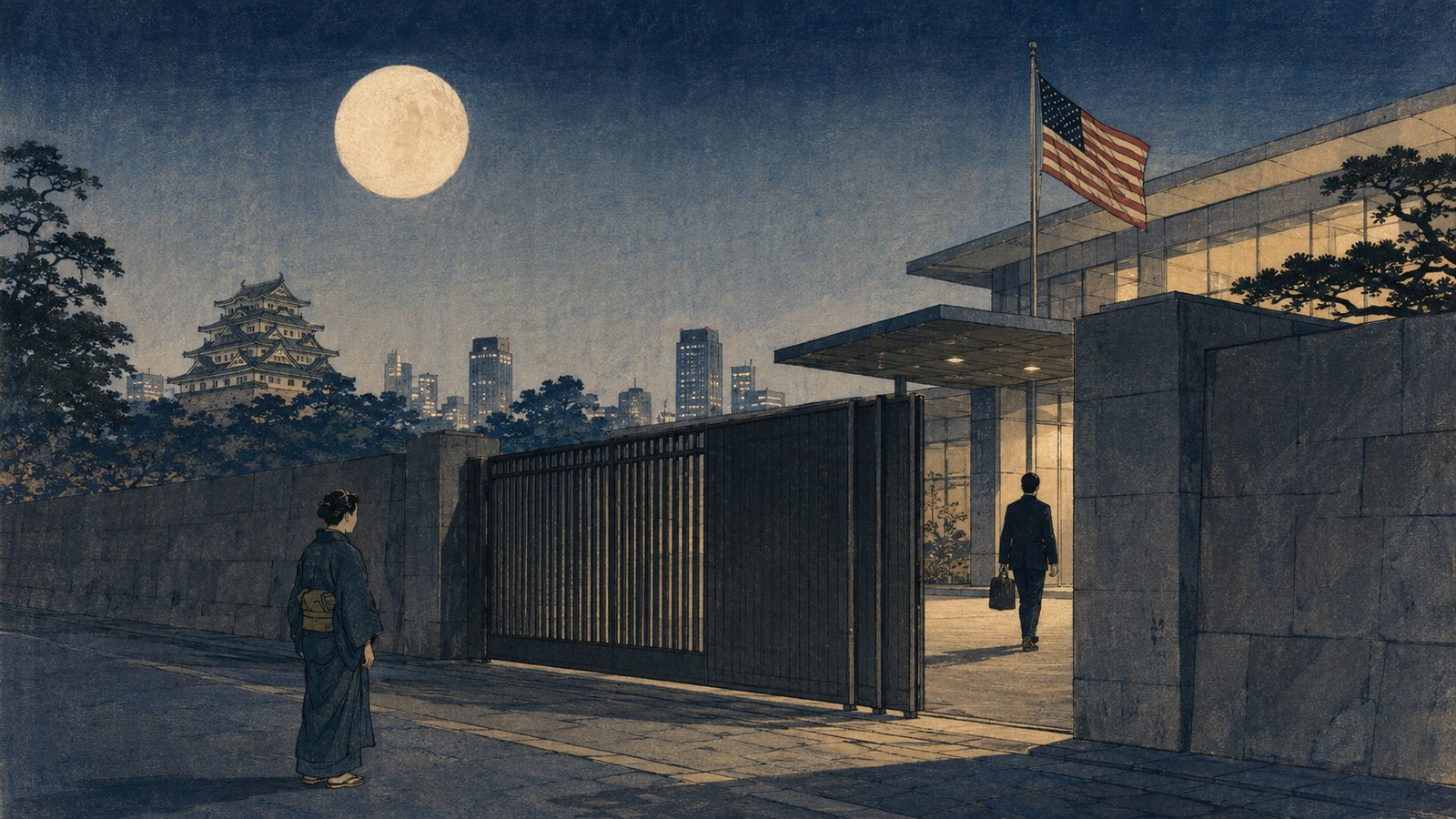
Walk east from Nagoya Station and, just before the Horikawa river, the Nagoya International Center rises above the city. The U.S. Consulate occupies part of its sixth floor. It has none of the broad grounds or imposing walls of the embassy in Tokyo. It is a modest diplomatic post folded into a building devoted to international exchange.
The plan to close that quiet door began not in Nagoya, but in Washington. In a nonpublic notice sent to some congressional committees, the State Department said it intended to close the Nagoya post along with missions in Medan, Indonesia; Winnipeg, Canada; Douala, Cameroon; and St. George’s, Grenada. The group includes an embassy, consulates and an embassy branch office. Closing several posts at once, without a war or political rupture forcing the decision, would be a rare contraction of America’s overseas network.
To describe Nagoya as one small office, however, is to miss what is being withdrawn. The lineage of the post reaches to 1912—before Toyota Motor existed and long before Japanese cars became central to the American economy. Its doors closed when the U.S.–Japan relationship broke down and opened when the two countries rebuilt it. For more than a century, the consulate has been a kind of barometer of the relationship.
For now, the closure exists on paper—not at the door
The first obligation is to distinguish a plan from its execution. According to Reuters, the notice reached congressional committees late last week. Asked about the report, the State Department did not confirm the posts. It stressed that the U.S. overseas footprint should be efficient and effective and that the department would follow congressional notification procedures. There is no public order naming a final day of operations or a successor office.
Japan’s Foreign Ministry list of foreign missions, updated in January 2026, still includes the U.S. Consulate at 1-47-1 Nagono, Nakamura Ward, on the sixth floor of the Nagoya International Center. It assigns the post Aichi, Gifu and Mie. The U.S. Mission in Japan includes the Tokyo embassy and posts in Sapporo, Osaka–Kobe, Naha, Nagoya and Fukuoka. If Nagoya goes, America will lose a permanent diplomatic post in the industrial center of the country.
- Reported: Officials familiar with a nonpublic notice told Reuters that the department plans to close five missions.
- Not confirmed: The State Department has not publicly confirmed the individual posts.
- Not published: The closing date, staffing effects, property arrangements or expected savings.
- Not published: Whether Tokyo or Osaka–Kobe would inherit responsibility for Aichi, Gifu and Mie, and how.
- Not published: The future of the Nagoya American Center, educational advising and regional programs.
Those unknowns are not administrative trivia. Closing a post means designing a replacement for emergency contact with U.S. citizens, liaison with local governments, business outreach, guidance for students considering study in America, and on-the-ground reporting about political and economic change. Nagoya is about 90 minutes from Tokyo and 50 minutes from Osaka by bullet train. That makes coverage from elsewhere possible. It does not make distance disappear.
America’s listening post before Toyota
According to the official U.S. history of the mission, consular activity in Nagoya began in 1912 and a formal consulate opened in 1920. The city was already expanding as a center for textiles, ceramics, machinery and maritime trade. Diplomats are posted outside capitals not for ceremony but for observation: to understand what ships carry, where factories invest, what local leaders debate and how commercial frustration is forming before it becomes national policy.
The early consuls could not have foreseen today’s automotive alliance. Yet putting American eyes and ears in Nagoya acknowledged that trade across the Pacific would grow. The formal consulate predates Toyota Motor by 17 years. Seen from today—when decisions in central Japan can move production lines across North America—the judgment looks prescient.
1940: closure on the eve of rupture
The first closure was not a cost-saving exercise. The war in China, U.S. export controls, the Tripartite Pact and deepening mistrust were collapsing relations between Tokyo and Washington. The Nagoya consulate closed at the end of 1940, roughly a year before Pearl Harbor.
The shuttering did not cause the war. But the loss of local contact was a sign that crisis had hardened into separation. Without regional posts, fewer people directly observe the other country’s local society. Reporting narrows toward politics and military power in the capital. Personal networks thin. A diplomatic post does not acquire value on the day a crisis begins; its value depends on the contacts and trust accumulated beforehand.
After the war, rebuilding began with a library
The return did not begin with an imposing diplomatic compound. It began with a simple library in 1947. Access to American books, periodicals and information carried the unmistakable imprint of occupation-era public affairs, but it also rebuilt a broken relationship through knowledge and individual contact. In 1953, the space was renamed the Nagoya American Cultural Center.
Consular functions returned in 1950 as the Nagoya American Consular Service. After the San Francisco Peace Treaty took effect in 1952, it again became a U.S. consulate. The treaty restored relations in law; the regional post translated that settlement into everyday contact. If reconciliation was a document, the consulate gave it an address and a telephone number.
Then, in 1970, the post closed again. This time there was no war—only a decision to rearrange the diplomatic footprint. For 16 years, a rapidly growing industrial region had no resident American diplomat.
Trade friction brought Washington back
By the late 1970s and 1980s, disputes over Japanese automobiles, semiconductors, machine tools and market access had become a defining strain in the alliance. From Washington, the negotiating partner seemed to be the government in Tokyo. In practice, the companies and communities making decisions about vehicle design, production and procurement were concentrated in central Japan.
The Nagoya American Center was established in the International Center building in 1984. In 1986, a Nagoya branch of the U.S. consulate in Kobe opened, returning American diplomats after a 16-year absence. On December 2, 1993, the U.S. Consulate Nagoya formally reopened after 23 years. Ambassador Walter Mondale attended the ceremony.
The logic was revealing. Washington could not understand Japan’s industrial power by criticizing it from afar. Supporting American market access, following Japanese investment in the United States, and building relationships with companies, universities, politicians and media required people where the economic decisions were being made. A consulate cannot dissolve trade conflict. It can turn assumptions into information and strangers into working contacts.
1912: U.S. consular activity begins in Nagoya.
1920: The formal U.S. consulate opens.
1940: The post closes as bilateral relations deteriorate.
1947: A postwar library opens and becomes a center for cultural engagement.
1950–52: Consular functions return; the office becomes a consulate after the peace treaty.
1970: The consulate closes for a second time.
1984–86: The American Center opens, followed by a Nagoya branch office.
1993: The consulate formally reopens after 23 years.
2005: Before the Aichi Expo, the consulate and American Center are consolidated on the sixth floor.
2026: The State Department is reported to have notified Congress of a closure plan.
2005: an investment in “the growing importance” of Chubu
The post moved into its present consolidated sixth-floor facilities for the 2005 Aichi Expo. The United States renovated the space, bringing the consulate, the U.S. Commercial Service and the Nagoya American Center together. In its opening announcement, Washington described the project as a sizable investment reflecting the growing importance of the Chubu region.
The expo drew 121 countries and four international organizations. The U.S. gave its commissioner general personal ambassadorial rank. According to the American record, it was the first time an envoy of that rank had been stationed in Nagoya. Washington did not assume that the work could be managed through occasional trips from Tokyo; when the world came to Chubu, the United States put a senior face on the ground.
The 2026 proposal reverses the message of 2005. No public assessment says central Japan has become less important. What changed is not the region’s industrial weight but the way Washington is measuring the cost and priority of its diplomatic network.
Not a provincial city, but a workshop for the world
On a population chart, Nagoya can look like one city outside Tokyo. On an industrial map, it looks entirely different. JETRO calls Aichi the industrial capital of Japan and says it has ranked first in the country for the shipment value of manufactured products since 1977. The prefecture accounts for roughly 40 percent of Japan’s transportation-equipment shipments. The wider Chubu region produces more than half of Japan’s aircraft and aircraft-related components; about one-third of a Boeing 787’s structure is manufactured in Aichi.
Toyota Motor’s headquarters and major research facilities, along with Denso, Aisin, Toyota Industries, Mitsubishi Heavy Industries and a dense web of materials, machine-tool and component companies, make Aichi and its neighbors a single production ecosystem. JETRO describes the Port of Nagoya as handling more freight than any other Japanese port. Tariffs, export controls, semiconductors, batteries, aerospace, defense production and Japanese investment in the United States—the major items on today’s U.S.–Japan economic agenda—become concrete in the factories and docks of this region.
| Washington’s policy issue | The reality in Chubu | Why a local post matters |
|---|---|---|
| Autos and tariffs | Vehicles, components, materials and machine tools cluster here; decisions about U.S. investment are made here | Officials can hear regional and corporate reactions directly, not only through Tokyo |
| Economic security | Aerospace, robotics, next-generation vehicles and advanced materials form critical supply chains | Local reporting can reveal the effects of policy changes early |
| People-to-people ties | Universities, researchers, prospective students and municipal exchanges | Advising, lectures and exchange programs can continue regionally |
| Crisis response | A huge industrial zone, port operations, foreign residents and Nankai Trough earthquake risk | Contacts with local authorities exist before a disaster |
This is the proposal’s first contradiction. The more Washington emphasizes resilient supply chains, investment in America and protection of advanced technology, the more it needs to understand Chubu. A policy that removes diplomats moves the point of understanding farther away.
A consulate is more than a visa window
It is fair to ask whether a regional post is still necessary when forms can be completed online and a bullet train can carry an officer from Tokyo. But reducing a consulate to appointments and documents erases the quiet part of diplomacy.
The Nagoya post tracks regional economic and political change for Tokyo and Washington. Its principal officer builds relationships with governors, mayors, companies, universities and media. The Nagoya American Center has advised students, parents and teachers about study in the United States and organized programs explaining American society. In the spring of 2026, the U.S. Mission took its America 250 anniversary outreach to the Japanese Grand Prix at Suzuka, another example of engagement built around a central-Japan audience.
The return on these activities is difficult to count. Attendance at a lecture can be measured. It is harder to price the phone call placed before a misunderstanding becomes a dispute, the corporate concern that reaches a policymaker early, or the student who chooses an American university after receiving reliable guidance. What can look like slack in a diplomatic budget is sometimes relationship capital reserved for a crisis.
Why close it now?
The five proposed closures are not connected by one region, threat or diplomatic emergency. Reuters reported that the common factor is the Trump administration’s drive to reshape government around its “America First” agenda and cut costs. In early 2025, the State Department prepared to close nearly a dozen missions, while the Office of Management and Budget advocated an option reaching as many as 30. The department later cut organizations and staff but, at that point, did not shutter foreign missions.
Secretary of State Marco Rubio has presented cost cutting as necessary to right-size an organization conservatives regard as too large and bureaucratic. There is a legitimate resource question behind that argument. Must every small post remain open in an allied country with excellent communications and fast transport? Should scarce diplomats and security money move to harder environments shaped by war, terrorism or strategic competition?
The difficulty is that the department has not published Nagoya’s operating cost, projected savings or the expense of replacing its work. Without numbers, outsiders cannot test the value-for-money claim. Rent and payroll savings appear immediately in an account. Delayed regional knowledge, weaker company relationships, extra burdens during a disaster and the cumulative effect of ceding local presence may not appear for years.
China would remain in Nagoya
The proposal also creates a strategic asymmetry. Japan’s Foreign Ministry lists a Chinese consulate-general in Nagoya. Reuters noted that China maintains a diplomatic presence in three of the five places on the U.S. closure list: St. George’s, Nagoya and Medan.
That should not be turned into a simplistic scorecard. U.S. and Chinese posts have different missions and sizes, and influence does not automatically transfer when one consulate closes. The U.S.–Japan alliance is deeply institutionalized across defense, trade, technology, investment and personal ties.
But diplomacy has a physical dimension: who is in the room. When a prefecture develops an international project, a university seeks partners or a company wants to discuss regulation and investment, a resident consul is easier to meet. If the United States covers Chubu from Tokyo while China builds relationships each day in Nagoya, the difference accumulates. Strategic competition advances not only through forceful statements, but through repeated appointments.
What a bullet train can replace—and what it cannot
Travel from Tokyo to Nagoya is easy. Video calls are routine. A national consular network and 24-hour emergency channels can support Americans even if one post closes. Washington would not vanish from central Japan.
Yet a visitor meets the people on an itinerary; a resident notices changes that were never scheduled. A short report in the local press, a supplier’s financing problem, a prefectural debate, a university breakthrough, a municipal disaster drill—none looks like national strategy alone. Collected over time, they reveal where an economy and society are moving.
Twice before, the United States left Nagoya and later decided it needed to return: after the war to rebuild relations, and during the 1980s and 1990s to understand the center of trade friction. The minimum test for the new plan is not a general promise that Tokyo can cover the region. It is a specific explanation of which office, with how many people and how often, will replace the functions Washington previously restored.
What happens next
First, watch for a public State Department explanation: the named posts, the administrative timetable, treatment of American and locally employed staff, and expected savings. Second, watch Congress. Notification is a procedural step, not the same thing as a public final announcement; lawmakers can scrutinize the policy through budgets, oversight and consultation. Third, watch how forcefully Japan’s government, central-Japan municipalities and the region’s business community ask for details.
The most practical question is the transition. Will Tokyo or Osaka–Kobe cover Aichi, Gifu and Mie? Will the Nagoya American Center remain? Who will own emergency coordination, student advising, and regular contact with companies and governments? The success of a closure is not measured on the day the sign comes down. It is measured the next morning, when someone calls and asks who now answers.
- A formal State Department announcement naming the posts and timetable
- Post-level costs, expected savings and new transition expenses
- The response from congressional committees and lawmakers in both parties
- Formal consultations with Japan and with Aichi, Gifu, Mie and Nagoya
- The handover of U.S.-citizen support and disaster-response contacts
- The future of the Nagoya American Center and EducationUSA advising
What one door says about an alliance
An embassy represents a state. A regional consulate translates the state-to-state relationship into ordinary life. It hears how a tariff negotiated in a capital lands in a factory. It knows local emergency officials before a disaster. It hands a map to a student considering America. It turns regional frustration into words before it hardens into a diplomatic problem.
The Nagoya consulate is not a grand building. That is why its value can be easy to misread. Its history since 1912 has not been a straight line. It closed in 1940 and 1970, then returned in the 1950s and 1993. Each time, Washington rediscovered a reason to put people in central Japan.
If the United States chooses a third retreat in 2026, the question is not nostalgia. It is whether the world’s leading manufacturing regions can be understood well enough without a permanent local post; whether America can thin regional diplomacy in one of its most important allied countries while competing for presence across the Indo-Pacific; and whether today’s savings will really exceed the price of having to return tomorrow.
For now, the door is closing on paper. The sixth floor of the Nagoya International Center still carries an American address. But diplomatic retreat does not begin on the last day of business. It begins when a government decides the relationships built on the ground are no longer worth maintaining there.
Reporting notes and sources
This article is based on public information checked through August 4, 2026, at 10:10 a.m. JST. The Reuters scoop was tested against U.S. and Japanese government records. The article will be updated if a closing date or transition plan is published.
- Reuters: U.S. State Department plans to close five foreign missions
- Japan Ministry of Foreign Affairs: U.S. Embassy and consulates in Japan
- U.S. Embassy & Consulates in Japan: Official site
- U.S. Embassy Japan: History of U.S. Consulate Nagoya
- U.S. Consulate Nagoya archive: Renovations Complete on Nagoya Consulate and American Center, 2005
- EducationUSA: U.S. Consulate Nagoya
- JETRO: Aichi regional and industrial profile
- JETRO: Nagoya City industrial profile
- Toyota Motor Corporation: Company profile and Aichi locations
- Japan Ministry of Foreign Affairs: Foreign missions including the Chinese Consulate-General in Nagoya
- U.S. Department of State Foreign Affairs Manual: Opening, Closing, or Changing the Status of a Foreign Post