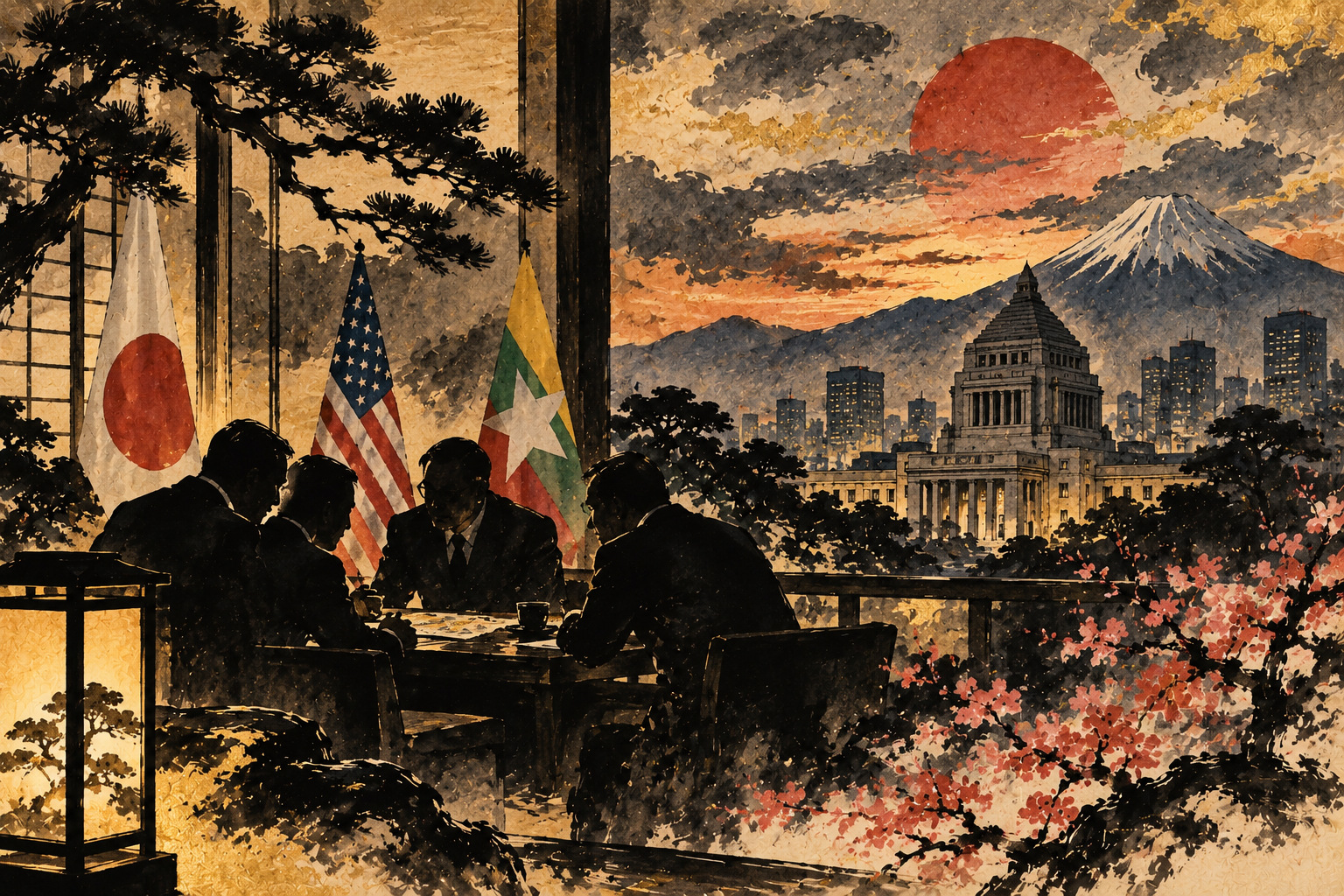
Tokyo was reportedly the venue. That does not establish Japan as the broker.
A discreet meeting in an unlikely city
Tokyo has emerged as the setting for a diplomatic encounter that neither Washington nor Myanmar’s military-backed authorities were eager to describe in public. Reuters reported on October 16, citing three people familiar with the matter, that American officials met representatives of the Myanmar government in Japan during the preceding week. It was reportedly their second meeting in roughly a month, following talks in Naypyidaw in September.
That makes the location striking but also easy to misread. A meeting held in Tokyo is not automatically a meeting mediated by Japan. There is no verified public account of Japan arranging the contact, endorsing its agenda or recognizing Myanmar’s military leadership. The identities of Myanmar’s participants and the precise discussion in Tokyo have not been established. The unanswered questions are central to the story, not footnotes.
Who was there—and how much is known
Reuters identified Michael Vance, the US assistant secretary of state responsible for intelligence and research, as the leader of the American delegation, citing a person familiar with the gathering. More than a dozen US officials were reportedly involved. The US State Department did not offer an account of the meeting; it said Vance’s bureau was not setting overall Myanmar policy.
Some governments maintain narrow contacts with adversaries over detainees, crime or humanitarian matters even while strongly disputing their legitimacy. Such contact does not necessarily constitute diplomatic recognition. Equally, a high-level delegation may indicate that someone in Washington sees possible value in a channel. Beyond those cautious inferences, the record does not establish a grand bargain.
Five years after the coup, no ordinary counterpart
Myanmar’s armed forces overturned an elected civilian government on February 1, 2021. The coup ended a fragile period of democratic opening and was followed by protest, armed resistance, repression and prolonged conflict. Japan’s 2026 Diplomatic Bluebook describes continuing fighting between the military, pro-democracy forces and ethnic armed organizations, along with grave civilian losses.
The UN human rights office documented extensive harms to civilians and infrastructure and warned in its 2026 update that attacks on children were especially severe in 2025. The identity of Washington’s interlocutor is therefore not a matter of diplomatic etiquette alone. Any opening toward military-linked rulers must be assessed alongside demands for accountability, humanitarian access and a credible political future for the people living under the conflict.
Detainees and cyberfraud: the immediate incentives
According to Reuters, the earlier September contact focused on the release of a detained American businessman and efforts to close cyber-scam operations targeting Americans. The October Tokyo agenda has not been independently confirmed. Whether the detainee’s position changed, whether particular sites were identified or whether promises were made remains unknown publicly.
The stakes of online scams extend far beyond financial loss. A February 2026 report by the UN human rights office describes trafficking victims trapped in large cyberfraud operations in Southeast Asia, sometimes coerced into defrauding people abroad. Raids on criminal compounds can be useful, but a durable solution must also protect exploited workers, prevent renewed recruitment, investigate organizers and avoid punishing trafficking survivors for offenses committed under coercion.
The rare-earth temptation—and its limits
Myanmar is relevant to the supply chain for heavy rare-earth elements used in industrial and defense technologies. China’s role in processing and the complex geography of border trade make any change in access strategically interesting to governments seeking diversified supplies. Reuters reported that mineral resources could enter broader future discussions. That is not evidence that the Tokyo meeting produced a mining deal, an offtake contract or a relaxation of sanctions.
The obstacles are severe: conflict, uncertain control of mine sites, environmental damage, transportation bottlenecks, legal restrictions and the need to protect local communities. Even a government seeking alternative rare-earth sources cannot treat ore in the ground as material ready to ship. A credible story should distinguish geopolitical interest from commercial feasibility and from any actual policy agreement.
Japan’s long investment history creates a dilemma
Japan’s economic engagement with Myanmar predates the current crisis. During the earlier period of opening, Japanese institutions and businesses supported industrial development, infrastructure and new commercial links. After the coup, firms faced operating restrictions, electricity shortages, security risks and complications with foreign exchange and imports. Some withdrew or reduced their footprint, while others maintained a presence under difficult conditions.
JETRO’s account of the Japanese Chamber of Commerce and Industry in Myanmar shows membership falling from 426 companies in April 2020 to 314 in April 2025 and 295 in April 2026. These are chamber membership figures, not a comprehensive count of operating Japanese businesses, yet they demonstrate the scale of contraction. Companies that remain face difficult questions about employees, payments, partners and potential links to sanctioned entities.
A venue is not a policy
Tokyo’s appearance in this story invites speculation that Japan is returning to an old role as a bridge between Myanmar and the West. Japan condemned the 2021 coup and has pursued a different sanctions approach from that of the United States. It has also continued to confront the humanitarian and practical realities of a country with which it has longstanding ties.
But establishing what Japan actually did in October requires evidence: who facilitated introductions, whether officials observed proceedings, what assurances were provided and whether ministries approved a particular role. Without that evidence, describing Japan as a broker or the meeting as a Japanese diplomatic initiative would overstate the facts. It is equally unwarranted to infer a change in formal recognition from the meeting’s location alone.
Where does ASEAN fit?
ASEAN’s Five-Point Consensus of April 2021 called for an immediate end to violence, dialogue, a special envoy, humanitarian assistance and access to Myanmar. The bloc reaffirmed those principles in subsequent statements and continued to express concern about the lack of implementation. Any unilateral American engagement exists alongside that regional diplomatic framework.
A carefully limited channel aimed at freeing a detainee could coexist with regional diplomacy. A larger negotiation over minerals, sanctions or political status would have different implications, particularly if democratic forces and ethnic communities were excluded. The question is not whether talking is inherently wrong, but which objectives are pursued, who is represented and what safeguards constrain the bargaining.
The risk of a transactional breakthrough
A policy of selective engagement could produce measurable benefits: the return of detainees, a sustained crackdown on fraudulent operations, the rescue of trafficking victims or improved access to humanitarian relief. But it could also offer prestige or leverage to military-aligned authorities without reducing attacks on civilians. That is the principal dilemma of talking to a government whose claim to political legitimacy remains fiercely contested.
Rare-earth opportunities may make the channel attractive to economic strategists. Yet accepting unverified extraction promises would introduce substantial ethical, environmental and commercial risks. Humanitarian issues must not become decorative language attached to a resource negotiation, and the outcome of any crime-fighting cooperation should be monitored independently.
Five questions Tokyo should help answer
Who initiated the meeting and who arranged the Tokyo venue? Did Japanese officials have advance knowledge or play any coordinating part? What was agreed, if anything, about the American detainee and scam compounds? Were mineral resources or sanctions on the agenda? How would representatives of Myanmar’s democratic and ethnic communities—and victims of the conflict—be heard?
The October 16 Reuters report opened an important window, but it did not settle these questions. Until there is documentary evidence or attributable official confirmation, this remains a story about reported contact and its possible consequences—not an accomplished diplomatic realignment. What matters next is not simply who sat in the room, but whether anything that follows improves security, accountability and the lives of Myanmar’s people.
Reporting basis and transparency
The private meeting is documented here through Reuters’ source-based reporting, not through interviews conducted by Japan.co.jp. Public official and UN records provide context. Readers may submit corrections and evidence through our contact page.
Sources and documentary record
- Reuters investigative report, October 16, 2026
- 外務省『外交青書2026』東南アジア・ミャンマー / MOFA Diplomatic Bluebook 2026
- JETRO ミャンマー貿易投資年報 / Investment and business environment
- UN Human Rights, Myanmar 2025 situation update, February 2026
- UN Human Rights, Trafficking into Cyber Scam Operations, February 2026
- UN Human Rights, Myanmar situation, June 2026
- ASEAN Five-Point Consensus, 2021
- ASEAN leaders review, October 2025