- A famous meal, and an extraordinary journey behind it
- What an eel website can teach an international audience
- The distinction between a dish, a species and an origin label
- The Japanese expedition that found the spawning grounds
- Cuisine, craft and the stories people tell
- The uncomfortable dependence built into aquaculture
- In 2026, full-cycle breeding crossed a commercial threshold
- Endangered does not mean the international policy debate is over
- The publisher has an eel business of its own
- A better definition of what it means to preserve a tradition
A famous meal, and an extraordinary journey behind it
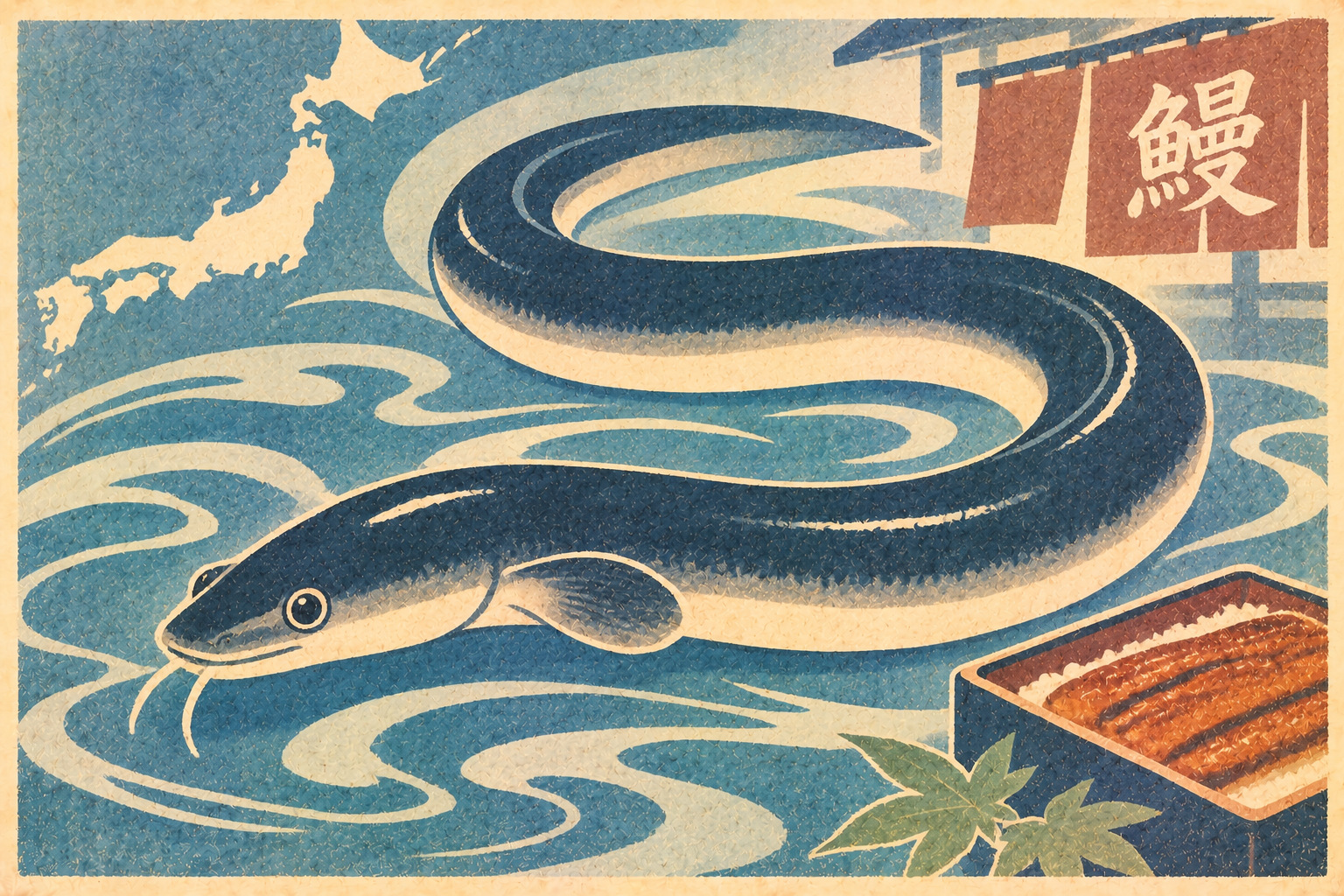
The scent of glazed eel over rice evokes a familiar corner of Japanese cuisine: the precise cut of the fillet, the heat of the charcoal, the lacquered box brought to the table. Follow the fish back from that plate, however, and the story moves beyond the restaurant. It reaches tidal estuaries, farming ponds, international trade routes and spawning grounds thousands of kilometers into the Pacific.
That larger journey is the promise of UNAGI JAPAN, a free information website whose organizers say it launched on October 28, 2026. In an announcement sent to JAPAN.co.jp on November 6, the editors described a 20-language guide to eel biology, cooking and aquaculture. A review of the public site confirms a 20-language menu, a world eel atlas and 44 listed articles.
The launch provides a timely occasion to ask a more difficult question. How does a country explain a cherished food tradition to the world when the Japanese eel at its center is classified as endangered? The answer begins with separating what diners commonly call “farmed eel” from what scientists mean by breeding an eel through its entire life cycle.
What an eel website can teach an international audience
UNAGI JAPAN offers content in Japanese and English alongside Chinese, Korean, Spanish, French, German, Arabic, Hindi and other languages. The material is grouped around discovery, food and craft. One article explains how to eat Nagoya-style hitsumabushi. Others compare Kanto and Kansai preparations, distinguish unadon from unaju, or describe the stages of eel farming.
The subjects vary deliberately in their presumed audiences. A first-time visitor may want to know how to add seasonings and broth to a rice dish. A chef may be interested in the difference between steaming and grilling. A fisheries student may be looking for a clear account of larvae, glass eels and the technical challenge of breeding them in captivity.
The result is a useful multilingual doorway rather than evidence that every page is equally authoritative in every language. We did not conduct an independent audit of translation quality, specialist review or the accuracy of every article. Those questions matter because language accessibility only becomes public knowledge when sources and limitations remain visible.
The distinction between a dish, a species and an origin label
Japanese eel is a species, Anguilla japonica. It belongs to the broader genus Anguilla, whose members are found in numerous regions of the world. A restaurant menu saying unagi does not necessarily tell the diner which species was served, where its juvenile stage originated or whether its adult growth took place in Japan.
Japanese eels follow a remarkable life cycle. They hatch in the ocean, pass through a thin, transparent larval stage known as leptocephalus, metamorphose into glass eels, and move toward coastal, estuarine and often freshwater habitats. As mature silver eels, they migrate back toward ocean spawning grounds.
This is why “raised in Japan” and “bred from captive-born parents” are not interchangeable claims. A fish may spend most of its measurable growth inside a Japanese aquaculture system while depending entirely on a wild-caught juvenile. Understanding this distinction is essential both for reading seafood labels and for evaluating sustainability arguments.
The Japanese expedition that found the spawning grounds
For centuries, scientists struggled to establish where freshwater eels reproduced. Japan became a center of modern eel-migration research in the 1970s, with oceanographic expeditions tracking larval distribution, currents and undersea geography. A decisive result came in May 2009, when a team associated with the University of Tokyo collected 31 wild Japanese eel eggs near the southern West Mariana Ridge.
The eggs were collected in waters roughly 3,000 kilometers from Japan. Their discovery gave researchers direct evidence of a spawning area, strengthening hypotheses about the relationship between lunar phase, seamounts and the location of the eel spawning migration. The team published its results in 2011.
An eel on a Japanese dinner table thus begins life in international ocean waters, with larvae transported through a vast system of currents before reaching East Asian coasts. The biology makes conservation fundamentally transboundary. Fish do not acknowledge the legal boundaries that governments use to organize fisheries and markets.
Cuisine, craft and the stories people tell
Eel has been part of Japanese food culture for centuries. The modern restaurant traditions surrounding kabayaki, rice bowls and lacquered serving boxes developed through historical changes in urban food markets and cooking techniques. The association with Doyo no Ushi no Hi, a calendrical midsummer day, is frequently explained through the tale that the scholar Hiraga Gennai promoted eel sales. That is a famous account, not a fully established single origin story.
Kanto and Kansai eel cooking are often presented as opposing traditions: the eastern preference for splitting from the back and steaming before grilling, and the western association with belly-splitting and grilling without a preliminary steam. Those descriptions capture widely taught distinctions, but actual kitchens have their own methods and exceptions.
An international guide can do more than define dishes. It can introduce the care of an experienced cook, differences in texture and seasoning, the regional identity of Nagoya-style hitsumabushi and the reason that a single food name carries many histories. Good cultural writing leaves room for variation.
The uncomfortable dependence built into aquaculture
Most eel aquaculture is not closed-loop breeding. Farmers buy or obtain glass eels caught in the wild, stock them in ponds or tanks, feed and grade them, and eventually sell mature fish. This distinction is explicit in Fisheries Agency explanations of the industry. It means a farmed final product may still depend on fishing pressure at the juvenile stage.
Japan introduced a ministerial permit system for eel farming in 2015, with controls over how many glass eels may be stocked. The system sits alongside international consultations involving China, South Korea and Taiwan. The framework has been tightened over time: prefectural licensing and strengthened penalties for collecting juvenile eels came into effect in 2023, with new traceability requirements applying from December 2025.
On November 6, 2026, Japan’s Fisheries Agency updated its public information on glass-eel stocking for the 2026 season. Those figures deserve careful treatment: a snapshot of reported stocking is not a direct headcount of wild spawning adults, and year-to-year comparisons require attention to the period, reporting coverage and species involved.
In 2026, full-cycle breeding crossed a commercial threshold
The potential alternative has a precise name: full-cycle aquaculture, in which captive-produced larvae are raised into juvenile fish and then to adults that reproduce the next generation. Japan achieved full-cycle breeding of the Japanese eel in 2010, but translating the biological achievement into economically viable production proved much harder.
Researchers at the Fisheries Research and Education Agency spent years improving feeds, larval survival, tanks, automated feeding and broodstock techniques. A research-agency summary describing progress as of July 2025 reported production costs of around ¥1,800 per artificial glass eel—substantially lower than earlier research costs but still several times the cost of wild juveniles under the comparison used.
A milestone arrived in May 2026 when the agency, Yamada Suisan and Marine Forum 21 announced trial public sales of kabayaki raised from fully captive-produced glass eels. Yamada Suisan reported producing more than 10,000 full-cycle glass eels annually in each of two consecutive years beginning in 2024. That is a real commercial-development milestone, but a limited trial sale is not proof that the technology can yet replace national demand at competitive prices.
Endangered does not mean the international policy debate is over
The Japanese eel is classified as Endangered by the International Union for Conservation of Nature, and Japan’s own Red List also identifies it as endangered. Habitat alteration, recruitment variability and fishing pressure all complicate the prospects for maintaining a species with such a wide-ranging life cycle.
Yet conservation classifications and trade controls are different instruments. At the 2025 conference of the Convention on International Trade in Endangered Species, a proposal to include all Anguilla eels in Appendix II was rejected. Japan’s foreign ministry reports that the government opposed the proposal, arguing that Japanese eel management and the state of the stock did not justify that particular international trade restriction.
There are genuine differences between conservation advocates who favor stronger international controls and governments and producers emphasizing managed use. The scientific Red List assessment, the CITES listing process and domestic fishing rules answer different questions. Treating them as if they were the same would conceal the actual policy choices.
The publisher has an eel business of its own
There is a relevant business disclosure. UNAGI JAPAN’s published editorial policy identifies its operator as Yamamoto Construction Co., Ltd. (山本建設株式会社), which also operates Kosa Eel Farm and the KATANA UNAGI brand. The site says it separates editorial material from promotion of related products and services and discloses connections when these are relevant.
This relationship does not automatically invalidate its educational work. A publisher with practical connections to eel farming may be well placed to explain some aspects of the industry. It also means readers should be able to identify when information is sourced to regulators or scientific institutions rather than to a related business.
This article was prompted by the operator’s November 6 announcement and independently checked against the public site and Japanese primary materials. JAPAN.co.jp did not interview the editors, inspect their internal editorial processes or independently test all twenty language editions.
A better definition of what it means to preserve a tradition
If the new site succeeds, an overseas reader will learn how to eat hitsumabushi. A more consequential success would be understanding what the young fish at the start of aquaculture looks like, why Japanese eel migration crosses oceans, how permits and trade requirements work, and what commercial-scale captive breeding still has to overcome.
Preserving unagi culture cannot be reduced to increasing the number of translated recipes. It also depends on honest reporting about resource assessments, illegal catches, habitat management, the economics of artificial seed production and the uncertainty that continues to surround parts of eel biology.
Japanese cuisine and eel conservation need not be framed as inherently incompatible pursuits. Nor is their compatibility guaranteed simply because a new technology exists. The value of a twenty-language guide will ultimately depend on whether it makes the difficult parts of the story as understandable as the delicious ones.
Sources and reporting method
Direct links to the publisher’s own statements and independent Japanese primary materials used to verify the broader story.
- UNAGI JAPAN — homepage
- UNAGI JAPAN — editorial policy and publisher
- Fisheries Agency — eel management and 2026 stocking data
- Fisheries Agency — FY2025 Fisheries White Paper summary
- Fisheries Research and Education Agency — May 2026 trial sales
- Fisheries Research and Education Agency — full-cycle breeding research
- University of Tokyo — spawning migration discovery
- FRA — artificial glass-eel production and cost background
- Ministry of Foreign Affairs — CITES decision explained
- IUCN conservation status as summarized in FishBase
- Fisheries Agency — eel aquaculture practices