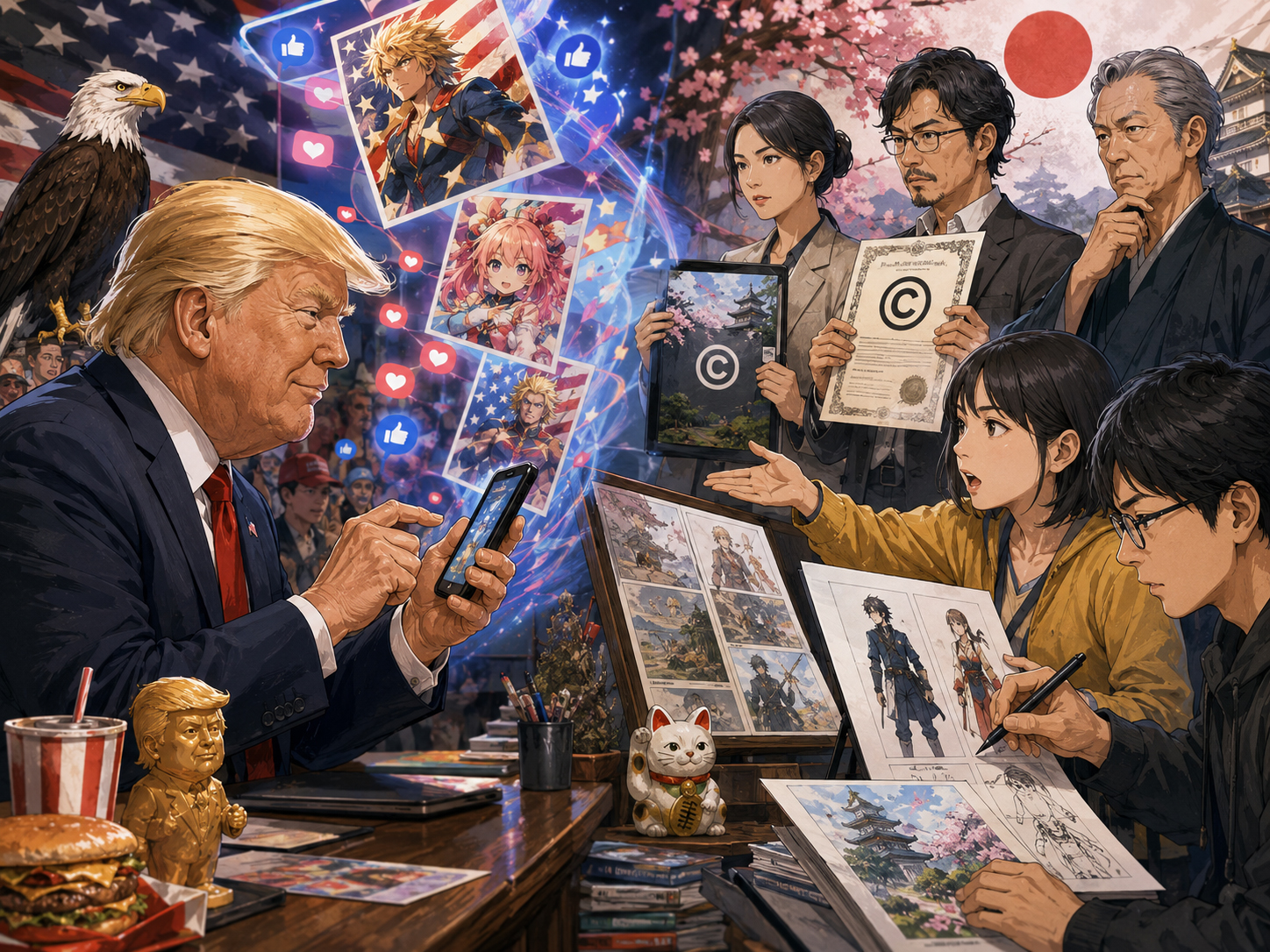
Japanese manga and anime have become a global visual language. That is why recent Trump-related social media posts using anime-style imagery and references to popular Japanese works produced more than jokes in Japan. Fans objected that the images and videos appeared to borrow from beloved characters without authorization and in political or military contexts far from the original works. Japanese officials also restated a basic position: copyrighted works require permission from rights holders.
The story is not only about one political figure. It is about what happens when Japanese character culture enters political communication, AI-style image generation, platform virality and international diplomacy. Copyright protection once focused mainly on pirate sites and illegal uploads. It now has to confront AI images, political memes, official-account posts and global fan culture.
What happened
According to public reporting, Japanese manga and anime fans launched a petition called “Protect Japanese Manga” after Trump-related posts and White House-linked social media activity used images and styles associated with popular franchises. The Guardian reported that references involving Dragon Ball, Yu-Gi-Oh! and Naruto drew objections, with signatures reaching the tens of thousands. Japan Today reported that a Japanese minister underlined the government’s stance against unauthorized use of copyrighted works after the anime-video controversy.
The legal and cultural problem is complicated because the posts are not simple bootleg copies. They involve political messaging, AI-like image generation, association with existing characters, fan culture and diplomatic awkwardness. If rights holders have not authorized the use of a character or close imitation, deploying it for political or military imagery can become both a legal and cultural flashpoint.
Who owns anime?
Manga and anime are not owned by “Japan” in a simple way. Rights can be divided among original artists, publishers, animation studios, production committees, broadcasters, streamers, toy companies, game companies and overseas licensees. When a manga character becomes an anime, a movie, a game and a merchandise line, the rights map becomes complicated.
Japanese copyright law also contains the concept of moral rights, including interests in attribution and integrity. The issue is therefore not only commercial loss. It can also involve whether a work is altered, repurposed or associated with a message the creator never intended. When characters are used in political imagery, fans may react not only as consumers but as guardians of the values they believe those stories carry.
The paradox of Cool Japan
For years, the Japanese government has promoted manga, anime, games, food and tourism through the language of Cool Japan. The Cabinet Office describes Cool Japan as a strategy to strengthen ties between Japan and other countries by communicating Japan’s appeal. The 2024 New Cool Japan Strategy identifies anime, manga and food as gateways for foreign interest in Japan.
But cultural export creates a paradox. The more successful a work becomes, the more it travels outside the control of its original makers. Fan art, memes, subtitles, clips, AI images and political remixes often grow from affection, but not all uses align with the interests of rights holders or creators. In the Cool Japan era, success cannot be measured only by visibility. It must also be measured by whether Japan can protect the rights and meaning behind that visibility.


AI makes the line harder
Since 2025, Japanese IP protection has increasingly collided with generative AI. CODA and Japanese rights holders have challenged unauthorized use of Japanese content in AI systems, while Japanese officials have described manga and anime as “irreplaceable treasures.” AI complicates the issue because it can produce outputs that evoke a work without necessarily copying a single frame. When that output enters politics, the stakes rise.
Technical research also shows why anime is difficult to police. The AnimeDL-2M project notes that image-manipulation detection systems trained on natural images perform poorly in anime domains. Stylized lines, eyes, hair, color and backgrounds create detection challenges that differ from photographs. That matters for rights holders, platforms and governments trying to distinguish parody, homage, AI imitation and infringement.
Why Japan pushes back
Japan has at least three reasons to push back. First is copyright: unauthorized use of protected characters or close derivatives can harm rights holders. Second is cultural context: stories about friendship, effort and courage can be distorted when used in political attack or military spectacle. Third is industrial policy: Japanese content is no longer a niche fandom. It is tied to tourism, publishing, streaming, games, consumer goods and national branding.
What to watch
- Whether Japan asks for clarification or restraint through diplomatic channels.
- Whether publishers or production committees issue formal objections or takedown requests.
- How courts and regulators treat AI-generated images that closely evoke protected characters.
- How platforms handle political posts that use copyrighted or culturally sensitive material.
- Whether Cool Japan evolves from promotion into a stronger international rights-protection strategy.
Cultural sovereignty in the meme age
The internet carries characters across borders. But global popularity does not mean anyone can freely recruit those characters for political purposes. Japanese anime and manga now belong emotionally to fans around the world, which is precisely why their protection is no longer only a domestic Japanese issue. It is a global cultural rulebook being written in real time.
The backlash to Trump-related anime posts is not merely a passing online flare-up. It is a preview of an era in which AI, copyright, politics and cultural diplomacy collide. What Japan is defending is not only a drawing. It is the labor, meaning and trust that made Japanese character culture one of the world’s most powerful soft-power exports.
Sources and references
This Japan.co.jp report is based on public reporting, government and industry sources, and copyright/AI research.
- The Guardian: Japanese manga fans urge Trump to stop using characters online
- Japan Today: Japan underlines stance on copyright works after Trump anime video post
- Agency for Cultural Affairs: Copyright policy
- Cabinet Office: Cool Japan Strategy
- CODA: Content Overseas Distribution Association
- AnimeDL-2M: AI-generated anime image detection research