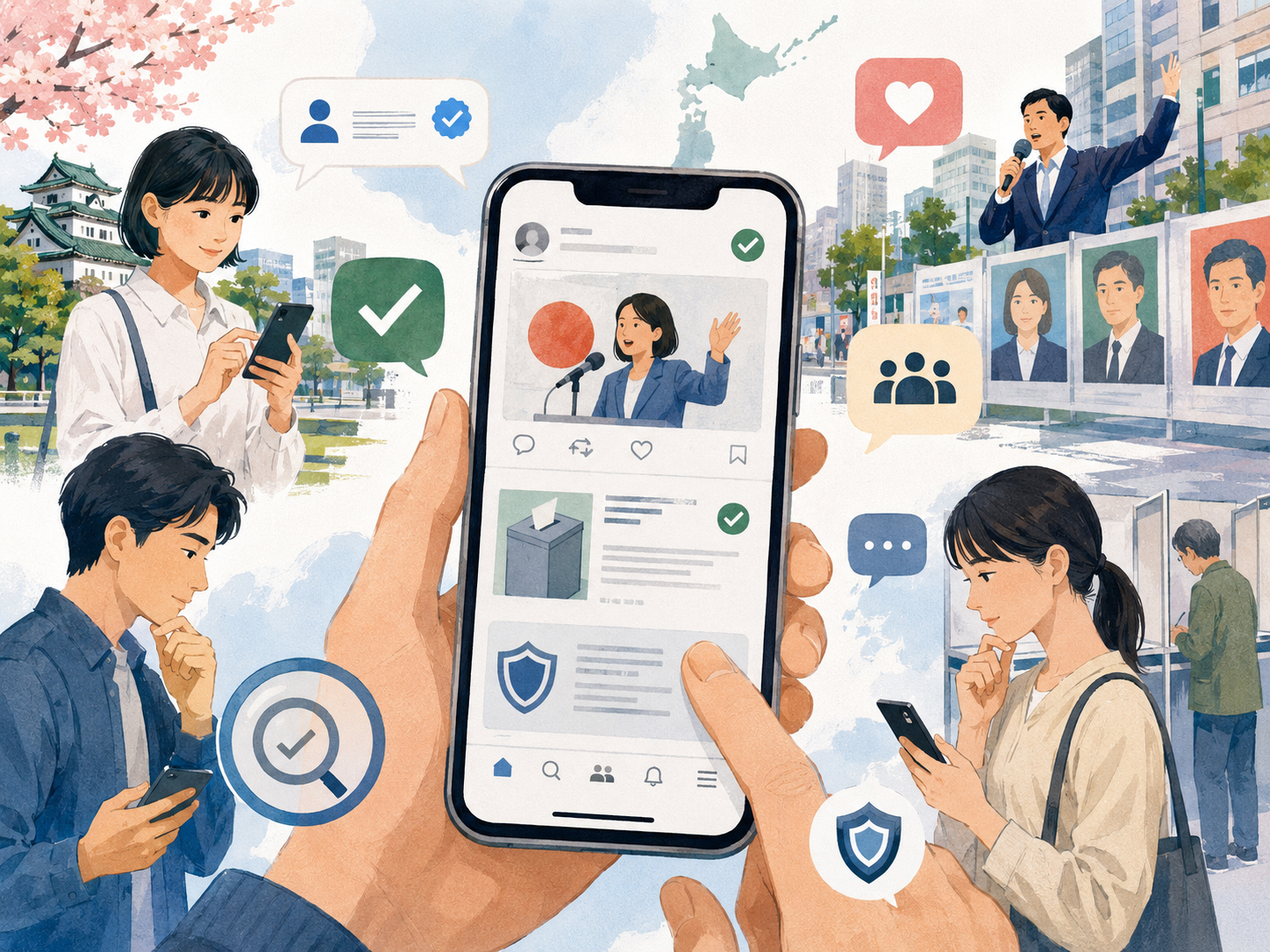
Japanese elections can no longer be understood only through street speeches, campaign cars and poster boards. Voters now meet candidates through clipped videos, anger-driven posts, AI-generated images and rumors moving across smartphone feeds. In 2026, Japan’s election law is trying to catch up. The government and major parties are preparing revisions that would state that social-media users must not harm election fairness through false statements or factual distortion.
The proposal is not aimed only at platforms. Large-scale social-media operators may be required to take steps against false information, label AI-generated realistic content, improve responses to deletion requests and disclose what measures they have taken. But the distinctive part is that ordinary users, campaign supporters and anonymous accounts would also be placed inside the responsibility framework. That is a major shift in Japan’s election culture.
2013: when internet campaigning was opened
Japan fully opened internet election campaigning in 2013. Before that, candidates and parties faced tight restrictions on how websites, email and social networks could be used during official campaign periods. The 2013 Public Offices Election Act revision allowed candidates, parties and voters to campaign through websites and social media.
The opening was not absolute. Email campaigning remained limited largely to candidates and parties; ordinary voters could not simply send campaign email on a candidate’s behalf. Websites and social media became available, but impersonation, defamation, publication of false facts, bribery and campaigning outside the official period remained problematic. Japan’s digital election system has always carried two goals at once: freer political communication and election fairness.
From candidates to supporters to anonymous accounts
In the early years of internet campaigning, attention focused on what candidates themselves posted on Twitter, Facebook or official websites. By the 2017 Lower House election, researchers were already examining the diffusion power of political-party accounts and the profiles of users who retweeted them. Politicians could speak faster than television; supporters could multiply the message instantly.
The same structure also made echo chambers more powerful. People with similar views connected with each other, reinforced one another’s posts and saw less of opposing information. In the 2020s the problem moved beyond official campaign accounts. Clipped videos, summary accounts, anonymous posts, foreign influence operations, bots, AI images and monetized outrage entered the election environment. Sometimes secondary posts by supporters or opponents travel farther than the candidate’s own statement.
Why user responsibility now?
The push toward user responsibility reflects a simple fact about elections: time is short. If a false claim spreads just before voting day, correction may arrive too late. Platforms need time to evaluate reports. A candidate may not have posted the claim, yet supporters or anonymous accounts may shape the voter’s impression. The political damage can be done before anyone knows who started it.
The planned rules are not supposed to police every political opinion. At least in principle, they target false statements and factual distortion that harm election fairness. But the line will be difficult. Criticism, satire, speculation, honest mistake, factual error, deliberate disinformation and AI deepfake are not the same thing. The heart of the reform will be whether Japan can protect election fairness without chilling political speech.


Why AI labels matter
AI-generated realistic content is one of the biggest reasons the rules are changing. A candidate can be made to appear to say something never said. A fake apology video can circulate. A synthetic voice can imitate a street speech. A manipulated photo can create a scandal that never happened. During an election campaign, even short-lived deception can matter.
Labeling is not a cure-all. Malicious actors may ignore labels, and voters may believe what they want to believe. But requiring realistic AI-generated content to be labeled during election periods creates at least one point of friction. It tells users to pause. It also gives platforms, media and election administrators a common standard around which to build response systems.
Old election culture, new technology
Japan’s Public Offices Election Act has long regulated campaign tools in great detail: leaflets, posters, loudspeakers, door-to-door canvassing, donations, campaign periods and printed materials. The logic was to reduce money politics and overheated campaigning while preserving a level playing field. But digital media does not fit easily into those old categories. Limiting poster numbers does little when AI images can be generated infinitely. Counting campaign-car routes does not measure the reach of anonymous accounts.
The 2026 debate is therefore not simply a social-media debate. It asks how Japan’s postwar election system moves from a world of paper and street corners to a world of algorithms, generative AI and monetized attention. It requires a new division of responsibility among candidates, parties, platforms, users, news media and election administrators.
What voters can do
- Be most skeptical of sensational posts that appear just before voting day.
- Check candidate pages, election administrators, credible media and multiple sources.
- Look for the origin, date and context of images, audio and video.
- Do not immediately share posts designed mainly to trigger anger or ridicule.
- Do not spread unverified claims, even when they help a candidate you support.
Who is responsible?
No single actor can carry the full burden. Platforms have design responsibility. Candidates have accountability for their campaigns. Parties have ethical responsibility for supporter networks. Newsrooms have verification responsibility. Election administrators must clarify rules. Users also have responsibility because a single voter with a phone can become a small broadcaster.
The success of Japan’s 2026 reform will not be measured only by penalties. The harder task is to reduce falsehoods without freezing participation, to preserve campaign energy while protecting fairness. Japanese elections are now searching, inside the smartphone screen, for the next form of a postwar democratic system.
Sources and references
This Japan.co.jp report is based on public reporting, legal background and academic research.
- Japan Times: Japan eyes responsibility of social media users during elections
- Japan Times: AI-created content labels during election campaigns
- Japan Times: Social media operators and election misinformation
- Mainichi: Social media OK, email not — Japan’s complex online campaign rules
- J-STAGE: Internet Election Campaign and the Public Office Election Law
- Yoshida & Toriumi: Political-party Twitter diffusion in Japan’s 2017 election
- Ippa & Hashimoto: Socialbots activity and influence in Japanese social media