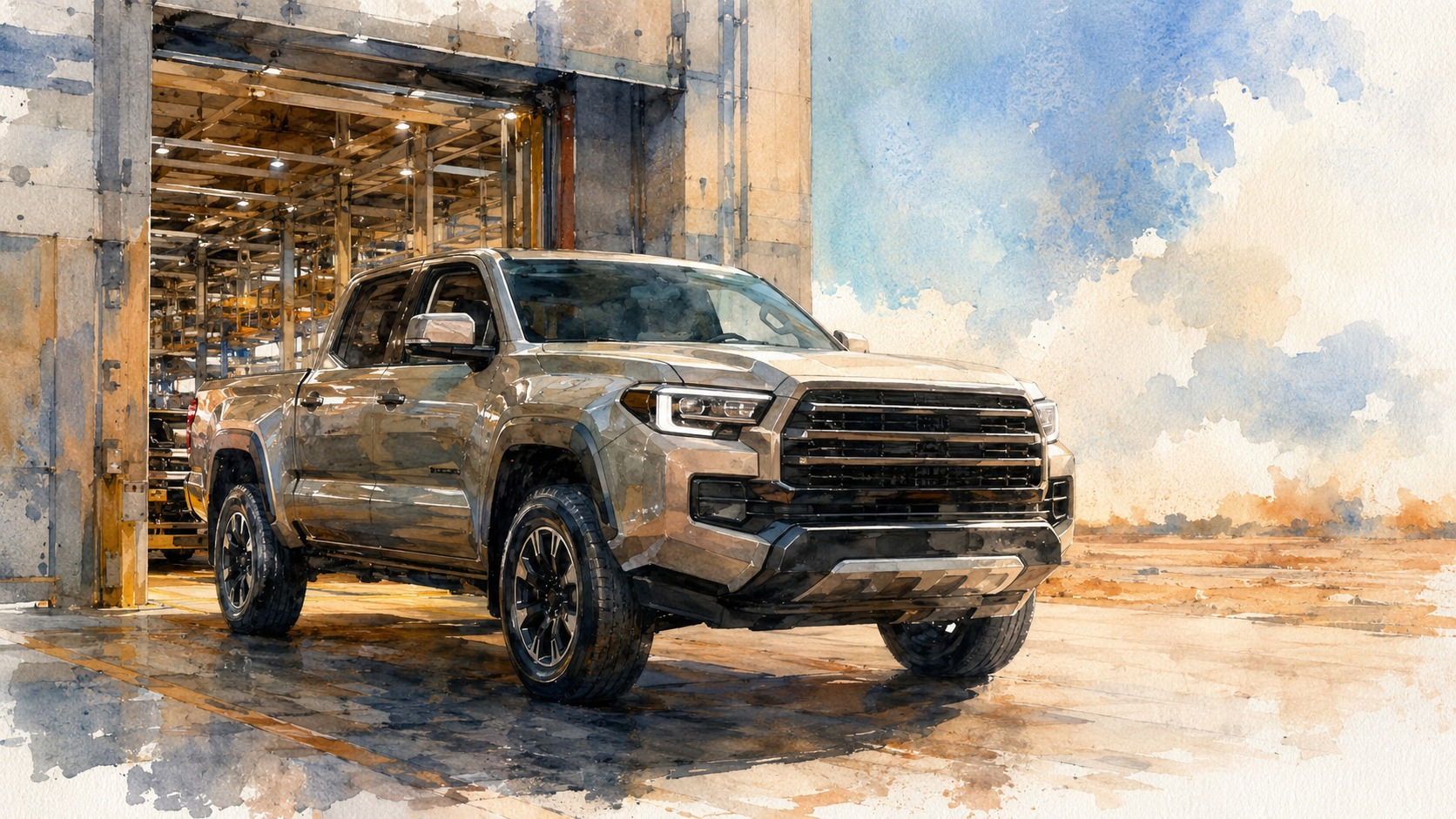
The 2,000 acres of ranchland on San Antonio’s South Side have contained an intentional emptiness for 23 years. When Toyota chose the site in 2003, it bought far more land than its first factory immediately required. In July 2026, the company gave that empty space a price: $3.6 billion for a second vehicle assembly line.
By 2030, Toyota plans to add 2.5 million square feet, roughly doubling the campus. Annual capacity will rise by approximately 150,000 vehicles and more than 2,000 direct jobs will be created. The new line’s central product is the Tacoma. Production now performed at Baja California will transition over roughly four years, putting Tundra, Sequoia and Tacoma assembly together in Texas.
Not merely a new factory, but a second chapter for an industrial city
The line will rise inside the existing campus. Toyota Texas already builds Tundra and Sequoia on one line and assembled more than 197,000 vehicles last year. Twenty-three on-site suppliers deliver seats, tires, interiors and other parts over extraordinarily short distances.
Direct Toyota employment is expected to reach approximately 6,000. The effects extend through suppliers, logistics, construction, restaurants, retail and housing. For San Antonio’s South Side, $3.6 billion is both capital spending and a wager on the occupational structure of the next generation.
In 2003, building a Texas Tundra on ranchland
Toyota selected San Antonio in 2003 to build the full-size Tundra near the cultural and commercial center of the American truck market. It broke ground that October on the former JLC Ranch. The first second-generation Tundra rolled off the line in November 2006.
The initial investment was roughly
Then the financial crisis and high fuel prices arrived. Toyota stopped Tundra production for about three months in 2008. A large plant and co-located supplier network revealed the weight of fixed costs when demand collapsed. Toyota nevertheless consolidated Tundra production from Indiana into Texas, helping preserve the San Antonio workforce.
The Tacoma came to Texas once—and then left
After General Motors withdrew from the NUMMI joint venture, the California factory moved toward closure. Part of Tacoma production transferred to San Antonio in 2010, supporting roughly 1,000 additional jobs. Texas could flex between the full-size Tundra and midsize Tacoma.
Toyota later reorganized North American truck production. Guanajuato, Mexico, opened in 2019, and San Antonio ended Tacoma assembly around 2021 to concentrate on Tundra and Sequoia. The fourth-generation Tacoma became a Mexico-built vehicle.
The new plan is not a wholesale exit from Mexico. Baja California output will transition to Texas, but Guanajuato will continue producing Tacoma. Toyota is adding U.S. capacity as insurance against tariffs and politics while still operating the United States, Mexico and Canada as an integrated production region.
Tariffs redraw the map of manufacturing
U.S. tariffs reduced Toyota’s FY2026 operating income by ¥1.38 trillion. Duties on vehicles, steel, aluminum and parts accumulate across a North American supply chain that can cross borders several times. A San Antonio Tacoma line reduces border exposure for trucks sold to U.S. customers.
But the factory will not open until 2030. Tariffs can change through elections, Congress, courts and USMCA negotiations; a $3.6 billion plant will outlast many policies. The economics must therefore rest not only on tariff avoidance but on U.S. truck demand, labor, logistics, suppliers and flexible utilization.
Toyota has urged a quick USMCA resolution and stressed its commitment to all three North American countries. It is not simply surrendering to protectionism. It is purchasing a production layout that can survive if free trade becomes less reliable.
$3.6 billion for 150,000 vehicles
Dividing $3.6 billion by 150,000 units produces
Tacoma has a powerful position in the U.S. midsize pickup market, with pricing and residual values that can support local investment. If demand persists, localization reduces transportation, duties and inventory time. If truck demand falls with the economy, fuel prices or interest rates, large fixed assets become a burden. The 2008 shutdown remains a warning.
The $531 million axle plant comes first
Before the second line, Toyota Texas is scheduled to open a $531 million rear-axle plant in fall 2026. The 500,000-square-foot facility will produce roughly 500,000 axles annually and add 411 jobs, bringing a critical component previously sourced from suppliers onto the campus.
Axle integration and the assembly expansion share one logic: shorten transportation, reduce inventory, accelerate quality feedback and improve resilience. The Toyota Production System requires more reliable supply as it removes buffers. Bringing parts closer is an investment in recovery as much as efficiency.
The public’s $303 million side of the bargain
State and local support is valued at at least $303 million. It combines incentives from San Antonio, Bexar County, Texas, utilities and infrastructure providers—property-tax abatements, grants, roads, power, water and training. About
Even so, support for one private corporation requires scrutiny. On a simple basis, it exceeds
The agreement contains conditions. Compensation for the new jobs must meet a $32.46-an-hour benchmark, and 10% of city tax-abatement savings must support training, transportation or child care. Hiring is projected at 320 workers in 2028, 1,440 in 2029 and 240 in 2030. The structure attempts to turn an incentive package into durable, accessible employment.
- Existing assembly line: flexible production of Tundra and Sequoia.
- Second assembly line: approximately 150,000 additional vehicles, centered on Tacoma, from 2030.
- Rear-axle plant: about 500,000 axles annually and 411 jobs from fall 2026.
- On-site suppliers: 23 companies compress transportation and inventory.
What kind of jobs will the 2,000 jobs be?
Modern auto plants are more automated than their predecessors. Welding robots, machine vision, automated movement and digital maintenance increase demand for skills in quality, electrical systems, robotics, data and logistics—not only repetitive assembly.
Assembly remains physically demanding. Shift work, line speed, repetition, heat, safety, commuting and child care shape retention. Conditions directing resources to training, transportation and care matter if the headline number is to become long-term employment.
Baja California faces the other side of the transfer. Moving production may affect Mexican workers and suppliers. Toyota’s four-year transition and continued Guanajuato production soften the disruption, but 2,000 new U.S. jobs do not automatically equal 2,000 net new jobs across North America.
Why invest in trucks during electrification?
A $3.6 billion truck line can look like a retreat into the combustion era. Toyota instead follows a “multi-pathway” strategy of hybrids, plug-in hybrids, battery EVs, fuel cells and efficient combustion tailored to local needs. Tacoma offers an i-FORCE MAX hybrid, while Tundra and Sequoia also use electrified powertrains.
The line’s value will ultimately depend on flexibility, not one engine. Can it mix powertrains or models as demand and regulation shift in the 2030s? Vehicles will still require bodies, paint, final assembly and quality assurance as batteries, software and electronics grow in importance.
Toyota has invested
“Best company in town” will be tested by outcomes
Toyota describes the expansion as part of its “best-company-in-town” philosophy. Cumulative San Antonio investment will reach $8.3 billion, direct employment roughly 6,000, and 23 suppliers operate on site. Two decades of Toyota have helped turn the South Side into an automotive center.
Corporate citizenship is measured by results, not announcement totals. Will construction meet its budget and timetable? Will 2,000 people be hired as promised and receive safe, sustainable work? Will public funds improve roads, child care and training? Will a water- and power-intensive factory accept responsibility for infrastructure and environmental burdens?
The empty ranchland becomes strategy
Toyota’s 2003 site choice looked beyond one factory. The 2,000 acres allowed suppliers to gather, vehicles to migrate during crises and capacity to expand when demand returned. A 2008 shutdown, Tacoma’s 2010 arrival, its later departure, the 2026 axle plant and now a second line show a campus functioning as a valve for North American strategy.
If the expansion succeeds, Toyota will turn a short-term tariff response into production capacity useful for decades. If it fails, rich incentives and expensive equipment will preserve an error in demand forecasting. The question is not merely whether a truck is made in America or Mexico. It is how flexibly Toyota can move production among policy, demand and technological change.
When the first Tacoma leaves the second line in 2030, it will be more than one pickup. It will combine Japanese production philosophy, a Texas workforce, a North American supply chain that still includes Mexico, and a new trade order. The empty space in San Antonio has become the place where Toyota will assemble its next 20 years.