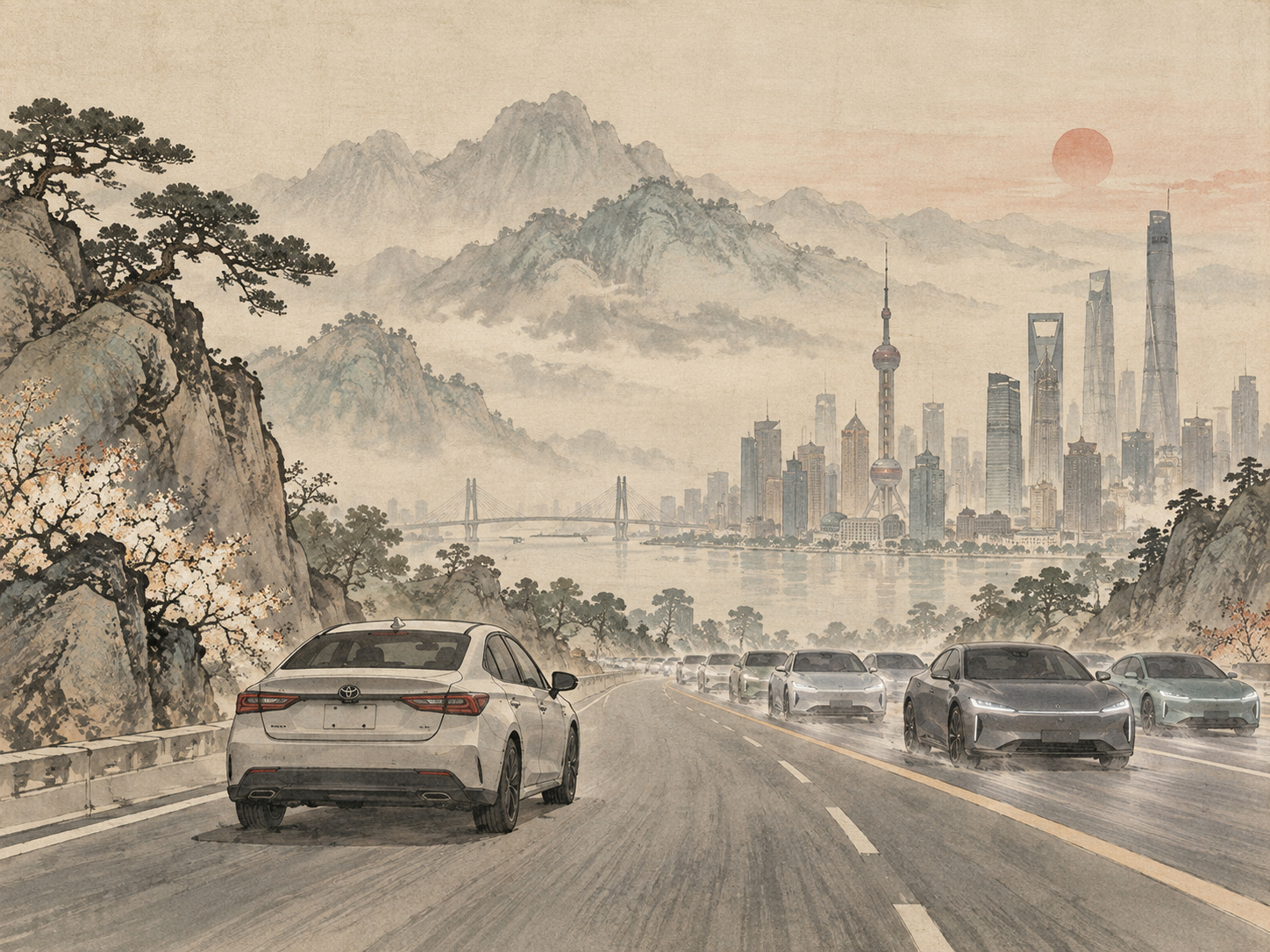
Toyota Motor’s sales in China fell for a seventh consecutive month in August, dropping 22.8% from a year earlier. The weakness helped pull Toyota’s global sales down 6.4% to 790,743 vehicles and production down 5.9% to 700,860. China, alongside the United States and Middle East, has become one of the clearest drags on what remains the world’s largest automaker by volume.[1]
It would be easy to read the result as a simple story of Toyota losing to Chinese EV makers. The reality is more complicated—and more consequential. China’s entire passenger-car retail market contracted sharply in August, while new-energy vehicles, a category that includes battery EVs and plug-in hybrids, captured about 65% of retail sales. Gasoline-powered cars are shrinking much faster than the overall market, placing unusual pressure on foreign manufacturers whose Chinese businesses were built around combustion engines and conventional hybrids.[2]
China is now large enough to move Toyota’s global numbers
The August result was not an isolated month. Toyota’s China sales fell 24.3% in July, marking a sixth consecutive decline, and plunged 31.7% in May. During Toyota’s first fiscal quarter, China sales were down 28% from a year earlier. The company can still post strong results in Japan, North America or Europe, but weakness in China is now large enough to shape group-level earnings and production decisions.[3][4]
Toyota said higher gasoline prices were one factor weighing on demand for both hybrids and traditional combustion-engine vehicles. That matters because the company’s most durable competitive advantage over the past two decades has been hybridization. In a market where fuel becomes more expensive while charging infrastructure, battery supply and EV choice are expanding, the economics can shift quickly toward battery-electric and plug-in vehicles.[1]
When 65% of the market is already “new energy”
China’s passenger-car retail market fell to about 1.54 million vehicles in August, down 23.6% year on year. Yet NEV retail sales reached roughly 1.005 million, giving the category a 65.2% share. NEV sales themselves were lower than a year earlier, but gasoline-car sales collapsed more quickly, pushing electrified penetration to a record level.[2]
The implication is profound. Battery EVs and plug-in hybrids are no longer an emerging niche in China; they have become the center of the new-car market. Toyota’s own 2025 integrated report described China as a market where vehicle size, electrification and “intelligent” features were evolving at a world-leading pace. It noted that new-energy vehicles had already exceeded half of sales in 2025.[5]
Chinese manufacturers compete not just on batteries, but also voice interfaces, vehicle operating systems, advanced driver assistance, rapid charging and frequent over-the-air software updates. Price competition is intense, and model cycles are shorter. For a traditional global manufacturer, the challenge is increasingly organizational: can a product conceived through a multiyear global development process still arrive while Chinese consumers consider its technology current?
BYD is the symbol, but “China speed” is the competitor
BYD has become the shorthand for the challenge. Its global vehicle sales rose to 463,561 in September 2026, the fifth consecutive month of growth, helped by rapidly expanding exports even as Chinese domestic demand remained weak. Chinese automakers are no longer only defending their home market; they are turning domestic scale into international expansion.[6]
But Toyota is not competing with one company. Geely, Chery, Xpeng, Li Auto, Nio and Xiaomi represent different combinations of price, software and propulsion technology. The deeper competitive advantage lies in China’s dense battery and electronics supply chain, close relationships with local technology companies, and the speed with which product decisions can be converted into showroom features.
Toyota moves authority into China
Toyota has been reorganizing in response. It created a “ONE R&D” structure intended to break down organizational boundaries among its Chinese operations and partners, including FAW, GAC and BYD. It also adapted Toyota’s long-standing Chief Engineer system into a Chinese Regional Chief Engineer, or RCE, structure, giving Chinese engineers more authority over vehicles developed for local customers.[7]
The logic is a reversal of the old export model. Rather than develop a global Toyota in Japan and adapt it for China, the company increasingly wants Chinese teams to define the product, make decisions locally and work with Chinese technology partners from the outset.
The bZ5 and GAC Toyota bZ3X are products of that direction. Toyota’s 2025 integrated report says the bZ3X was led by a Chinese RCE and jointly developed with GAC, combining Toyota’s safety positioning with the large cabin and “intelligent” features sought by younger Chinese buyers. Toyota said the model became the top-selling BEV among joint-venture brands in China in 2025, while being priced in the 100,000-yuan range.[5]
bZ7 takes localization further
The bZ7 unveiled at the 2025 Shanghai Motor Show pushed that strategy further. Toyota said the large battery-electric sedan was developed jointly by GAC, GAC Toyota and Toyota’s Intelligent ElectroMobility R&D Center in China, combining Toyota’s manufacturing and safety practices with China’s advanced technology ecosystem. The company highlighted smart cockpit, driving-assistance and safety technology rather than treating propulsion alone as the selling point.[8]
Toyota China has also described the bZ7 as its first D-segment sedan with a Huawei HarmonyOS cockpit. That decision is strategically revealing: Toyota is willing to integrate a major Chinese technology platform directly into the in-car experience rather than insist that every layer of the digital stack be developed internally.[9]
A wholly owned Lexus operation in Shanghai
The clearest break with Toyota’s traditional China model may be happening in Shanghai. In February 2025, Toyota announced a wholly owned company in Shanghai’s Jinshan district to develop and produce Lexus battery EVs and batteries. Production is scheduled to begin from 2027, with initial capacity of around 100,000 vehicles a year and roughly 1,000 jobs planned at launch.[10]
Toyota built its modern Chinese business through joint ventures, particularly with FAW and GAC. The Shanghai operation is different. Lexus Electrified Shanghai describes itself on Toyota China’s recruitment site as Toyota’s first wholly owned integrated operation spanning manufacturing, sales and technology, centered on Chinese employees and charged with planning, developing and manufacturing battery EVs for Chinese customers.[11]
That structure can be read as an attempt to remove layers from decision-making. The core question in China is increasingly not whether Toyota understands electrification, but whether it can move quickly enough to use local batteries, chips, software and AI in products while those technologies are still competitive.
From the Crown in 1964 to the EV era
Toyota’s history in China extends much further back than the current EV contest. Its corporate history records exports of GA trucks to northeast China in 1936 and prewar assembly operations in Tianjin and Shanghai. After the establishment of the People’s Republic, Toyota began exporting the Crown to China in 1964. FAW personnel trained at Toyota in the late 1970s, and Taiichi Ohno, one of the architects of the Toyota Production System, worked with FAW in the early 1980s as industrial ties deepened.[12]
Modern local production expanded rapidly after 2000. FAW Toyota began vehicle production in 2002 and GAC Toyota in 2006. Corolla, Camry, RAV4, Highlander and other models made China one of Toyota’s most important markets. Toyota’s current manufacturing list shows FAW Toyota producing vehicles including bZ3 and bZ5, while GAC Toyota builds bZ4X, bZ3X and bZ7 alongside its hybrid-heavy mainstream lineup.[13]
In 2014, marking 50 years since the Crown entered China, Toyota publicly described a long-term ambition to build an annual two-million-vehicle China business. The priority then was scale, dealer coverage and localization of manufacturing. In 2026, “localization” means something much more demanding: local software, local engineers, local technology partners and decision-making speed.[14]
Hybrids are not Toyota’s weakness—but they are not enough in China
There is a danger in turning China’s EV boom into a simplistic argument that Toyota’s hybrid strategy has failed. Globally, hybrids remain a major strength. In the United States, for example, high gasoline prices in 2026 have helped Asian manufacturers whose lineups emphasize hybrids and fuel efficiency. Toyota’s multi-pathway strategy—offering hybrids, plug-ins, battery EVs and fuel-cell vehicles according to regional conditions—still has a rational foundation.[15]
China is different because the market has already crossed a threshold. When roughly two-thirds of passenger retail is new-energy vehicles and consumers evaluate cars on software ecosystems and driver-assistance features, fuel economy alone is no longer sufficient differentiation. Toyota’s challenge is not simply to “make an EV.” It is to make the right EV, with the right digital experience, at a locally competitive price and at Chinese development speed.
The harder competition is development speed
Chinese automakers’ advantage is often described as price, but speed may be more important. A dense domestic ecosystem of battery suppliers, chip developers, software companies and consumer-electronics firms allows features to move from supplier roadmaps into vehicles quickly. Product updates happen through software as well as model replacements.
Traditional automakers were built to perfect a vehicle before launch, then sell it largely unchanged for years. The Chinese market increasingly rewards a software-like rhythm: launch, collect data, update, cut price, add functions and replace models quickly. Toyota’s RCE system, ONE R&D organization and Shanghai Lexus unit are all attempts to change the institution, not just the drivetrain.
Not a verdict on Toyota—an unusually severe management test
Seven consecutive months of falling sales are serious, but they are not a final verdict. China’s domestic vehicle market itself has contracted sharply in 2026, making year-on-year comparisons unusually difficult for every manufacturer.
The more important question is whether Toyota can adapt a management system built around manufacturing discipline, long product lives and global platforms to a market organized around rapid local development and software iteration.
If bZ3X-style local development becomes a repeatable system across bZ7, Lexus and the next generation of Chinese products, the current downturn may eventually be seen as part of a strategic reset. If decision-making remains too slow, the loss of relevance could become structural.
More than 60 years after the Crown first entered China, the market is no longer simply a place where Toyota sells Japanese cars. It has become one of the places where the future definition of the automobile is being written. Toyota’s seven-month slide matters because it measures how difficult that transition has become.
Sources
- Reuters, Toyota August 2026 sales and production
- CPCA data summary: China passenger-car and NEV retail, August 2026
- Reuters, Toyota July 2026 sales
- Reuters, Toyota fiscal first-quarter results
- Toyota Motor Corporation, Integrated Report 2025
- Reuters, BYD September 2026 sales
- Toyota China, ONE R&D and Regional Chief Engineer structure
- Toyota Motor Corporation, bZ7 and Shanghai Motor Show 2025
- Toyota China, localized intelligent-EV strategy
- Toyota Motor Corporation, Shanghai BEV and battery company
- Lexus Electrified Shanghai official recruitment profile
- 75 Years of Toyota: China history
- Toyota manufacturing operations in China
- Toyota, 50 years in China statement, 2014
- Reuters, U.S. market and hybrid demand, Oct. 1, 2026