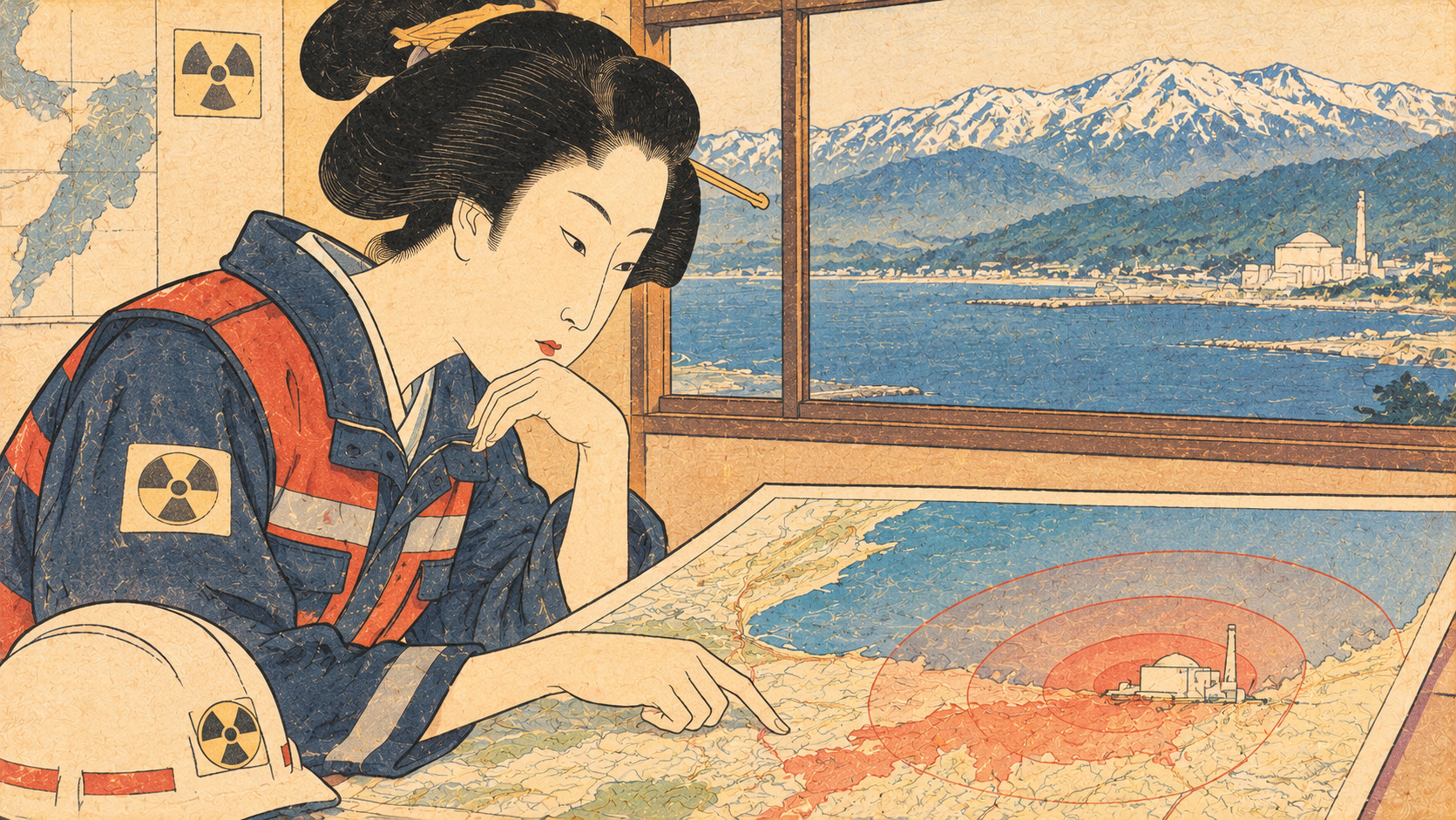
- Recovery changes the calendar of preparedness
- What was reduced—and what remains on the schedule
- A frightening scenario at a plant across the border
- Why a neighboring prefecture has nuclear responsibilities
- The 2024 Noto earthquake showed how systems can overlap
- A drone, a care home and the problem of a severed road
- Radiation screening is a process, not a checkpoint photograph
- Himi’s August floods are more than background
- The real test begins after the rehearsal
Recovery changes the calendar of preparedness
Emergency plans are written for the day something goes wrong. In the Japanese coastal city of Himi, the difficulty is that something already has. Destructive rainfall in August 2026 left the community rebuilding homes and infrastructure. Three months later, authorities were preparing to practice what would happen if an earthquake across the prefectural border triggered a severe emergency at the Shika nuclear power station.
On November 13, Toyama Prefecture announced that its annual nuclear-disaster drill would proceed on a reduced scale. Participation by residents of the affected emergency-planning area would be omitted in recognition of the flood damage. Yet the event would not simply disappear: 52 organizations and a projected 350 participants would still test the chain of command, radiation monitoring, vehicle screening, care-facility logistics and medical response.
It is a revealing collision of priorities. A community recovering from one hazard needs to prepare for another, but the same people, roads, public buildings and officials cannot be treated as unlimited resources. The central story is not a cancelled exercise. It is the challenge of protecting a population already living through disaster recovery.
What was reduced—and what remains on the schedule
The main exercise is scheduled for Sunday, November 22, beginning around 7 a.m. and ending around noon. Some medical training will continue on the November 23 holiday. Participating bodies include national authorities, Toyama and Ishikawa prefectures, Himi City, Hokuriku Electric Power and other organizations. The total projected attendance is approximately 350, including around 30 volunteers and disaster-prevention specialists from within the prefecture.
The wording matters. Toyama says participation by residents in the disaster-affected target area will be forgone. It does not say there will be no public participants anywhere. The plan still calls for volunteers, including people from outside the urgent protective action planning zone, to take part in screening demonstrations. An earlier October 30 notice had solicited some 30–40 participants and approximately 30 vehicles. The November 13 announcement refines that arrangement in light of continuing recovery.
A separate command-post tabletop exercise had already taken place November 10. Thus, the scaling-back refers to parts of a multi-stage program, not an abandonment of all nuclear preparedness activity for the year. Actual attendance and any further changes remain to be confirmed after the event.
A frightening scenario at a plant across the border
The scripted emergency begins in Shika, Ishikawa Prefecture, where a magnitude is not specified but shaking is assumed to reach the highest level on Japan's seismic intensity scale—shindo 7. Unit 2 at Hokuriku Electric Power's Shika nuclear plant automatically shuts down and loses external power. The assumed failure of emergency core-cooling injection then takes the scenario to a general emergency, followed by a release of radioactive material affecting surrounding communities.
This is an exercise scenario, not a report of an actual November 2026 incident. According to the utility, Shika Unit 1 entered commercial operation in July 1993 and Unit 2 in March 2006. The prefecture's exercise centers on Unit 2 and the implications of a compound earthquake and radiological emergency.
Two emergency headquarters meetings are scheduled for Toyama's Disaster Prevention and Crisis Management Center: the first from 8:50 to 9:10 a.m., addressing the declaration of a nuclear emergency and sheltering instructions; the second from 9:25 to 10 a.m., considering temporary relocation in selected parts of the planning zone. The sequencing is significant. Response depends on decisions that change as conditions deteriorate, not a single order to evacuate everyone immediately.
Why a neighboring prefecture has nuclear responsibilities
Although the Shika station stands in Ishikawa Prefecture, geographic exposure does not end at an administrative border. Toyama's public education materials put the closest distance from the plant to its prefectural boundary at roughly 21 kilometers. Part of Himi City lies within the Urgent Protective Action Planning Zone, or UPZ, extending roughly 30 kilometers from the plant.
Japanese emergency planning distinguishes that zone from the Precautionary Action Zone, or PAZ, generally within approximately five kilometers. A general emergency typically prompts immediate evacuation planning for the PAZ, whereas sheltering indoors is generally the initial protective response in the UPZ, followed by movement when conditions and measurements justify it. Real decisions must account for facility status, radiation measurements and transport conditions.
The institutional framework has also been evolving. Toyama announced in August that Himi had become eligible for certain national support available to areas near nuclear installations after the relevant geographic scope expanded from approximately eight to ten kilometers to approximately 30 kilometers. The change recognizes that emergency-management responsibilities can extend across prefectural lines.
The 2024 Noto earthquake showed how systems can overlap
Japan's 2011 Fukushima Daiichi disaster remade public understanding of nuclear emergency planning and led to substantial changes in evacuation zones, monitoring and regulatory requirements. But another event has particular resonance for communities around Shika: the January 1, 2024 Noto Peninsula earthquake.
Both Shika units were shut down at the time. Hokuriku Electric Power documented transformer insulating-oil leaks, damage to parts of the external power system and other equipment issues. The utility said alternative power supplies and safety systems were available and that the confirmed events did not compromise nuclear safety. Those technical statements should be attributed to the operator rather than treated as proof that every dimension of regional preparedness was unaffected.
Earthquakes can damage the roads, bridges, communications and care facilities on which a nuclear evacuation plan relies. That is why the most useful exercises combine hazards: they ask whether protective actions remain possible when the disaster generating a nuclear emergency has simultaneously damaged the region's ability to respond.
A drone, a care home and the problem of a severed road
Among the most concrete events planned for November 22 is a 40-minute drone-supply exercise at Eldervilla Himi, a long-term care health facility. The scenario assumes that earthquake damage has severed roads and isolated the building. Officials plan to seek assistance from the Toyama Prefecture Drone Goods Transport Association and practice moving supplies to the site.
For residents of a care facility, evacuation may itself create health risks. Maintaining access to essentials can buy time while authorities determine whether sheltering remains safer than movement. However, the prefecture's announcement does not specify the cargo list, aircraft capability or an operational guarantee in heavy rain or high winds. The drone portion may be cancelled if weather conditions are unsuitable.
The broader lesson is logistical rather than technological spectacle. A drone becomes valuable only when health-care administrators, transport coordinators, emergency managers and communications systems know how to summon and support it. Whether the demonstration actually succeeds will not be known until the exercise takes place.
Radiation screening is a process, not a checkpoint photograph
At Konan Elementary School in Himi, the prefecture plans to test evacuation-area screening between 10 and 11:45 a.m. Cars and buses are to pass through gate-style monitors. Vehicles exceeding prescribed screening thresholds would undergo simple decontamination; designated occupants could then be checked with survey meters and receive additional decontamination if necessary.
Nearby, at Izumi Fureai Park, responders will practice emergency monitoring of ambient radiation under national direction. A separate November 23 program at Toyama University Hospital will train medical teams to treat potentially contaminated casualties. Screening, environmental monitoring and medical response are different tasks, but a complete emergency system must coordinate them.
Residents should not interpret the exercise arrangements as current evacuation instructions. Toyama says a decision on whether the November 22 event will proceed will be posted at 6 a.m. on the prefecture's disaster information website. Additional scaling-back or cancellation is possible if another disaster threatens, and the drone exercise is especially dependent on the weather.
Himi’s August floods are more than background
The heavy rain beginning August 27 caused serious damage in Himi. On September 18, Toyama announced application of Japan's Act on Support for Reconstructing Livelihoods of Disaster Victims, enabling assistance for eligible affected households. The threshold of at least 60 “destroyed-household equivalents” in the administrative criteria must not be mistaken for a verified count of 60 completely destroyed homes: the law counts certain damaged or inundated households as fractions of a total loss.
Himi's November 6 press briefing included a roadmap for supporting people affected by the floods and carrying out reconstruction. The prefecture also convened a special meeting, scheduled November 9, to consider flood-control responses after the August disaster. Residents and local officials are therefore engaged in tangible recovery work even as the nuclear exercise approaches.
Omitting participation by the most directly affected residents can be understood as an effort not to place another burden on them. It also creates a genuine preparedness gap: people inside the planning zone lose an opportunity this year to practice procedures they might one day need. That trade-off calls for follow-up training once recovery permits, not a simplistic judgment that preparedness has been abandoned.
The real test begins after the rehearsal
Figures such as 52 agencies and 350 projected participants describe a plan, not an accomplished result. Whether the drone flies, whether vehicles are screened efficiently, whether decisions move smoothly between Toyama, Himi, Ishikawa and national bodies—and whether a vulnerable facility can be reliably supplied—are questions for an after-action assessment.
Another question is how affected residents will be reintegrated into future exercises. The most meaningful measures may be mundane: accessible emergency messages, workable transport for people with disabilities, realistic road alternatives, and clear instructions that distinguish sheltering from movement. Those capabilities cannot be assumed simply because a meeting was held or a demonstration completed.
Himi illustrates a wider truth for disaster-prone regions. Recovery and preparedness are not competing boxes on a calendar; they draw on the same community capacities. An exercise scaled to avoid overburdening residents can still be useful, provided its limitations are acknowledged and its lessons lead to stronger protection when the next emergency comes.
Primary sources, research and limitations
Compiled from Toyama and Himi government releases, regulator context and utility records. No original interviews or site visits were conducted. Exercise outcomes, precise current flood recovery status and future resident participation arrangements require follow-up.