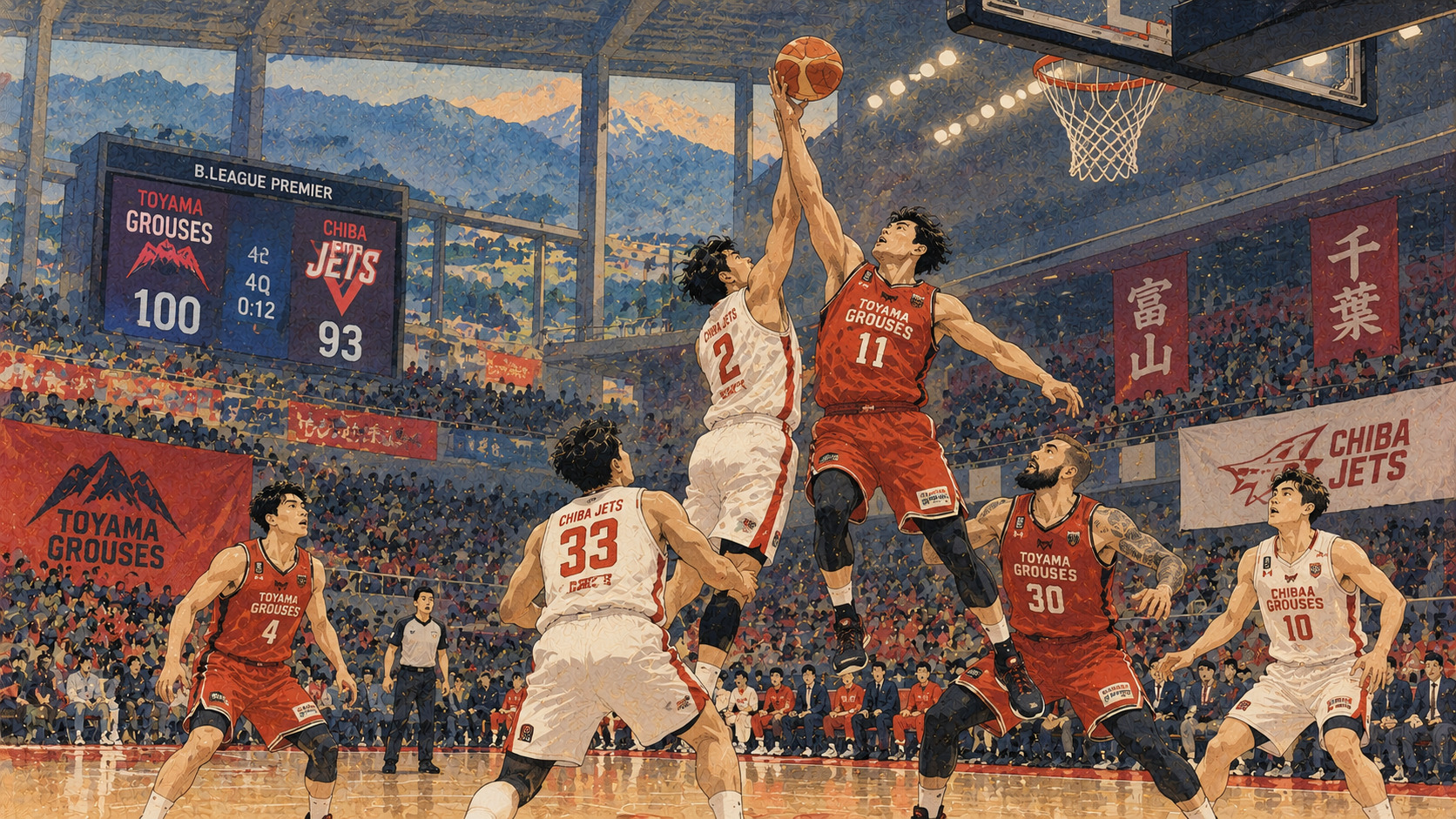
Chiba shot better from three. Toyama won more opportunities to score.
A game turned after ten minutes
The first-quarter score looked like an invitation to another Chiba Jets home victory: 34–27. At LaLa arena TOKYO-BAY on October 31, 2026, before 9,890 spectators, Chiba's offense had flourished. But the visiting Toyama Grouses did not merely survive the opening burst. They responded with a 30–19 second quarter, seized a 57–53 halftime lead, and then held Chiba to just 11 points in the third. The final was Toyama 100, Chiba 93: a road victory built on second chances, intelligent passing and a powerful inside game.
The pivotal middle twenty minutes
Toyama outscored Chiba 54–30 in the second and third quarters combined, reversing an early seven-point deficit and entering the fourth ahead 81–64. Chiba produced 29 points in the last period and Toyama scored 19, but the comeback did not erase the damage. Calling the contest simply a last-minute upset misses its tactical shape: the decisive separation arrived well before the final buzzer.
Rebounds that created a second offense
The official box score credits Toyama with 47 total rebounds to Chiba's 37. Crucially, 23 of Toyama's rebounds came at the offensive end, versus 13 for Chiba; both sides collected 24 defensive rebounds. An offensive rebound can return a possession after a missed shot, force the defense to reset and increase opportunities close to the basket. The 10-rebound advantage therefore needs to be read alongside shot volume, not merely as an abstract measure of effort.
Why the numbers matter more than shooting percentage
Chiba actually shot better from three-point range: 12 makes in 31 attempts, or 38.7%, versus Toyama's 9 in 33, or 27.3%. Yet Toyama attempted 80 field goals to Chiba's 61 and finished with 35 makes to 28. The visitors made 26 two-point baskets on 47 tries, while Chiba made 16 on 30. Those additional opportunities and two-point makes changed the arithmetic of the contest. It is misleading to describe the result as a Toyama three-point shooting explosion.
Passing, possession and the paint
Toyama recorded 30 assists and only 11 turnovers, compared with Chiba's 21 assists and 17 turnovers. Toyama also led 48–32 in points in the paint and 22–12 in points from turnovers. The figures do not disclose every play call or defensive adjustment, but they support a clear reading: ball movement and additional possessions mattered more than a simple hot hand.
The individuals behind the scoreboard
The official statistical leaders were Darall Willis Jr. for Toyama with 23 points and 15 rebounds, and Brian Angola with 10 assists. Chiba's Nate Williams scored a game-high 34 points; Yuki Togashi led the Jets with nine assists, and Luke Maye secured 10 rebounds. These contributions should not be confused with the outcome: Williams' scoring was exceptional, but the team-wide possession balance favored Toyama.
A famous arena, a demanding home crowd
LaLa arena TOKYO-BAY is an important stage for Chiba, a club that helped make Japanese professional basketball more visible through its domestic success and prominent national-team players. The official attendance of 9,890 adds scale to Toyama's achievement. It does not, by itself, prove how individual spectators reacted, and no player or coach quotation is attributed here without independent sourcing.
Toyama and the long climb
The Grouses emerged in 2006 as a professional club in Toyama, a Hokuriku region known for its mountains, manufacturing and strong local sports loyalties. Japanese basketball has repeatedly reorganized its divisions; Toyama's history includes promotions, demotions and rebuilding. The win mattered because an out-of-town club showed that a marquee opponent can be beaten with a collective performance, even on a night when the hosts shoot efficiently from long range.
From rival leagues to B.LEAGUE PREMIER
Japan's modern B.LEAGUE began in 2016 after a difficult era of competing professional and corporate-league structures. The 2026–27 campaign marks the launch of B.LEAGUE PREMIER within the league's reorganized structure. Its broader ambitions include arena standards, commercial sustainability and nationwide visibility. Those structural goals are context, not evidence that one game has altered the league's economic trajectory.
The moment is bigger than one upset
Entering this game Chiba had already experienced uneven form, while Toyama had beaten Levanga Hokkaido away and Shimane at home, but had also lost heavily to Ibaraki earlier in the week. That sequence argues against a simplistic narrative of unstoppable momentum. For Toyama, the more durable question is whether its offensive rebounding and low turnover count can be reproduced against other contenders.
The test that follows
The two clubs were scheduled to meet again on November 1. This article reports the completed October 31 match only; the subsequent game's result and any injuries, lineup changes or disciplinary matters require separate confirmation. It would be premature to turn this outcome into a forecast for a season that is still unfolding.
What Toyama really demonstrated
The winning formula was not mysterious. A 7-point first-quarter deficit gave way to a 17-point lead after three quarters, thanks to the middle-period run, 23 offensive rebounds, 30 assists, 48 paint points and 11 turnovers. Toyama's victory is a reminder that in a modern basketball game, possession quality and possession quantity can outweigh the opponent's better long-distance shooting. That lesson travels well beyond Toyama and Chiba.
Sources and verification
Official league data is the controlling source for statistics. Reported interpretations are identified as analysis; no interviews or quotations are invented.