- Why Sharaku still feels radical
- A meteoric career shaped by Edo's print market
- Curated work 1: Ōtani Oniji III as Yakko Edobei
- How Sharaku uses gesture as psychology
- Curated work 2: Ichikawa Ebizō as Takemura Sadanoshin
- Mica grounds, bust portraits, and the first 28 designs
- The mystery of Sharaku's identity
- From Edo celebrity prints to global museum icons
- Curatorial table
- Why Sharaku is the right Art Choice now
Why Sharaku still feels radical
Many ukiyo-e artists made actor prints. Sharaku made something more unsettling. Instead of idealizing his subjects, he compressed role, reputation, theatrical energy and private temperament into faces and hands that seem to twitch with thought. His prints do not merely record Kabuki; they diagnose it.
That is why Sharaku remains so potent. He created star portraits, but he refused to flatter. The result is a kind of image that feels surprisingly contemporary: psychologically sharp, graphically bold, and willing to let awkwardness intensify truth. In a media landscape that often prizes polish, Sharaku's refusal to smooth away tension is still fresh.
A meteoric career shaped by Edo's print market
The Tokyo National Museum describes Sharaku as an artist who left more than 140 works in the space of roughly ten months, from the fifth month of 1794 through the beginning of 1795. All of those designs were published by Tsutaya Jūzaburō, one of the most sophisticated publishers in Edo. That detail matters. Sharaku was not an isolated genius working outside the system. He emerged through one of the city's most ambitious cultural entrepreneurs.
His debut was spectacular. The museum's special-exhibition materials note that Sharaku burst onto the scene with 28 deluxe large-format bust portraits based on performances at the three Edo theaters. Their black mica grounds were expensive and visually arresting. The strategy was clear: announce a new artist not quietly, but with a complete and unmistakable visual program.
Yet Sharaku did not remain fixed in that format. Later phases introduced full-length figures, narrower print formats, more background detail and serial compositions. The change suggests commercial testing as well as artistic restlessness. He was adapting to the market even as he transformed it.
Curated work 1: Ōtani Oniji III as Yakko Edobei
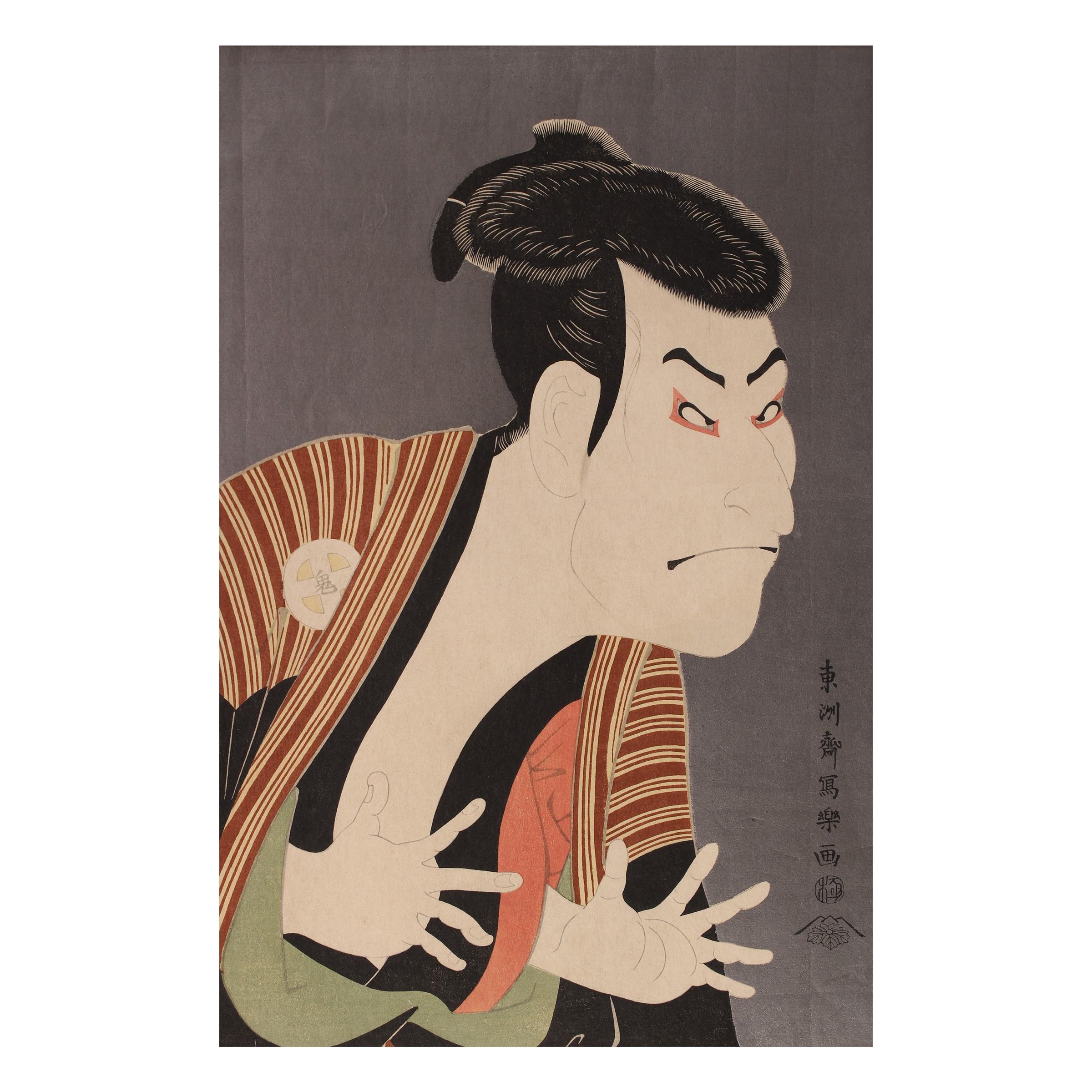
The first image in this feature is among the best-known works in Japanese art. The Metropolitan Museum of Art identifies it as Kabuki Actor Ōtani Oniji III as Yakko Edobei, a 1794 print showing the actor in the role of a samurai's servant from The Colored Reins of a Loving Wife (Koi nyōbō somewake tazuna). The museum emphasizes the actor's leering face, bristling hair and groping outstretched hands as evidence of Sharaku's ability to capture both character and performer.
The print's power lies in compression. Nothing here is wasted. The background eliminates narrative clutter; the body is cropped to intensify attention; the fingers splay forward like the first movement of a seizure or a grasp. Sharaku turns a single theatrical role into an anatomy of menace.
This is also the print that many readers meet first. It has become a shorthand for Sharaku because it delivers the entire proposition in one glance: exaggeration serving insight, not decoration. You can feel both the actor's technique and the villain's intent.
How Sharaku uses gesture as psychology
Western discussions of portraiture often privilege the face. Sharaku insists that hands matter just as much. In Yakko Edobei, the hands are not secondary details but psychological engines. They extend the actor's expression into space and convert character into action before action has fully begun.
This is one reason Sharaku differs from merely documentary printmakers. He is not satisfied with saying who the actor is. He wants to show how the role behaves, how it thinks, and how an audience remembers it. The print becomes a memory of theater rather than a simple report on theater.
Curated work 2: Ichikawa Ebizō as Takemura Sadanoshin
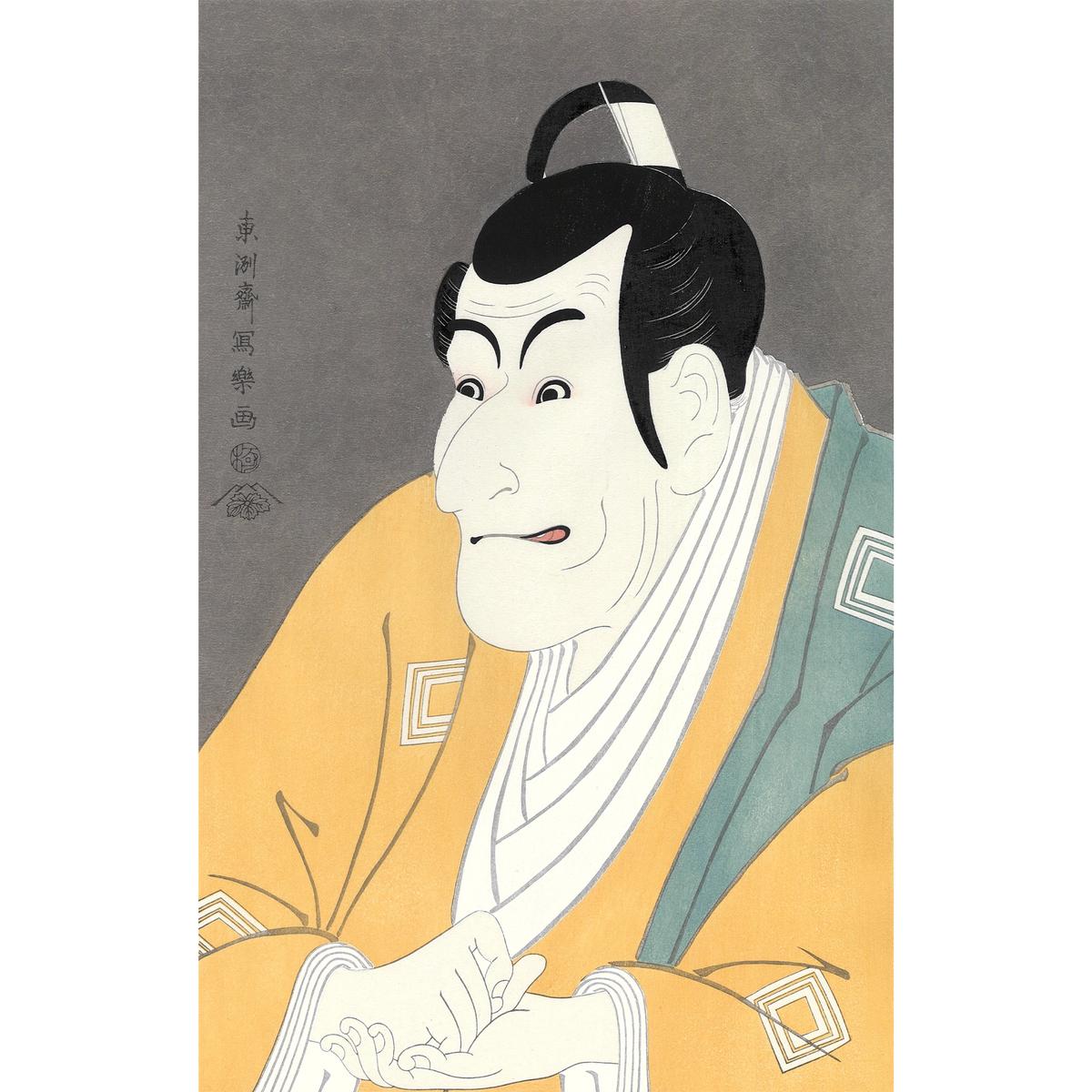
The second image is quieter on the surface and no less intense. The Edo-Tokyo Museum's digital archive identifies it as Ichikawa Ebizo as Takemura Sadanoshin, published by Tsutaya Jūzaburō in 1794. It belongs to the same inaugural group of bust portraits, but its emotional register is different. Instead of predatory reach, we see collected strain.
The actor's hands are clasped, not spread. The costume is bright yellow with visible family crests; the face is alert but inward. Museums such as the Cleveland Museum of Art and Tokyo Fuji Art Museum emphasize the role's dramatic seriousness and the way the design integrates costume, expression and posture. What makes the print memorable is its emotional restraint. The role seems to hover between decision and resignation.
Even the costume helps tell the story. The famous nested-box crest of the Ichikawa line asserts star identity, while the angled collars and compressed pose create composure under pressure. If Yakko Edobei externalizes danger, Takemura Sadanoshin internalizes it.
Mica grounds, bust portraits, and the first 28 designs
These two works reveal why Sharaku's first period matters so much. The black mica grounds are luxurious, but they also do conceptual work. They sever the actor from literal stage setting and push the viewer toward face, pose, costume and role. The print is no longer a scene. It is an encounter.
That first set of 28 bust portraits remains central because it introduced Sharaku's most uncompromising mode. Later works are fascinating, but these images announce the terms most clearly: close cropping, concentrated character study, and a sense that performance can be distilled without being diluted. They are not simply stylish—they are editorial in their boldness.
The mystery of Sharaku's identity
Who was Sharaku? Japan's National Diet Library authority record lists "Saitō Jūrōbei" as a variant name, and Japanese museum writing has long treated the theory that Sharaku was an actor attached to the Awa domain's Noh tradition as a leading possibility. But leading is not the same as settled. No final document closes the case.
That uncertainty matters, but perhaps not in the most obvious way. Sharaku's biography is incomplete, yet his artistic profile is extraordinarily coherent. The evidence inside the prints—the eye for performance, the theatrical intelligence, the ability to turn gesture into structure—feels stronger than the external paperwork. His mystery survives because the work itself is so vivid that readers expect an equally vivid biography and do not get one.
For a news publication, the responsible position is simple: present the major theory, identify it as a theory, and resist inflating speculation into fact. The mystery is real. So is the limit of current proof.
From Edo celebrity prints to global museum icons
Sharaku's afterlife is one of the great stories in the history of collecting. Prints once sold to theatergoers in Edo became prized museum objects in Tokyo, New York, Cleveland, Brooklyn and elsewhere. The Edo-Tokyo Museum notes that its impression of Takemura Sadanoshin can be traced through the Meiji art dealer Hayashi Tadamasa to the Paris jeweler and collector Henri Vever—a small but telling example of how Japanese prints circulated internationally.
Today, digital access has changed the terms again. Major museums now publish these works online at high resolution, sometimes under Public Domain or CC0 frameworks. Sharaku's images are no longer difficult to see. What remains difficult—and rewarding—is learning how to read them well.
Curatorial table
| Work | Object history | Why it matters visually | Why it matters historically |
|---|---|---|---|
| Ōtani Oniji III as Yakko Edobei | 1794; actor bust portrait; tied to Koi nyōbō somewake tazuna; famous Public Domain impression at The Met. | Hands, face and hair combine to project a villain's energy before the plot even advances. | A flagship example of Sharaku's first-period bust portraits and one of the best-known images in all ukiyo-e. |
| Ichikawa Ebizō as Takemura Sadanoshin | 1794; actor bust portrait published by Tsutaya Jūzaburō; preserved in multiple major collections. | Clasped hands, crest-bearing costume and tense facial structure create inward drama rather than overt aggression. | Shows the range within Sharaku's first 28 designs and demonstrates how he could shift from ferocity to moral concentration. |
Why Sharaku is the right Art Choice now
For JAPAN.co.jp, Sharaku is an ideal Art Choice because he sits at the intersection of recognition, depth and visual force. He is internationally famous yet still genuinely mysterious. He represents Kabuki culture, Edo publishing and the history of Japanese image-making all at once. And his prints can seize a reader's attention immediately, even before any explanation begins.
That combination is rare. Sharaku offers a story about celebrity, media technology, commerce, performance, authorship and disappearance. He is not simply a "great artist" in the abstract. He is a case study in how a short burst of concentrated work can outlast centuries of biographical uncertainty.
In the end, Sharaku's mystery is not a deficit. It is the frame around an achievement that remains fully visible. The record may not tell us everything about the man. The prints tell us more than enough about the artist.
Primary sources and scope
This article was prepared from official museum and public-institution sources available through November 18, 2026 JST. It avoids asserting a final solution to Sharaku's identity. Title spellings and character forms vary by institution, so the article preserves source-specific forms where relevant.
- The Metropolitan Museum of Art: Kabuki Actor Ōtani Oniji III as Yakko Edobei
- Edo-Tokyo Museum Digital Archives: The Actor Ichikawa Ebizo as Takemura Sadanoshin
- Tokyo National Museum: Sharaku
- Tokyo National Museum: Special Exhibition “Sharaku”
- National Diet Library Authority Record: Tōshūsai Sharaku
- Tokyo Fuji Art Museum: Ichikawa Ebizo as Takemura Sadanoshin
- Cleveland Museum of Art: Ichikawa Ebizō IV as Takemura Sadanoshin
- Brooklyn Museum: Ichikawa Ebizo IV as Takemura Sadanoshin