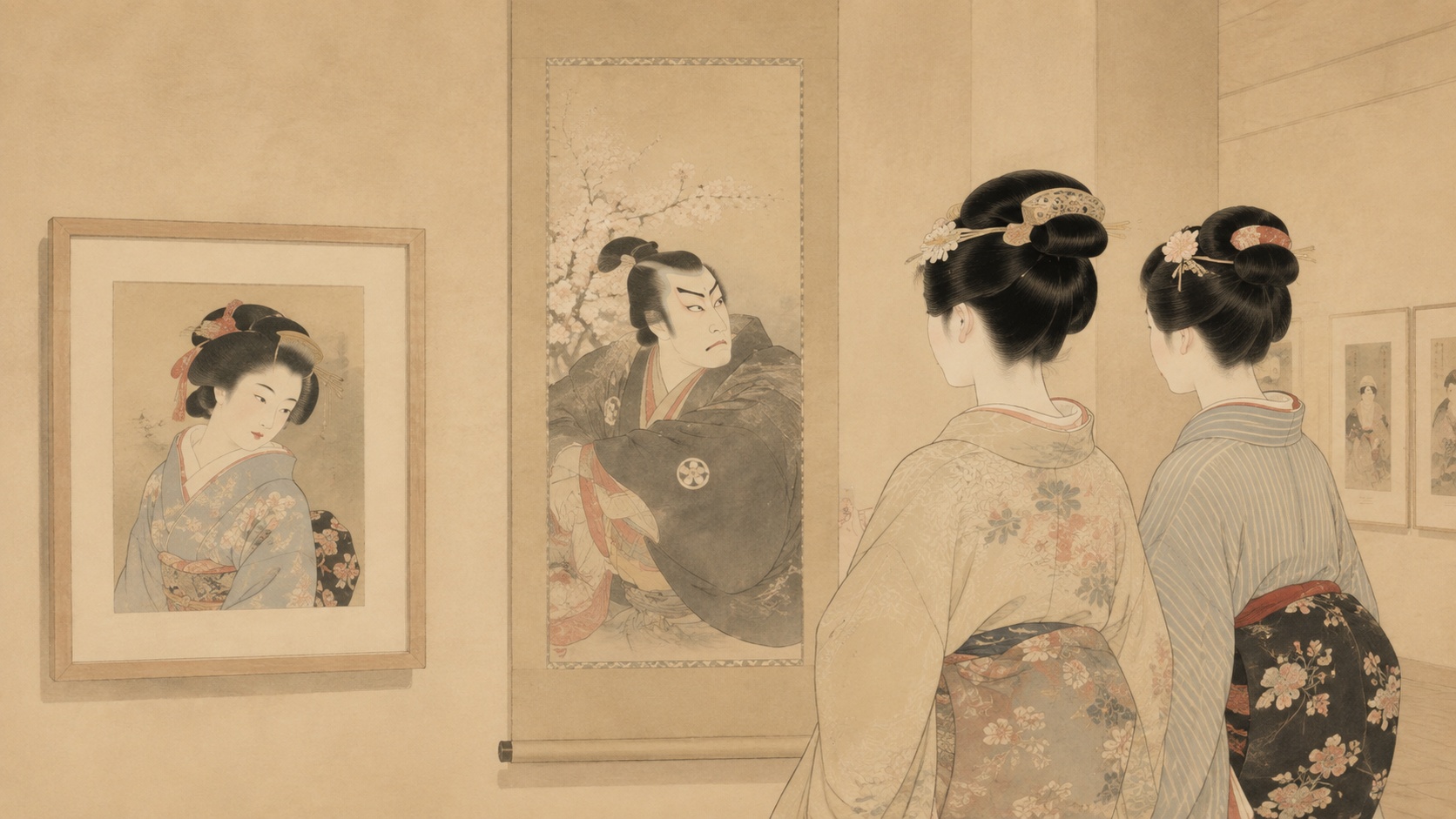
Torii Kotondo becomes simpler the more of his career you leave out. Call him a shin-hanga beauty-print artist and his delicate women fit neatly beside Hashiguchi Goyō and Itō Shinsui. Call him the eighth head of the Torii school and he belongs to a three-century Kabuki institution that painted theater signboards before modern advertising existed. The problem is that he was both.
The exhibition now open at Tokyo's Ota Memorial Museum of Art is built around that contradiction. “Torii Kotondo: Kabuki Paintings and Shin-Hanga (New Prints)” marks 50 years since his death and is the museum's first major Kotondo retrospective since 2000. Roughly 70 works are on view through September 27.
The museum has done something particularly useful for understanding the artist: it is showing all 22 of Kotondo's shin-hanga bijin-ga prints, alongside alternate impressions and rare proofs, while also presenting large hand-painted Kabuki pictures, real theater signboards and privately painted beauty pictures such as Verdant Rain.
He inherited a job before he chose an art
Kotondo was born in 1900 into a family in which painting was not only an artistic identity but a professional obligation. The Torii school had supplied Kabuki theaters with imagery since the Genroku period. Kabuki's official website still identifies Torii painting with theater signboards and with two visual conventions that reach back to the school's early generations: hyōtan-ashi, “gourd-shaped legs” that exaggerate muscular force, and mimizugaki, worm-like lines with strong modulation.
The signboard mattered because it was public communication. It had to be legible from outside the theater. It had to tell potential spectators something about the characters and the drama before they entered. Kabuki's official educational material distinguishes these large hand-painted boards from commercial actor prints: the signboard presents the larger world of the play rather than building its power around an individualized actor likeness.
For a child born into the Torii house, then, “tradition” was unusually concrete. It meant subject matter, line, muscular anatomy, scale, theater relationships and a client system inherited from earlier generations.
Ota Memorial Museum says the young Kotondo felt resistance toward that family profession. His importance begins with that resistance.
He looked toward intimate modern life instead
Kotondo first studied with historical painter Kobori Tomoto and then, at about 20 or 21, entered the circle of Kaburaki Kiyokata. Kiyokata is famous as a painter of beautiful women, but his own museum in Kamakura stresses a wider subject: ordinary urban life, literature, portraits and the emotional texture of people living in the city.
That kind of looking differed radically from the Torii signboard. A theater board needed the body to read across distance. A bijin-ga could depend on a loosened lock of hair, the turn of a neck, the weight of a yukata sleeve, or the quietness of someone absorbed in a private task.
The 2026 show includes Verdant Rain, a folding-screen painting documented as having appeared in the Kiyokata-school Kyōdokai exhibition in May 1928. Ota describes its subdued coloring and moist, restrained figure as one of Kotondo's little-known hand-painted masterpieces.
Shin-hanga was not old ukiyo-e mechanically revived
Modern audiences sometimes read shin-hanga as “newly printed ukiyo-e.” Its structure was more ambitious. The Edo-Tokyo Museum defines shin-hanga as a modern woodblock movement that flourished from the Taishō into the early Shōwa period while reviving the collaborative technical system of Edo-period prints.
A shin-hanga image was not simply painted by one artist and reproduced. A publisher coordinated a painter, specialist block carvers and printers. The museum estimates that more than 2,000 shin-hanga designs were created across varied subjects as artists and craftsmen tried to preserve advanced woodblock skills while making modern art.
That model developed alongside the sōsaku-hanga movement, in which artists emphasized carving and printing their own work. Modern Japanese print culture therefore contained competing ideas of artistic authorship: the single artist making the entire print versus a coordinated workshop creating one image through specialization.
Kotondo's presence inside shin-hanga was unusual because he was not merely a modern painter borrowing an Edo production system. He came from a living ukiyo-e lineage whose own work had never fully severed its relationship with theater.
Seeing all 22 beauty prints changes the argument
Showing a handful of Kotondo's most famous prints can make him appear to be an artist of flawless feminine refinement. Showing all 22 forces a different kind of looking.
His women are often caught in ordinary acts rather than formal presentation: arranging hair, wearing a summer robe, looking aside. Their faces are highly controlled, but the emotional charge often comes from a transitional moment — before the hair is fixed, before the pose is settled, before the figure turns back toward the viewer.
Morning Hair is the obvious example. Ota Memorial Museum says the print is said to have been confiscated by the Metropolitan Police under contemporary censorship rules. The wording matters: the museum presents it as a transmitted account, and the public materials reviewed for this report do not independently reproduce a police seizure record.
The museum also says Steve Jobs collected Kotondo as well as Kawase Hasui and kept Morning Hair in his private room until the end of his life. That is an intriguing reception history, but Japan.co.jp treats it as the museum's account rather than as an independently verified Apple archival fact.
The print does not need either anecdote to be compelling. Its subject is a woman before social presentation is complete. Traditional collaborative woodblock technique is being used to make a modern image of privacy.
A proof of Iris-Patterned Yukata makes the workshop visible
The exhibition pairs completed impressions with alternate colors and rare trial proofs, including material related to Iris-Patterned Yukata.
That matters because shin-hanga can be visually so polished that the labor disappears. A proof reminds the viewer that each result came through choices: how a line would be carved, how many blocks would carry color, how deeply a tone would be printed, where gradation would begin, whether the skin and cloth should sit close together or separate through contrast.
The Edo-Tokyo Museum emphasizes that shin-hanga depended not on the painter alone but on the combined skill of the publisher, carver and printer. The proof impression is evidence of negotiation before the “finished” image becomes fixed in our minds.
Then, around 1929, he inherited the profession he had resisted
Ota Memorial Museum's English exhibition text says Kotondo is believed to have succeeded as eighth head of the Torii school in 1929 after his father's retirement.
The museum's Japanese text gives a slightly different emphasis: he later succeeded the school and, especially after the war, used the name Torii Kiyotada VIII while producing large numbers of signboards and stage designs. Those two statements suggest a useful distinction between inheriting institutional responsibility and later foregrounding the inherited artist name in professional life.
The result was not a simple return to the past. His Kabuki paintings combined what Ota calls the traditional force of Torii imagery with a modern sensibility that was recognizably his own.
Shibaraku and Narukami show the other Kotondo at full scale
The Kabuki section includes the large folding-screen work Shibaraku, along with Yanone, Narukami and Yasha-ō from Shuzen-ji Monogatari. The museum is also showing rare signboards that actually hung at theaters.
The change in visual register is dramatic. The beauty prints reward nearness. The Kabuki paintings demand a body that can dominate space.
A theater signboard had to perform advertising, narrative and atmosphere at once. Its characters could not depend upon the individualized physiognomic appeal of a close-up actor portrait. They had to announce the play at architectural scale.
Kotondo's achievement was to work in that inherited public language after having developed another language based on intimate modern observation.
One artist, two enormous ukiyo-e lineages
Ota Memorial Museum makes a provocative claim about Kotondo: that he can be regarded as the unique heir to both the Torii and Utagawa lineages, two of ukiyo-e's great traditions.
The Torii connection is familial. The Utagawa connection runs through Kiyokata's artistic genealogy back toward Utagawa Kuniyoshi. This allows the museum to position Kotondo as a point where the Kabuki-signboard lineage and one of ukiyo-e's vast print-school genealogies converge.
That “unique heir” phrasing is an interpretive statement by the museum, not an official designation bestowed by a cultural agency or scholarly governing body. But as a way of looking at the retrospective, it is productive.
Examine only the beauty prints and Kotondo looks like a Kiyokata-line modernist. Examine only the Kabuki works and he looks like the Torii hereditary master. Put the two together and an unusually complicated modern ukiyo-e history emerges.
The Torii line did not end with Kotondo
Kotondo died in 1976. The Torii theater tradition continued. Kabuki's official website says Torii Kiyomitsu IX trained under her father Kiyotada and succeeded to the ninth-generation name in 1982. She became the first woman to head the school.
Torii signboards continued to appear at Kabukiza, and Kiyomitsu also worked on stage design and costume. In a Kabuki interview, she described the relationship with the theater not as her personal connection but as something inherited generation after generation.
This makes Kotondo a poor candidate for the romantic label “last ukiyo-e artist.” He was not an endpoint. He was a difficult transition point inside a tradition that kept going.
1900: Born the eldest son of Torii Kiyotada VII.
Around age 20–21: Believed to enter Kaburaki Kiyokata's circle and study bijin-ga.
1928: Verdant Rain documented at a Kyōdokai exhibition.
Around 1929: Believed by Ota Memorial Museum to succeed as eighth head of the Torii school.
Postwar: Works as Torii Kiyotada VIII, producing Kabuki signboards and stage designs.
1976: Dies.
1982: Torii Kiyomitsu IX succeeds the Torii line.
2000: Ota Memorial Museum mounts a Kotondo retrospective.
2026: 50th anniversary of his death; first major retrospective there in roughly 25 years.
“The last great age of shin-hanga” is evocative — but not a clean historical boundary
The idea of Kotondo belonging to the “last great age” of shin-hanga has emotional power. Historically, it should be used as interpretation rather than chronology.
Shin-hanga flourished especially from the Taishō through early Shōwa years, but it did not stop on a single date. Publishers, craftsmen and woodblock artists continued working after the war, and traditional print production has descendants today.
Kotondo's importance therefore is not that he stood at a precise final moment. It is that he inhabited two preservation projects at once. Shin-hanga tried to rescue sophisticated collaborative woodblock technique by giving it modern subjects. The Torii school preserved an even older professional relationship between painting and Kabuki theater.
His career asks whether artistic modernity must come from breaking with inheritance. His answer, reluctantly and inconsistently, was no.
The order in which you see the show changes who Kotondo seems to be
Start with Morning Hair and Iris-Patterned Yukata, and Kotondo appears to be a quiet modern observer of women. Move next to Verdant Rain, and the painterly side of his Kiyokata training becomes clearer.
Then reach Shibaraku, Narukami and the theater boards, and the scale of the career changes. The artist of a loosened strand of hair is also the artist of a public theatrical body meant to be read from across a street.
Reverse the route and the surprise reverses too. Begin with the hereditary Kabuki master and then encounter the privacy of the beauty prints. The question becomes: how did a painter raised inside such a codified theater language learn to see ordinary modern life this quietly?
The exhibition's achievement is that it refuses to decide which side is the “real” Kotondo.
Through September 27, Harajuku offers a history of ukiyo-e refusing to end
When did ukiyo-e end? With the end of Edo? With the decline of commercial nishiki-e? When photography changed the image market? When modern advertising replaced painted theater publicity?
Kotondo makes every answer unstable.
The Torii school remained on the theater façade. Shin-hanga reused Edo's collaborative woodblock system for modern subjects. Kiyokata's modern Japanese painting still carried an Utagawa genealogy. Kotondo moved through all of those structures.
The retrospective is therefore less a memorial to the end of ukiyo-e than evidence of its ability to mutate. Kotondo first tried to move away from an inherited profession, became known for modern beauty, then returned to the theater under the inherited Kiyotada name.
That return did not cancel the rebellion. It made the tradition different.
Sources
- Ota Memorial Museum of Art, “Torii Kotondo: Kabuki Paintings and Shin-Hanga (New Prints)” — official 2026 English exhibition page; dates, approximately 70 works, 22 shin-hanga beauty prints, succession around 1929, principal works and museum-attributed anecdotes.
- 太田記念美術館「没後50年記念 鳥居言人 歌舞伎絵と新版画」 — controlling Japanese source for the exhibition title, Japanese artwork titles, Torii Kotondo's name and the museum's interpretation of his career.
- Edo-Tokyo Museum, “Reviving Ukiyo-e: Beautiful Taishō Shin-Hanga” — definition of shin-hanga, traditional collaborative production and the scale of the movement.
- Edo-Tokyo Museum, “Tokyo — Birth of a Modern City in Prints of the 1920s–30s” — contrast between sōsaku-hanga and publisher-led shin-hanga.
- Kabuki official site, history of theater programs and Torii signboards — Genroku-era continuity, hyōtan-ashi, mimizugaki and Torii Kiyomitsu IX.
- Kabuki official site, “Ekanban” — the function and composition of Kabuki signboard painting compared with actor prints.
- Kamakura City Kaburaki Kiyokata Memorial Art Museum — official reading of Kaburaki Kiyokata's name and summary of his interest in urban life, literature and bijin-ga.
- Izu City Digital Museum, Kobori Tomoto — official public-museum source for the reading and career of Kotondo's earlier teacher.
This article was checked against public information available by 7:00 AM JST on September 4, 2026. Japanese exhibition and artwork titles are controlled by Ota Memorial Museum's Japanese materials. The museum's English page says Kotondo is believed to have succeeded his father as eighth head of the Torii school in 1929; the article therefore treats the year as an informed museum attribution, not an absolute archival certainty. Ota says Morning Hair is said to have been seized by the Metropolitan Police under contemporary censorship rules; Japan.co.jp did not independently locate the original police seizure record. The museum also states that Steve Jobs admired Kotondo and displayed Morning Hair in his private room until the end of his life; that anecdote is attributed to the museum and not presented as independently verified from Apple records. Ota's description of Kotondo as the unique heir to both Torii and Utagawa traditions is presented as curatorial interpretation, not an official cultural designation.
Image rights: © 2026 Japan.co.jp. AI-assisted editorial illustration. Unauthorized republication or reuse is prohibited. The image symbolically juxtaposes Kotondo's beauty painting and Kabuki careers; it does not reproduce the Ota Memorial Museum galleries, a specific exhibited work, Torii Kotondo or an actual model. For licensing, use the contact page.