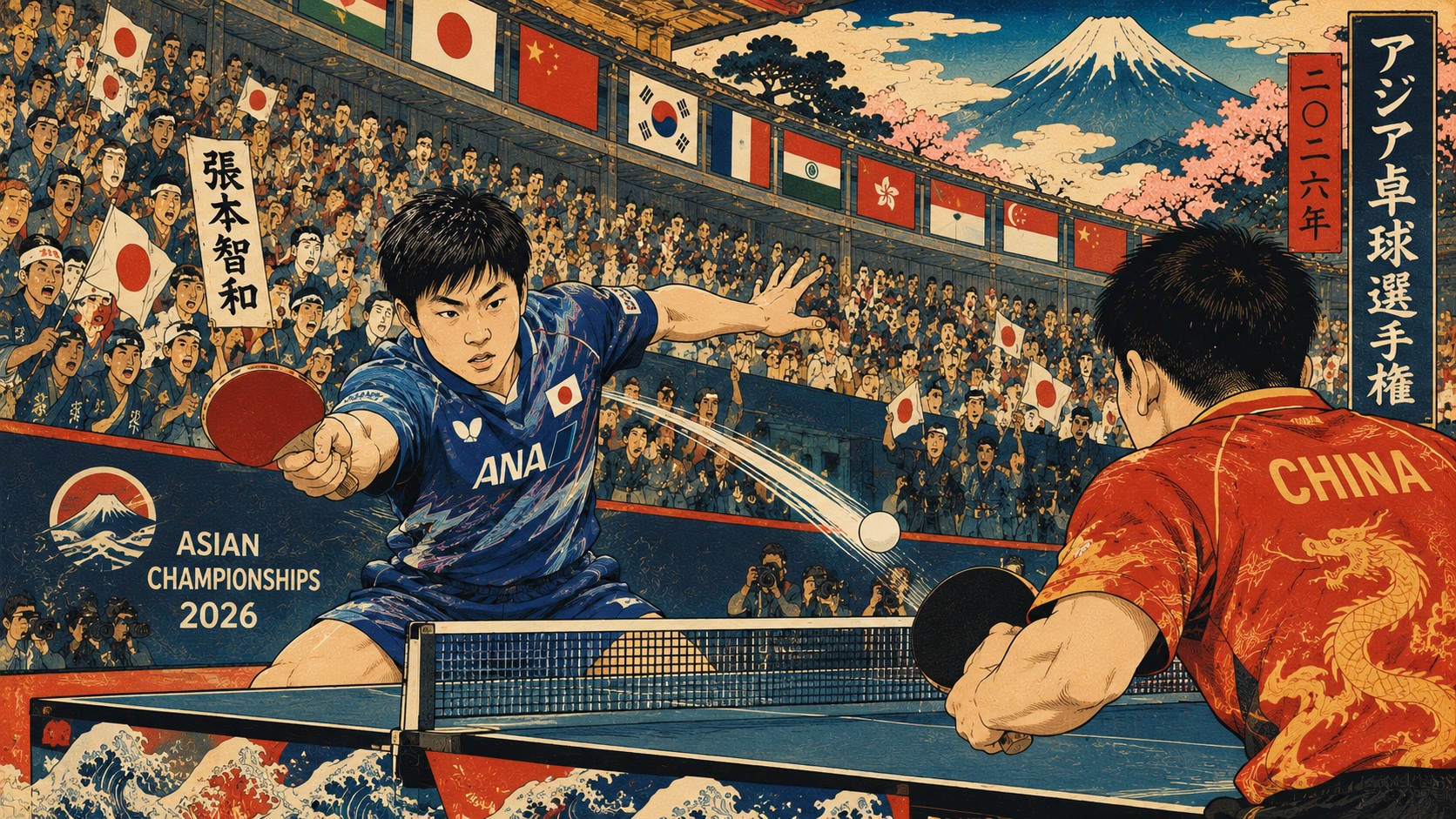
He did not win by never falling behind. He won by changing the match after falling almost impossibly far behind.
The champion lost the opening game 1–11
Tomokazu Harimoto’s defense of his Asian men’s singles title began with a humiliation on the scoreboard. In Tashkent, Uzbekistan, on October 25, 2026, China’s 19-year-old defensive specialist Li Tianyang took the opening game 11–1 and the next 11–9. Harimoto was one game from defeat. Then the Japanese player solved enough of the problem to win 11–7, 11–8 and 11–7. The five-game sequence is more revealing than the headline result. It shows a champion forced to adapt under the immediate threat of elimination rather than simply overpowering an opponent.
Why this was a difficult matchup
Li is a chopper, a defender who uses heavy backspin, changing depth and occasional attacks to disrupt the timing of an opponent who wants to attack with topspin. This style makes the quality of one shot depend on what happened several exchanges earlier. According to TV Tokyo’s detailed match account, Harimoto lost 11 consecutive points after taking the opening point. The second game was more competitive: he briefly came back to lead 8–6, only to lose 9–11. It was the first meeting between the two players, and Li’s unusual mix of defensive variation and sudden offense presented a tactical puzzle.
The comeback required more than hitting harder
TV Tokyo described Harimoto gradually adjusting to the chop, changing the pace and moving Li forward and back. The third game went to Harimoto 11–7 and the fourth 11–8. In the decider, the Japanese player went ahead 7–2, surrendered five points in succession and was level at 7–7. He took the last four points to close out the match. No official ball-by-ball spin-speed dataset was available for this report, so descriptions of technique are attributed to match reporting, not presented as independently measured data. What the scores independently confirm is an extraordinary reversal.
Three Chinese opponents on the route to gold
Harimoto beat China’s Huang Youzheng 3–0 in the fourth round, Chinese semifinalist Wen Ruibo 3–0 and Li Tianyang 3–2 in the final. He also needed a comeback from two games down against Chinese Taipei’s Feng Yi-Hsin in the quarterfinals. Match records compiled by Japanese specialist publication Takurepo provide the round-by-round scores. The variety of these tests matters: the tournament was not just one dramatic final against China, but several different tactical demands, including two matches in which Harimoto recovered from a 0–2 deficit.
The precise meaning of a 52-year milestone
Harimoto previously won the Asian Championships men’s singles title at Astana in 2024. Winning again in Tashkent made him the first Japanese man since Nobuhiko Hasegawa, champion in 1972 and 1974, to win consecutive editions of that event. That is the 52-year comparison reported by Japanese broadcasters. It does not mean Japan had gone 52 years without winning any Asian men’s singles championship; the record is specifically about back-to-back editions. This historical precision turns a striking statistic into a useful one.
The long struggle to match Asian table-tennis powers
Japan once occupied a formidable place in world table tennis, and Hasegawa was among the defining Japanese figures of the era. International competition then developed through decades of technical change and increasingly sophisticated training systems. China built exceptional depth, while Japan invested in junior development, international experience, corporate-backed competition and a professional domestic league. Harimoto’s result belongs within that evolving sporting landscape. It is neither proof of permanent Japanese supremacy nor merely an upset to be explained by nationality.
Harimoto the seasoned competitor
Born in Sendai, Miyagi Prefecture, Harimoto became famous internationally at a remarkably young age. At 23 during the 2026 championship and playing for Toyota Motor Corporation, he is no longer only the teenage prodigy of earlier headlines. His game is associated with aggressive, fast table tennis, but the Tashkent final offers a different view of his development: a player who could withstand an unfamiliar defender’s success, change his responses and recover even after a decisive lead in the final game evaporated.
The other Harimoto had a remarkable week too
The family story goes beyond Tomokazu. His younger sister, Miwa Harimoto, partnered Sora Matsushima to win mixed doubles gold, defeating China’s Huang Youzheng and Chen Yi 3–2. She also reached the women’s singles final and, with Hina Hayata, the women’s doubles final, taking silver in both. Japan’s women also won the team title, according to the event results. Miwa’s achievements deserve to be understood as her own, not merely as a supporting detail in her brother’s career.
Tashkent and a broader Asian game
The 29th ITTF–ATTU Asian Championships ran October 19–25 in Uzbekistan’s capital. Its location is another reminder that Asian table tennis encompasses more than the traditional leading teams of East Asia. Athletes and organizers across Central Asia, Southeast Asia, South Asia and the Middle East participate in the sport’s regional institutions. The ITTF points toward the 2027 World Championships in Astana, Kazakhstan, as another major event in Central Asia. The geography of major tournaments is changing alongside the competition.
What this win proves—and what it does not
Harimoto won the final 3–2 after losing the first two games, defeated three Chinese opponents in successive later rounds and became Japan’s first consecutive men’s singles Asian champion since Hasegawa. Those are verifiable results. Neither the score sheet nor television analysis reveals every thought in the player’s mind. This article does not invent locker-room dialogue, coaching instructions or a promise about Olympic or world-championship results. A champion losing 1–11, falling two games behind, and still finding a route to gold is dramatic enough without embroidery.
Sources and verification
Cross-checked against ITTF’s recap, Japanese match reporting and round-by-round records. No direct interview with Harimoto or his coaching staff was conducted.