- A Nagoya hotel becomes a workshop window
- What is actually on show
- The meaning of a line of paste
- Miyazaki Yūzensai and a story from Kyoto
- Tokyo’s hand-painted tradition
- The Nagoya obi and the woman who needed time
- Why Tokyo Yuzen and the Nagoya obi are not synonyms
- A younger group experiments with an older language
- Can a hand-dyed object find a lasting market?
- The craft survives by being used
A Nagoya hotel becomes a workshop window
For four days in November, the lobby of a Nagoya hotel is being asked to do something more interesting than welcome guests: show how an elaborate artistic tradition might fit into a modern day. From November 12 to 15, SONO Moon Nagoya hosts “The Appeal of Tokyo Yuzen and Nagoya Obi,” a display and sale of hand-painted silk kimono, sashes and accessories. The visiting artists are Somemoyou (そめもよう), a group that works with Tokyo’s hand-painted yuzen tradition.
The organizer announced the event on October 1, not November 12. Its stated theme—bringing flowers, color and yuzen into everyday life—turns a modest exhibition into a larger question. If beautiful textiles are made only for rare ceremonies, how can workshops retain the skills needed to make them? The display is an invitation to look closely, not evidence by itself that the market has been revived.
The location matters. Nagoya is associated with the very practical Nagoya obi, a sash devised to simplify the business of getting dressed. Tokyo Yuzen, meanwhile, is admired for intensely personal hand-drawn designs. Together they suggest that tradition has always included invention.
What is actually on show
The organizers describe kimono, obi, small textile goods and a consultation opportunity in the first-floor lobby lounge at SONO Moon Nagoya, 4-22-21 Meieki, Nakamura Ward, around an eight-minute walk from Nagoya Station’s Sakura-dori exit. The publicized hours are noon–7 p.m. on November 12, 11 a.m.–7 p.m. on November 13 and 14, and 11 a.m.–5 p.m. on November 15. These are organizer-advertised hours, not an independently verified account of opening-day operations.
The program includes an unusual workshop: participants can decorate an original T-shirt using yuzen techniques, with designs offered for people and for LOVOT companion robots. The announced prices are ¥7,700 for a human-size shirt and ¥13,200 for the LOVOT version, tax included. The organizer specifies that workshop places require advance booking even though ordinary visits do not require a reservation.
This is not a museum retrospective, and an on-site sale does not establish the sales performance of the participating artists. It is a working contemporary showcase. The relevant questions are what steps the visitors can observe, what pieces they can discuss with makers, and whether those encounters lead to longer-term interest in the craft.
The meaning of a line of paste
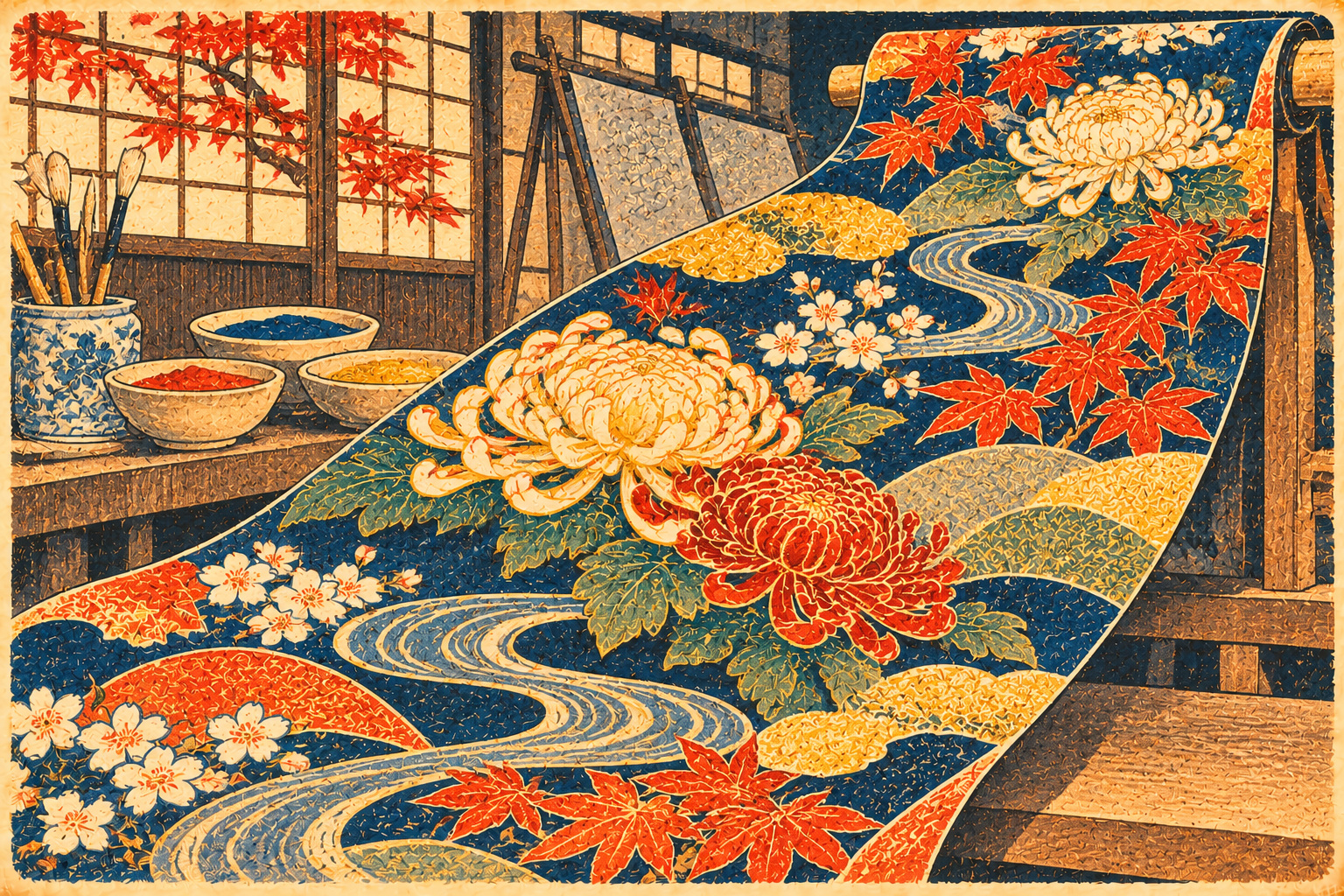
Yuzen is sometimes described as painting on a kimono. That is not wrong as a starting image, but it conceals a technical achievement: preserving crisp boundaries between different dyes on delicate cloth. A conventional hand-painted sequence begins with a design and a temporary sketch, followed by the application of a fine resistant paste along the outlines—known as itome-norioki. It is a barrier that keeps adjacent colors from bleeding together.
Colors are then applied by brush in the process called irosashi, sometimes with gradients that make flowers appear to turn toward the light. More paste may be used to protect completed areas while the ground color is drawn across the silk. Steaming fixes the dyes; washing removes paste and excess color; finishing may add fine drawing, gold or embroidery. Specific order and materials vary by workshop and technique, so no one six-step diagram fully describes every yuzen piece.
The result can look effortless. Yet every clear border records a decision about where one color stops. A small irregularity is not necessarily a failure; it can distinguish a piece made by a person from an identical printed repeat. That distinction is attractive aesthetically, but it also limits how cheaply the work can be reproduced.
Miyazaki Yūzensai and a story from Kyoto
The historical account commonly told by craft organizations begins in late-seventeenth-century Kyoto with Miyazaki Yūzensai, a painter renowned for designs on folding fans. The Tokyo Crafts Dyeing Cooperative dates the associated emergence of yuzen designs to the Jōkyō era, 1684–1688. It gives his personal name as Hioki Kiyochika. The account is framed as a tradition handed down about the origins, not as proof that a single man invented every resist-dyeing method.
Yuzen developed in a world where elite fashion, merchant taste, publishing and visual art increasingly met. Patterns could travel from drawings to cloth, and textile surfaces allowed extraordinary freedom of imagery. Later, the migration of artisans from Kyoto into Edo helped shape a different urban style: a culture of sophistication often expressed through restraint rather than abundant ornament.
Kyoto and Edo cannot be reduced to a simple pair of opposites—bright versus subdued. The distinction reflects markets, tastes and workshop organization across several centuries. Nevertheless, Tokyo’s official craft introduction emphasizes the individual artisan’s role from drawing through coloring, and a distinctive capacity for contemporary subjects as well as traditional flora.
Tokyo’s hand-painted tradition
“Tokyo hand-painted yuzen,” or Tōkyō tegaki yūzen (東京手描友禅), is the precise official craft name. It was designated a national traditional craft on March 3, 1980, and received Tokyo metropolitan designation on December 24, 1982. Principal production areas include Shinjuku, Nerima and Nakano, according to the metropolitan government. Those recognitions document an established craft community; they do not certify every individual garment in a contemporary exhibition.
The city’s craft guidance stresses that a Tokyo artisan often carries a piece through many stages, contrasting with the more specialized division of labor associated with other dyeing centers. This concentration of authorship makes the finished textile a record of a particular maker’s choices, but it also places considerable training, production and business burdens on each workshop.
A city scene, a cat, a botanical study or an unfamiliar modern object can all become a yuzen motif. Traditional technique is compatible with a contemporary picture. The risk lies not in drawing an unconventional subject but in losing the ability to execute the line and the color with conviction.
The Nagoya obi and the woman who needed time
The Nagoya obi has a particularly revealing origin story. Koshihara Gakuen credits educator Haruko Koshihara (越原春子, 1885–1959) with devising an easier-to-wear sash around the founding of Nagoya Girls’ School in 1915. As an educator working at a time when kimono remained standard daily dress for many women, she wanted to avoid the long preparation demanded by heavier, more elaborate obi.
Her practical alteration used a narrower, doubled section around the waist and a wider single-layer section for the decorative knot. School records state that salesman Yoshio Ozawa (小澤義男) of Nakamura Gofukuten noticed the sash, brought the design to the store and helped commercialize a Kyoto-produced version in 1924. The name Nagoya obi then spread nationally. Nagoya City Library independently summarizes the same school-history account.
This history has a significance beyond fashion. Koshihara was an educator and later one of Japan’s early women members of the postwar Diet. Her obi emerged from the pressures of working life and the wish to spend less time dressing. The modern sash preserved beauty by improving convenience, not by insisting that customs never change.
Why Tokyo Yuzen and the Nagoya obi are not synonyms
The two phrases describe different things. Yuzen refers to a family of dyeing and decorative techniques, and Tokyo hand-painted yuzen names a recognized regional craft. A Nagoya obi is a particular construction and wearing style of sash, which can be made from different woven or dyed fabrics. It need not be yuzen-dyed, and yuzen work is not confined to Nagoya obi.
When both appear in one exhibition, the combination can be felicitous: a painterly silk surface meets a practical piece of clothing shaped by twentieth-century life. But it would be misleading to present the event as if the Nagoya obi originated from Tokyo hand-painted yuzen or as if every item offered is a designated traditional craft product.
Visitors can ask questions that reveal the craft more effectively than labels alone: who drew the original design, what fabric was used, which parts were resist-dyed, how many colors were applied, and how should the piece be cleaned, repaired and stored?
A younger group experiments with an older language
Somemoyou identifies itself as a group of younger creators working mainly in hand-painted yuzen. The group dates its launch to December 2013 and its incorporation to April 2022; its studio website also describes a “some-pri” line and contemporary products. The Nagoya organizers emphasize kimono, obi, accessories and participatory workshops as means of meeting people who might never enter a specialist textile shop.
Putting the work in a hotel lobby changes the audience. Someone visiting Nagoya for business may encounter a hand-dyed object while walking through a public interior. A LOVOT T-shirt is more playful still. It does not make a traditional garment, but it allows the skill of applying a pattern by hand to travel into an unfamiliar format.
Experimentation alone does not prove commercial success. The organizers have not supplied independently audited sales numbers, demographic evidence of new customers or a measured long-term impact on apprenticeships. Those outcomes should not be inferred from a well-photographed event.
Can a hand-dyed object find a lasting market?
Japanese textile producers face a difficult equation. Silk, specialized dyes, workshop time, distribution and finishing all carry costs. Meanwhile, everyday clothing choices have changed substantially. A ceremonial kimono can be cared for and worn repeatedly across generations, yet its initial price and the complexity of dressing and maintenance can deter people unfamiliar with the practice.
A successful strategy may involve several markets rather than one heroic return to mass kimono wearing: collectors of high-quality garments; repairs and alterations; workshops that teach technique; interior textiles; accessories; and collaborations with designers. The financial viability of each depends on actual orders, margins and labor conditions rather than on the generic popularity of “Japanese craftsmanship.”
Environmental claims deserve particular caution as well. The long life of a cherished silk garment may be meaningful, but that fact alone does not establish a lower carbon or water footprint. Dyes, water treatment, silk cultivation, transport and cleaning must all be considered before declaring one product more sustainable than another.
The craft survives by being used
The November 12–15 Nagoya event is a small window into a much longer story: how Japan has repeatedly turned art into something that can be worn, handled, repaired and adapted. Miyazaki Yūzensai’s remembered patterns, Edo’s workshop culture and Haruko Koshihara’s time-saving sash are not competing chapters. They are different examples of design responding to people.
For a visitor, the most rewarding moment may be the simplest: looking at a line where two colors meet, then realizing a craftsperson deliberately placed a temporary barrier there before the dye was applied. That little line makes a dense history tangible.
It is too early to claim the Nagoya exhibition has transformed the industry. It has posed a useful challenge instead. A tradition remains alive when people can still acquire the skill, when makers can earn enough to continue, and when an object remains relevant without giving up the qualities that made it worth preserving.
Visitor information (organizer-announced)
| Dates | November 12–15, 2026 |
|---|---|
| Venue | SONO Moon Nagoya, first-floor lobby · 4-22-21 Meieki, Nakamura, Nagoya |
| November 14 | 11:00–19:00 |
| November 15 | 11:00–17:00 |
| Workshop | ¥7,700 human-size shirt / ¥13,200 LOVOT shirt; advance booking required |
Sources and reporting method
This report distinguishes the event’s promotional announcement from documented craft history; claims about economic impact, attendance and the sustainability of individual products were not independently verified.
- SONO Hospitality Japan, exhibition announcement, October 1, 2026
- SONO Moon Nagoya, organizer event information
- Somemoyou / Yukiya studio, event and workshop information
- Tokyo Metropolitan Government, Tokyo hand-painted yuzen
- Tokyo Crafts Dyeing Cooperative, origin of Tokyo hand-painted yuzen
- Nagoya City, hand-painted yuzen production techniques
- Koshihara Gakuen, Nagoya obi invention and commercial history
- Nagoya City Library, investigation of Nagoya obi origins
- Koshihara Gakuen, biography of Haruko Koshihara
- Kyōritsu Women’s University, research into Yuzen dyeing methods