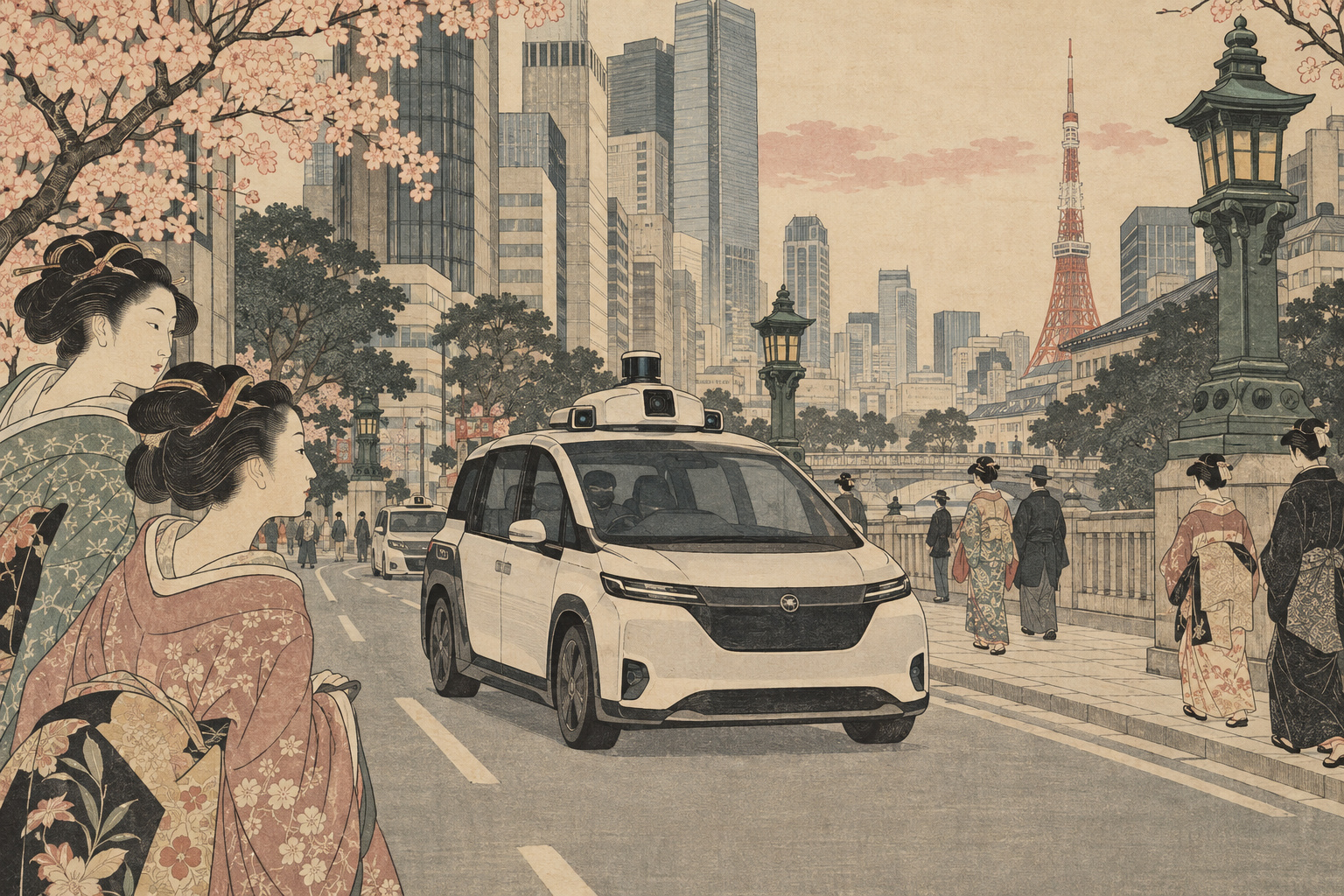
A driverless taxi can look like a one-company technology story: a Waymo vehicle arrives, the front seat is empty, and software does the driving. Tokyo’s planned 2027 launch is more complicated—and more interesting. It is a three-part operating model built around Waymo’s automated driver, GO’s dispatch platform and Nihon Kotsu’s licensed taxi operation.
On September 15, GO, Waymo and Nihon Kotsu said they had agreed to prepare a commercial Level 4 service in Tokyo that is intended to carry public riders with no driver in the vehicle during 2027. The partners plan to begin with an initial fleet and scale gradually to around 100 vehicles in key Tokyo neighborhoods. Riders are expected to be able to hail the autonomous taxis through either the GO app or Waymo’s app.[1][2]
That changes the nature of the project. The question is no longer simply whether Waymo can make an autonomous car negotiate Tokyo streets. The question is whether three companies can turn that capability into a regulated taxi business: approved vehicles, authorized driverless operations, fleet depots, charging, cleaning, maintenance, dispatch, customer support, incident response and a commercial service that people use alongside ordinary taxis.
The companies say the 2027 launch depends on national and local regulatory approvals and on completing validation of Waymo’s technology and the partners’ joint operations. A precise launch date, initial fleet size, fare structure, first service zone and final commercial vehicle specification have not been published.[1][2]
The project began as a road-learning exercise
The partnership was first announced in December 2024 as a testing program. GO, Waymo and Nihon Kotsu said they would bring the Waymo Driver to Tokyo to study how the technology could fit a dense Japanese city and how autonomous taxis might contribute to mobility as Japan’s population and transport workforce change.[4]
In April 2025, Waymo vehicles began operating on public roads across seven central wards: Minato, Shinjuku, Shibuya, Chiyoda, Chuo, Shinagawa and Koto. In the initial phase, Nihon Kotsu drivers manually drove the vehicles to build detailed maps and collect experience on local traffic patterns. Waymo described those kilometers as its first public-road operations outside the United States.[5]
The program has since progressed to autonomous driving with trained Nihon Kotsu personnel supervising in the vehicle. The partners say the system has been adapting to Tokyo’s narrow streets, dense pedestrian flows and other local conditions while they test the operating model around it.[1][2]
December 2024 — GO, Waymo and Nihon Kotsu announce a Tokyo testing partnership.
April 2025 — Waymo vehicles begin public-road operations in seven central wards, initially driven manually by Nihon Kotsu personnel.
2025–2026 — The program advances to supervised autonomous driving and joint operational validation.
September 15, 2026 — The companies announce a strategic partnership aimed at commercialization.
During 2027 — Fully driverless public rides are the target, subject to approval and validation.
Level 4 does not mean “any road, any time”
“Level 4” is often reduced to a simple idea: the human driver is no longer needed. The legal and engineering meaning is narrower. The automated system is responsible for the driving task within defined operating conditions. Those conditions can include geography, road type, weather, speed and other limits.
Japan created a permit regime for what the Road Traffic Act calls specified automated operation after legislation passed in 2022; the relevant provisions took effect in April 2023. The National Police Agency describes it as operation using Level 4-equivalent automated-driving equipment without a human driver, within the system’s approved conditions. The framework also assumes that the vehicle can reach a safe stop if those conditions are no longer met or the automated system cannot continue.[6]
That distinction matters in Tokyo. The 2027 service is not automatically a license to roam every street in every condition. The partners have not yet disclosed the final operational design domain or the first commercial zone.
The driver disappears; the operator does not
A fully driverless taxi still sits inside several layers of Japanese transport law. The vehicle itself must satisfy the Road Transport Vehicle Act and the conditions attached to its automated-driving equipment. A driverless operation on public roads requires authorization under the Road Traffic Act. The Tokyo Metropolitan Police Department’s procedure calls for an application describing the specified automated-operation plan and related materials.[7]
Passenger transport adds another layer. MLIT guidance for Level 4 operations reflects amendments to the Road Transportation Act and related rules, including requirements for passenger-transport businesses using specified automated operation to appoint safety personnel and maintain the responsibilities of an operator even when there is no driver behind the wheel.[10]
This explains the partnership’s division of labor. GO is to design how Waymo technology fits into the taxi industry, coordinate with local taxi operators and provide the service through the GO app. Waymo supplies the autonomous-driving technology and operating infrastructure, including fleet-management systems and specialized know-how. Nihon Kotsu is to handle frontline operational management and depot operations.[1]
Driverless does not mean operator-less. Tokyo’s commercial test is whether responsibility can be reorganized around software without being diluted.
Japan already has driverless Level 4 service—but not this kind
The Tokyo project should not be described as Japan’s first Level 4 operation without qualification. In March 2023, a vehicle used in Eiheiji, Fukui Prefecture, became the first in Japan approved under the Road Transport Vehicle Act as a Level 4 vehicle not requiring a driver. After transport registration and police authorization, a driverless mobility service began there in May 2023.[8][9]
Eiheiji’s service was deliberately constrained: roughly two kilometers, low speed and a route that followed guidance infrastructure. The Waymo-GO-Nihon Kotsu ambition is different. The companies are aiming for what they describe as Japan’s first commercial taxi service using fully driverless Level 4 operation on Tokyo streets.
That difference—between a bounded public-mobility route and an on-demand taxi—is why the 2027 project matters. A taxi must respond to individual trips, variable pickup points, changing traffic and a much wider range of customer situations.
Around 100 cars is small for Tokyo, but large enough to expose the business
A fleet of around 100 vehicles would be tiny compared with Tokyo’s overall taxi supply. But it would be large enough to move the project beyond a technology demonstration. At that scale, the hard problems include not only perception and path planning but also dispatch efficiency, charging, vehicle cleaning, maintenance, damaged vehicles, lost property, customer complaints, blocked pickup points, software updates and recovery from communications failures.
Waymo says it is preparing an on-demand, 24/7 service, beginning with an initial fleet and scaling toward around 100 vehicles in key areas. That remains an operating intention rather than a guarantee that every launch zone will run around the clock from day one.[2]
The integration with GO may be just as important as the vehicle. GO President Hiroshi Nakajima says users will be able to request both conventional taxis and Waymo autonomous rides through the same app. That reduces one of the commercial barriers to robotaxis: asking customers to adopt an entirely separate mobility system. Autonomous capacity can instead appear as one option inside an existing taxi marketplace.
| Item | Status as of September 15, 2026 |
|---|---|
| Target launch | During 2027, contingent on regulatory approval and validation. |
| Driving mode | Fully driverless Level 4 commercial taxi service is the goal. |
| Fleet | Initial deployment followed by gradual expansion to about 100 vehicles. |
| Customer access | GO app and Waymo app. |
| GO | Industry integration, overall service design and app distribution. |
| Waymo | Automated-driving technology, operating infrastructure and fleet systems. |
| Nihon Kotsu | Frontline operating management and depot operations. |
| Not yet disclosed | Exact launch date, fares, initial fleet count, first commercial zone and final vehicle platform. |
The labor shortage is real, but autonomy is not a one-line cure
Japan’s transport policy is increasingly shaped by workforce constraints. The 2025 MLIT white paper says the number of taxi drivers fell by about 50,000 between fiscal 2019 and fiscal 2022. The number bottomed around the end of March 2023 and has been recovering, but the ministry still describes securing bus and taxi drivers as an urgent problem for residents and visitors.[11]
That does not mean Tokyo suffers the same shortage at every hour or in every neighborhood. Taxi supply is highly uneven across time, weather and events. The economic value of autonomous cars will therefore depend less on a headline count of “drivers replaced” than on whether the fleet can be positioned where demand is difficult to meet.
The national government has set a target of 10,000 autonomous-service vehicles across buses, taxis and trucks by fiscal 2030. Transport Minister Yasushi Kaneko said on September 15 that the Waymo-GO-Nihon Kotsu agreement could be a major step toward that target.[3]
Tokyo’s robotaxi market is becoming a race
Waymo is not alone. In March 2026, Uber, British autonomous-driving developer Wayve and Nissan announced plans to prepare a Tokyo robotaxi pilot for late 2026 using a Nissan LEAF equipped with the Wayve AI Driver. In August, Uber added Hinomaru Kotsu as its local fleet-operations partner. The initial pilot is planned with experienced drivers acting as safety operators before any future fully driverless phase, which would itself require regulatory approval.[14][15]
The competitive history also argues for caution with launch dates. In 2023, Honda, GM and Cruise announced a plan to begin a driverless ride-hailing service in central Tokyo in early 2026, starting with dozens of purpose-built Cruise Origin vehicles and eventually reaching 500.[16]
The lesson is not that the 2027 Waymo target will fail. It is that robotaxi commercialization depends on several moving systems at once: technology, capital, vehicles, regulation, local operating partners and public acceptance. A press-release date is a milestone; it is not the same thing as a permit.
Tokyo is building a regulatory and physical environment for Level 4
The Tokyo Metropolitan Government has been running autonomous-vehicle trials and designating “promotion zones” intended to support earlier Level 4 implementation by making administrative coordination more efficient and helping build public acceptance. Existing zones include parts of the bay area, West Shinjuku and Mizuho Town.[12][13]
Those designations should not be treated as a map of Waymo’s future taxi territory. The companies have not announced their first commercial operating zone, and it would be speculative to infer it from Tokyo’s other autonomous-driving programs.
US operating experience matters—but Tokyo has to be proven in Tokyo
Waymo enters Japan with far more real-world commercial experience than it had when the Tokyo partnership was first announced. The company says it now provides more than half a million rides per week while expanding fully autonomous service across 15 US cities. That is relevant evidence of operational scale, although it is company-reported data and does not by itself establish safety performance under Tokyo conditions.[2]
Tokyo brings its own problem set: narrower streets, heavy pedestrian and bicycle interaction, different stopping behavior, rail crossings, roadworks, curb rules and taxi-stand conventions. The meaningful safety record will be the one produced within the approved Japanese operating domain.
There is also a customer-service dimension that crash statistics cannot capture. What happens when a passenger becomes ill, a wheelchair user needs assistance, the vehicle cannot reach the exact pickup point, a rider leaves property behind or a communications link fails? A taxi service is partly driving and partly hospitality, judgment and recovery from the unexpected.
The economics will only become visible after launch
Autonomy may reduce the need for a person to drive each individual vehicle, but it does not eliminate operating costs. The system requires expensive vehicles and sensors, computing, communications, charging, depots, cleaning, maintenance, remote support, insurance, software updates, mapping, regulatory work and safety management.
The announced partnership quietly acknowledges that reality. Nihon Kotsu remains responsible for operating infrastructure on the ground; Waymo brings fleet systems as well as the Driver; GO supplies demand and dispatch. Commercial success will depend on utilization: how many hours each vehicle can be productive, how many passenger trips it can complete, how much downtime charging and maintenance require, and how reliably the fleet can serve peaks in demand.
That is why “100 cars” will not be the most important number in 2027. Trips per vehicle, response times, intervention rates, operating hours, downtime and customer retention will say more about whether the Tokyo deployment is a transport business rather than a technology showcase.
The first riders will judge whether it feels like an ordinary taxi
For most passengers, the technical architecture will eventually fade into the background. They will open an app, request a car, get in, travel and pay. The robotaxi will have succeeded when that sequence feels normal—even in rain, at night, after a missed train, with luggage, or when something goes wrong.
Waymo, GO and Nihon Kotsu form a logical combination for that test. Waymo automates the driving task. GO controls a familiar digital doorway into the taxi market. Nihon Kotsu brings the routines and obligations of a Japanese taxi operator.
The 2027 milestone is therefore bigger than an empty driver’s seat. It is a test of whether Tokyo can make a driverless vehicle behave, commercially and institutionally, like one more dependable taxi in the city.
Sources and references
- GO Inc.: GO, Waymo and Nihon Kotsu agree to prepare commercial autonomous taxis, Sept. 15, 2026
- Waymo: Opening our doors to Tokyo riders in 2027 with Nihon Kotsu and GO, Sept. 14, 2026
- MLIT: Transport Minister Yasushi Kaneko press conference, Sept. 15, 2026
- GO Inc.: 2024 Tokyo autonomous-driving test partnership announcement
- GO Inc.: Waymo vehicles begin driving in seven central Tokyo wards, Apr. 14, 2025
- National Police Agency: Autonomous driving and the Road Traffic Act
- Tokyo Metropolitan Police Department: Specified automated-operation permit procedure
- MLIT: Japan’s first Level 4 vehicle approval without a driver, Mar. 31, 2023
- MLIT: Start of Japan’s first Level 4 mobility service without a driver, May 2023
- MLIT: Level 4 legal changes under the Road Transportation Act
- MLIT White Paper 2025: Bus and taxi driver workforce
- Tokyo Metropolitan Government: Overview of autonomous driving
- Tokyo Metropolitan Government: Autonomous-driving promotion zones
- Uber / Wayve / Nissan: Japan robotaxi collaboration, Mar. 11, 2026
- Uber / Hinomaru Kotsu: Tokyo robotaxi pilot operations partnership, Aug. 13, 2026
- Honda: Plan announced in 2023 for a Tokyo driverless ride-hailing service in early 2026
- Bank of Japan: Foreign Exchange Rates, Sept. 15, 2026
- Reuters: Waymo and Japanese partners target a Tokyo driverless taxi service in 2027, Sept. 15, 2026
Evidence reviewed early September 16, 2026, Japan time. The precise launch date, initial fleet count, fares, first service zone and final commercial vehicle platform remain undisclosed. The partners’ “first in Japan” claim is reported in the narrower sense of a commercial taxi service using fully driverless Level 4 operation. Waymo operating and safety figures are treated as company-reported data. Analysis is Japan.co.jp’s unless otherwise attributed.