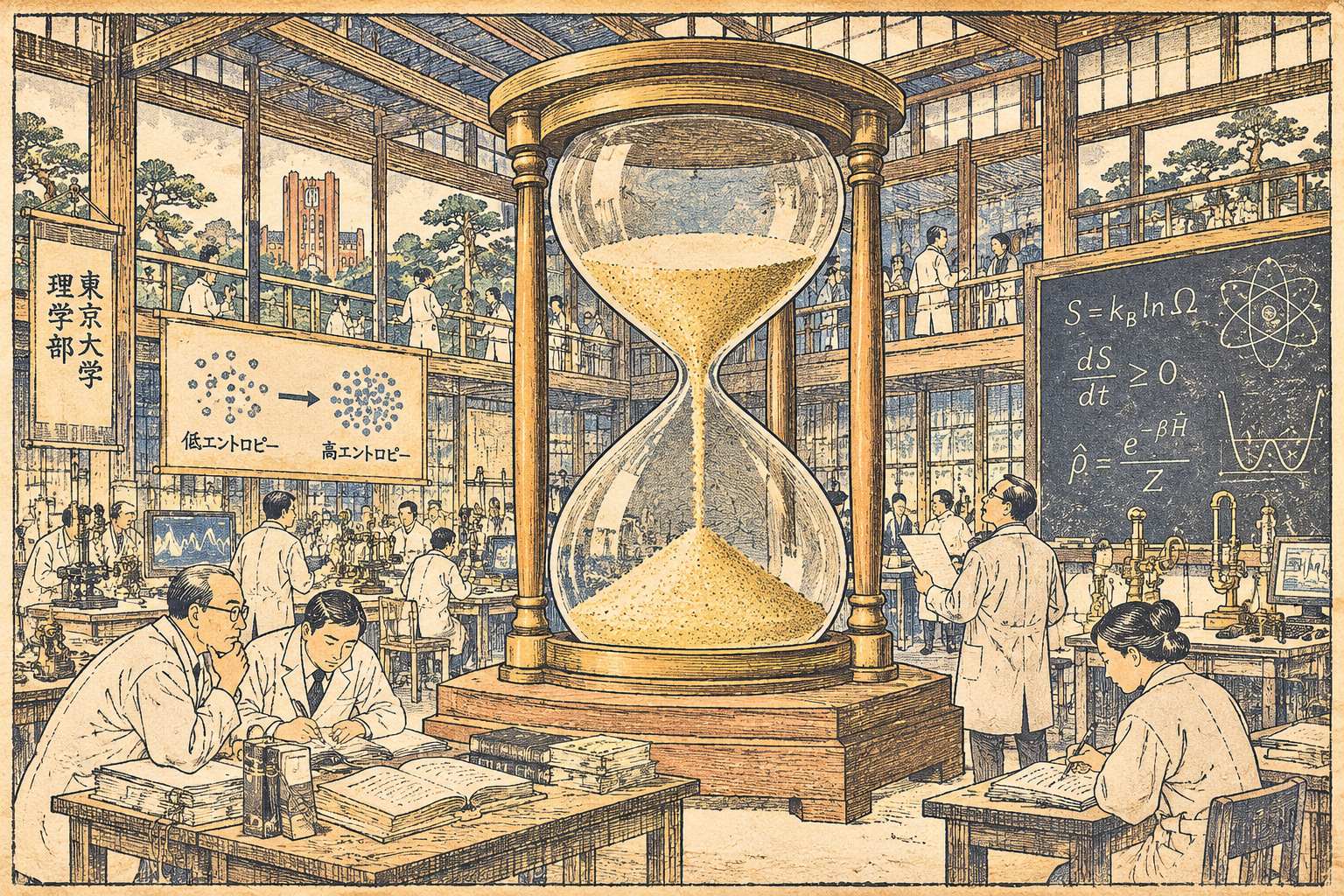
- The hourglass and the quantum paradox
- A significant theorem, not a machine that reverses time
- From steam engines to statistical mechanics
- Why a pure quantum state can be a thermal state
- The distinction between conceivable and physical control
- First consequence: no free macroscopic work from equilibrium
- Second consequence: an entropy measure that matches thermodynamics
- What the proof says—and does not say—about the arrow of time
- The crucial caveat: how long the operation takes
- From Maxwell’s demon to quantum machines
- A more exact bridge between two descriptions of nature
The hourglass and the quantum paradox
Turn an hourglass over and its sand begins to fall. Watch long enough and the grains collect in the lower chamber. There is nothing in ordinary experience suggesting they will spontaneously organize themselves back into the upper chamber. Hot coffee cools. Gas disperses. A broken cup does not reassemble. Time seems to announce its direction through irreversible changes.
The second law of thermodynamics provides a mathematical language for this asymmetry. Yet the quantum equations describing the particles inside that coffee, cup and hourglass allow reversible evolution for a closed system. How can the very same physical world obey a reversible microscopic theory and an apparently irreversible macroscopic one?
A collaboration involving Japan's RIKEN institute, the University of Tokyo and the University of Osaka has now supplied a rigorous piece of the answer. In research published November 3, 2026, in PRX Quantum and announced in Japan on November 4, four physicists showed how two formulations of the second law follow from quantum mechanics when equilibrium, allowed operations and entropy are defined in ways that capture macroscopic physics. It is not a universal proof that all motion of time must be forward. The precise scope is what makes the result worth understanding.
A significant theorem, not a machine that reverses time
The paper, 'Second Law of Thermodynamics in Closed Quantum Many-Body Systems,' is by Yuuya Chiba, Yasushi Yoneta, Ryusuke Hamazaki and Akira Shimizu. Its publication details are PRX Quantum, volume 7, article 043023, DOI 10.1103/3y8f-yrp8. The authors work across RIKEN's theoretical research and quantum-computing groups, the University of Tokyo and the University of Osaka. Japanese institutional releases identify the four by the names 千葉侑哉, 米田靖史, 濱崎立資 and 清水明.
The work is theoretical: it establishes statements by mathematical argument, not by running a novel quantum machine. The team constructs a framework for identifying quantum states that count as thermal equilibrium and for identifying quantum operations corresponding to thermodynamic manipulation.
Two consequences follow. Under the specified operations a macroscopic amount of work cannot be drawn from an equilibrium state through a cycle. And a newly defined macroscopic entropy density does not decrease through the specified operation-and-relaxation process. These are related statements of the second law, but the authors emphasize that they are not equivalent claims in quantum mechanics.
From steam engines to statistical mechanics
Nineteenth-century thermodynamics was forged in the age of heat engines. Sadi Carnot asked what limits the conversion of heat into work; Rudolf Clausius and William Thomson, later Lord Kelvin, gave the second law its defining forms. Clausius helped introduce entropy as a state quantity, while Ludwig Boltzmann's statistical approach connected thermodynamic behavior with the multiplicity of microscopic arrangements.
The modern intuition is that macrostates compatible with enormously many microscopic possibilities overwhelmingly dominate states with unusually special arrangements. This helps explain why a gas released into a box tends to spread and why thermal equilibration is so common, although the foundations of irreversibility have continued to provoke profound questions.
Quantum mechanics made the tension sharper. A closed quantum system evolves through a unitary transformation, which preserves information about its full quantum state. Thermodynamic entropy, however, appears to increase in ordinary processes. A satisfactory account must show how both descriptions can apply to the same many-particle object without silently changing what an observer is allowed to measure or do.
Why a pure quantum state can be a thermal state
The puzzle intensifies when a many-body quantum system is in a pure state. Pure does not mean cold or ordered in the everyday sense. It means the full quantum state is not a probabilistic mixture of distinct states. Research on quantum thermalization has established that many such states can look thermally equilibrated to macroscopic observers.
But a pure state's von Neumann entropy—the standard entropy measure of quantum information theory—is zero. A thermally equilibrated object can still possess substantial thermodynamic entropy. The two quantities cannot simply be identified in every situation.
There is a second difficulty. If every mathematically possible unitary transformation is allowed, one can transform a pure state into another pure state in ways that enable work extraction. That seems to violate the thermodynamic principle that a cyclic operation cannot extract useful macroscopic work from equilibrium. The paper does not blame quantum mechanics for a physical contradiction. It asks whether the allowed control has been specified too broadly.
The distinction between conceivable and physical control
In thermodynamics, a laboratory operator may vary a magnetic field, move a piston or change a few large-scale parameters. That is different from individually manipulating an astronomical number of microscopic degrees of freedom with arbitrary precision. Mathematical permission and practical thermodynamic control are not identical categories.
The researchers introduce an equilibrium criterion called iMATE, short for infinite-observable macroscopic thermal equilibrium. A quantum state qualifies when the expectation values of all additive observables—quantities built by adding contributions across a system, such as energy or total magnetization—match equilibrium macroscopic values. This formulation can encompass pure quantum states.
They then define macroscopic operations as unitary evolution generated by time-dependent additive Hamiltonians controlled through a finite number of external parameters. This turns the ordinary laboratory distinction between changing a field and micromanaging every particle into a precise mathematical distinction. The theorem depends on this choice, rather than on permission to perform every unitary transformation imaginable.
First consequence: no free macroscopic work from equilibrium
A classical statement associated with Planck says that if a system starts at thermal equilibrium and the external controls are taken through a cycle back to their original settings, a thermodynamically adiabatic operation cannot reduce the system's energy in a way that yields net work. For the closed systems considered here, an energy reduction would correspond to work delivered outside the system.
Under the team's definitions, an initial state satisfying iMATE cannot yield an extensive, macroscopically significant amount of work through any permitted cyclic macroscopic operation, within the stated operation-time conditions. This remains true even if the full initial quantum state is pure.
The theorem does not assert that heat engines cannot operate. Real engines use nonequilibrium resources, such as a temperature gradient or fuel. The proposition concerns work from an equilibrium state under a restricted class of cyclic operations. Confusing these cases would transform a precise result into a false claim about all energy conversion.
Second consequence: an entropy measure that matches thermodynamics
The ordinary von Neumann entropy cannot, by itself, be the entire answer for a globally pure quantum state: the unitary evolution of that closed state preserves its von Neumann entropy at zero. Yet a body described by that state may look like a thermal system with nonzero thermodynamic entropy.
Chiba and colleagues therefore formulate a quantum macroentropy density constructed using spatial averaging over local quantum states. For states satisfying iMATE, it agrees with thermodynamic entropy density, including when the full quantum state is pure. It is a deliberately macroscopic quantity rather than a direct replacement for all uses of quantum-information entropy.
They consider a permitted macroscopic operation followed by relaxation while the external controls are held fixed. Under physically motivated conditions for that relaxation, the new entropy density cannot decrease. The team has thus derived a nondecrease law as well as a restriction on work extraction, separately proving two quantum-mechanically distinct expressions of the second law.
What the proof says—and does not say—about the arrow of time
The result has clear implications for how physicists understand the emergence of thermodynamics. It does not, however, answer why the early universe began in a comparatively low-entropy condition. It does not settle every philosophical account of the arrow of time, or explain memory, causality and cosmological history through one theorem.
Its domain is specific: closed quantum many-body systems, equilibrium states defined by macroscopic observables, and thermodynamically meaningful operations followed, for the entropy result, by a stipulated relaxation process. The authors have not shown that entropy must increase under every arbitrary quantum operation.
That qualification is a strength, not a weakness. Scientists gain an explanation of how reversible microscopic equations can be compatible with irreversible macroscopic restrictions by specifying which quantities observers see and which controls they can reasonably deploy. A theory that marks its boundaries is more illuminating than a headline that claims time itself has been solved.
The crucial caveat: how long the operation takes
The authors place an important limit on the proof. Their rigorous results address macroscopic operations whose durations do not grow with system size. This is a mathematical assumption about control times, not a statement that all real processes are rapid.
Some familiar thermodynamic procedures—very slowly moving a piston, for example—may require longer and longer times as systems scale. RIKEN's Japanese release explicitly notes that applying the current framework without modification to certain operations whose duration increases with size can produce theoretical counterexamples to the second law.
That does not establish a laboratory violation of thermodynamics. It means the broader mathematical framework needs additional assumptions about states or control. The researchers point to quantum simulators as a possible way to examine some such behavior, while acknowledging that extension to long-duration operations remains a research problem.
From Maxwell’s demon to quantum machines
For generations, Maxwell's demon has posed a pointed question about information and the second law: if an imaginary agent sorts molecules with enough knowledge, can it defeat thermodynamic constraints? Modern work links feedback, measurement and information-processing costs to the behavior of small systems.
Japanese researchers have also pursued quantum versions of demon-like information-to-work processes, including a University of Tokyo release in 2025 concerning information flow and feedback in a quantum spin system. But the new PRX Quantum result is not an experiment involving a demon or feedback control. It addresses a different question about closed many-body systems and macroscopic operations.
Its potential relevance to quantum technology is conceptual. Understanding which transitions or work-extraction strategies are forbidden under realistic forms of control can inform how physicists set resource limits. There is no evidence in this paper of a faster quantum computer, a more efficient commercial power plant or a new device that exploits the theorem today.
A more exact bridge between two descriptions of nature
The November research does not render thermodynamics obsolete. It sharpens the conditions under which thermodynamics emerges from quantum mechanics. Instead of invoking an unspecified gap between microscopic laws and macroscopic experience, the team gives mathematical content to equilibrium, observables, entropy and operations.
For an immense collection of particles, knowing and controlling every microscopic detail is not equivalent to measuring temperature, energy or magnetization. The distinction is not merely philosophical. It can determine which transformations are physically relevant and which entropy statements can be rigorously defended.
An hourglass still carries more mystery than any single paper can resolve. But the research provides a carefully drawn answer to a fundamental question: how can matter governed by reversible quantum evolution also obey thermodynamic limits that make macroscopic change so profoundly one-way? The response is not an appeal to magic or a claim that time has been unlocked. It is a proof with clearly stated premises—and an agenda for what comes next.
Sources and reporting method
Based on the peer-reviewed original paper and Japanese-language announcements from RIKEN and its collaborating universities. Claims about potential technology applications are identified as prospective, not achieved.
- 理化学研究所・東京大学・大阪大学、2026年11月4日共同発表 / Japanese joint release
- 東京大学大学院理学系研究科・日本語発表 / University of Tokyo Japanese press release
- Chiba, Yoneta, Hamazaki and Shimizu, PRX Quantum 7, 043023 (2026), peer-reviewed original article
- 東京大学・英語の機械翻訳版 / University of Tokyo English release (machine translated)
- 東京大学・量子情報を活用したマクスウェルのデーモン研究(2025年) / Maxwell’s demon research context