An introduction is not an innovation. The real measure is what happens after the meeting.
The other Tokyo begins west of the towers
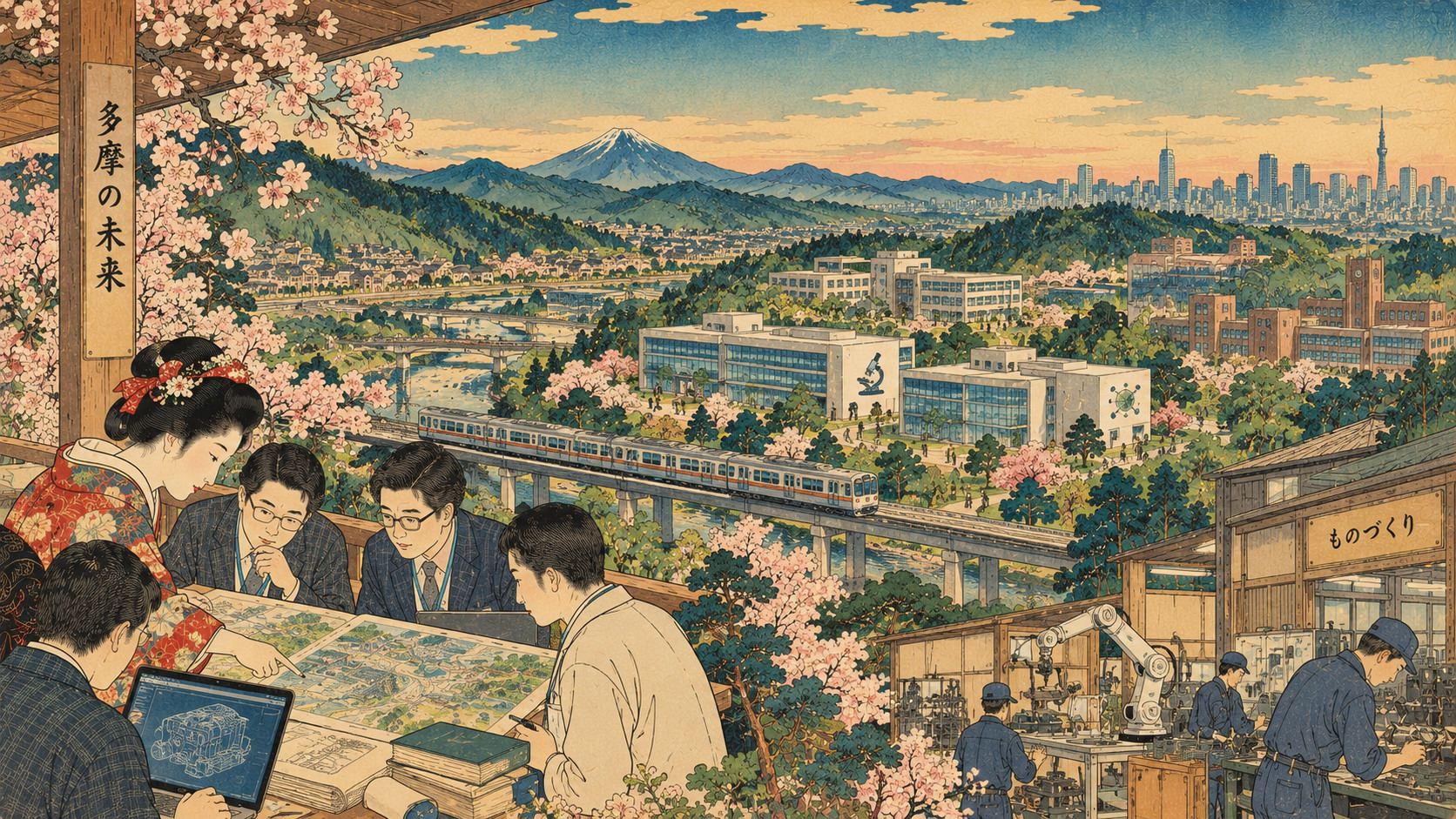
Tokyo's international reputation is built on its central business districts, venture capital circles and enormous corporate headquarters. Yet an alternative geography of invention lies farther west, across the Tama area: precision suppliers, university laboratories, growing enterprises and communities whose working lives rarely feature in global startup coverage. The question is whether these assets can function as an interconnected regional economy, rather than simply coexist on a map.
A new invitation, not a new factory
On October 20, 2026, the Tokyo Metropolitan Government announced Tama Future Collaboration Expo 2026 (たま未来連携EXPO 2026), scheduled for December 17–18 at Tokyo Tama Mirai Messe in Hachioji. Tokyo says approximately 40 organizations from universities, research institutes, municipalities, business-support bodies and companies will participate. Exhibitions, talks and business-matching opportunities are planned. This is an announcement of a future event, not evidence that its partnerships or products have already materialized.
What the numbers actually say
The event office calls this the third installment and says last year's attendance was nearly double the inaugural edition. It also reports that more than 95% of survey respondents wanted to participate again. Those are organizers' claims about attendance and expressed interest. A willingness-to-return survey is not a count of signed research agreements, new companies, paid contracts or jobs. Even the respondent base and survey method should be reviewed before using the satisfaction figure as evidence of commercial success.
Why Hachioji—and why now?
The December gathering will use Tokyo Tama Mirai Messe, the Tokyo Metropolitan Tama Industrial Exchange Center in Hachioji. The western metropolis offers a different mixture of manufacturing expertise, transport links, campuses and suburban cities from central Tokyo. Where a venture investor might ask for a presentation about addressable markets, an established supplier may begin with tolerances, test methods, patents and repeatable production. Creating an opportunity for both sides to speak a common language is the initiative's most credible near-term purpose.
The historical roots of an industrial suburb
Tama's history is not a sudden leap from bedroom communities into advanced technology. Western Tokyo developed through railway expansion, postwar urbanization, university relocation and the growth of specialized manufacturing and corporate research. The late twentieth century also left the region with the familiar dilemma of suburban Japan: older industrial establishments, dispersed job centers and residents commuting toward the urban core. That inherited landscape helps explain the appeal of place-based innovation policy today. This is broad historical context, not a claim that every participating company came out of the same industrial lineage.
Tokyo has been trying to build the connective tissue
The metropolitan government's Tama Innovation Ecosystem initiative predates the latest expo. Tokyo says it convened a regional executive committee with economic organizations and support institutions and adopted an action policy in March 2022, later reviewing results and direction in March 2025. The official program seeks repeated collaboration among small and medium-sized enterprises, universities, research centers and startups. Its language of an 'ecosystem' implies something more demanding than one trade show: relationships that endure after the booths come down.
A grant is a tool—not an outcome
One concrete policy instrument is the leading-project support program. Tokyo's 2026 call described hands-on assistance and eligible support of up to ¥5 million in the first year for joint projects moving researched products and services toward implementation, with a similar ceiling in the second year subject to progression and program conditions. The ceiling is an offer of possible support, not proof that each project received that amount. And subsidized demonstration still has to survive customer testing, procurement rules, operating costs and the challenge of finding repeat clients.
Two events at one venue, two different purposes
The calendar presents a potential source of confusion. The New Technology Creation Exchange 2026, organized by the Tokyo Metropolitan Small and Medium Enterprise Support Center, is scheduled for October 22–23 in Hachioji, also at Tokyo Tama Mirai Messe. It features meetings and product displays for smaller firms and large-company partners. The Tama Future Collaboration Expo is a separate event scheduled for December. Neither should be described as a completed event as of the October 21 research cutoff. The October gathering can, however, illuminate an existing practical model of manufacturing-oriented matchmaking.
What success would look like
The most useful follow-up measures would be collaborations that survive six or twelve months: paid pilot installations, jointly owned intellectual property, new orders to local manufacturers, repeat investment, skilled hires, and measurable municipal improvements. A company that finds one dependable design partner may benefit more than an expo that records thousands of unqualified conversations. For professional audiences, transparency about the conversion from introduction to production would be more informative than glowing event testimonials.
The barriers outsiders often underestimate
University laboratories work to different time horizons from product customers. Small manufacturers need confidentiality and workable liability terms before sharing process know-how. Municipal buyers face budgeting cycles and procurement procedures. Venture capital can prefer scalable software while a local engineering business needs long-lived capital equipment. Transportation between neighboring Tama centers is not frictionless either. These are structural obstacles, not defects unique to this initiative; organizers should be judged by how deliberately they address them.
A region must also answer a social question
If regional innovation merely relocates existing Tokyo business activity to different meeting rooms, it will do little for ordinary communities. Its more ambitious test is whether local students can see technical careers nearby, smaller firms can win meaningful orders, and aging industrial neighborhoods can retain productive employers. Business formation and livable communities need not compete, but the benefits do not arrive automatically. The distribution of jobs and opportunities deserves as much examination as patent filings or pitch sessions.
What to watch after October 23
Tokyo says detailed programs and visitor registration for the December event are expected in November. The announced schedule is December 17, 10 a.m.–5 p.m., and December 18, 10 a.m.–4 p.m.; the venue is in Myojincho, Hachioji. Readers considering attendance should check the official site for registration and changes. Japan.co.jp will be better able to judge the experiment when partners are named, projects described and results made public. For now, the strongest factual story is an organized attempt to connect industrial capacity already in the region—not a proven new Silicon Valley.
Sources and documentation
Research cutoff: October 23, 2026 (Japan time). Dates after the cutoff are schedules, not results. Organizer estimates are identified as such; no attendance or commercial outcomes are independently verified.
- Tokyo October 20 announcement
- Tokyo Tama innovation ecosystem policy
- Tama Future Collaboration Expo announcement
- Expo venue and participation schedule
- Tama Innovation Ecosystem official program
- Tama ecosystem project grants
- October technology collaboration event
- October event venue details
- Tokyo Startup Ecosystem Consortium