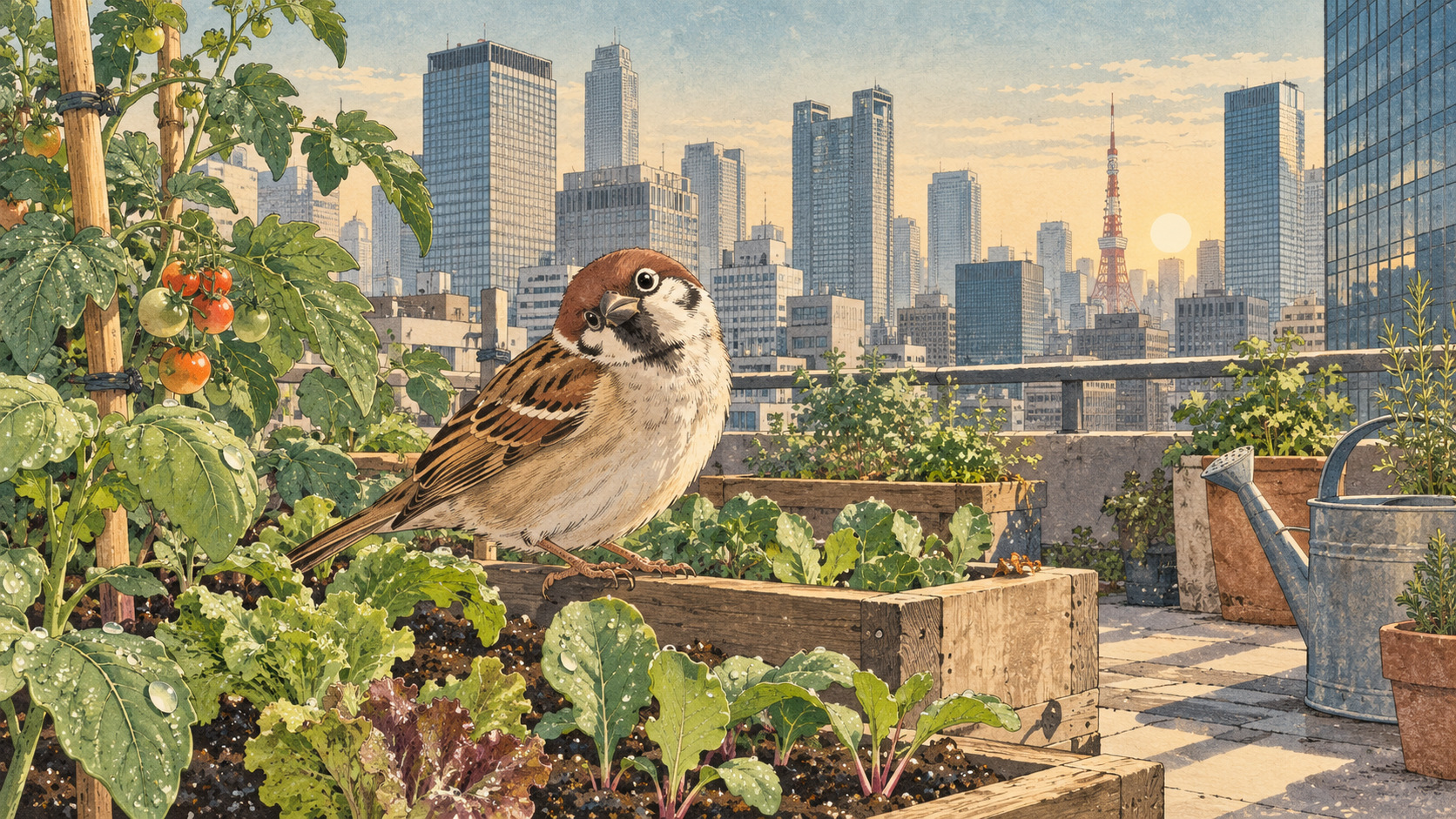
The scent of fresh herbs is not what most people expect when they leave an office tower in central Tokyo. On October 22, however, a small event in Ōtemachi will invite commuters to spend a few minutes examining, handling and tasting plants grown above the financial district.
Called After Work Farm—officially advertised in Japanese as Shigoto-gaeri ni, chotto hatake e—the free evening program will run from 6 to 9 p.m. under the first-floor Flat event area of the Tokyo Sankei Building. Organizers promise edible bouquets assembled from locally grown vegetables and herbs, herb-based drinks and farm-related merchandise. Visitors can participate briefly rather than committing to a full agricultural class.
There is one crucial correction to the romantic headline: no new farm is opening at the event site, and the workshop is not taking place on the building's roof. The food and herbs come from an existing rooftop farming initiative elsewhere in Ōtemachi. That difference actually makes the event more interesting. It is a small experiment in carrying the experience of cultivation from the roof into the everyday paths of office workers.
How much of farming fits into five minutes?
A visitor might pick up a fresh herb, smell it, make an edible bouquet and leave for the station. The process is far from growing an entire crop: it omits the risks of weather, disease, irrigation, labor and prices that determine whether a real farm survives. Nevertheless, an encounter with a recognizable plant rather than a packaged product can make agricultural production less abstract.
The host's language centers on picking, smelling and tasting. These are deliberately sensory activities, not claims that participants will become farmers. A responsible interpretation is that they offer an introduction to cultivation, with the deeper work taking place elsewhere.
The real garden above Ōtemachi
That other location is part of the appeal. THE Edible Park OTEMACHI by grow operates on the rooftop SkyLAB space of the Ōtemachi Building at 1-6-1 Ōtemachi, not the Tokyo Sankei Building at 1-7-2. Its organizers describe a shared garden maintained by members who grow vegetables and herbs and enjoy the results together.
A separate September 2026 event, Night Farm, offered rooftop tours and introduced composting, urban beekeeping, planting and farm-to-table eating. The program was organized by THE Edible Park with partners including the Marunouchi Honey Project. These descriptions establish that the garden predates this October's short workshop, although they do not independently quantify its food production or environmental benefits.
From a business perspective, the model is curious. Prime real estate normally earns its keep through tenants and services, yet a shared garden asks people to value part of the property for community, education and an experience of nature. Whether that creates durable social or commercial value requires evidence beyond promotional descriptions.
A longer history of farming inside Japan's cities
Japanese urban agriculture is not a fashionable invention of rooftop designers. Farms have long persisted within and around expanding cities, especially in suburban districts where generations of families cultivated land as development reached them. The policy question was once framed chiefly around whether such plots should give way to housing.
In April 2015 Japan enacted the Urban Agriculture Promotion Act; the government adopted its associated basic plan in May 2016. The Ministry of Agriculture, Forestry and Fisheries says the policy change helped recast urban farmland from land expected to become residential property into land with an enduring place in urban life.
Under ministry guidance, urban agriculture can provide fresh produce near consumers, educational opportunities, green and open spaces, community contact, environmental services and potential disaster-related benefits. But it is a mistake to assume a small rooftop installation performs every function of conventional farmland. Different sites have different limitations and costs.
Could the city become a classroom for food?
Ōtemachi is associated with office employment and finance. A community farm offers a different lesson about the rhythms of work: plants cannot be accelerated to match a presentation schedule. Seeds require time. Harvests vary. Composting and soil maintenance are as important as the photograph of a beautiful salad.
That educational value may become part of the argument for urban growing spaces. Yet success cannot simply be inferred from attendance at one promotional event. Does a participant return to the rooftop garden? Do more people understand seasonal food and the work of rural farmers? Are these programs accessible to someone who cannot afford to join a paid membership? The answers would require independent interviews and participation data.
Urban gardens are not substitutes for the countryside
Even an ambitious rooftop farm is unlikely to replace the crop output of Japan's rural producers. Roofs face constraints that fields do not: wind, structural capacity, access, water supply and intensive maintenance. A more plausible ambition is to make urban consumers curious about the production system supporting them.
That matters in an era of concern about food prices, labor availability and resilience. The link from a few herbs to a national agricultural supply chain is not an economic forecast. It is a question about public understanding: can a short encounter with plants change how someone thinks about the food in their shopping basket?
The organizer also mentions a herb mojito experience and merchandise sales. Free event entry should not be confused with a guarantee that all products and optional purchases are free.
A festival asks the city to find its seasons
After Work Farm is one piece of the Tokyo Sankei Building Autumn Festival, October 19–30, whose theme translates roughly as restoring a sense of the seasons to people who work in the city. The wider program includes art, sport, regional food, workshops and neighborhood exploration.
A few sprigs of herbs will not resolve Japan's agricultural challenges. But the gesture may encourage a fresh observation: the city is not outside nature. It has simply designed much of daily life to hide the processes that keep people fed. In Ōtemachi on October 22, those processes will briefly step out onto the pavement.
Visitor information
Event: After Work Farm, October 22, 2026, 6–9 p.m. Location: First-floor Flat outdoor area, Tokyo Sankei Building, 1-7-2 Ōtemachi, Chiyoda-ku. Admission: Free, with merchandise sales separately advertised. The event location is different from the existing rooftop garden. Confirm late changes with the venue.
This is advance reporting based on organizer and government documents. Japan.co.jp did not witness the event or independently interview participants.
Sources and methodology
Based on pre-event organizer material and Japanese agricultural-policy documents. No independent attendance, output or impact figures were verified.