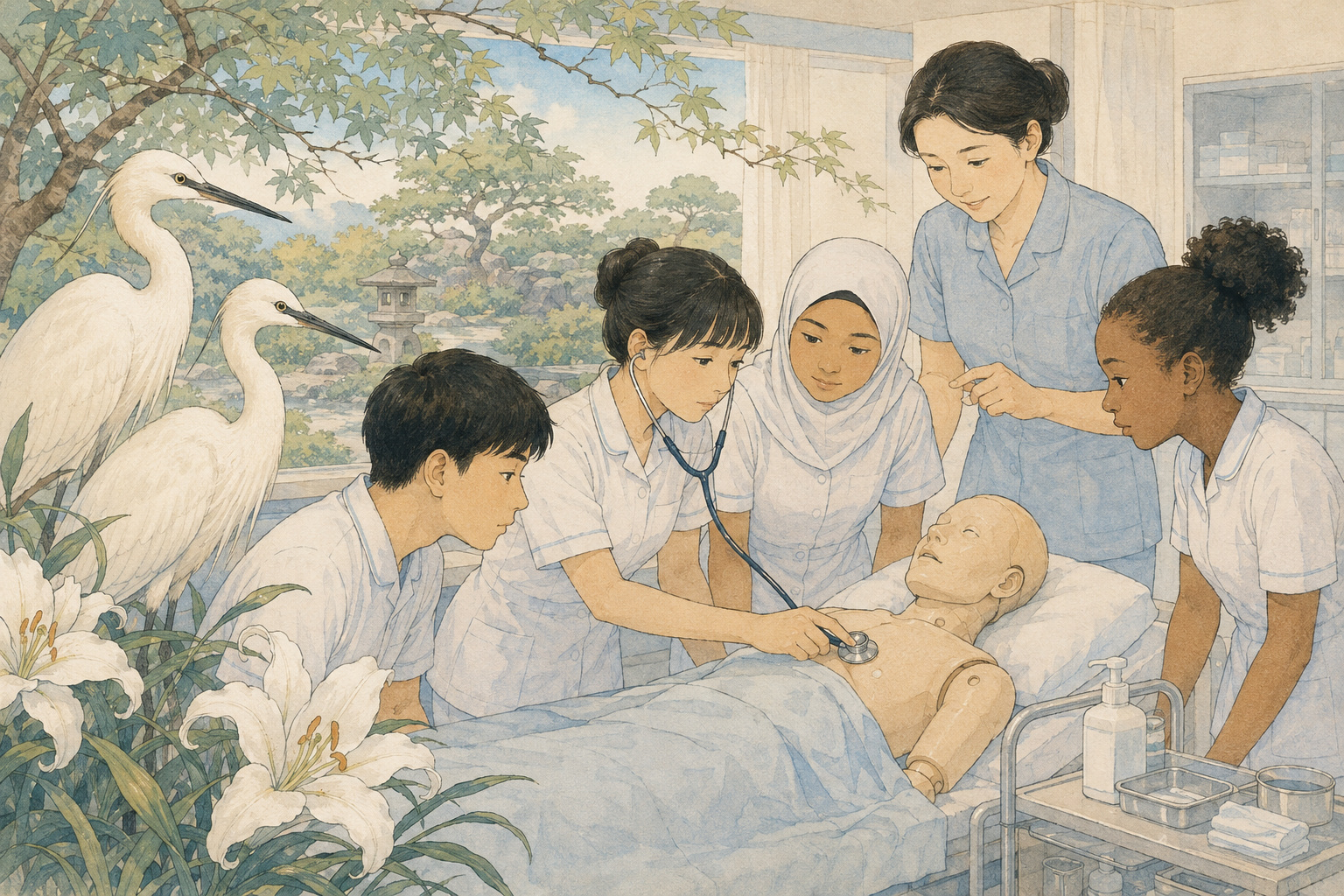
Before there is a stethoscope, there is a hand. Two fingers rest over an artery. The student waits through the temptation to count too quickly. A rhythm emerges: not merely a number, but one clue among breathing, temperature, skin color, expression and the story a person tells.
That small act explains why Tokyo University of Information Sciences chose “What does a nurse read from observation?” for the classroom center of its two-day summer camp. Middle- and high-school students are being asked to consider how temperature, pulse and respiration become clinical meaning—not just how to dress like a nurse for a photograph.
The event also includes practice uniforms, an infant-care experience, an aging simulation and virtual reality that places participants inside an emergency scenario. A food-truck lunch, shaved ice and taiyaki make the campus hospitable. But beneath the summer-program brightness is a serious regional calculation: Chiba needs more nurses, and it cannot wait until university applications to make the profession imaginable.
A Tokyo Name on a Chiba Campus
The university’s English name can mislead an overseas reader. Tokyo University of Information Sciences is not in central Tokyo. Its campus stands at 4-1 Onaridai in Wakaba Ward, Chiba City, roughly 40 kilometers east of the capital’s center. The location is central to the story because the stated workforce problem is Chiba’s.
The school opened in Chiba in April 1988 under the Tokyo University of Agriculture Educational Corporation. It describes itself as Japan’s first private university to place “information” in its name. The nursing faculty came later, and the combination now gives the institution a distinctive claim: training nurses who can use health information, electronic records, data analysis, tele-nursing and digital tools while remaining grounded in community care.
The camp takes place in Building 9, the nursing-practice building. It is therefore partly a career program and partly a demonstration of the institution’s identity. The VR headset is not an unrelated novelty brought in for children; the university says it introduced VR-based experiential curriculum in 2025 for its enrolled nursing students.
What the Two Days Promise
The published program is built as a progression from image to judgment. Participants may first put on a practice uniform and take a commemorative photograph. That familiar symbol lowers the threshold: a teenager can briefly see a future self in the mirror.
Next come encounters with bodies across the life course. Holding an infant model demands head support and gentleness. An aging-simulation suit or sensory restriction can make movement, sight and hearing more difficult. Such exercises cannot reproduce infancy, disability or old age, and facilitators must avoid turning another person’s life into a costume. Used carefully, they can expose how environments create risk and dependence.
The mock class moves from empathy to measurement. Students consider how nurses interpret temperature, pulse and respiration. A raised respiratory rate may reflect fever, pain, anxiety, lung disease or exertion. A single vital sign rarely gives an answer; its value emerges through comparison, trend, context and conversation.
VR then changes the scale. An emergency can unfold without exposing a patient or teenager to danger. The scene may demand prioritization, orientation and rapid attention. Yet VR does not transmit the warmth of skin, resistance of tissue, smell of infection, weight of a falling body or uncertainty in a family member’s voice. Simulation can rehearse perception; it cannot confer competence.
| Camp element | Educational opportunity | Limit that should be explained |
|---|---|---|
| Uniform and photograph | Makes a possible identity visible | Professional authority is earned through education, licensure and practice |
| Infant-care exercise | Introduces support, fragility and communication | A model cannot reproduce a living infant’s variability |
| Aging simulation | Shows how sensory and mobility barriers affect daily life | A temporary suit is not equivalent to aging or disability |
| Vital-sign class | Connects measurement with clinical reasoning | Numbers require context and cannot be interpreted in isolation |
| VR emergency | Allows repeatable, low-risk situational practice | It omits touch, full teamwork and real consequences |
Why Chiba Is Recruiting So Early
Chiba Prefecture’s nursing association says the prefecture had the nation’s 46th-lowest supply of employed nursing professionals per 100,000 residents at the end of 2024. Only one prefecture ranked lower. The number is a rate, not proof that every Chiba hospital or neighborhood faces the same vacancy, but it identifies a persistent shortage relative to population.
An earlier association plan counted 62,016 nursing professionals in 2022—894 more than two years before—yet placed the rate at 989.7 per 100,000, then 45th nationally. The 2026 plan says Chiba slipped to 46th on the updated measure. Head count can rise while adequacy remains poor if population, need, work patterns and geographic distribution move at the same time.
Chiba contains several health-care economies. The northwestern corridor is integrated with metropolitan Tokyo; the Bōsō Peninsula includes rural and aging communities; Narita brings international movement; large hospitals compete with home-care, long-term-care and municipal public-health services. A nurse trained in the prefecture is not guaranteed to work where the shortage is greatest—or to remain in Chiba at all.
That is why a camp can be a sensible first step but never a staffing policy by itself. The pipeline has at least four leaks: young people must become interested, gain admission, complete demanding education and licensing, then enter and stay in workplaces that need them.
Japan Has More Nurses—and Still Not Enough in the Right Places
Nationally, the number of nursing professionals has grown for decades. The Japanese Nursing Association reports 1.746 million employed in 2023 across nurses, public-health nurses, midwives and assistant nurses. Hospitals remain the largest setting, while home-visit nursing and long-term-care employment have expanded.
Shortage and growth can coexist. Need rises as the population ages, care moves into homes and older patients live with multiple conditions. The distribution of workers does not automatically follow need. A position may be funded but unattractive because of nights, workload, commuting, pay, childcare or insufficient support.
The demographic problem will intensify. Association material comparing 2025 with 2040 projects a 15 percent fall in the working-age population and about a 42 percent increase in people aged 85 or older. The potential labor pool shrinks just as the group most likely to need complex nursing grows.
There is also no single “nursing shortage.” A hospital may need night-shift staff, a rural town a public-health nurse, a home-care agency someone able to drive between patients, and a long-term-care facility nurses skilled in dementia and end-of-life care. Recruiting a teenager with a hospital rescue scene is only honest if the profession’s wider geography is also shown.
From “Helping the Doctor” to a Licensed Profession
Care of the sick is ancient; professional nursing education in Japan is comparatively recent. After the Meiji government adopted Western medicine, formal midwifery regulation began under the 1874 medical system. In 1885, the first modern nurse-training institution opened at Yūshi Kyōritsu Tokyo Hospital, an ancestor of today’s Jikei nursing school.
The Japanese Red Cross began training nurses in 1890 under rules adopted the previous year. Its first class contained ten students. All ten joined relief work after the 1891 Nōbi earthquake, helping establish disaster nursing as more than a wartime function. A standardized Red Cross textbook followed in 1896.
Law followed practice slowly. The Midwives Regulation came in 1899, the Nurses Regulation in 1915 and the Public Health Nurses Regulation in 1941. The 1948 Public Health Nurses, Midwives and Nurses Act built the postwar licensing framework. In 2001, gendered occupational titles were revised so the Japanese word kangoshi applied to nurses regardless of sex.
University nursing education expanded rapidly from the 1990s as medicine became more complex and care shifted toward chronic illness, prevention and community life. This history matters to the camp: the uniform once signified disciplined assistance within a hierarchy; contemporary education asks nurses to assess, explain, coordinate, prevent harm, use evidence and advocate for patients.
1874 Japan’s medical system establishes a basis for midwifery education and licensing.
1885 The first modern nurse-training institution opens.
1890 The Japanese Red Cross begins formal nurse education.
1915 The Nurses Regulation defines the occupation nationally.
1948 The postwar licensing law creates the modern professional framework.
1990s onward Four-year university nursing education expands.
2017 Tokyo University of Information Sciences opens its nursing faculty.
2025–26 The university adds VR learning and runs the two-day youth camp.
Observation Is Not Passive
The camp’s best pedagogical choice may be the least theatrical word in its publicity: observation. To a novice, observation sounds like looking while someone else acts. In nursing, it is structured work.
A nurse notices that a patient who answered in full sentences an hour ago now pauses for breath. The monitor value may still sit inside an alarm threshold. The nurse combines rate, effort, color, posture, history and a subtle change over time, then decides whether to reposition, measure again, begin an allowed intervention or escalate to another professional.
That process is neither intuition alone nor a checklist alone. It joins embodied attention with data. It also shows why an information university can make a legitimate contribution to nursing. Electronic records and sensors can reveal patterns; badly designed systems can bury the same warning under alerts and documentation burden. “Information-strong” nursing must include skepticism about data quality and the courage to look back at the person.
Could a Teen Camp Change a Career?
Career imagination is partly an access problem. A student with a nurse in the family already knows the vocabulary of shifts, wards, licensing and specialties. Another may know only television emergencies or the memory of being a patient. A free campus program can reduce that information gap.
Requiring both days gives the event more depth than a one-hour open-campus demonstration. Parent participation matters because families influence educational cost, commuting and the perceived status or difficulty of a career. Free parking, a shuttle and lunch remove some immediate barriers.
Demand appears real: the official page says registration closed after reaching capacity. But a full camp is not evidence that Chiba’s shortage will shrink. The university has not published a participant count, demographic breakdown, pre- and post-event survey, or long-term tracking showing how many attendees later enter nursing education.
- Publish capacity, attendance, age, home area and prior exposure to health careers without identifying participants.
- Measure what students believe nurses do before and after the camp.
- Ask whether interest rises, falls or becomes more realistic after hands-on work.
- Offer follow-up mentoring and track applications only with informed consent.
- Report whether boys, rural students, low-income families and students with disabilities can participate equitably.
- Follow eventual enrollment, graduation, licensing and Chiba employment—not merely application inquiries.
The Gender Question
Modern Japanese nursing was constructed as women’s work, and the profession remains overwhelmingly female. Health ministry figures for 2024 show 95.4 employed male nurses and 1,005.7 female nurses per 100,000 population—men therefore account for roughly 8.7 percent of employed nurses.
A youth camp can widen the image if its language, photographs and facilitators make boys feel explicitly invited. The official event says middle- and high-school students, not girls only. That neutrality should be made visible in practice.
Diversity is not merely a numerical solution. Male nurses do not exist to lift heavier patients, and female nurses should not be assumed naturally caring. The profession needs people able to learn clinical judgment, communicate across difference and accept accountability. Early exposure should break stereotypes rather than recruit teenagers into them.
The Reality Behind the Rescue Scene
VR “saving a life” is an effective doorway because urgency creates attention. Yet most nursing is not a continuous sequence of dramatic rescues. It includes medication checks, pressure-injury prevention, discharge teaching, toileting, documentation, infection control, listening, repeated reassessment and conversations that do not resolve cleanly.
The work also imposes costs. The Japanese Nursing Association’s 2025 hospital survey found 2024 turnover of 11.0 percent among regularly employed nursing staff, 8.4 percent among new graduates and 16.1 percent among experienced hires. In Chiba’s responding hospitals, regular-staff turnover was 12.9 percent. These rates do not describe every workplace, but they show why recruitment without retention simply feeds a revolving door.
Students deserve inspiration and truth together: night work disrupts sleep; mistakes can cause harm; grief accumulates; harassment and understaffing exist. They should also see the sources of meaning—earning trust, detecting deterioration, helping a family understand, making home life possible and working inside a team whose knowledge is shared.
The University’s Own Test
The camp is also a student-recruitment activity. Tokyo University of Information Sciences’ medium-term plan places events for younger high-school and middle-school students inside its strategy for securing nursing-faculty enrollment. That does not invalidate the public purpose. A university can help Chiba and attract applicants at the same time. Transparency requires saying both.
Recruitment, however, creates an obligation to show educational outcomes. In the 115th National Nursing Examination announced in March 2026, 54 of 72 Tokyo Information University candidates passed, a 75.0 percent overall rate. Among first-time candidates, 47 of 55 passed, or 85.5 percent. Nationwide, 88.3 percent of all examinees and 94.1 percent of new graduates passed; the university’s own plan had set a goal of 100 percent for new graduates by fiscal 2025.
One cohort does not define every teacher or graduate, and repeat candidates lower the overall figure. Still, the gap is material. A credible pipeline cannot stop at sparking a thirteen-year-old’s interest. It must support admitted students through science courses, clinical placements, psychological strain, graduation, the national exam and transition into practice.
The honest measure of the camp is therefore not how convincing the uniform looks. It is whether the institution can turn curiosity into competent, licensed and durable practice.
What a Future Nurse Should See
A teenager entering Building 9 may imagine a nurse at a hospital bedside. The profession is larger: public-health nurses map risk across communities; midwives accompany pregnancy and birth; home-visit nurses work inside family space; school and occupational health prevent illness; disaster nurses operate when normal systems fail; specialists manage infection, cancer, critical care and chronic disease.
Technology enlarges the field again. Tele-nursing can reach a patient between visits. Data can identify a deteriorating pattern. Robots may move supplies, sensors may detect falls and generative systems may draft notes. None removes the need to decide whether the system is wrong, biased, incomplete or inappropriate for the person in front of it.
The infant model, the aging suit, the vital-sign exercise and the VR emergency are therefore not four attractions. Properly connected, they describe nursing’s range: life course, embodiment, information and action.
The Pulse After the Headset Comes Off
A recruitment camp succeeds at the moment a profession becomes less glamorous and more compelling. The participant should leave knowing that nursing is not “being kind” in a uniform and not operating machines beside a doctor. It is a licensed discipline of noticing, reasoning, acting, explaining and remaining present.
Chiba’s shortage will not be solved in two August days. It requires enough educational seats, strong teaching, national-exam success, clinical mentorship, safer staffing, workable night schedules, fair pay, childcare, mental-health support and routes into underserved communities.
But systems begin in individual imagination. Somewhere in the practice building, a student may feel a pulse, count carefully, compare it with breathing and ask why the numbers disagree. That question—not the costume, not the headset—is the first real step into nursing.
Reporting notes and principal sources
Program claims and capacity status are based on the university’s official page and release. Workforce rankings are attributed to the Chiba Nursing Association. Examination results derive from the health ministry’s school tables as reproduced in the cited compilation; national rates come from the 2026 results summary. No camp outcome evaluation had been published at the reporting cutoff.
- Tokyo University of Information Sciences: official Nursing Summer Camp 2026 page
- Tokyo University of Agriculture Educational Corporation: camp announcement and program
- Tokyo University of Information Sciences: institutional history and location
- University president: nursing, information, VR and community-care curriculum
- University medium-term plan: nursing enrollment and outreach strategy
- Chiba Nursing Association: sixth workforce retention and recruitment plan
- Ministry of Health, Labour and Welfare: 2024 employed nursing-professional statistics
- Japanese Nursing Association: nursing delivery toward 2040
- Japanese Nursing Association: 2025 hospital nursing survey
- Japanese Nursing Association: history and structure of nursing in Japan
- Japanese Red Cross Society: history of nurse training and disaster relief
- Jikei Nursing School: the first modern nurse-training institution
- 115th National Nursing Examination: school-by-school results table
- Obunsha, using ministry data: national 2026 nursing-exam results