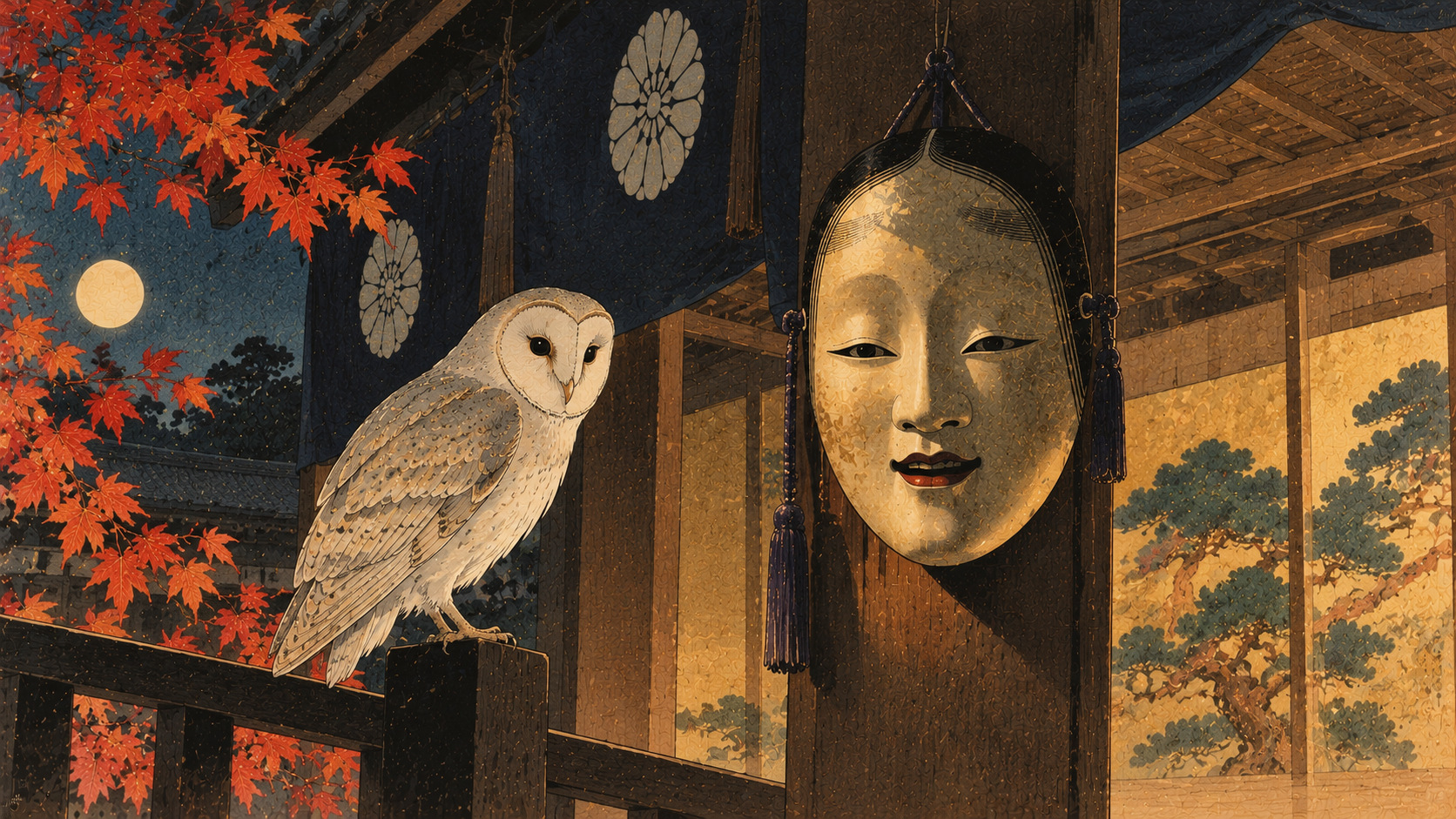
The wood never changes shape. The audience sees the face change nonetheless.
The face that refuses to stay still
The phrase “a Noh mask” has become shorthand for a face that betrays nothing. Tokyo National Museum is asking visitors to reconsider that assumption. Its exhibition, “What Is This Face Feeling? The Emotions Expressed by Noh Masks,” runs in Room 4 of the Honkan through October 25, 2026. Rather than treating the masks as anonymous curiosities, it asks viewers to imagine the characters, relationships and emotional states that each object could embody.
The timing offers a useful opportunity: the show closes on Sunday, October 25, and a gallery talk for children is scheduled for that day. The story is not a newly discovered collection or an exhibition that has just opened. It is a closing-week look at what six centuries of performance can teach contemporary audiences about expression.
How a wooden face can appear to smile—or grieve
Traditional explanations of Noh performance describe two related movements, terasu and kumorasu. Raising the mask slightly can make its expression appear brighter; angling it downward can make it seem more shadowed or sorrowful. The actor is not manipulating facial muscles. The face is carved wood. Meaning emerges from light, the performer’s controlled motion, the music and the story.
This is not a universal code in which “up” always equals happiness. Different masks, lighting conditions and dramatic situations change the effect. An actor may scarcely move, yet the audience experiences a dramatic shift. Noh makes the spectator an active participant in reading an expression.
A 15th-century face and an extraordinary provenance
The museum identifies one centerpiece as Waka-shakumi (若曲見), an Important Cultural Property dating from the 15th–16th centuries. The mask was transmitted through the Konparu family in Nara and has an incised inscription described by the museum as “Heisenji / Zairen / made by Kumadayū.” Such markings are part of the object’s documented history; they should not automatically be treated as modern proof of authorship.
The mask’s reserved features do not simply convey a single emotion. Tiny shifts in the mouth and eyes allow a performer to suggest different states through movement and narrative. Its historical survival also reflects the importance of transmission in Noh—objects were preserved as tools of performance and inheritance, not only as works to be hung on gallery walls.
Not all Noh masks are serene
The exhibition includes an Okina mask from the Muromachi period, a Hannya mask from the Edo period marked “Ōmi-uchi,” and an Important Cultural Property mask called Ōtobide from the Muromachi period. Together they disrupt the idea that Noh masks all wear one neutral, pale expression.
Okina evokes age and ritual gravitas. Hannya, often depicted with horns, is associated with a character transformed by jealousy, grief and rage; reducing it to a generic monster loses its dramatic humanity. The striking golden face and wide eyes of Ōtobide point toward a different, supernatural register. The museum’s selection traces an expressive spectrum rather than one standard type.
From popular performance to a highly refined art
Noh developed out of centuries of performance traditions, including sarugaku, itself related to entertainments introduced from the Asian mainland. Its familiar theatrical form was refined in the late medieval period, especially through Kan’ami and his son Zeami. Zeami’s treatise Fūshikaden articulated a sophisticated idea of theatrical effect long before modern acting theory.
The styles and names of many masks became more standardized during the middle and later Muromachi period. Specialist carvers continued the craft, and prominent family lineages preserved costumes and masks. That history matters because a museum case presents only one chapter of an object’s life. Onstage, it is selected and worn for a particular role, and becomes part of a moving dramatic language.
A museum exhibition that invites a different kind of looking
The Tokyo National Museum deliberately frames the exhibition for parents and children. Its question is refreshingly direct: What might this face be feeling? The museum’s curator Seri Kawagishi encourages audiences to approach masks from different angles and consider their apparent emotions. There is no need to master every Noh plot before entering the gallery.
The exercise also suggests a useful caution in an age of automated image interpretation: expression is not identical to emotion. Noh does not prove that every still image conceals a precise feeling; it shows how interpretation depends on an encounter between object, performer, narrative and observer. That is a cultural insight, not a scientific measurement.
A final weekend in Ueno
The exhibition closes on October 25. The museum lists children’s gallery talks for that Sunday at 10:15–10:30 a.m. and 2–2:15 p.m. in Room 4. Visitors should confirm admission, access and the latest program information directly with the museum.
A worthwhile way to look is to resist naming the emotion immediately. Spend time with the mouth, cheekbones, eyelids and shadows. What first looked impassive may begin to suggest an interior life. These faces do not move by themselves, but centuries of artistry have made them remarkably capable of moving us.
Sources and further reading
The exhibition opened September 1 and closes October 25. This feature is based on published museum and Noh sources; no on-site visit or independent curator interview is claimed.