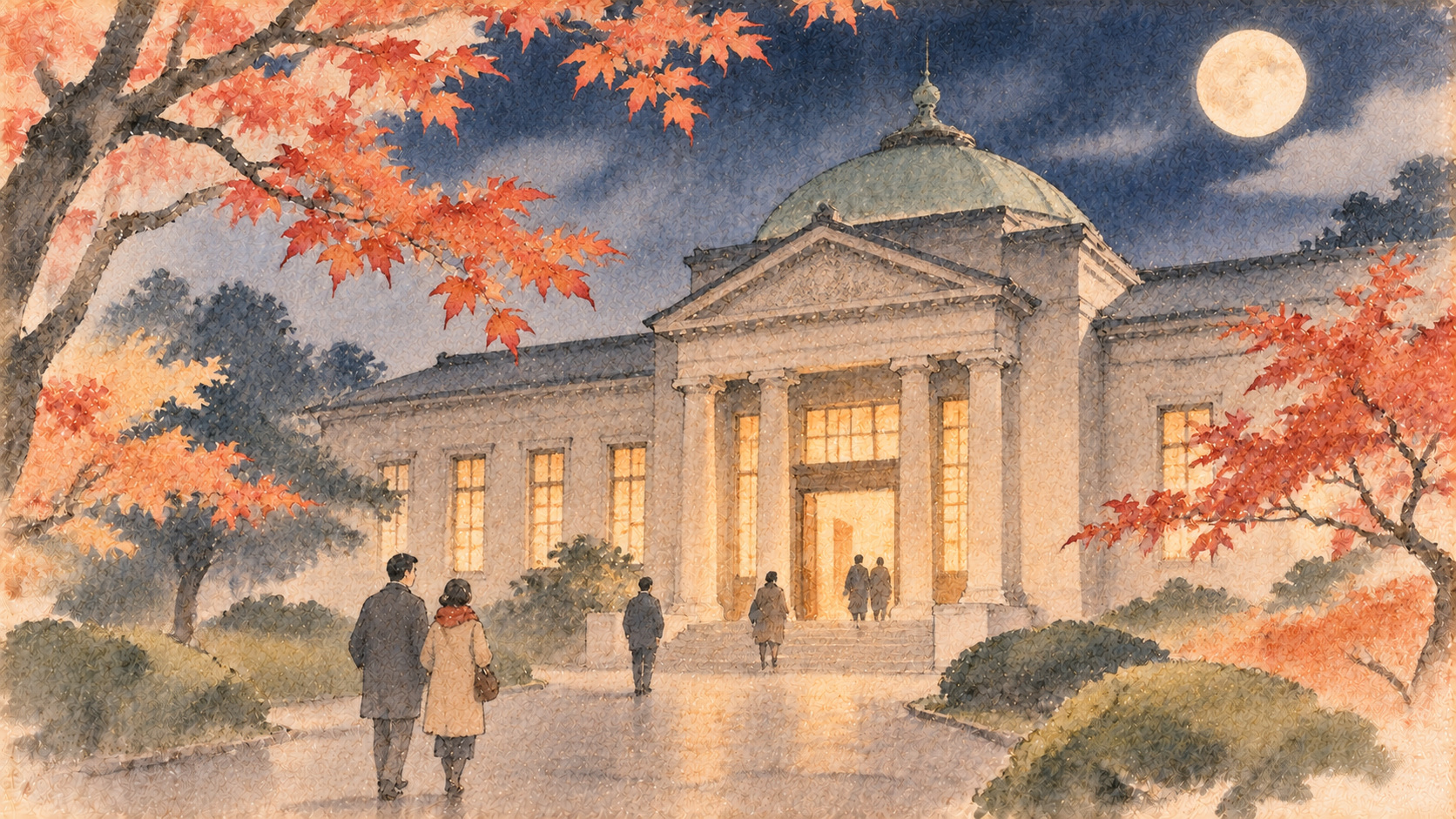
- The museum visit that fits between work and home
- Two overlapping initiatives, not one uniform opening
- A century-old institution tests a different kind of evening
- Thirty-nine institutions means thirty-nine sets of practical details
- What can visitors still see on Saturday, November 21?
- Tokyo did not invent nighttime art access in 2026
- Time, price and the less visible barriers to culture
- The neighborhood is part of the museum experience
- The harder test comes after the lights go out
The museum visit that fits between work and home
There is a practical reason people miss exhibitions: many museums close before the working day ends. Tokyo’s coordinated late-opening initiative this November asks a deceptively simple question. What changes when a cultural institution stays open long enough to become part of an ordinary weekday, rather than an expedition reserved for weekends?
On November 6 and 20, ARTE TOKYO × NIGHT MUSEUM brings together 39 participating museums and galleries across the metropolitan area. It is a coordinated program, not a promise that every participant opens until precisely 8 p.m. Admission windows, exhibition access and special events vary by institution. The official program is the best starting point for checking a particular site.
Two overlapping initiatives, not one uniform opening
The 39-institution ARTE TOKYO program is separate from Autumn Night Museum 2026, run through the Tokyo Metropolitan Foundation for History and Culture. The latter involves six metropolitan cultural facilities, among them the Tokyo Metropolitan Art Museum in Ueno, the Museum of Contemporary Art Tokyo in Kiyosumi-Shirakawa and the Tokyo Metropolitan Teien Art Museum in Shirokanedai. Participating metropolitan sites extend to 8 p.m. on specified November dates, with different exceptions. Tokyo’s September 30 announcement sets out the terms.
November 20 is the key overlap date, but the distinction becomes essential for anyone reading this story on November 21: all 39 sites are not thereby committed to a second citywide opening on Saturday. The Teien Art Museum, however, explicitly schedules a Saturday evening opening on November 21.
A century-old institution tests a different kind of evening
The Tokyo Metropolitan Art Museum, founded in 1926 and marking its centenary in 2026, is among the participants. It has scheduled 8 p.m. openings for November 20 and 27, with last entry at 7:30 p.m. On the 20th, its auditorium is due to host two free short concerts, at 6:30 and 7:30 p.m. The museum’s own notice also outlines extended shop and restaurant operations.
That matters because a night museum can become more than a daytime exhibition with a later closing time. Combining a concert, a gallery visit and time in a museum café offers different routes into culture. Yet the museum also states that the special evening admission discounts do not apply to every exhibition, including its Musée d’Orsay centenary-related presentation. A late opening should not be confused with universal free admission.
Thirty-nine institutions means thirty-nine sets of practical details
The range of participating museums is itself revealing. The Matsuoka Museum in Shirokanedai scheduled an 8 p.m. closing on November 20, with violin-and-piano performances at 5 and 7 p.m. Showakan in Kudanshita also announced an 8 p.m. opening, but its late-evening access covers only the second-floor photographic display, not its entire permanent exhibition. The official Matsuoka and Showakan notices confirm those differences.
At the other end of the scale, the Accessory Museum says the program marks its first evening opening to the general public. Its November 20 hours end at 7 p.m., with final admission at 6:30 p.m. A genuinely coordinated cultural network can make smaller, specialist institutions visible alongside major national and metropolitan museums—but it does not erase their different operating constraints.
What can visitors still see on Saturday, November 21?
For readers planning a Saturday visit, the Tokyo Metropolitan Teien Art Museum provides a confirmed option. Its exhibition on Marimekko printmaking and design is scheduled to remain open until 8 p.m. on November 21. Students qualifying under the autumn program may enter selected presentations free after 5 p.m.; reduced rates are offered to other eligible visitors. Timed-entry ticket conditions and identification requirements matter. See the Foundation’s English guide before traveling.
The museum’s grounds are not without restrictions. Certain Japanese-garden paths close earlier for safety, while areas of the Western garden and a south entrance are under construction-related closure. The evening experience must therefore be planned exhibition by exhibition and area by area, not assumed from a single headline promising a late closing.
Tokyo did not invent nighttime art access in 2026
Many Tokyo museums already have a tradition of late openings. The National Museum of Modern Art, Tokyo, for example, lists Friday and Saturday operations until 8 p.m. and offers evening discounts for its collection exhibition. What distinguishes the 2026 moment is the broad coordination of institutions with different ownership, locations and specialties. The ARTE TOKYO roster contains museums extending existing routines as well as facilities experimenting with public evening access for the first time.
The longer history is one of public access. The Tokyo Metropolitan Art Museum opened in 1926 as a pioneering public art institution. A century later, the question is not only which objects a museum safeguards, but who can realistically enter its doors. Opening hours are part of cultural policy, even if they rarely attract the attention given to a blockbuster exhibition.
Time, price and the less visible barriers to culture
Later opening addresses one barrier: a working or school schedule. Discounts address another. Tokyo’s metropolitan program advertises free entry for eligible students after 5 p.m. at specified exhibitions, alongside reduced general admission prices. But some high-profile exhibitions are excluded, and visitors may need to show appropriate identification.
Even when an evening ticket is cheaper, transit expenses, care responsibilities, fatigue, accessibility requirements and the availability of safe late transport can still shape who attends. Night opening may make museums more accessible; it does not by itself prove that the audience becomes more diverse. Evaluating the claim requires new-visitor surveys, comparisons with ordinary Fridays and data that organizers have not yet publicly supplied.
The neighborhood is part of the museum experience
The geography of the program stretches from Ueno and Kyobashi to Shirokanedai, Ikebukuro and western Tokyo. A museum visit after dusk necessarily involves the journey from the station, the surrounding streets, and perhaps a café or restaurant. Evening access could become part of a broader cultural economy—but any claim of a measured spending boost would require data, not supposition.
Concerts are particularly interesting here. Someone drawn by a small live performance might encounter an exhibition they would otherwise overlook. Conversely, a regular gallery visitor might stay for music. These are plausible pathways for audience development, not confirmed outcomes of the November program.
The harder test comes after the lights go out
The real measure of success will not be whether a brightly lit museum looks appealing in photographs. Organizers need to learn how many attendees could not have visited during normal hours, whether younger and first-time audiences came, how staff experienced the extended shift, and what additional security, electricity and transport costs were incurred.
One fall program cannot settle those questions. Still, Tokyo’s overlapping initiatives offer a valuable trial: coordinated evening access can be treated as part of the museum’s public mission, not merely a special occasion. If it proves worthwhile, the lasting story will be what institutions choose to continue after November 2026.
Primary sources and reporting limits
Independently composed from official organizer, metropolitan-government and museum notices. We did not interview visitors or verify attendance, economic impact, or the execution of all November 20 activities firsthand. Check individual museums for updates.
- ARTE TOKYO / ARTE TOKYO × NIGHT MUSEUM (23 Oct 2026)
- Tokyo Metropolitan Government / Autumn Night Museum (30 Sep 2026)
- Tokyo Metropolitan Foundation for History and Culture / Museum program
- Tokyo Metropolitan Art Museum / Evening opening and concert (29 Oct 2026)
- Showakan / Gallery access restrictions
- Accessory Museum / First public evening opening
- Matsuoka Museum / Evening openings
- ARTE TOKYO / English program information
- Tokyo Metropolitan Foundation / English visitor information