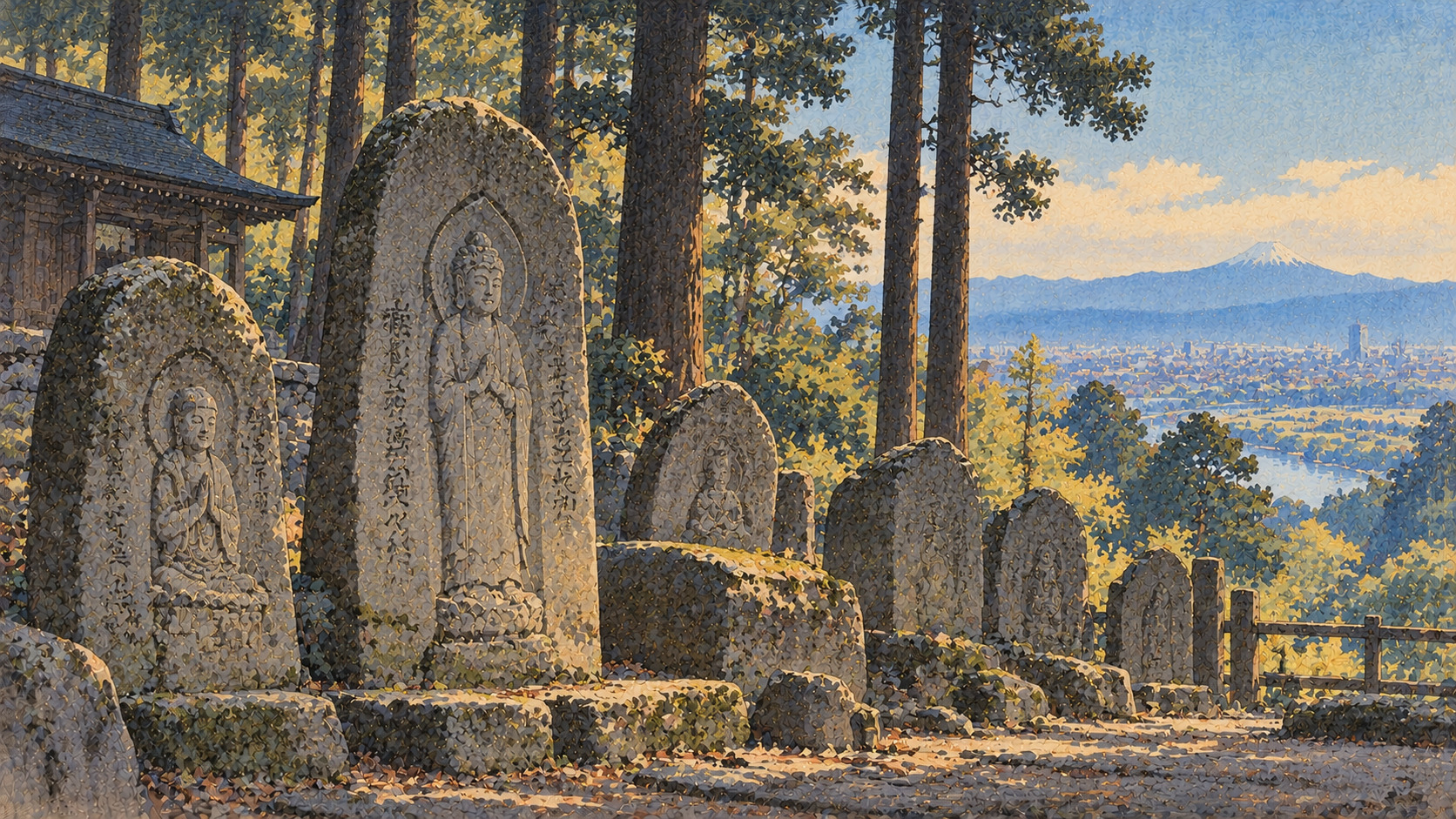
The researchers know the stones were gathered. They do not yet know who did it—or why.
Seventy-eight stones—and a missing explanation
Beneath what became suburban Tokyo, archaeologists encountered an unusual collection of medieval Buddhist memorial stones. Inagi City records 78 itabi found in three groups on a slope at the Ōmaru archaeological site. The stones appear to have been moved from elsewhere and deliberately rearranged. Yet neither the people who assembled them nor their purpose has been established. A special exhibition opening October 27, 2026, at Tokyo’s metropolitan archaeological research center puts that unanswered question at its heart. The stones tell a story not simply of death, but of how a community handled memory over time.
What the new exhibition actually shows
The official Japanese title is “多摩ニュータウン遺跡群の板碑集積” (Concentrations of Itabi from the Tama New Town Archaeological Sites). It runs through November 23 as part of Tokyo Cultural Heritage Week 2026. Objects from Tama New Town Site No. 513 in Ōmaru, Inagi, are central; finds from that site include Tokyo-designated cultural property. The display is at the Tokyo Metropolitan Archaeological Research Center in Tama City, not in the central Tokyo museum district. The focus is the archaeological grouping itself, not the announcement of a newly unearthed site this autumn.
What is an itabi?
An itabi is a thin stone Buddhist memorial marker, especially characteristic of medieval eastern Japan. Such stones were erected for memorial rites on behalf of the dead (tsuizen kuyō), or as rites performed during one’s lifetime to seek well-being after death (gyakushū). Calling them simply gravestones loses important distinctions. Many carry Sanskrit seed syllables representing Buddhist figures, dates, names or dedicatory language. They are objects of devotion and, in many cases, historical documents in stone.
The secret lives of inscriptions
Inagi’s official historical guide describes a 1454 marker at Myōkakuji temple bearing signs of the Amida triad and a dedication associated with lifetime memorial observances. Other surviving examples reflect devotion to the Thirteen Buddhas. The range is a reminder that medieval Buddhist practice was not a single uniform ritual. These are local comparative examples, however, not inscriptions that can automatically be assigned to every object from Site No. 513. Interpretation depends on each stone’s actual marks, condition and archaeological context.
A medieval society without a complete paper trail
Across the Kamakura, Nanbokuchō and Muromachi periods, medieval eastern Japan was shaped by warriors, religious institutions and village communities. Surviving written records are uneven. Stone markers can preserve personal names, devotional language and dates where other records are silent. Their evidential strength lies partly in that material permanence. But weathering, reuse and movement can separate a monument from the location for which it was first commissioned, limiting what researchers can safely reconstruct.
Why did someone collect the stones?
There are plausible possibilities: a religious site may have changed, an old landscape may have been reorganized, or people may have gathered monuments for a later rite. But possibility is not discovery. The archaeological center explicitly says the actors and reasons behind the concentrations remain mysterious, despite comparable finds elsewhere in the Kantō region. This is why an enticing account of wartime destruction or a single dramatic ceremony would be misleading without direct evidence. The arrangement in which the stones were found is itself a crucial clue.
The buried history of the commuter suburbs
Tama New Town is associated with postwar housing expansion, planned neighborhoods and rail connections. Archaeological work preceding development disclosed landscapes occupied long before modern suburbs. The finds complicate a simple story in which the area began with concrete apartment blocks. Beneath modern streets lie traces of settlements, religious activity and changing land uses. The research center preserves and interprets material recovered as the region was transformed. It is a particularly revealing place to encounter medieval beliefs because the modern setting is so familiar.
Three sites, not just one
Issue 146 of the archaeological center’s publication Tama no Yokoyama devotes its special exhibition feature to concentrations of itabi from Sites No. 513, No. 742 and No. 874. The comparison matters. Stones found together need not have been made together, and similar clusters need not share one purpose. Archaeologists can compare their construction, recorded dates, wear and location. Site-to-site patterns may help establish when and how monuments were gathered, while leaving open the harder question of why.
A database encompassing about 70,000 monuments
Japan’s National Museum of Japanese History launched its Eastern Japan Itabi Database in March 2008. It brings together information on approximately 70,000 markers across the Kantō, Tōhoku and Hokkaidō regions, connecting object descriptions, locations and literature. This figure is not a tally from the Tama exhibition; it shows the scale of the field. By analyzing stone inscriptions alongside archaeological findspots, scholars can investigate relationships among religious practice, regional history and the circulation of commemorative forms.
What visitors can see—and how to interpret it
The exhibition gives the public access to finds that are not necessarily on regular display, including material designated as cultural property. Visitors should look beyond the carving on each stone to its archaeological setting: was it upright, toppled or grouped with others, and what evidence records its removal or reuse? The center has announced an explanatory session on November 3 beginning at 10 a.m., with places for approximately ten people allocated on the day. Conditions should be reconfirmed before travel.
Visiting from central Tokyo
The Tokyo Metropolitan Archaeological Research Center is at 1-14-2 Ochiai, Tama City. Tama City’s visitor guide lists 9:30 a.m.–5 p.m. opening hours and free admission, with the center about five minutes on foot from the Keio and Odakyu Tama Center stations or seven minutes from the Tama Monorail station. The special display runs October 27–November 23. Check the center’s website for temporary closures, event arrangements and rules governing photography before visiting.
The mystery is the point
The appeal of these monuments lies in what survives—and what does not. An inscription may tell us that someone prayed for another life, but it does not necessarily tell us who later carried the stone to a different slope. Instead of inventing a final answer, the exhibition asks visitors to think historically: distinguish excavation evidence from conjecture, compare related sites, and recognize the voices that left no written archive. The concentration of 78 markers is compelling precisely because the people behind their movement have not yet been identified.
Sources and verification
Primary Japanese institutional and local-government records. The purpose of the stone concentrations remains unproven.
- Tokyo Archaeological Center, special exhibition announcement
- Inagi City, itabi history and 78 Ōmaru markers
- National Museum of Japanese History, Eastern Japan Itabi Database
- Archaeological Center, Tama no Yokoyama issue 146
- Tokyo Metropolitan Government, Cultural Heritage Week 2026
- Tama City, official visitor information
- Archaeological Center, 2026 exhibition program
- Archaeological Center, curator talk notice