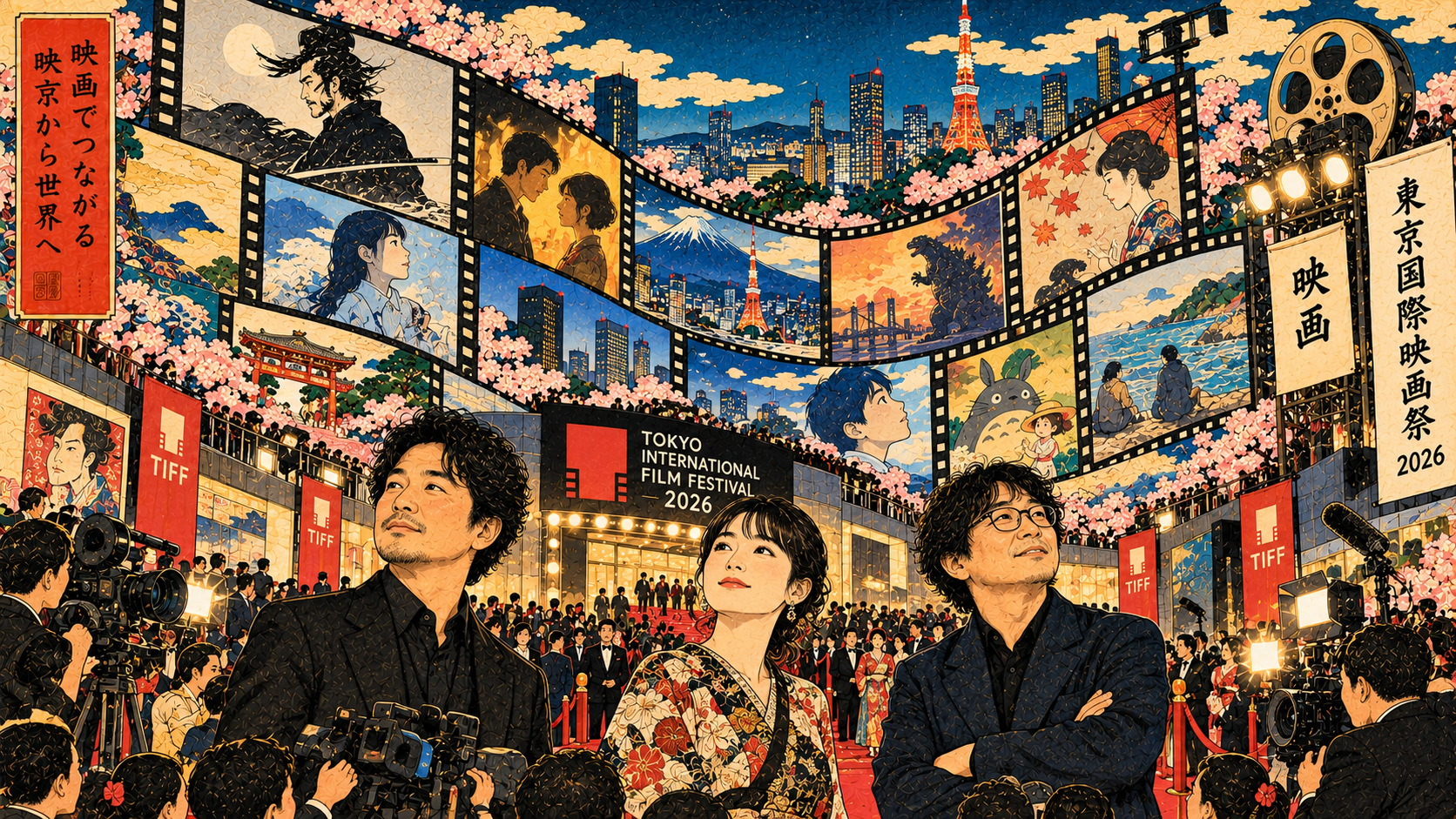
The strength of Japan’s three contenders lies not in a single national style, but in their differences.
Three Japanese films, three different ways of seeing
The red carpet is the visible face of a festival. Its deeper purpose is to put films into conversation with unfamiliar audiences. At the 39th Tokyo International Film Festival, which opened on October 26, three films directed by Japanese filmmakers appear in the 15-title international competition: Yukiko Mishima’s Two Cigarettes, Three Nights (Otoko Tomodachi), Akira Ikeda’s Yokai, Bakemono o Hirou, and Han Yamamoto’s Katai. Rather than representing one unified national style, the three offer markedly different approaches to intimacy, transnational production and family life.
The scale of the competition
According to the festival’s October 1 lineup announcement, 1,892 films were submitted from 112 countries and territories, with 15 selected for the competition. The festival runs through November 4 in the Hibiya, Yurakucho, Marunouchi and Ginza areas. The competition’s Tokyo Grand Prix and other awards have not yet been decided. Selection matters because it can bring filmmakers to the attention of critics, distributors and audiences, but it should not be confused with an award, a sale or an international release.
Yukiko Mishima: the difficult geography of closeness
In Otoko Tomodachi, presented internationally as Two Cigarettes, Three Nights, Mayu Matsuoka and Ryo Narita portray people whose relationship resists an easy label. Festival materials describe a woman who has lost sight of what she wants to depict and a male friend who accompanies her through places including Kyoto, Toyama and Hiroshima. In an interview released by the festival, Mishima characterized the picture as an exploration of the difficulty and tenderness of staying beside another person. She said it is her eleventh feature. The project also offers a lens on the compromises and possibilities of filmmaking at the boundary between independent expression and outside investment. A synopsis, however, is not a substitute for having watched the finished film; we do not infer its ending.
Akira Ikeda: a Japanese–Taiwanese story filmed on Kinmen
Ikeda’s Yokai, Bakemono o Hirou is a Japan–Taiwan co-production filmed on Kinmen, the Taiwanese island near China’s southeastern coast. The film stars Kimiko Yo, while Joe Odagiri is among its producers. The festival reports that the narrative draws on a true story and explores the depth of human affection. Kinmen’s landscape and history provide an intriguing setting, but it would be reductive to assume the film is principally about cross-strait politics without evidence from the work. Ikeda previously screened Uron na Tokoro in the festival’s Japan Cinema Splash section in 2017; a return in the main competition marks a different kind of visibility for his work.
Han Yamamoto: reproduction, identity and two neighboring societies
Katai adapts a novel by Shiho Tanimura and stars Erika Karata and Jiyoung. Its premise involves a reproductive-medicine error and the intertwined lives of two women with ties to Japan and South Korea. In the festival’s published conversation, Yamamoto stressed the ordinary daily details of their lives, and the importance of working with Korean performers and crew members. The film invites discussion about motherhood, identity and the emotional weight of medical technology without being a documentary account of any particular clinical case. Its multinational production context may help it speak to audiences outside Japan, but those audiences’ reactions remain to be established.
From Kurosawa’s Ran to the 39th edition
The first Tokyo International Film Festival was held in 1985, with Akira Kurosawa’s Ran among its signature screenings. The event initially occurred every two years through its fourth edition and switched to an annual schedule in 1992. Its earliest history was closely associated with Shibuya; the current festival spreads across central Tokyo districts. Across four decades, the festival has become a showcase for international cinema, an access point for Asian filmmaking and a place for Japanese directors to seek a dialogue beyond domestic commercial categories. The historical record is the festival’s own; this account does not imply that each edition has had the same format.
Why “Connect” is a meaningful theme
This year’s official theme is CONNECT, emphasizing what cinema can bring together beyond a single screening. At the lineup conference, programming director Shozo Ichiyama noted the presence of works that revisit history to examine contemporary tensions. New festival director Takeo Hisamatsu emphasized widening the audience and helping Japanese, Asian and women filmmakers reach international viewers. Those are stated festival ambitions, not proof of measurable outcomes. What makes this year’s Japanese trio interesting is how differently they pursue human connections: emotional companionship, an island co-production and two women whose lives intersect across national boundaries.
The festival is not the content marketplace
TIFFCOM, held October 28–30, runs alongside the festival as an industry market for licensing, financing, adaptation and distribution. The competition, by contrast, judges completed films and gives audiences a chance to experience them. Their proximity creates useful opportunities for filmmakers, but no deal or box-office success can be inferred from being selected. Readers interested in the commercial side can consult Japan.co.jp’s separate TIFFCOM report.
What to watch next
By November 4, the jury will have chosen its awards. The more enduring questions may take longer to answer: Do these films find distributors overseas? Are audiences moved by their particular perspectives rather than by a generic idea of Japanese cinema? And can a major festival provide room for films that ask difficult questions without simplifying them? Tokyo has brought the three directors into the same competition. What they make of that opportunity is a story still unfolding.
Sources and verification
Based on the festival’s official releases, film pages, published filmmaker interviews, historical records and reporting. No original film viewing or interviews are claimed. Awards have not been decided.