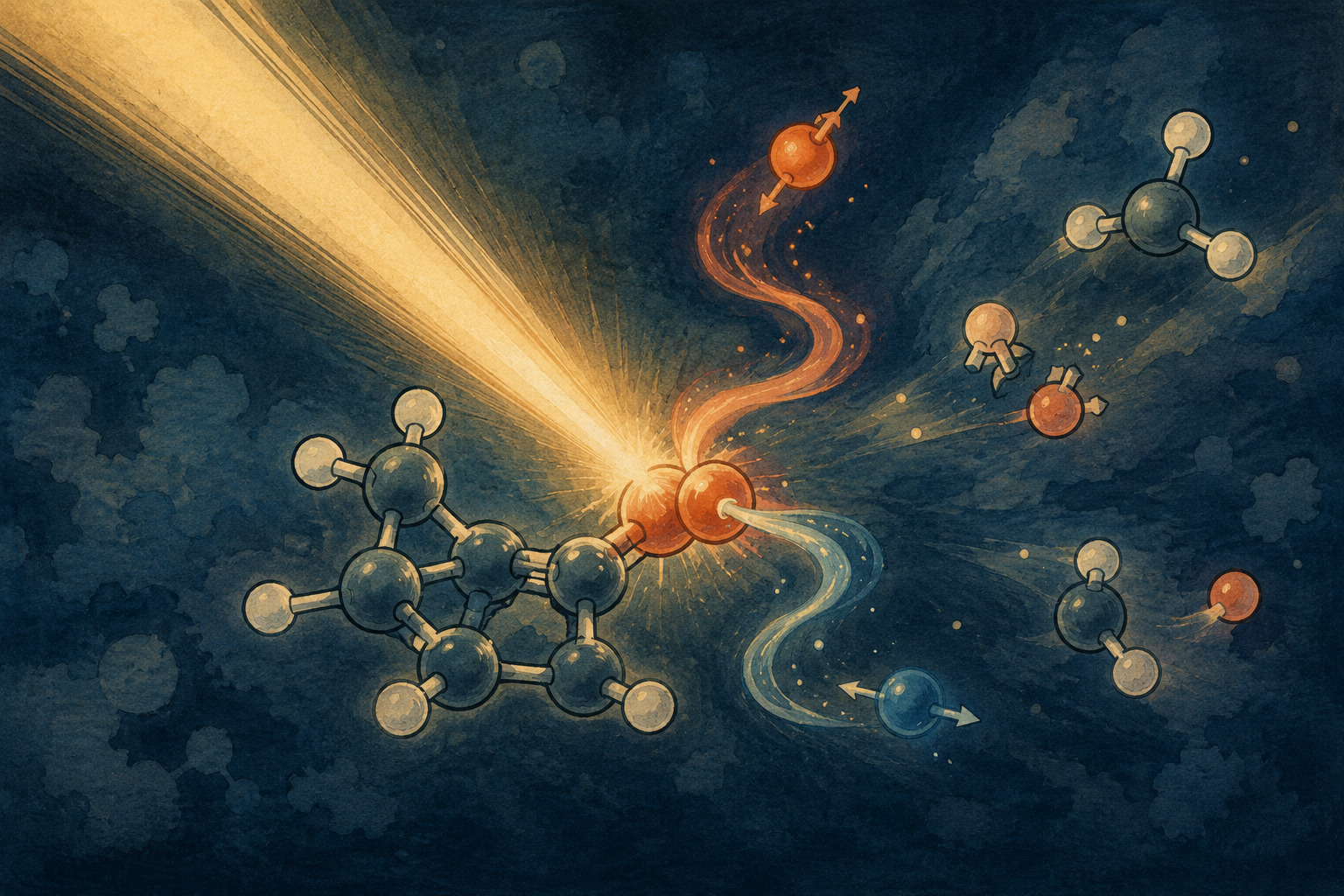
A chemical bond can break and still fail to release its payload. If the two fragments remain close and rapidly recombine, a light-activated molecular cage simply closes again. That return path is the inefficiency a Japanese research team has now mapped—and found a way for electron spin to obstruct.
The study concerns a photolabile protecting group based on 2-(4-nitrophenyl)-1H-indole-3-ylmethyl, abbreviated NPIM. Chemists use photolabile groups, often called photocages, to temporarily block a reactive function. Light removes the cage at a selected place and time, allowing the previously hidden group to act without adding another chemical reagent.
Researchers led by Professor Manabu Abe of Hiroshima University’s Graduate School of Advanced Science and Engineering and Professor Jun Yoshinobu of the University of Tokyo’s Institute for Solid State Physics reconstructed what happens after NPIM absorbs light. Project Researcher Kenta Kuroishi and Associate Professor Ryusuke Matsunaga at the University of Tokyo were among the researchers identified in the institutional announcement.
The work was published online August 28 in the Journal of the American Chemical Society. It combines ultrafast infrared vibrational spectroscopy, time-resolved absorption, in situ infrared product analysis, oxygen-quenching tests and density functional theory. Together, the methods connect an initial molecular twist to bond cleavage and the eventual formation of products.
A photocage is a molecular timing device
Protecting groups are standard tools in organic chemistry. They temporarily cover one reactive part of a molecule so that another transformation can be performed elsewhere. A later chemical step removes the protection. A photocage replaces that later reagent with light.
That substitution gives the experimenter spatial and temporal control. A beam can illuminate a small area, and the reaction can begin when the light is switched on. Photocages are consequently used in cell-function studies, neuroscience, precision synthesis and materials processing. Drug release is a prospective application when a therapeutic group can be held inactive and liberated only where it is needed.
Release has at least two chemical hurdles. The excited molecule must cleave the intended bond, and the resulting pieces must avoid immediately joining again. Optimizing the first step without understanding the second can produce a molecule that appears photoreactive but has a poor final uncaging yield.
NPIM addresses the second hurdle through spin. Its carbon–oxygen bond undergoes homolysis, meaning the two electrons in the bond divide between two radical fragments. Those fragments emerge as a triplet pair. Recombining into the original molecule’s singlet ground state would require a change in spin multiplicity, a transition restricted by the spin-selection rule.
A five-picosecond twist opens the triplet route
After absorbing light, NPIM first enters a singlet excited state. Electron density shifts from its indole donor region toward its nitrophenyl acceptor region. Ultrafast infrared measurements developed at the University of Tokyo’s Institute for Solid State Physics showed that the two regions form a twisted intramolecular charge-transfer state in about five picoseconds.
The twist reduces the energy separation between the singlet and triplet excited states. The reported gap is 5.3 kilocalories per mole. With those states closer in energy, intersystem crossing—the conversion from one spin multiplicity to another—becomes efficient. The institutional release says NPIM reaches the triplet state on an approximately one-nanosecond timescale.
The triplet state lasts much longer than the initial singlet. Its measured lifetime was 2.3 microseconds, compared with 1.6 nanoseconds for the singlet excited state. That longer interval provides a reaction window in which the carbon–oxygen bond can split homolytically.
The radical pair retains triplet character when it forms. Because the starting molecule has a singlet ground state, direct recombination is spin-forbidden. The rule does not make recombination impossible, but it slows that route enough for the fragments to separate or continue to stable products.
Light absorption NPIM is excited primarily with 355–400-nanometer light in the reported experiments.
About 5 picoseconds Donor-to-acceptor charge transfer produces a twisted molecular state.
About 1 nanosecond The reduced energy gap promotes intersystem crossing into the triplet state.
2.3 microseconds The long-lived triplet state supplies time for homolytic bond cleavage.
1.5 milliseconds An NPIM radical intermediate remains detectable as the reaction moves toward products.
The evidence comes from rates, lifetimes and products
Oxygen provided a functional test. Molecular oxygen efficiently quenches many triplet excited states. When the researchers increased oxygen exposure, the decomposition rate fell by about 70% under air and about 88% in an oxygen atmosphere, according to the University of Tokyo release. Suppressing the triplet state suppressed the reaction, indicating that most cleavage proceeds through that state.
Time-resolved measurements then identified successive species. The team observed a 1.6-nanosecond singlet excited state, the 2.3-microsecond triplet excited state and a 1.5-millisecond NPIM radical intermediate. Linking three timescales made it possible to distinguish the initially excited molecule from the longer-lived reaction channel and its radical product.
In situ infrared analysis supplied chemical evidence for the cleavage mode. The researchers directly detected benzoic acid, an oxidized NPIM product and carbon dioxide attributed to a benzoyl radical. That product set supports homolysis rather than an alternative route in which both bonding electrons move to the same fragment and form an ion pair.
Calculations added an energetic explanation. Cleavage from the triplet state is feasible because it relieves excited-state antiaromaticity, an electronically destabilizing condition in the ring system. The same calculations helped explain why the surrounding solvent can either favor or obstruct the reaction.
Solvent changed the cleavage efficiency by more than 68-fold
| Solvent | General character | Triplet-state bond-cleavage efficiency | Interpretation |
|---|---|---|---|
| Carbon tetrachloride | Nonpolar | 0.82 | Highest of the three reported conditions; cleavage from the triplet state was strongly favored. |
| Benzene | Nonpolar | 0.56 | Substantial cleavage, but below the carbon-tetrachloride result. |
| Acetonitrile | Polar | 0.012 | About one sixty-eighth of the carbon-tetrachloride value; calculations found a higher reaction barrier. |
The comparison is a warning against describing spin control as a universal efficiency switch. Molecular structure, oxygen concentration, solvent polarity, excited-state lifetime and the ability of fragments to separate all influence the final result.
The value 0.82 is not an 82% drug-release rate in a living organism. It describes the efficiency of bond cleavage from the triplet excited state for this NPIM system under a specified organic-solvent condition. Overall uncaging efficiency also depends on how much light the molecule absorbs, how often it reaches the triplet state and what happens to the fragments afterward.
“Spin manipulation” does not mean steering one electron by hand
Electron spin is a quantum property often represented as “up” or “down.” In a singlet state, the relevant electron spins are paired in opposite directions and yield total spin zero. In a triplet state, two unpaired spins align to produce total spin one and three possible spin projections.
The phrase quantum spin manipulation can suggest an external device turning individual spins on command. That is not what the NPIM experiment did. The researchers used a molecular structure that naturally forms a twisted charge-transfer state, crosses efficiently into a triplet state and generates a triplet radical pair whose recombination is restricted by the spin-selection rule.
The control is therefore built into the reaction landscape. Light starts the sequence, but the molecule’s electronic structure determines which state is populated and which return path is disfavored. Applying the strategy to another photocage will require measuring its own singlet–triplet gap, intersystem-crossing rate, triplet lifetime and cleavage chemistry.
Why lower light doses would matter
If fewer released groups are lost to recombination, a photocage may deliver the same useful output with less incident light. That could reduce photodamage in biological samples and energy use or exposure time in materials processing. It could also make precise activation more reliable where only a limited dose reaches the target.
Several barriers separate that design principle from an in-body delivery system. The 355–400-nanometer excitation used here lies in the ultraviolet-to-violet range and penetrates tissue poorly. Biological media are aqueous, polar and oxygenated—the combination that the reported experiments identify as challenging for this reaction.
Future work may need a photocage that absorbs longer wavelengths, retains efficient triplet formation in water, tolerates oxygen and produces nontoxic fragments. Engineers could also consider two-photon excitation or light-delivery hardware, but those are development routes, not outcomes demonstrated by the paper.
- Can the triplet-state cleavage remain efficient in water and other polar media?
- Can the excited state survive long enough in the presence of dissolved oxygen?
- Can activation move to a wavelength that penetrates tissue with less damage?
- Are the released active group and the spent cage products nontoxic?
- Can spatially and temporally selective release be reproduced in cells and animals?
The design target moves from the bond to the whole exit route
Photochemical yield is decided by a sequence, not a single event. A molecule must absorb the photon, enter a useful excited state, cleave the intended bond, avoid recombination and form acceptable products. Improving only one step can move the bottleneck rather than remove it.
The NPIM study connects that entire early sequence across more than eight orders of magnitude in time—from a five-picosecond twist to a 1.5-millisecond radical intermediate. Oxygen quenching, spectroscopy, product detection, solvent dependence and theory all support the same triplet-homolysis pathway.
Its immediate result is a reaction mechanism and a design rule, not a medical product. The rule is useful because it identifies a loss mechanism that molecular designers can address: do not merely make the cage easy to open; make the fragments reluctant to close it again.
- University of Tokyo Institute for Solid State Physics — Electron-spin control improves NPIM photocage cleavage, August 28, 2026
- University of Tokyo — Joint institutional research announcement
- Kuroishi et al. — Journal of the American Chemical Society paper, DOI: 10.1021/jacs.6c13942
- Kuroishi et al. — ChemRxiv preprint and abstract
- University of Tokyo Matsunaga Group — Publication record
- Hiroshima University Abe Group — Publication announcement