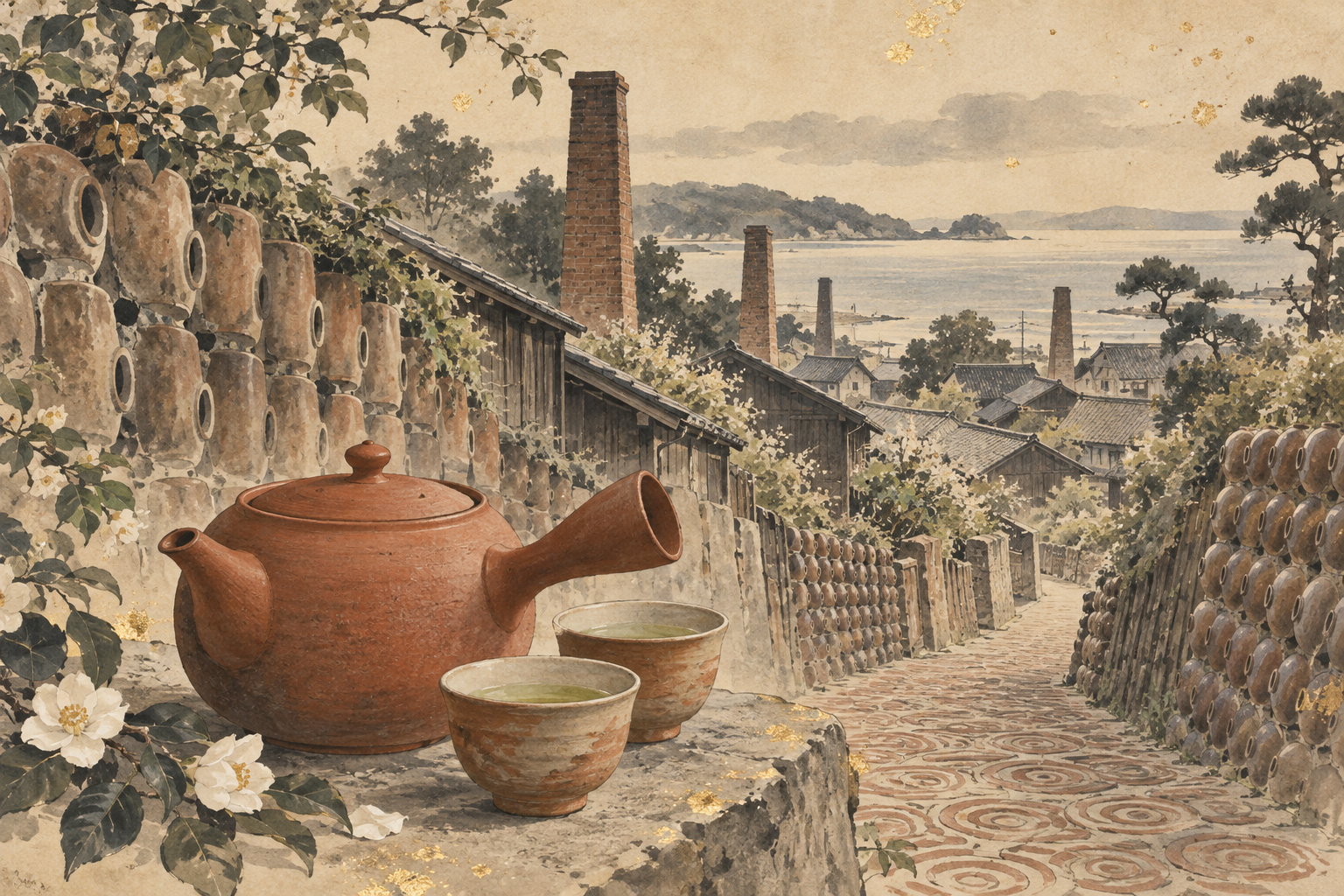
A teapot has to do several things well at once. Its lid must sit properly, its handle must make sense to the hand, and its strainer must keep leaves from following the tea into the cup. Tokoname’s official pottery guide describes a vessel assembled from separately formed components. What looks like a compact, familiar object is a series of decisions made in clay. [1]
That makes the kyūsu an unusually good introduction to this pottery town on Aichi’s Chita Peninsula. Follow its making beyond the shop counter and the story expands: to storage jars shipped by sea, pipes made for infrastructure, kilns shared by producers and classrooms where another generation learns the work. The teapot is a way into that history, rather than the whole of it.
Long before the red teapot
Tokoname belongs to Japan’s Six Ancient Kilns, a grouping of pottery-producing regions with medieval roots. Its ceramic history reaches back to the late Heian period. The official Six Ancient Kilns account describes bowls, jars and other wares made in the Chita hills, with large vessels subsequently distributed by water. Coastal access helped a heavy, bulky product travel far beyond its place of manufacture. [2]
This is an important corrective to the assumption that Tokoname has spent a thousand years making essentially the same red teapot. Kyūsu production came much later. The municipal ceramics institution, Tokoname Tō no Mori, recounts a tradition that Inaba Shōzaemon began making them during the Bunsei era, 1818–1830, as sencha culture developed. [3]
The distinction makes the place more interesting. A town’s most recognisable product can be the outcome of adaptation within a much older industry. Clay-working knowledge was durable; the things made with it changed. Visitors looking for continuity should therefore watch for a continuing ability to answer new needs, as well as familiar shapes.
Colour from the material
The reddish colour of shudei ware is closely associated with Tokoname. Aichi Prefecture’s industry account explains it through the iron in the clay. Understanding the colour as part of the ceramic body, rather than simply surface decoration, directs attention to materials and firing. The prefecture also records June 2, 1976, as the date of Tokoname ware’s national traditional-craft designation. [4]
Tō no Mori credits Sugie Jumondō with achieving the red-clay teapot in 1854, taking Chinese Yixing tea ware as a model. That account places exchange at the centre of a local tradition: an admired object from elsewhere became a problem for local makers to solve. [3] Tokoname’s identity was formed partly through such encounters, not through isolation.
Red is also only part of the visual vocabulary. The tourism association’s guide includes seaweed-based mogake decoration and combined-clay techniques. [1] For a buyer, the productive question is how a particular surface was made. A familiar colour is a starting point for an explanation, not a sufficient test of quality or authenticity.
Making a vessel that works
Wheel throwing and mould-based production coexist. In slip casting, liquid clay is placed in plaster moulds to form components; the local guide emphasises that assembly still normally involves hands adjusting their positions and angles. [1] The simple opposition between handmade and mass-produced misses that practical complexity.
A teapot is useful precisely because its parts work together. Its sculptural appearance can attract the eye, but everyday use adds other tests. Can the buyer handle it comfortably? Does its capacity suit the number of cups normally poured? Is the strainer appropriate for the leaves they use? These are questions about living with an object, rather than ranking every object on a single scale of prestige.
| Look at | Ask about |
|---|---|
| Capacity and handle | How much tea will you usually make, and can you hold it comfortably? |
| Strainer | Does its design suit your leaves and cleaning routine? |
| Lid and spout | Can the seller explain its fit and pouring technique? |
| Material | What care instructions apply to this particular piece? |
These are Japan.co.jp’s practical suggestions, not a performance certification. Nor does the colour of a clay body establish that every tea will taste better in it. There is ample reason to value a well-made vessel without assigning it an unverified universal effect on flavour.
Chimneys with a job to do
Along the pottery walking route, the Tōei kiln offers a larger view of the production system. Built around 1887 and used until 1974, it had eight connected firing chambers and ten chimneys. The tourism association describes shared ownership and the firing of teapots and bonsai pots among its uses. [5]
The surviving structure can look picturesque, but it was equipment. It organised heat and batches of goods. Equally, it should not be mistaken for a diagram of how all present-day teapots are fired: the association’s account also discusses gas and electric kilns in contemporary use. [5] Preserved production sites and working production methods belong to different moments in the town’s history.
Tokoname City identifies stacked clay pipes and shōchū bottles among the walking route’s characteristic sights. [6] Seen beside a teapot, they reveal the remarkable range of products made here. The landscape invites a question broader than “Which souvenir should I buy?”: what kinds of work made this town possible?
A timely exhibition about pipes
This autumn, Tō no Mori’s museum provides a direct answer through its exhibition on Koie Hōju, presented as a pioneer of modern clay pipes. The published run is July 18–October 12, 2026, in the museum’s special exhibition room. It brings records of his enterprises into view, giving September visitors a reason to connect the town’s small vessels with its industrial history. [7]
The museum’s historical account describes the challenge of producing strong pipes with consistent joints, and the development of wooden moulds to help achieve the required shapes. [3] Here, repeatability was an achievement. That is a useful companion to the pleasure of finding individual variation in an artist’s pot.
Both belonged to a ceramic economy. One customer required a distinctive vessel; another required many components that fitted together. The exhibition helps explain why industrial production deserves a place in a craft town’s story. It also makes the precision of a small assembled teapot easier to appreciate.
Learning more than a shape
Tō no Mori’s training pages show clay preparation, throwing, casting, teapot-wheel work, glaze study and kiln loading alongside communication classes and gallery visits. [8] Read together, the subjects suggest that becoming a maker involves more than producing an attractive form. Work must be fired successfully, presented and connected with an audience.
A curriculum does not prove that every graduate will earn a living, or that the industry’s future is secure. It does show a concrete means of passing on knowledge. Behind the object that a visitor can buy are repeated attempts and instruction that a finished surface cannot fully reveal.
The institution publishes regular hours of 9 a.m.–5 p.m., with free admission and Monday closure, moving to the following day when Monday is a public holiday. The museum and the research institute/training workshop have different addresses. Check the destination; organised groups and visitors seeking staff explanations should arrange these beforehand. [9]
The most lasting part of a visit may begin after returning home. A kyūsu puts the town’s work into an everyday routine: filling, waiting, pouring and cleaning. Its history reaches beyond tea, to ships, storage vessels, pipes and kilns. Using it gives that history another small place in the present.
- Tokoname Tourism Association: teapot history and production
- Six Ancient Kilns: Tokoname history and maritime distribution
- Tokoname Tō no Mori: historical guide to teapots and modern clay pipes
- Aichi Prefecture: materials, history and traditional-craft designation
- Tokoname Tourism Association: kilns past and present, including Tōei kiln
- Tokoname City: the pottery walking route
- Tokoname Tō no Mori: Koie Hōju exhibition, July 18–October 12, 2026
- Tokoname Tō no Mori: training activities
- Tokoname Tō no Mori: visiting hours and separate facility locations