- The discovery that connects two very different dangers
- A door is more complicated than a lock
- How the researchers found it
- An airway cell has two sides
- Why the placenta matters
- The unexpected measles connection
- A warning first recognized in 1941
- Japan eliminated endemic transmission—but not the threat
- The unfinished business of immunity
- What the discovery does—and does not—promise
The discovery that connects two very different dangers
Rubella is easily underestimated when it looks like a short-lived rash. Its historical danger lies elsewhere: infection early in pregnancy can disrupt fetal development and lead to congenital rubella syndrome. For decades, researchers lacked a satisfying molecular explanation of how the virus gained access to important human tissues. A Japanese-led collaboration has now identified a major part of that missing mechanism: a cell-surface adhesion protein called nectin-4.
The peer-reviewed Nature paper was published online on November 4, 2026, with a Japanese institutional announcement following on November 9. The team includes the Japan Institute for Health Security, the National Institute of Health Sciences, Institute of Science Tokyo, Yokohama City University, Tohoku University, the University of Osaka and Gunma University. Its findings link infection in airway epithelial cells to infection in placental tissue. That is an important biological result, not a newly available drug.
A door is more complicated than a lock
Viruses cannot reproduce on their own. They must attach to and enter a compatible host cell before they can exploit the cell’s machinery. A receptor is a molecule that can make that encounter possible; its presence does not, by itself, guarantee infection. Subsequent steps such as membrane engagement, internalization and replication also matter.
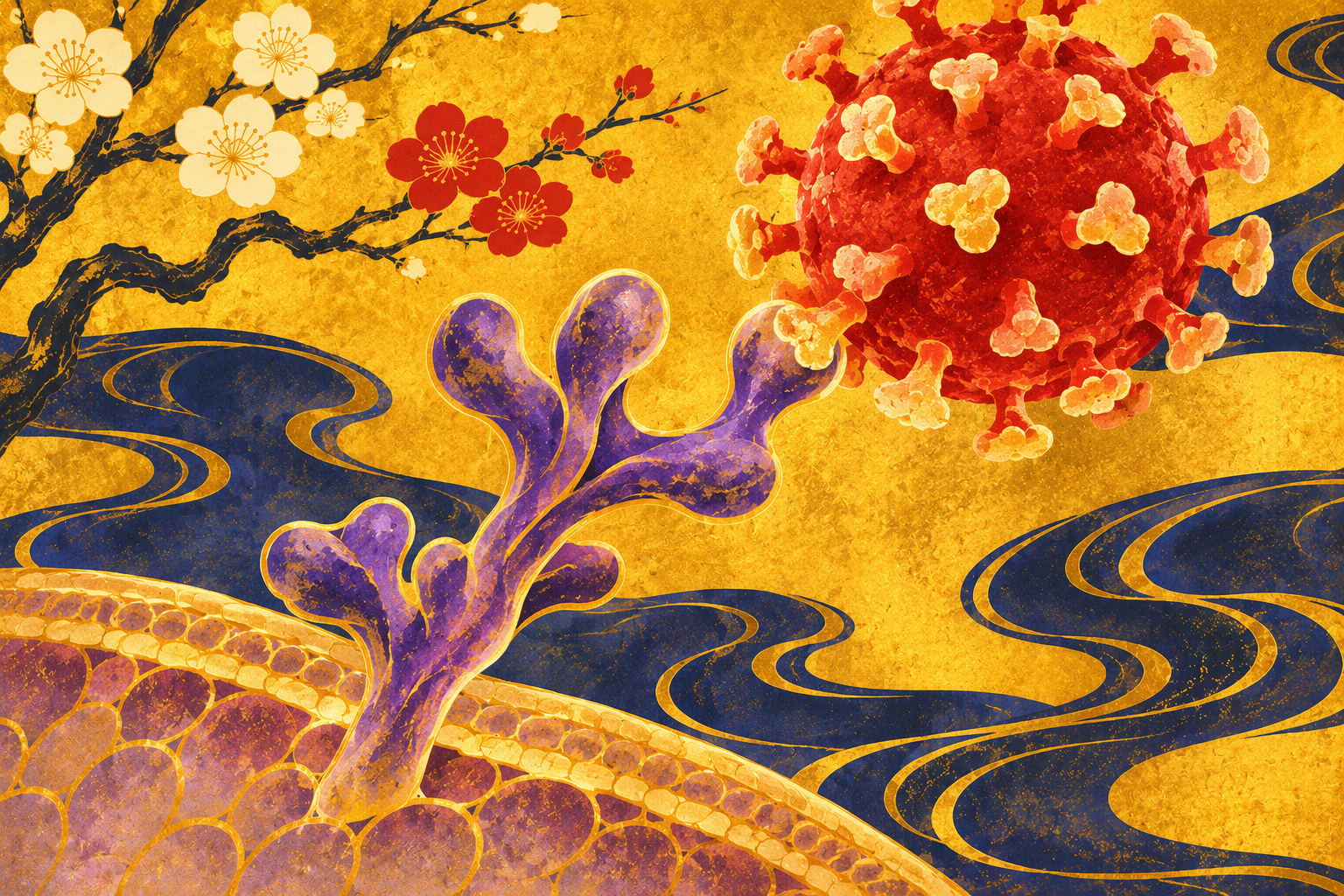
Nectin-4 is a cell-adhesion protein normally found at the surface of epithelial cells. The researchers found that it interacts directly with the rubella virus envelope glycoprotein complex and facilitates receptor-mediated entry. Initial attachment to cellular lipids also involves a calcium-dependent step. This is therefore a multistage mechanism, not a simple one-key-one-lock picture.
How the researchers found it
First, the scientists used specially designed virus-like particles and proximity biotin-labeling proteomics to survey proteins near a virus particle at the cell surface. They then applied CRISPR–Cas9 genetic screening to test which candidates actually affected infection. The combination is important: physical proximity generates possibilities, while deliberate genetic perturbation can help establish function.
Cells ordinarily resistant to rubella infection became susceptible after being engineered to express nectin-4. Conversely, blocking the protein with antibodies or removing its gene sharply reduced infection. This gain-and-loss pattern supports a causal role in the laboratory models. It does not establish that nectin-4 is the only possible route for every viral strain and cell type.
An airway cell has two sides
Human airway epithelium is polarized. The apical face looks toward the airway lumen; the basolateral surface faces underlying tissue. In specialized airway-cell models, the researchers observed rubella entering preferentially from the basolateral side and progeny virus emerging from the apical side. Nectin-4 mediated the entry step.
That directional pattern offers a plausible molecular connection between infection within tissue and virus release into the respiratory tract. It also raises a deeper question: how does the virus encounter the basolateral surface in natural infection? A cultured airway model reveals an important mechanism but cannot, on its own, reconstruct the full sequence of human-to-human transmission.
Why the placenta matters
Congenital rubella syndrome can involve hearing impairment, cataracts and heart defects. Its risk is particularly serious when maternal infection occurs early in pregnancy, when organs are developing. The placenta, where maternal and fetal systems interface, is therefore central to understanding the disease.
The study found substantial nectin-4 expression in syncytiotrophoblast cells on the outer surface of placental villi and evidence that the receptor participates in infection there. That helps explain a previously uncertain route into placental tissue. It does not allow scientists to calculate a particular pregnancy’s risk or predict clinical outcomes in an individual fetus.
The unexpected measles connection
Nectin-4 was already known as a receptor used by measles virus, an entirely different pathogen. Rubella and measles can both present with rash, but they belong to different viral lineages and cause distinct diseases. Their convergence on a common epithelial receptor is striking because it suggests a shared solution to a biological problem despite their evolutionary distance.
The finding does not make measles and rubella interchangeable, and it does not imply that a therapy aimed at one virus would automatically work for the other. Instead, it invites further investigation into how viruses exploit ordinary molecules that hold human tissues together.
A warning first recognized in 1941
The history of rubella is a case study in how a seemingly mild childhood infection became a major maternal and child health concern. In 1941, Australian ophthalmologist Norman Gregg identified an association between maternal rubella and congenital cataracts. The virus was isolated in 1962, and the large epidemics of the 1960s underlined the need for vaccination and surveillance.
Japan’s immunization strategy evolved unevenly. Early policy emphasized vaccination of schoolgirls, aiming to protect future pregnancies, before broader vaccination of children regardless of sex and the present two-dose measles-rubella schedule. Those historical differences mattered: some generations of men had not been offered routine vaccination during childhood, leaving gaps in population immunity.
Japan eliminated endemic transmission—but not the threat
Japan reported roughly 17,000 rubella cases in the 2012–2013 outbreak and 45 cases of congenital rubella syndrome in 2012–2014. Workplace-associated transmission among susceptible adults was a major part of that episode. The resulting policies included extra antibody testing and vaccination opportunities for men born between April 2, 1962, and April 1, 1979.
In September 2025, a WHO Western Pacific regional committee recognized Japan as having eliminated endemic rubella transmission. Elimination is a surveillance and transmission milestone, not global eradication. Imported infections remain possible, and immunity must be maintained. The Japan Institute for Health Security reported childhood first-dose coverage of 92.7% and second-dose coverage of 91.0% in fiscal 2024, both below the 95% target.
The unfinished business of immunity
The national catch-up program reached only a portion of its intended population. By March 2025, about 5.04 million of approximately 15.37 million eligible men had undergone antibody testing (32.8%), while roughly 1.09 million received a vaccine through the program (7.1% of the target population). Those percentages are not estimates of how many people lacked immunity; they measure use of the program.
Japan’s special fifth-period catch-up program ended after fiscal 2024, with limited extensions for specified people affected by vaccine availability and related conditions, potentially through March 31, 2027. Eligibility should be confirmed with a local government or healthcare provider. Checking vaccination records and maintaining appropriate protection before pregnancy remain more immediate public-health measures than experimental receptor-directed approaches.
What the discovery does—and does not—promise
Finding a receptor supplies an experimental target. It can help researchers investigate candidate entry blockers, test whether alternative infection pathways exist and refine tissue models. Yet nectin-4 also performs normal adhesive functions, making safety and selective targeting critical concerns. Blocking a virus in a laboratory culture is not proof that a drug will be safe or effective in patients.
No therapeutic trial, approved antiviral treatment or improved pregnancy outcome is demonstrated by this paper. The study clarifies the molecular mechanics of rubella at two crucial tissue interfaces. That is a genuine scientific advance, and its value becomes clearer—not smaller—when separated from treatment claims. Vaccination, surveillance and timely clinical guidance remain the practical defenses available today.
Sources and verification
This is document-based reporting using the original peer-reviewed study, Japanese institutional disclosures, and public-health sources. JAPAN.co.jp did not conduct interviews with the researchers. There is no patient treatment trial or approved therapy in this finding.