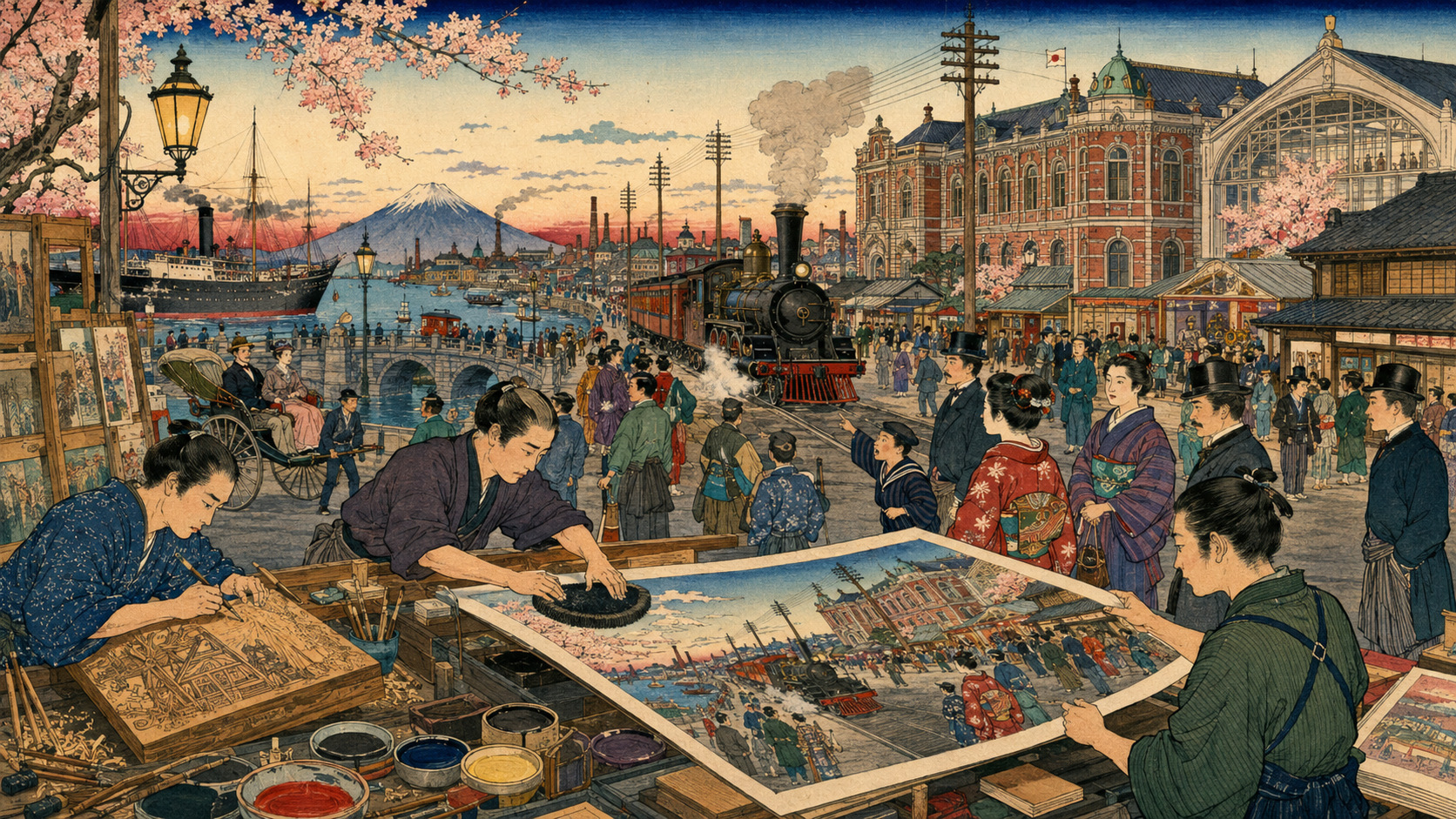
The future arrives at Ueno in three sheets
Imagine Ueno Park on March 1, 1881. The gates open onto nearly 143,000 square metres organized around a main building and six exhibition halls. Inside are pumps, agricultural implements, ceramics, textiles, pictures, models and machines. Outside, the crowd is part customer, part student and part citizen of a state still inventing the public meaning of “modern.”
Japan is in a difficult economy. Inflation following the Satsuma Rebellion and a persistent trade imbalance have not disappeared. Yet the Second National Industrial Exposition becomes a sensation. The National Diet Library records 823,094 admissions during the four months to June 30—almost twice the daily attendance of the first exposition. Exhibits have multiplied fourfold. The government has transformed Ueno into a temporary map of what the country makes and what it hopes to become.
Utagawa Kunitoshi turns this policy project into a color woodblock triptych. The Tokyo National Museum’s work, catalogued by Art Platform Japan as Second National Industrial Exposition, is dated 1881 and composed of three large ōban sheets. An Edo-Tokyo Museum record preserves another impression as a single surviving sheet. The National Diet Library identifies a Kunitoshi view published on March 11 and notes that the composition maps the exposition grounds from the present Takenodai area toward today’s Tokyo National Museum, with Josiah Conder’s exhibition art building beyond the fountain.
This is more than architectural reportage. Kunitoshi gives industrial policy a horizon, a route and a crowd. The viewer can wander through national ambition without entering the gates. A government exhibition becomes a portable public picture.
The man is less documented than his machines
The verified outline is surprisingly thin. Japan’s national authority record gives the artist as Utagawa Kunitoshi, 歌川国利, 1847–1899. Museum and standard reference accounts identify his personal name as Yamamura Kiyosuke or Seisuke and his art name as Baiju. They place him within the Utagawa lineage, with training associated with Kunitsugu, Kunisada I and later Kunisada II. The precise sequence is repeated in reference literature, but the surviving web-accessible museum record is much stronger on objects than on private life.
That imbalance should shape how he is written about. There is no rich diary waiting to tell us what he felt when the first railway opened, whether he admired government industrial policy, or how he negotiated with publishers. “Kunitoshi believed” is often too confident. What can be said is that publishers repeatedly issued designs under his name in genres that turned new institutions and technologies into marketable sights.
Born in 1847, Kunitoshi entered the world six years before Commodore Perry’s arrival and reached adulthood as the Tokugawa order ended. He was about twenty-one at the Meiji Restoration. His working life unfolded inside a sequence that would have seemed impossible in childhood: ministries devoted to industry, rail and telegraph lines, public industrial expositions, brick commercial districts, imported dress, constitutional ceremony and imperial spectacle. He did not need to invent modernity as a theme. It kept rebuilding the street outside.
Kaika-e: civilization and enlightenment for the eye
Kunitoshi is most closely associated with kaika-e—“civilization and enlightenment pictures.” The term is useful if it is not mistaken for a rigid school. These prints showed Western-style buildings, uniforms and dresses; locomotives and horse vehicles; bridges, gas lamps and public entertainments; ministries, ceremonies and commercial streets. They were souvenirs, news pictures, advertisements, urban guides and lessons in how to recognize the new.
The National Diet Library describes how Meiji prints acquired a more journalistic function after the old shogunate restrictions on depicting contemporary politics and events fell away. The first nishiki-e newspaper appeared in 1874. Meanwhile, Yokohama prints had already trained audiences to look at foreigners, imported objects and an opened port as spectacle. Kaika-e carried that visual appetite into Tokyo’s rebuilding.
“Enlightenment” did not make the images objective. A print could compress distance, tidy a street, brighten a façade, enlarge a crowd or present a proposed order as though it had already become normal. That is not a defect unique to Kunitoshi. It is how visual persuasion works. The print says: this strange object belongs here; these rails have a destination; this ceremony has a center; this modern city is legible.
A machine hall becomes a national self-portrait
The industrial expositions were domestic cousins of the world’s fairs Japan’s officials and exhibitors had studied abroad. The first was held in Tokyo in 1877, the second and third in 1881 and 1890, followed by Kyoto in 1895 and Osaka in 1903. JACAR’s institutional record shows how seriously the state treated them: an exposition office was created for each event, and later rules placed an imperial family member at its head with the agriculture and commerce minister as deputy.
The purpose was not simply to display curiosities. A University of Tokyo library history notes that organizers sought products and skills with continuing commercial or industrial value. The 1881 catalogue included ceramics and oil paintings, but also pump models, mowing machines and other equipment. The National Museum of Nature and Science preserves an illustrated catalogue of machines displayed in the second machinery hall.
Kunitoshi’s panorama participates in that classification. Buildings separate categories; paths organize movement; visitors supply scale. But the print also does something a list cannot: it turns policy into desire. The halls appear not as warehouses but as a destination. The crowd confirms that progress is popular.
There is a contemporary echo. A government white paper also sorts a nation into inspectable halls—economy, communications, water, cities, tourism, trade, manufacturing, energy, defense, science. Each chapter supplies routes, labels and preferred vantage points. The form is different; the curatorial act is remarkably familiar.
The street begins to move
Japan’s first railway opened between Shimbashi and Yokohama on October 14, 1872. The National Diet Library notes that artists depicted trains and stations intensively around the opening. A locomotive was more than transport. It was smoke, speed, punctuality, imported engineering, new land use and the state’s capacity made visible at once.
Kunitoshi’s surviving transport record extends beyond steam. Art Platform Japan catalogues his New Edition: The Coming and Going of the Horse Tram from 1893 in the Equine Museum of Japan. Another work, New Edition: Changing Bicycles, dates to 1894 and is held by the Ishikawa Prefectural Museum of Art. Reference accounts also attribute to him an 1882 etched view of horse-drawn railcars crossing Manseibashi.
These vehicles matter because they alter the social geometry of a city. Tracks claim a fixed corridor. Timetables discipline movement. Horses, pedestrians, rickshaws and carriages negotiate the same space. A bicycle turns balance and individual propulsion into modern entertainment. In Kunitoshi’s world, machinery is rarely isolated on a diagram. It is tested against congestion.
Iron crosses a river of memory
Azuma Bridge had connected the banks of the Sumida since 1774. In 1887 it was rebuilt as the first metal bridge across the river. Kunitoshi’s Azumabashi, published in December 1888 as part of a Tokyo sights series, made the new structure a landmark. The print record describes diagonal iron members, Western perspective, carriages and fashionable pedestrians; a pleasure district lay on one side and a beer factory on the other.
This is exactly the kind of subject at which kaika-e excels. The site was not new. Generations knew the river, Asakusa and the crossing. The material was new. Iron entered a landscape already thick with memory, and the print reassured viewers that the city could absorb it.
The bridge also exposes a central Meiji tension. Modernization was often presented as replacement—wood gives way to iron, ferry to bridge, rickshaw to rail. Everyday reality was additive. Old and new coexisted, collided and changed one another. Kunitoshi’s crowded pictures feel truthful not because every measurement is exact, but because no single era has cleared the street.
The Constitution becomes a picture
In February 1889 the Constitution of the Empire of Japan was promulgated. The National Archives summarizes its settlement carefully: the emperor exercised sovereign power as head of state; an Imperial Diet was established to deliberate bills and budgets; enumerated liberties existed within law; judicial power was separated from executive power.
In March, Kunitoshi issued View of the Issuance of the Constitution under the name Baiju Kunitoshi. The Metropolitan Museum of Art holds the full ōban triptych and catalogues him directly as 1847–1899. The same year he designed an imperial-carriage triptych, of which the Met holds sheets titled Illustration of the Imperial Carriage and View of the Imperial Carriage.
Here modernity is not only a machine. It is choreography. Architecture frames power, costumes rank bodies, and the triptych’s width turns state ceremony into public theater. The print makes constitutional order visible while placing sovereignty unmistakably at its center.
That is why these images should not be called neutral snapshots of progress. They helped audiences imagine the modern state through pageantry. The industrial exposition showed what the nation could produce. The constitutional and imperial prints showed who authorized the national frame.
When Saigō returned as a star
Kunitoshi’s modern world was never purely rational. The British Museum owns his 1877 color diptych Strange Tales of Popular Stars, in which onlookers watch the miraculous appearance of Saigō Takamori. The work was published in Tokyo in the year Saigō died during the Satsuma Rebellion.
The picture is a useful antidote to the idea that trains simply displaced ghosts. A rebellion, a celebrity death, rumor, astronomy and popular belief could occupy the same sky. The artist who drew exhibition halls also drew an apparition. Modern mass culture did not abolish legend; it gave legend new distribution.
This wider range matters. Kunitoshi also produced traditional sights, beauties, historical and entertainment subjects. His repeated Shinobazu Pond horse-racing pictures from the mid-1880s combine an old religious and leisure landscape with a newly organized public spectacle. “Painter of machinery” describes today’s chosen lens, not the boundary of his career.
Old craft, imported color, new perspective
A color woodblock print was a network before it was an image. A publisher commissioned and financed it. The artist supplied the design. A carver translated lines and color areas into cherry blocks. A printer registered paper across repeated impressions, one block after another. Distributors and shops completed the circuit. The signature privileges the designer, but the object is collaborative manufacturing.
That makes kaika-e deliciously paradoxical: imported machines were explained through an exacting Edo production system. A train could be carved by hand. A steel bridge could be printed from wood. Western perspective entered a medium built around contour, pattern and layered color.
The colors were modern too. The Met notes that vivid purples, greens and reds in an 1881 Ueno print by Hiroshige III came from chemical aniline dyes imported from Germany. Such dyes also colored fabric, and schools opened in the late 1870s to explore them. It would be unsafe to identify every pigment in a Kunitoshi sheet without material analysis, but the period palette itself was part of the industrial exchange the pictures celebrated.
Bright color was not just decoration. It made newness visible at a glance. Red brick, purple dress, black iron and blue sky became a chromatic argument: the future should look more intense than the past.
The medium that pictured its successor
Kunitoshi’s career overlaps the erosion of the commercial world that sustained him. The National Diet Library traces the expansion of movable type, lithography and photomechanical processes: lithography grew fashionable from about 1881, collotype production arrived by 1889, and a practical photo-zinc process followed in 1890. These methods could be faster, cheaper or more photographically convincing.
Woodblock prints briefly found renewed demand during the Sino-Japanese War of 1894–95. By the Russo-Japanese War a decade later, mass color printing and official picture postcards had changed the market. Kunitoshi died in 1899, before that later contest fully played out.
There is poignancy in the sequence. His prints advertised transport networks, industrial capacity and modern communications—forces that accelerated newer media. The old information technology pictured the infrastructure that would help replace it.
Optimism, with nowhere left to stand
The immediate appeal of a Kunitoshi modernization scene is abundance. A single design can offer architecture, vehicles, signage, uniforms, hats, kimono, landscaping and spectators. Diagonals pull the eye through the print. Repetition turns windows, rails and crowds into rhythm. The city appears busy enough to validate itself.
But abundance can become pressure. A railway consumes the center. Poles divide open sky. Buildings harden the horizon. People are numerous but often small, typed by occupation or costume. Technology is optimistic and slightly overwhelming—the precise quality that makes Kunitoshi a powerful visual guide for an edition about artificial intelligence, autonomous vehicles, advanced materials, nuclear systems, defense capability and concentrated metropolitan infrastructure.
The emotional ambiguity may not be an explicit criticism by the artist. It emerges from composition. When every innovation demands attention, the viewer experiences progress as excitement and congestion at once.
What the pictures leave outside the gate
An industrial-exposition print does not tell us who worked the longest hours, whose workshop failed, how smoke affected a neighborhood, who lost land to a railway, or how imported technology was financed. An imperial ceremony does not reveal the full contest over representation and rights. A new bridge can be magnificent while public works redistribute cost and access.
Meiji modernization expanded education, communications, mobility and productive capacity. It also strengthened a centralized state, military power and imperial reach. These outcomes should not be projected backward as a secret message in every Kunitoshi design. Nor should a brilliant surface be allowed to erase them.
The honest way to look is double. First, respect the print as an artifact of aspiration, skilled labor and visual invention. Then ask what its chosen vantage point cannot show. Beauty and critique do not cancel each other; together they make the object historically useful.
A verified working catalogue for this theme
| Date | Documented work | What it contributes |
|---|---|---|
| 1877 | Strange Tales of Popular Stars, British Museum | Saigō Takamori’s apparition; rumor and legend inside modern print culture |
| 1881 | Second National Industrial Exposition, Tokyo National Museum / Edo-Tokyo Museum records | Machinery, state policy and the crowd organized as one public panorama |
| 1884–1890 | Multiple Shinobazu Pond horse-racing views, Equine Museum of Japan | Modern spectacle layered onto a familiar Tokyo landscape |
| 1888 | Azumabashi, Tokyo sights series | Iron infrastructure, fashionable movement and Western perspective |
| 1889 | View of the Issuance of the Constitution, Metropolitan Museum of Art | The modern state staged through architecture, dress and ceremony |
| 1889 | Illustration/View of the Imperial Carriage, Metropolitan Museum of Art | Mobility transformed into sovereign pageantry |
| 1890 | Complete View of the Third National Industrial Exposition, National Diet Library record | The exposition as a recurring visual form of national self-assessment |
| 1893 | New Edition: The Coming and Going of the Horse Tram, Equine Museum of Japan | Urban transport as repeatable, popular motion |
| 1894 | New Edition: Changing Bicycles, Ishikawa Prefectural Museum of Art | Individual mobility, novelty and playful machine culture |
How to read a modernization print
- Read the title: “true view,” “famous place,” “opening” and “complete view” are claims about authority, not guarantees of photographic accuracy.
- Find the route: tracks, bridges, paths and diagonals tell the eye how the modern city is supposed to move.
- Find the center: a machine, pavilion or sovereign figure reveals the hierarchy of the composition.
- Count coexistence: kimono and top hats, rickshaws and rails, shrines and iron show modernity accumulating rather than arriving all at once.
- Notice scale: large buildings and small people can make institutions feel inevitable.
- Inspect the seams: a triptych is three sheets. Alignment and misregistration remind us that the seamless national picture was physically assembled.
- Ask who paid: the publisher expected a market. Even ideological-looking images were commodities competing for attention.
- Look beyond the frame: labor, displacement, pollution, rural experience and dissent may be precisely what the chosen view excludes.
Why Kunitoshi unifies today’s edition
Today’s ten Japanese government white-paper stories describe a country trying to make enormous systems legible: wages and productivity, artificial-intelligence adoption, drought infrastructure, Tokyo concentration, hotel labor, fragmented trade, manufacturing investment, the nuclear fuel cycle, defense capability, and science and innovation. Five company stories then move closer—to regulatory T cells, metal-organic frameworks, open-source autonomous driving, atomic-scale materials simulation and cattle-waste biomethane.
Kunitoshi offers a visual grammar for the whole set. Railways supply the line of movement. Exposition halls turn technical complexity into public display. Bridges connect systems. Crowds establish scale. Government architecture gives policy a façade. Saturated color carries optimism, while the overloaded composition preserves unease.
The analogy has limits. AI is not a steam engine, a Treg therapy is not an iron bridge, and a white paper is not a nishiki-e. The connection is perceptual: societies need pictures before most people can directly inspect a new system. Images decide whether technology appears intimate or remote, emancipating or disciplinary, orderly or out of control.
About today’s editorial artwork
The hero image and the other illustrations in this edition borrow broad visual principles from Kunitoshi’s modernization prints: panoramic crowds, assertive diagonals, saturated color, layered infrastructure, a mixture of Japanese and Western dress, and technology treated as civic theater. The printmakers in the foreground make the central paradox explicit—the future is being manufactured through an older craft.
The image is not presented as a lost Kunitoshi work. It combines a steam railway, port, bridge, telegraph network, factory skyline, Western-style public architecture and traditional streets in a deliberately anachronistic city. It should not be used to identify a real station, building, locomotive or industrial site. Its purpose is editorial: to make the viewer feel the exhilaration and compression of a society watching systems arrive faster than any single street could contain them.
That distinction protects both history and imagination. Historical works are linked below in museum records. The editorial image is clearly labeled as a contemporary composition inspired by a public-domain artist who died in 1899.
A life synchronized with transformation
1847 Utagawa Kunitoshi (歌川国利) is born.
1853–54 Perry’s expeditions force the treaty-port question into Kunitoshi’s childhood world.
1868 The Meiji Restoration begins; Kunitoshi is about twenty-one.
1870 The Ministry of Industry is created to promote and manage railways, mines, telegraphy and engineering.
1872 Japan’s first railway opens between Shimbashi and Yokohama.
1877 The first National Industrial Exposition opens; Kunitoshi publishes his Saigō apparition diptych during the Satsuma Rebellion.
1881 The second exposition draws 823,094 admissions; Kunitoshi designs its documented panorama.
1882 Tokyo’s horse tram begins service, turning rails into everyday urban infrastructure.
1887–88 Azuma Bridge is rebuilt in metal and Kunitoshi publishes it as a new Tokyo sight.
1889 The Meiji Constitution is promulgated; Kunitoshi pictures its issuance and imperial carriage ceremony.
1890 The third National Industrial Exposition opens in Ueno; an exposition panorama is catalogued under Kunitoshi.
1893–94 His catalogued horse-tram and bicycle prints make mobility playful and popular.
1899 Kunitoshi dies as photography and mechanized printing are remaking the picture market.
The final lesson is not “machines are beautiful”
Kunitoshi deserves attention because he was neither outside modernity nor fully absorbed by it. He used a mature urban craft, built on hand skill and publisher risk, to picture industrial systems that promised speed, scale and national strength. His prints are not blueprints and not transparent evidence. They are interfaces between policy and popular imagination.
Look long enough and the machinery changes character. The locomotive is also a line through a neighborhood. The bridge is also a claim on a river. The exposition hall is also a government’s argument about value. The Constitution is also a ceremony that determines where sovereignty stands. The crowd is evidence of enthusiasm, and a reminder that people can become decorative scale within a picture of institutions.
That is the right visual tension for 2026. Japan’s newest systems—AI models, autonomous vehicles, cell therapies, materials engines, fuel-cycle infrastructure—again arrive wrapped in demonstrations, diagrams and official narratives. Kunitoshi teaches us to enjoy the brilliance, trace the route, identify the center and then inspect the edge of the frame.
Research notes and principal sources
Museum catalogues and Japanese public databases were checked through August 7, 2026. Where catalogues disagree in biographical detail, the article favors authority records and object-level documentation. The requested artist is identified by the characters 歌川国利 and the life dates 1847–1899. Interpretive claims about visual persuasion, crowding and the relationship to today’s white-paper edition are Japan.co.jp analysis.
- Art Platform Japan / Tokyo National Museum: Kunitoshi, Second National Industrial Exposition, 1881
- Tokyo Museum Collection: Kunitoshi, Second National Industrial Exhibition
- National Diet Library Search: Kunitoshi’s 1881 exposition view and site description
- National Diet Library: Second National Industrial Exposition dates, grounds and attendance
- National Museum of Nature and Science: 1881 exposition catalogue and machinery hall
- JACAR: National Industrial Promotion Exhibitions Office and the five expositions
- JACAR: Ministry of Industry and the state’s railway, mining and engineering program
- National Diet Library: characteristics, journalism and technological decline of Meiji nishiki-e
- National Diet Library: railway ukiyo-e and the 1872 Shimbashi–Yokohama opening
- Art Platform Japan: Kunitoshi, New Edition: The Coming and Going of the Horse Tram, 1893
- Art Platform Japan: Kunitoshi, New Edition: Changing Bicycles, 1894
- University of Oregon collection research: Kunitoshi’s Azumabashi, 1888
- Metropolitan Museum of Art: Baiju Kunitoshi, View of the Issuance of the Constitution, 1889
- Metropolitan Museum of Art: Kunitoshi, Illustration of the Imperial Carriage, 1889
- National Archives of Japan: Constitution of the Empire of Japan, 1889
- British Museum: Kunitoshi (歌川国利), Strange Tales of Popular Stars, 1877
- British Museum: the different artist Utagawa Kunitoshi (歌川国歳), identity cross-check
- Metropolitan Museum of Art: imported aniline dyes in an 1881 Ueno print