A face for the mountains
A solitary figure stands inside a world reduced to decisive contours, densely inked shapes and a small vocabulary of colors. It may be tempting to call Umetaro Azechi’s Mountain Men melancholy. But their emotional range is larger: endurance, curiosity, vulnerability, even unexpected companionship. They are not portraits of famous mountaineers. They are a way of thinking about what the mountains do to the human imagination.
For Japan.co.jp’s October 11 Ehime edition, that idea begins with a local story. Azechi was born in a village now part of Uwajima. The Museum of Art, Ehime identifies his 1953 color woodcut Mountain Man as a turning point: after decades of making mountain landscapes, the artist increasingly used unnamed figures to convey the experience of being among them.
The journey from a village in Iyo
Azechi was born December 28, 1902, in Futana village in present-day Mima, Uwajima. His life did not begin with the patronage or professional security often associated with a celebrated artist. Uwajima’s municipal chronology describes his departure from home in 1918, work aboard a freighter, and his move to Tokyo in 1920. There he delivered newspapers while attending the Seisoku English School.
He began studying oil painting through correspondence in 1922. Four years later, working for the government Printing Bureau, he experimented with plates and printmaking. The experience matters to the art: printing was not merely a means of multiplying a picture but a way of deciding how an image should be made.
Inside Japan’s creative-print revolution
Japanese woodblock printing is often introduced abroad through ukiyo-e, where publisher, designer, carver and printer historically performed distinct roles. Azechi belonged instead to the modern sōsaku hanga, or creative-print, movement, which placed greater emphasis on the artist’s direct control over the work. The distinction is not that one tradition was creative and the other was not; it is how artistic agency and the process of production were organized.
He received encouragement from Un’ichi Hiratsuka and encountered the influential Kōshirō Onchi. In 1927 he was accepted into the Japan Creative Print Association exhibition; by 1932 he had joined the Japan Print Association. Early compositions often pictured streets and industrial waterways. They show an artist learning to make the world intelligible through printed lines.
Returning to Ehime in print
One of Azechi’s most important early undertakings was Iyo Fūkei, a suite of prints associated with his home region and issued in 1936. The Museum of Art, Ehime preserves works depicting Mount Ishizuchi, the sacred mountain that anchors the prefecture’s physical and cultural geography. These prints do not make Azechi a purely local artist; they show how a landscape held in memory could serve as a foundation for an increasingly universal visual language.
The Tokyo National Research Institute for Cultural Properties records his encounter with Mount Asama in 1937 as a key event in his long commitment to mountain imagery. What changed was not merely the scenery he chose but the effort to turn travel, physical exertion and remembered place into a distinct kind of print.
The decisive Mountain Man of 1953
The Museum of Art, Ehime dates its Mountain Man to 1953 and specifies color woodcut on paper, measuring 39.0 by 28.5 centimeters. It describes this as a landmark in Azechi’s movement away from rendering identifiable mountains toward conveying the presence of anonymous people who inhabit or traverse them. The innovation arrived after the artist turned fifty.
A related work, White Figure (1958), in Machida’s print museum, offers a useful key. The museum calls its central figure an image of inward perception rather than a literal depiction of a particular climber. Azechi’s Mountain Men allow viewers to project their own encounter with isolation, danger or exhilaration into a spare outline.
The craft of restraint
Strong silhouettes and reduced palettes can make Azechi’s work appear simple at first glance. Yet their economy is demanding. In a woodcut, boundaries between planes matter; too much descriptive detail can weaken a central form. He uses broad bodies of color and pronounced outlines to make a person feel simultaneously fragile and monumental.
The figures are not only lonely, either. Birds, companionship and the everyday gestures of walking and pausing appear across the wider series. Reading every work as solitude risks ignoring the warmth and humor that curators and viewers have long recognized in them.
A local artist in an international conversation
Azechi’s career crossed prewar creative-print circles and the postwar international market for Japanese prints. Museum biographies record appearances at the São Paulo Biennial and international print exhibitions in Lugano. Such recognition suggests the extent to which his visual vocabulary could travel without demanding knowledge of an individual Japanese mountain.
Still, the story should not be reduced to a straightforward march from provincial obscurity to global acclaim. Training, workshops, colleagues, professional associations and the circulation of editions were all part of the conditions that made recognition possible. His art is a record of patient work as much as a succession of remarkable images.
Two homes for a body of work
The Umetaro Azechi Memorial Museum in Mima, Uwajima, preserves the connection with the birthplace. Meanwhile, the Museum of Art, Ehime holds works that map his development from early urban scenery through the Iyo landscapes and Mountain Men to his later Mount Ishizuchi designs. Studying these in sequence reveals a career shaped through change, rather than an instantly recognizable style appearing fully formed.
Machida, where he lived later in life, became another artistic home. The Machida City Museum of Graphic Arts preserves important prints and organized the 2019 exhibition Umetaro Azechi: My Mountain Men. His legacy belongs to multiple communities, not to any single institution.
What his figures mean to Ehime now
A Sunday edition about Ehime in 2026 inevitably addresses departures, aging, adaptation and the future of rural places. Azechi’s anonymous figure is a useful counterpoint to such abstractions. A population graph cannot tell us how an individual feels about leaving home or climbing toward an uncertain horizon. A woodcut cannot substitute for a census, but it can restore a human scale to the discussion. This is an editorial interpretation, not a claim about Azechi’s stated political views.
Azechi’s mountains remain demanding and sometimes severe. His people remain curiously welcoming. In that contrast lies the attraction of an artist whose career began in Ehime but whose figures have been recognizable to viewers far beyond it.
How we illustrate this feature
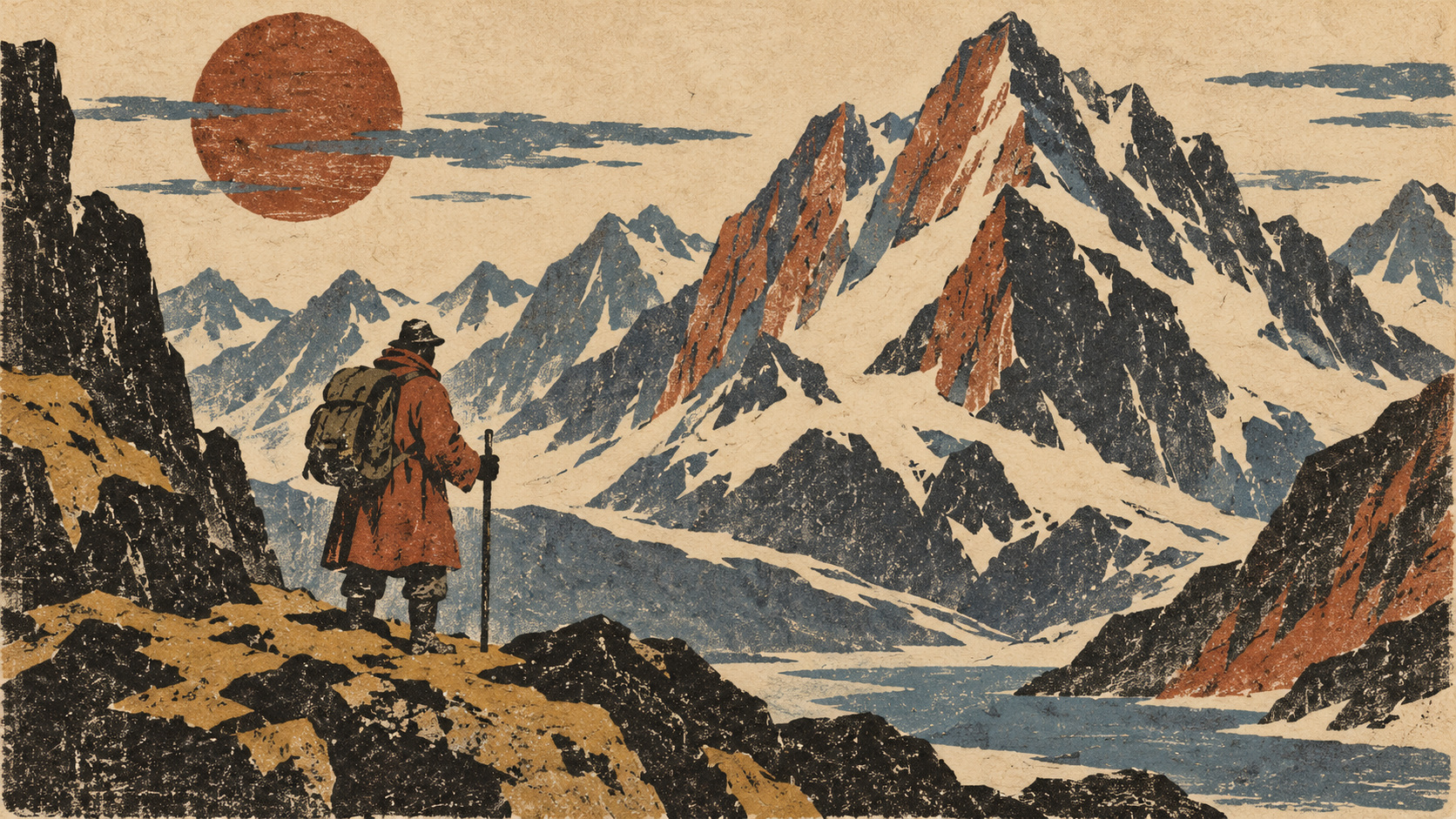
The hero image accompanying this article is an original contemporary illustration commissioned for this edition and inspired by aspects of Azechi’s woodblock vocabulary. It is not an authentic print by Azechi, an authorized reproduction of Mountain Man, or a newly discovered work. For authenticated examples readers should consult the linked collection entries at the Museum of Art, Ehime and Machida City Museum of Graphic Arts.
Because Azechi died in 1999, his artworks generally remain under copyright in Japan in 2026. Reproduction of a specific work requires separate attention to rights and the holding institution’s image-use terms.
Sources and further reading
- 宇和島市「畦地梅太郎を知る」
- 宇和島市「畦地梅太郎のあゆみ」
- 愛媛県美術館《山男》(1953)
- 愛媛県美術館 畦地梅太郎所蔵作品
- 町田市立国際版画美術館《白い像》
- 町田市立国際版画美術館「畦地梅太郎・わたしの山男」
- 練馬区立美術館 作家データ
- 東京文化財研究所「畦地梅太郎」
- 国立美術館 所蔵作品検索
Research cutoff: October 8, 2026. Work titles, dates and artist biography checked against official museum and city resources.