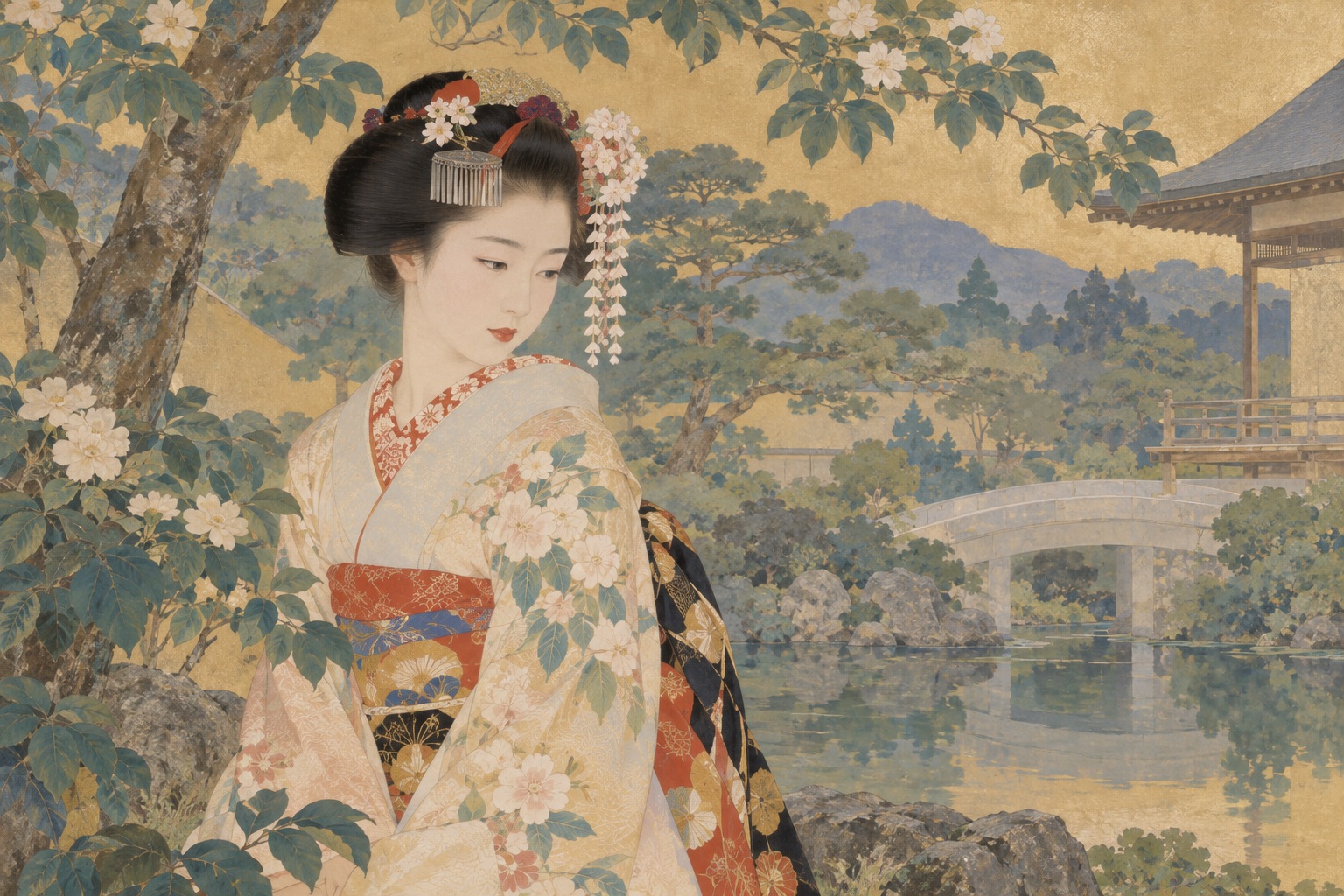
The maiko does not look at us.
She stands in elaborate dress and heavy white makeup before a garden of fresh green leaves, rocks and water. The place is Tenju-an, a subtemple of Nanzen-ji in Kyoto. Yet Tsuchida Bakusen’s Maiko in a Garden is not really a picturesque record of Kyoto.
The woman and the garden have both been taken apart and rebuilt inside a narrow vertical rectangle. Her body is stripped of much of its physical volume, almost doll-like in its stillness. The garden does not recede naturally into distance; stones, trees and water behave as shapes arranged across a surface. The subject is deeply Japanese, but the discipline of the composition reflects what Bakusen had learned by looking at European painting.
Completed in 1924, when Bakusen was 37, Maiko in a Garden—Japanese title 舞妓林泉, read Bugi Rinsen—was shown at the Fourth Kokuga Sōsaku Kyōkai Exhibition. It is color on silk, 217.7 by 102.0 centimeters, and belongs to the National Museum of Modern Art, Tokyo. Painted the year after Bakusen returned from Europe, it has become one of the defining works of modern nihonga.[2][3]
The Japanese title is read “Bugi Rinsen”
Even the title creates distance from everyday speech. Official cultural records give the reading Bugi Rinsen, not the ordinary Japanese pronunciation maiko for 舞妓. The English title is Maiko in a Garden.[3]
The two nouns in the Japanese title—the dancer and the garden—are also the picture’s two protagonists. The painting is not a portrait with scenery behind it. Nor is it a landscape that happens to contain a figure. Its central problem is how to make the two belong to one pictorial order.
From Sado to Kyoto: a boy who might have become a monk
Bakusen was born in 1887 on Sado Island in Niigata Prefecture. His given name was Kinji. As a boy he spent time living at a temple, and Niigata Prefecture notes that fusuma paintings he made at the age of 14 are still preserved on Sado.[10]
He eventually moved to Kyoto, first entering the circle of Suzuki Shōnen and then studying under Takeuchi Seihō. In 1909 he entered the Kyoto Municipal Special School of Painting. The Adachi Museum of Art describes this period as the point at which he awakened to modern Western art and began pursuing freer individual expression.[5]
Kyoto painting carried the long legacy of the Maruyama-Shijō tradition, with its intense attention to observation. Seihō himself had studied Western painting and brought a modernized naturalism into nihonga. Bakusen inherited that seriousness about looking—but he wanted more than observation.
He wanted to change the structure of the picture itself.
Black Cat Society, Mask Society: young Kyoto painters looked West
The Agency for Cultural Affairs records Bakusen’s participation in the Black Cat Society (Chat Noir) around 1910 and its successor, the Mask Society (Le Masque), groups in which younger Kyoto painters discussed new Western art, including Post-Impressionism.[6]
For these artists, Western modernism was not a problem reserved for Japanese oil painters. Gauguin, Renoir and Cézanne offered new ways to think about color, simplification and pictorial construction.
Bakusen’s Woman of the Island (1912) and Ama (1913) pushed figure painting toward bolder form under the impact of Gauguin. Yet he did not simply switch media and become a Western-style painter. The experiment was harder: bring modern ideas of form into silk, mineral pigments and the inherited conventions of Japanese painting.[6]
In 1918 he helped create an alternative to the official exhibitions
In 1918, Bakusen joined Murakami Kagaku, Sakakibara Shihō, Ono Chikkyō and others in founding the Kokuga Sōsaku Kyōkai. The Adachi Museum describes his career as a search for free individual expression and a new direction in Japanese painting.[5]
The group offered an alternative to the government-sponsored exhibition system. Rather than paint primarily for juries and official recognition, they created a place in which they could define the problems of modern Japanese painting themselves.
For the first exhibition, Bakusen produced Yuna. The work combined echoes of Momoyama screen painting and early ukiyo-e with his interest in Renoir and Gauguin. The Agency for Cultural Affairs describes it as an effort to create modern Japanese painting without simply imitating Western painting.[6]
Then he went to Europe to see the originals
In 1921 Bakusen traveled to Europe with fellow painters including Ono Chikkyō and Nagase Banka. The National Museum of Art preserves his Europe diary covering October 4, 1921 to November 21, 1922, along with postcards, sketches and later works shaped by the journey.[12]
What mattered was not only modern painting. Official museum accounts emphasize his study of early Italian Renaissance art and fresco painting, as well as Cézanne and other modern European artists.[3][4]
Bakusen did not return having learned merely how to model bodies more realistically. What he absorbed most deeply was a problem of composition: how figures and spaces could be bound into a disciplined whole.
Italian fresco, with its wall-bound flatness, may have looked less foreign to a nihonga painter than conventional art history would suggest.
Maiko in a Garden was the answer he brought home
The painting appeared the year after his return, at the Fourth Kokuga Sōsaku Kyōkai Exhibition.
MOMAT’s collection commentary describes a maiko standing before the fresh greenery of Tenju-an at Nanzen-ji, her physical sensuality deliberately suppressed until she appears almost doll-like. After seeing Renaissance frescoes and Cézanne directly in Europe, Bakusen pursued a tighter, more rigorous organization of the picture.[4]
This is not a Japanese subject placed in a Western-looking environment.
It is a Japanese garden and a Kyoto maiko reconstructed by an eye changed through Western art.
The garden becomes pattern without losing space
The painting’s treatment of space is one of its great tensions.
There is depth. Water, stones and vegetation occupy different distances. But the scene is not organized as a window opening onto a single vanishing point. Each element retains a strong identity as a shape on the silk.
Areas of color and contour build the tall rectangle. The patterns of the costume answer the patterns of the garden.
Bakusen is neither abandoning spatial depth nor surrendering the surface. He keeps both active at once.
Is this a beauty painting?
Seen as a conventional bijinga, the picture can feel strangely cool.
The maiko is richly dressed, but her face gives little away. The old MOMAT commentary calls her almost doll-like. Her body has been denied much of the soft volume that another painter might use to make the figure physically seductive.[4]
Bakusen is not primarily telling us who this woman is or what she feels. She becomes part of the painting’s architecture.
Yet she never becomes purely abstract. The lowered gaze, the position of the hands, the slight shift of weight preserve a quiet human presence inside the strict structure.
“The work of a purely pictorial eye”
Writing about the painting in 1925, Bakusen described his aim as the work of a “purely pictorial eye”.
He also wrote that he would be satisfied if he could express something of the tight construction he sought, the most beautiful lines and colors found in nature, and the elegance he associated with Japanese culture.[3]
The statement is revealing because it shifts emphasis away from narrative.
The painting does not need to tell a story about a maiko. Line, color, shape and construction are themselves sufficient subjects.
That is a distinctly modern claim.
The finished painting hides an enormous amount of drawing
The final work is so controlled that it can appear to have arrived fully formed. The museum collections tell a different story.
MOMAT preserves studies of the maiko and for Maiko in a Garden. The National Museum of Modern Art, Kyoto, holds a nearly full-scale preparatory drawing measuring 215.2 by 100.5 centimeters.[7][8]
Bakusen observed, drew, shifted the figure, refined contours, tested the arrangement and brought the design up to nearly full size before the final silk painting.
The stylization is therefore not evidence that he stopped looking at nature.
It is evidence that he looked intensely—and then chose what to keep.
He studies nature through drawing, then reconstructs that observation as line, color and surface. The modernity of Maiko in a Garden lies in that movement back and forth.
Not Westernization—but using the West to remake nihonga
Modern Japanese art is often narrated as a binary: Japanese tradition versus Western influence; nihonga versus yōga.
Bakusen makes that opposition unstable.
He did not study Europe and abandon Japanese painting. Seeing Cézanne and Renaissance art gave him new ways to understand the flatness, line, silk, mineral color and decorative structure already available within Japanese traditions.
The Adachi Museum summarizes his mature ambition as a search for harmony between Western painting and the decorative qualities of Japanese painting.[5]
Maiko in a Garden is perhaps the most brilliant moment in which that harmony still feels like a visible tension rather than a settled formula.
The Kokuga Sōsaku Kyōkai did not last long
The Japanese-painting division of the Kokuga Sōsaku Kyōkai dissolved in 1928, only about a decade after its founding.
Its short life does not diminish its significance. Creating an exhibition outside the official salon gave Taishō-era painters room to experiment with what modern Japanese painting could be.
Bakusen later returned to the Imperial exhibition system. Works such as Poppies, later flower-and-bird paintings and Heishō moved toward an increasingly refined, restrained classicism. He became a member of the Imperial Art Academy in 1934 and died in 1936 at the age of 49.
In 2026, ninety years after his death, Niigata looked again
2026 marks the 90th anniversary of Bakusen’s death.
From June through August, the Niigata Prefectural Museum of Modern Art presented “90 Years Since the Death of Tsuchida Bakusen and Artists of the Kyoto Painting World,” showing all of its Bakusen holdings across two rotations.[9]
The trajectory is remarkable: a boy from Sado, a student of Kyoto painting, a rebel against the official exhibition system, a traveler studying Europe, and finally one of the artists who helped redefine what nihonga could contain.
Maiko in a Garden stands at a particularly charged point on that line—still sumptuous, still ambitious, with East and West held in visible tension.
The painting became a postage stamp
The work has also escaped the museum wall in a literal sense.
Japan Post selected Maiko in a Garden, together with Uemura Shōen’s Jo-no-Mai, for its 2025 Philatelic Week stamps. Japan Post described Bakusen’s work as combining a geometrically structured garden informed by Western sensibility with a meticulously rendered maiko carrying Japanese atmosphere.[11]
A painting that once challenged the boundaries of Japanese painting is now used as an emblem of Japanese art small enough to travel on an envelope.
The avant-garde becomes tradition with time.
Why look at it today?
Maiko in a Garden offers a useful answer to a question that remains current: does a culture become less itself when it learns from somewhere else?
Bakusen looked hard at Europe. He studied Renaissance painting. He absorbed Cézanne, Renoir and Gauguin. Then he came home and painted a Kyoto garden and a maiko.
The important question is not what he borrowed.
It is what the borrowing allowed him to see differently in his own tradition.
The maiko is Japanese. The garden is Japanese. But the logic that binds them is no longer the same as it would have been before the journey.
In 1924, nihonga looked West through Bakusen’s eyes. It did not become Western painting. It used that encounter to redraw itself.
Tsuchida Bakusen, Maiko in a Garden (Bugi Rinsen), 1924. Color on silk, framed, 217.7 × 102.0 cm. National Museum of Modern Art, Tokyo. Shown at the Fourth Kokuga Sōsaku Kyōkai Exhibition.
Sources
- National Museum of Modern Art, Tokyo: Tsuchida Bakusen artist record and holdings
- National Museum of Art collections database: Maiko in a Garden
- Cultural Heritage Online: Maiko in a Garden and contemporary commentary
- National Museum of Art: Maiko in a Garden collection commentary
- Adachi Museum of Art: Tsuchida Bakusen
- Agency for Cultural Affairs database: Tsuchida Bakusen biography and Yuna
- National Museum of Art: full-scale study for Maiko in a Garden
- National Museum of Art: study for Maiko in a Garden
- Niigata Prefectural Museum of Modern Art: Bakusen 90th-anniversary collection exhibition
- Niigata Prefecture: Sado temples and Bakusen’s early fusuma paintings
- Japan Post: 2025 Philatelic Week stamp featuring Maiko in a Garden
- National Museum of Art: Bakusen’s Europe diary, studies and related works
